

For a lot of brands, the answer is a resounding yes, selling on Amazon is worth it—but let's be clear, it's not a golden ticket. Think of Amazon as the world's largest, busiest shopping mall. It offers incredible foot traffic you could never dream of generating on your own, but the rent is high, and you’re surrounded by thousands of competitors all fighting for the same shoppers.
The Final Verdict: Is Selling on Amazon Worth It?

Deciding whether to sell on Amazon is one of the biggest strategic moves a modern brand can make. Its value hinges entirely on your product, your margins, how ready your operations are, and whether you’re willing to play by a very strict set of rules. It’s a decision that demands a clear-eyed look at both the massive opportunities and the very real challenges.
At its core, the debate boils down to a fundamental trade-off. On one side, you get instant access to a massive, ready-to-buy customer base that already trusts the Amazon name. On the other, you hand over a slice of your profits to fees and give up a significant amount of control over your branding and customer relationships.
The Opportunity for Small Businesses
Selling on Amazon has become an incredibly lucrative path for independent sellers, especially small and medium-sized businesses (SMBs). In fact, more than 60% of all sales on Amazon now come from third-party sellers, a number that has been climbing for years.
The average US-based SMB now pulls in over $290,000 in annual sales on the platform, which shows just how powerful the marketplace can be for growth. You can dive deeper into the trends shaping the Amazon marketplace to see the full picture.
This proves that success isn't just for the big corporations. Smart, agile SMBs can use Amazon's incredible infrastructure to reach a global audience without the kind of massive upfront investment that used to be required.
The real question isn't just "is it worth selling on Amazon?" but rather, "Does my business have the right product, margin structure, and strategy to win in this hyper-competitive environment?"
To help you answer that, it's best to frame the decision around the key benefits and drawbacks. Understanding this balance is the first step toward making a strategic choice, not just a hopeful one. We’ll dig into each of these areas, but here’s a quick look at what you’re weighing.
Amazon Selling At a Glance: Pros vs. Cons
Before diving deep, this table gives a quick snapshot of the key arguments for and against selling on Amazon. Think of it as your cheat sheet for the big decision.
| Key Advantages | Key Disadvantages |
|---|---|
| Massive Customer Access: Tap into hundreds of millions of active customers who are ready to buy, dramatically cutting your customer acquisition costs. | Fierce Competition: You'll be competing against thousands of other sellers—including Amazon's own private-label brands—in a brutally price-sensitive arena. |
| Powerful Logistics: Fulfillment by Amazon (FBA) can handle your warehousing, packing, shipping, and customer service, allowing you to scale operations with ease. | Steep Fees: Referral fees, FBA charges, storage costs, and advertising can significantly eat into your profit margins if you don't manage them obsessively. |
| Built-in Trust: Customers trust the Amazon platform, which often translates to higher conversion rates for your products right out of the gate. | Loss of Control: Amazon controls the customer relationship, your branding options are limited, and you’re subject to their rules and algorithm changes. |
| Global Reach: Easily expand to international markets using Amazon's global fulfillment network without setting up your own international logistics. | Risk of Suspension: Your entire business can be shut down overnight for policy violations, often with little warning or a difficult appeals process. |
This table lays out the fundamental trade-off. You're exchanging control and a cut of your profits for unparalleled reach and operational support. The following sections will help you figure out if that exchange makes sense for your business.
The Unmatched Advantages of Selling on Amazon
If you're asking, "is selling on Amazon worth it?" you need to look past the astronomical audience size. The real power is in the mindset of an Amazon shopper. They don’t just show up to browse; they arrive with a credit card saved and a purchase in mind. This is high-intent traffic, the exact kind standalone websites spend years and fortunes trying to attract.
Amazon has spent decades building a fortress of consumer trust. Shoppers trust the reviews, the fast shipping, and the no-questions-asked return policy. When you list your product on the platform, you instantly get to borrow a piece of that hard-won credibility. That means higher conversion rates right out of the gate because customers are far more willing to buy from an unknown brand inside an ecosystem they already trust.
Tap Into World-Class Logistics with FBA
One of the most compelling reasons to sell on Amazon is gaining access to its legendary fulfillment network. Think of Fulfillment by Amazon (FBA) as your own outsourced logistics department—only it’s bigger, faster, and more efficient than anything you could build yourself.
With FBA, you just ship your products in bulk to an Amazon warehouse. From there, Amazon handles everything.
- Warehousing: They store your inventory securely in their massive fulfillment centers.
- Picking and Packing: When an order comes in, their teams pick the item, pack it in an Amazon box, and get it ready to ship.
- Shipping: They manage all the shipping logistics, ensuring that Prime two-day delivery promise is met.
- Customer Service and Returns: Amazon takes care of all post-purchase questions and returns, lifting a massive operational weight off your shoulders.
This system frees you up to focus on sourcing great products and marketing your brand, not packing boxes in your garage. It’s the engine that lets small businesses scale fast and compete on a surprisingly level playing field.
FBA isn't just about shipping; it's about buying back your time. By outsourcing the most time-consuming parts of ecommerce, you can concentrate on strategic growth activities that actually move the needle for your business.
Leverage Immense Marketing Power
Beyond logistics, Amazon offers marketing leverage that’s tough to replicate anywhere else. Your products become eligible for the coveted Prime badge, a symbol of fast, free shipping that millions of customers specifically filter for. Without that badge, your products are practically invisible to a huge chunk of buyers.
You also get access to massive, platform-exclusive sales events. The biggest of them all is Prime Day, which has morphed into a global shopping holiday. Participating in events like this can supercharge your revenue in just a few days.
Prime Day, for instance, consistently shatters records. During one recent event, independent sellers hit record sales while customers saved billions. Prime Day sales in the US alone reached $14.2 billion, an 11.8% jump from the previous year, showing just how critical these events are for sellers. You can dig into more numbers in these Amazon statistics and seller trends.
These built-in marketing moments provide a massive boost that would be nearly impossible for a small or medium-sized business to generate on its own. It's a key reason so many sellers find the platform essential. If you want to learn more about capitalizing on this, check out our guide on how to increase sales on Amazon. By combining these advantages, you create a powerful engine for ecommerce growth.
Decoding the True Cost of Selling on Amazon
To figure out if selling on Amazon is truly worth it, you have to look past the potential sales numbers and get a real grip on the costs. The platform's fee structure can feel like a maze at first, but it's totally manageable once you break it down. Think of it like a restaurant bill: you’ve got the price of the meal, but then there's tax and a tip on top. On Amazon, your product price is just the starting line.
The actual cost of selling on Amazon isn’t just one number; it’s a collection of different fees that all take a bite out of your sale price. Understanding these deductions is the only way to calculate what you’ll actually make and build a business that lasts. Without that clarity, a sale that looks profitable on the surface can easily turn into a loss.
This is where you start to see how Amazon's ecosystem works to a seller's advantage, combining customer access, logistics, and marketing to create a growth flywheel.
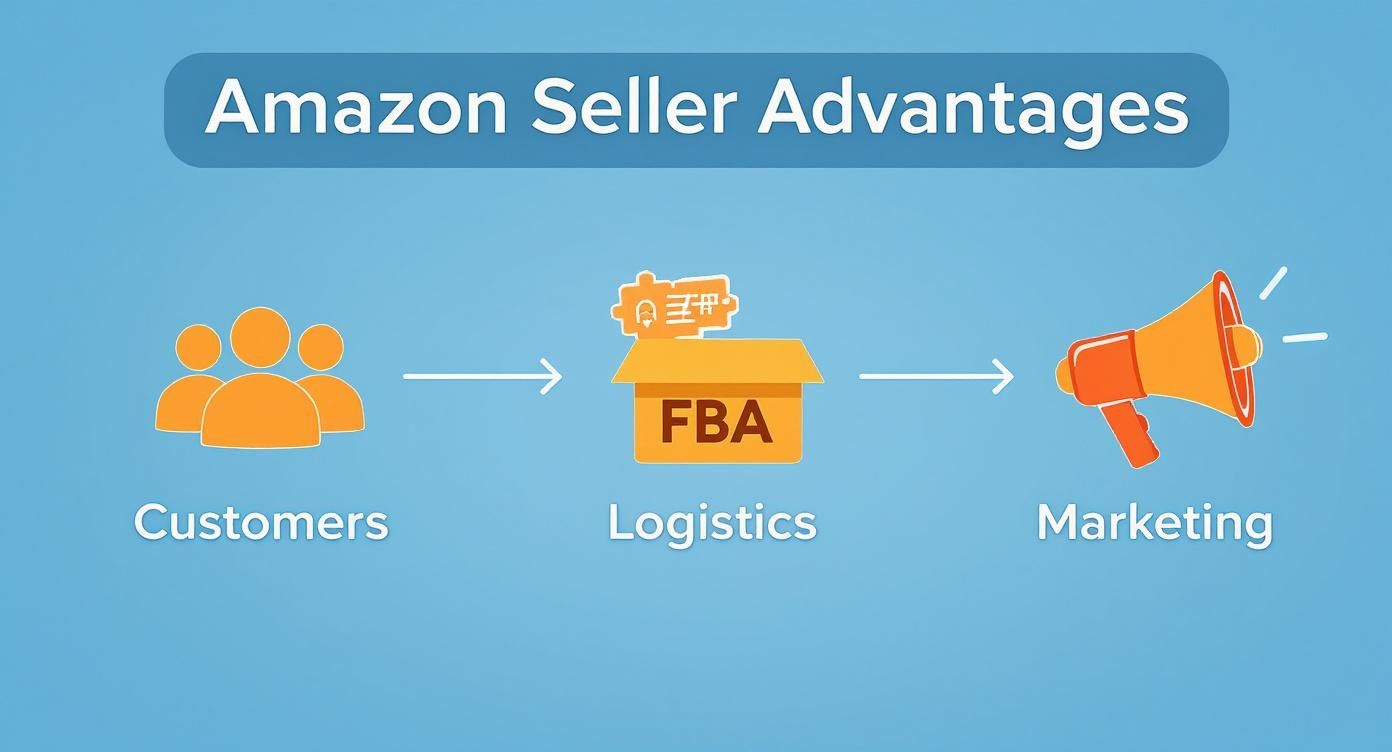
As the diagram shows, tapping into Amazon's massive customer base, FBA infrastructure, and built-in promotional tools gives sellers a powerful engine for scaling their brand.
The Three Main Buckets of Amazon Fees
Most of the costs you'll run into on Amazon can be sorted into three main buckets. Each one pays for a different part of the service, and knowing them is critical for figuring out your real profitability.
-
Selling Plan Fees: This is your basic "cover charge" to sell on the platform. The Professional Plan is a flat $39.99 per month, which makes sense for anyone selling more than 40 items a month. For those just dipping their toes in, the Individual Plan has no monthly fee but charges $0.99 for every item sold.
-
Referral Fees: Think of this as Amazon's commission for every sale you make. It's a percentage of the total sale price (including shipping) and changes depending on the product category, but it usually lands somewhere between 8% and 15%. For example, a Home & Kitchen product will cost you 15%, while consumer electronics are often closer to 8%.
-
Fulfillment Fees (FBA): If you decide to use Fulfillment by Amazon, these fees cover all the logistics—from storing your products in Amazon's warehouses to picking, packing, and shipping them out to customers. The exact cost depends on your product’s size and weight.
A good way to think about Amazon's fees is that you're paying for access and services. The selling plan is your membership, the referral fee is the commission for using their marketplace, and FBA fees are what you pay their world-class logistics team to handle all the heavy lifting for you.
Calculating Your Potential Profit Margin
Let's make this real with an example. Say you're selling a small, lightweight kitchen gadget for $25.
Here’s how the math breaks down:
- Sale Price: $25.00
- Cost of Goods: -$8.00 (what you paid your supplier to make it)
- Referral Fee (15%): -$3.75 (which is 15% of $25)
- FBA Fee (estimated): -$4.25 (a typical fee for a small, standard-sized item)
After you subtract all those costs, your net profit on each unit sold is $9.00. This quick calculation shows that nearly 64% of your sale price gets eaten up by the product cost and Amazon's fees. To really get a handle on the fulfillment part of this equation, it helps to dig into what Amazon FBA means for your business and see how those fees are calculated.
This simple math is the financial heart of your Amazon strategy. It tells you your true margin and helps you price your products smartly, so you don't get any nasty surprises when your first payout arrives.
A Clear Breakdown of Common Seller Fees
To help you avoid any confusion, it’s useful to see all the potential costs laid out in one place. The table below covers the most common fees you'll come across as an Amazon seller, giving you a clear picture so you can build a realistic budget from the get-go.
Breakdown of Common Amazon Seller Fees
| Fee Type | Description | Typical Cost |
|---|---|---|
| Selling Plan Fee | The monthly subscription for your seller account. | $39.99/month for Professional or $0.99/item for Individual. |
| Referral Fee | Amazon's commission on each sale, which varies by product category. | Typically 8% to 15% of the total sale price. |
| FBA Fulfillment Fee | The cost for Amazon to pick, pack, and ship your FBA orders. | Varies by product size and weight, starting around $3.22 for small items. |
| FBA Storage Fee | The monthly cost to store your inventory in an Amazon fulfillment center. | Varies by product volume and time of year (higher from October to December). |
| Advertising Costs (PPC) | Optional costs for running pay-per-click ads to promote your products. | Varies based on your budget and campaign performance. |
Getting familiar with these fees is the first step toward building a profitable business on Amazon. Once you know where your money is going, you can start making smarter decisions about pricing, advertising, and inventory.
Navigating the Marketplace Challenges and Competition

While the upside of selling on Amazon is huge, it’s anything but a passive income stream. To succeed, you have to navigate a fiercely competitive world filled with major operational hurdles. Getting a clear-eyed view of these challenges is the only way to decide if Amazon is truly worth it for your brand.
The marketplace’s massive scale is a double-edged sword. Yes, you get access to a giant audience, but you’re also stepping into an incredibly crowded arena. There are roughly 9.7 million registered sellers worldwide, with about 2.5 million of them actively selling products at any given moment. That kind of environment puts immense pressure on your pricing, visibility, and ability to stand out.
This isn’t just about competing with other third-party sellers, either. In many categories, you’ll find yourself going head-to-head with Amazon's own private-label brands, like AmazonBasics, which often get preferential treatment in search results and pricing.
The Fight for Visibility and Brand Identity
Let's be clear: on Amazon, you’re a guest in their house. And the house rules are designed to put the Amazon brand first, always. This creates a massive roadblock for building your own brand identity and earning long-term customer loyalty.
Your product pages are stuck in a template. Your ability to talk to your customers is severely limited. Even your packaging is often covered in Amazon branding. All this makes it nearly impossible to create a unique experience or build a direct relationship with the people buying your products. You don’t get their data, which means no retargeting and no building an email list for future marketing.
Your brand can become nearly invisible on Amazon. Customers often say they "bought it on Amazon," not "bought it from [Your Brand]," which makes it difficult to build the kind of brand equity that drives repeat business off the platform.
To even have a chance at standing out, you have to master Amazon's internal ad system. Running pay-per-click campaigns isn't an option anymore; it’s a non-negotiable cost of doing business. You need a solid ad budget just to get your products to show up. Understanding what PPC is on Amazon and how it works is step one to gaining any traction in this space.
Strict Performance Metrics and Platform Dependency
Amazon holds its sellers to incredibly high standards with a rigid set of performance metrics. Your entire business on the platform hinges on maintaining a near-perfect record.
The Account Health dashboard becomes a constant source of pressure, tracking things like:
- Order Defect Rate (ODR): This has to stay below 1%. It includes negative feedback, A-to-z Guarantee claims, and credit card chargebacks.
- Late Shipment Rate: Every order must ship on time. Fail here, and you’ll face penalties fast.
- Valid Tracking Rate: You’re required to provide valid tracking numbers for almost every shipment.
If you slip up on any of these, Amazon can suppress your listings or, in the worst-case scenario, suspend your account without any warning. The appeals process is notoriously slow and frustrating, leaving your business—and your revenue—in limbo. This total dependency on the platform is one of the biggest risks you’ll face.
On top of that, sellers have to constantly keep up with Amazon’s ever-changing policies and algorithms. A strategy that works today might be useless tomorrow, so you have to stay vigilant. And it’s not just Amazon’s rules; you also need to stay on top of broader regulations, like understanding the INFORM Act and its impact on Amazon sellers. This operational awareness isn’t just a good idea—it’s essential for survival.
Who Should Sell on Amazon and When to Avoid It
The big question, "is selling on Amazon worth it," doesn't have a simple yes or no answer. The platform is not a one-size-fits-all solution. It's a specific tool that can launch some businesses into the stratosphere and be a costly distraction for others. The right choice comes down to your product, your operational readiness, and where you want to take your brand long-term.
Think of it like choosing a vehicle. A massive semi-truck is perfect for hauling tons of cargo across the country, but it’s a terrible choice for navigating a crowded city. In the same way, Amazon is an unmatched engine for scale and volume, but it might not be the best fit if your main goal is building an intimate, high-touch brand experience.
To figure out where you land, let's break down the ideal seller profiles for this massive marketplace and pinpoint the red flags that suggest you should steer clear or look at other options.
Ideal Candidates for the Amazon Marketplace
Certain types of businesses are almost perfectly built to win in Amazon's ecosystem. These are the sellers who can treat the platform's fees and intense competition as a calculated cost of doing business, turning its immense power into fuel for rapid growth.
-
Agile SMBs Ready to Scale: If you're a small or medium-sized business with a proven product but are hitting a wall with logistics, you're a prime candidate. Using Fulfillment by Amazon (FBA) lets you instantly plug into a world-class distribution network without the crushing upfront investment in warehousing, staff, and shipping contracts. It’s a genuine shortcut to scaling your operations.
-
New Entrepreneurs Testing a Product: For anyone launching something new, Amazon is an incredible, lower-risk launchpad. Instead of sinking thousands into building a website and then trying to drive traffic to it, you can list your product on a platform where millions of customers are already searching. It’s the fastest way to find out if people actually want what you’re selling and get that crucial early feedback.
-
Brands with High-Volume, Standardized Products: If you sell items that are fairly simple, easy to ship, and have healthy profit margins, Amazon is made for you. Think phone cases, kitchen gadgets, or supplements. The platform is a volume game, and businesses that can efficiently source and sell these kinds of products can do exceptionally well.
D2C Brands Using Amazon as a Strategic Channel
For established Direct-to-Consumer (D2C) brands, the decision gets a bit more complicated. Here, the goal isn't just to sell—it's to acquire new customers without cheapening your brand or cannibalizing sales from your own website.
Amazon should be treated as a customer acquisition tool, not your entire business. Use it to introduce your brand to a massive new audience, but always have a strategy to drive those customers back to your own properties for future purchases.
Smart D2C brands use Amazon strategically by listing only a limited selection of their core products. This approach captures the high-intent Amazon shopper who might never have found the brand otherwise. The key is to protect your premium brand identity and avoid gutting your main site's sales in Amazon’s price-driven environment.
When You Should Probably Avoid Selling on Amazon
On the flip side, some business models just don't mesh with the realities of the marketplace. Forcing a fit here can lead to torched margins, brand damage, and a whole lot of frustration.
-
Luxury or High-End Niche Brands: If your brand identity depends on a carefully curated customer experience, storytelling, and premium positioning, Amazon is a tough place to be. The cookie-cutter product pages and lack of direct customer communication make it nearly impossible to convey that luxury feel.
-
Businesses with Razor-Thin Margins: Amazon's fees aren't trivial. If your product margins are already tight, the combination of referral fees, FBA costs, and advertising expenses can quickly evaporate any profit you hoped to make. You have to have enough room in your pricing to absorb these costs.
-
Sellers of Highly Customized or Complex Products: Products that need detailed consultation, personalization, or a complicated setup just don't work with Amazon's fast, transactional model. Customers on the platform expect to click "buy" and have a simple, straightforward experience.
The marketplace world is also getting bigger. For some sellers, exploring options like how to sell on Walmart Marketplace can offer a less crowded starting point. At the end of the day, making the right call means honestly asking if your business goals align with what Amazon does best: providing massive reach and logistical power, but at a significant cost.
Making Your Final Decision: A Strategic Framework
Deciding is it worth selling on Amazon isn't a simple yes or no. It’s about figuring out if the platform fits into your bigger business picture, not just seeing it as another place to sell things.
At its core, the decision is a trade-off. You get access to a mind-boggling number of customers and world-class logistics. In return, you hand over a big slice of your margin, face ferocious competition, and become heavily reliant on a single, powerful platform.
The right choice comes down to your brand’s specific situation. A business with fat product margins that needs to scale fast will see that trade-off very differently than a luxury brand focused on cultivating a high-touch, direct customer experience. Instead of looking for a one-size-fits-all answer, you need to do an honest internal audit to see how well your business model meshes with Amazon’s ecosystem.
Your Final Decision Checklist
Before you jump in, run through this checklist. It’s designed to help you move from a vague question to a calculated, data-backed decision.
-
Do my profit margins support Amazon's fees? After you subtract your cost of goods, referral fees, FBA charges, and what you’ll likely spend on ads, is there still a healthy profit? If your margins are already paper-thin, you could find yourself in a losing battle fast. Digging into historical Amazon sales data can give you a solid benchmark for what to expect.
-
Does my operational capacity match Amazon's demands? Seriously, are you ready for the relentless pace of FBA inventory management? Amazon's performance metrics are notoriously strict, and they expect operational excellence from day one. There's no grace period.
-
What are my long-term brand ambitions? If your number one goal is building direct, loyal relationships with customers, you have to ask yourself if you’re okay with the brand dilution that often comes with selling on Amazon. You need to define how the platform serves your brand, not the other way around.
The goal is to make a calculated decision. That might mean going all-in, starting with a small test of a few products to gather real-world data, or deciding to take an alternative path that better aligns with your long-term vision.
As you build out your strategic framework, you’ll also need to get a handle on the technical side of things. A crucial first step is learning how to connect to Amazon and integrate its systems with your own.
In the end, your answer will be unique to your business. By honestly weighing your products, finances, operations, and brand goals against this framework, you can confidently decide if Amazon is the right strategic move to fuel your growth.
A Few Lingering Questions
Even with a solid plan, a few questions are probably still bouncing around in your head. Let's tackle the most common ones we hear from sellers trying to make their final decision.
How Much Does It Really Cost to Start Selling on Amazon?
The honest answer? It varies wildly. But you don't need a massive bankroll to get started. Your two biggest upfront costs will be your selling plan and your first batch of inventory.
- Selling Plan: Most serious sellers go for the Professional plan at $39.99 per month. If you're just testing the waters, the Individual plan has no monthly fee but dings you $0.99 per item sold.
- Initial Inventory: This is where the numbers can really swing. You could start small with a test run for a few hundred bucks, or you could invest thousands if you're confident in your product.
Don't forget to set aside a little extra for the small stuff, like ordering product samples, shipping your goods to Amazon's fulfillment centers, and a modest ad budget to get those first few sales rolling in.
How Long Until I’m Actually Profitable on Amazon?
Profitability doesn't happen overnight. Plan on reinvesting pretty much everything you make back into the business for the first 6 to 12 months. This is your foundation-building phase—you’re gathering sales data, racking up reviews, and figuring out what works with your listings and ads.
Your timeline really depends on your product's demand, how crowded your niche is, and your pricing. A smart product in a less competitive space might turn a profit in just a few months. A dog-eat-dog category? That'll take more time. The trick is to manage your expectations and aim for steady, sustainable growth, not a lottery win.
The real answer to "is it worth selling on Amazon?" often boils down to patience. Success here is a marathon, not a sprint. Think of your first year as an investment in building a real asset, not a get-rich-quick scheme.
Do I Have to Use Fulfillment by Amazon (FBA)?
Nope, it’s not required, but for most sellers, it’s a no-brainer. The alternative is Fulfilled by Merchant (FBM), which means you’re on the hook for storing, packing, and shipping every single order yourself. You also have to handle all the customer service.
The real kicker? If you go the FBM route, you miss out on that coveted Prime badge, and that can seriously throttle your sales. FBA takes all the logistical headaches off your plate and puts your products in front of Amazon's most loyal, ready-to-buy customers. For the vast majority of sellers, the advantages of FBA make the fees more than worth it.
Ready to stop wondering and start strategizing? The team at Next Point Digital specializes in turning marketplace potential into real, measurable growth. We build data-driven roadmaps for Amazon sellers that optimize listings, manage advertising, and scale profits.
Schedule your free growth analysis today and find out how we can make selling on Amazon worth it for your brand.