

To win on Amazon, you have to master four core areas your competitors often neglect: strategic pricing, flawless fulfillment, perfect seller metrics, and deep inventory.
Excelling in these areas signals to Amazon’s algorithm that you offer the best possible customer experience, making you the default choice for buyers.
Why the Buy Box Is Your Most Important Battle
If you’re an Amazon seller, the Buy Box isn't just another feature—it's the entire battlefield. That little box on the right side of a product page is where the overwhelming majority of transactions happen. It holds the "Add to Cart" and "Buy Now" buttons, and securing your spot inside it is the single most important driver of your sales.
The financial stakes are massive. Winning the Amazon Buy Box is non-negotiable, with data showing that around 80–83% of all Amazon sales happen through it. That number climbs even higher for mobile shoppers, who now drive over 70% of purchases and often only see the Buy Box winner as their purchase option.
When you're not in the Buy Box, you're practically invisible. For a deeper dive into this, check out our comprehensive guide on how to win the Amazon Buy Box.
Understanding the Algorithm's Logic
Amazon’s algorithm has one goal: create the best possible experience for the customer. To do this, it constantly evaluates every eligible seller for a product and awards the Buy Box to the one it trusts most. And here's the kicker—it's not just about having the lowest price.
Think about this common scenario:
- Seller A (FBM) lists a product for $19.99 with $4.99 shipping (a landed price of $24.98) and a 5-day delivery window.
- Seller B (FBA) lists the same product for $25.99 with free Prime shipping and a 2-day delivery window.
Even though Seller A is cheaper, Seller B will almost always win the Buy Box. Why? Because Amazon's fulfillment network (FBA) guarantees a fast, reliable shipping experience, and the algorithm values that dependability far more than a slightly lower price. This is a core principle you have to get right.
The Buy Box isn't awarded to the cheapest seller; it's awarded to the seller Amazon trusts to provide the best overall value and experience to its customers.
Mastering this concept is the first step toward building a strategy that can seriously boost your sales volume. As we move forward, we'll break down each factor the algorithm considers, turning this complex challenge into an actionable plan. This focus is a key part of our broader discussion on how to increase sales on Amazon.
Mastering Your Pricing and Fulfillment Strategy
When you’re trying to figure out the puzzle that is the Amazon Buy Box, it really boils down to two things that matter more than anything else: your fulfillment method and your landed price. Get these right, and you’re already miles ahead of most sellers.
At the end of the day, Amazon’s algorithm is obsessed with customer experience. And what defines that experience better than how much something costs and how fast it shows up? These are the two pillars holding up your entire Buy Box strategy.
It's Not Just About Being the Cheapest
Amazon doesn't just look at your item price. It cares about the landed price—that’s your product price plus whatever it costs to ship it. This is the final number the customer pays to get the product to their door. A lower landed price is a huge advantage, but don’t make the mistake of thinking it’s a race to the bottom.
Slashing prices manually to be the cheapest is a losing game. A much smarter move is to use an automated repricing tool. Modern repricers are more than just reactive price-droppers; they’re strategic. They can analyze a competitor's stock levels or seller feedback and make intelligent decisions.
For example, if your main competitor is about to run out of stock, a smart repricer might actually raise your price slightly, knowing you're in a prime position to win the Buy Box anyway.
Key Takeaway: Winning on price isn't about being the absolute cheapest. It's about being the most competitively priced seller who also crushes all of Amazon's other performance metrics.
This approach helps you win the Buy Box at the best possible price, protecting your margins while still staying in the game.
The Unbeatable Edge of Fulfillment by Amazon (FBA)
Your fulfillment method is arguably the single biggest lever you can pull. Amazon has built a world-class logistics network, and it heavily, heavily favors sellers who use it. This is where the choice between Fulfillment by Amazon (FBA) and Fulfillment by Merchant (FBM) becomes a game-changer.
When you use FBA, you’re essentially handing the keys to Amazon. You send them your inventory, and they take care of everything: storage, packing, shipping, and even customer service. For the Buy Box algorithm, this is a massive green flag for a few reasons:
- Instant Prime Status: FBA products automatically get the Prime badge, which means fast, free shipping for millions of loyal Prime members. The algorithm is built to favor Prime offers, period.
- Flawless Shipping Metrics: With FBA, your shipping time, on-time delivery rate, and valid tracking rate are all perfect because Amazon is handling them. You get top marks without lifting a finger.
- Built-In Customer Trust: Shoppers trust the Prime badge. They know the order will be fast and reliable, which makes them far more likely to click "Add to Cart" on an FBA offer.
If you're still weighing the options, it's worth taking a closer look at what Fulfillment by Amazon means for your business and how it can transform your operations.
This diagram paints a pretty clear picture of the two paths a seller can take and where they usually lead.
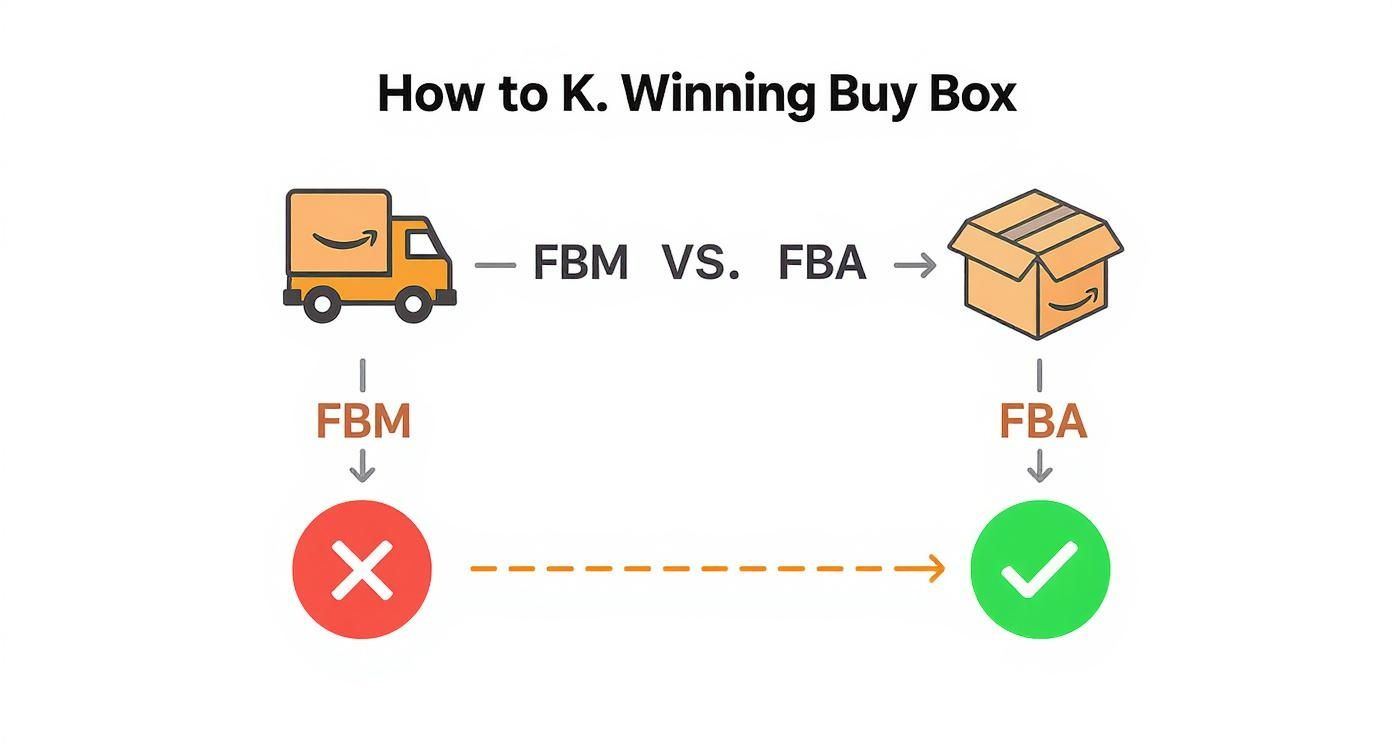
As you can see, choosing FBA is like taking the express lane to the Buy Box.
The following table breaks down exactly how your fulfillment choice stacks up against the core factors Amazon's algorithm is looking at.
FBA vs FBM Impact on Key Buy Box Factors
| Buy Box Factor | Fulfillment by Amazon (FBA) Advantage | Fulfillment by Merchant (FBM) Consideration |
|---|---|---|
| Shipping Time | Guaranteed fast shipping via Prime. Automatically earns max points. | Must compete with Prime speed. Requires exceptional logistics. |
| On-Time Delivery | Perfect 100% score since Amazon handles all logistics. | Must maintain 97%+ on your own. Any slip is heavily penalized. |
| Landed Price | Prime members see free shipping, making your offer more attractive. | Must offer free or very low-cost shipping to compete, cutting into margins. |
| Inventory Depth | Amazon's network can handle high volume, reducing stockout risk. | You are solely responsible for stock levels and avoiding sell-outs. |
| Customer Service | Amazon handles all inquiries and returns, meeting their high standards. | You must manage all customer service to Amazon's strict requirements. |
This comparison makes it clear: FBA is designed to tick all the boxes that matter most to Amazon's algorithm, giving sellers a powerful, built-in advantage.
Can You Compete as a Fulfillment by Merchant (FBM) Seller?
While FBA is the clear favorite, it's not the only way to win. If you're fulfilling orders yourself (FBM), the path is much steeper, but it’s not impossible. You just have to prove to Amazon that your operation is every bit as good as theirs. That means near-perfection on your shipping metrics.
To even have a chance as an FBM seller, you need to be obsessed with:
- Shipping Time: Your handling and transit times have to be lightning-fast. Think same-day or one-day handling just to stay in the running.
- On-Time Delivery Rate: You absolutely must keep this at 97% or higher. Drop below that, and your Buy Box chances plummet.
- Valid Tracking Rate: Amazon needs to see a valid tracking number for at least 95% of your shipments. No exceptions.
The ultimate goal for a top-tier FBM seller is qualifying for Seller Fulfilled Prime (SFP). This program lets you show the Prime badge while shipping from your own warehouse. But be warned: the performance standards are incredibly demanding and require a seriously buttoned-up logistics operation.
For most sellers, FBA is simply the most direct and reliable path to mastering fulfillment and dominating the Buy Box.
Beyond just sharp pricing and speedy fulfillment, Amazon is constantly grading you. This report card, your account health, carries a ton of weight with the Buy Box algorithm. Think of it as Amazon’s trust score for your business—if that score drops, you can get booted from the Buy Box even if you have the lowest price.
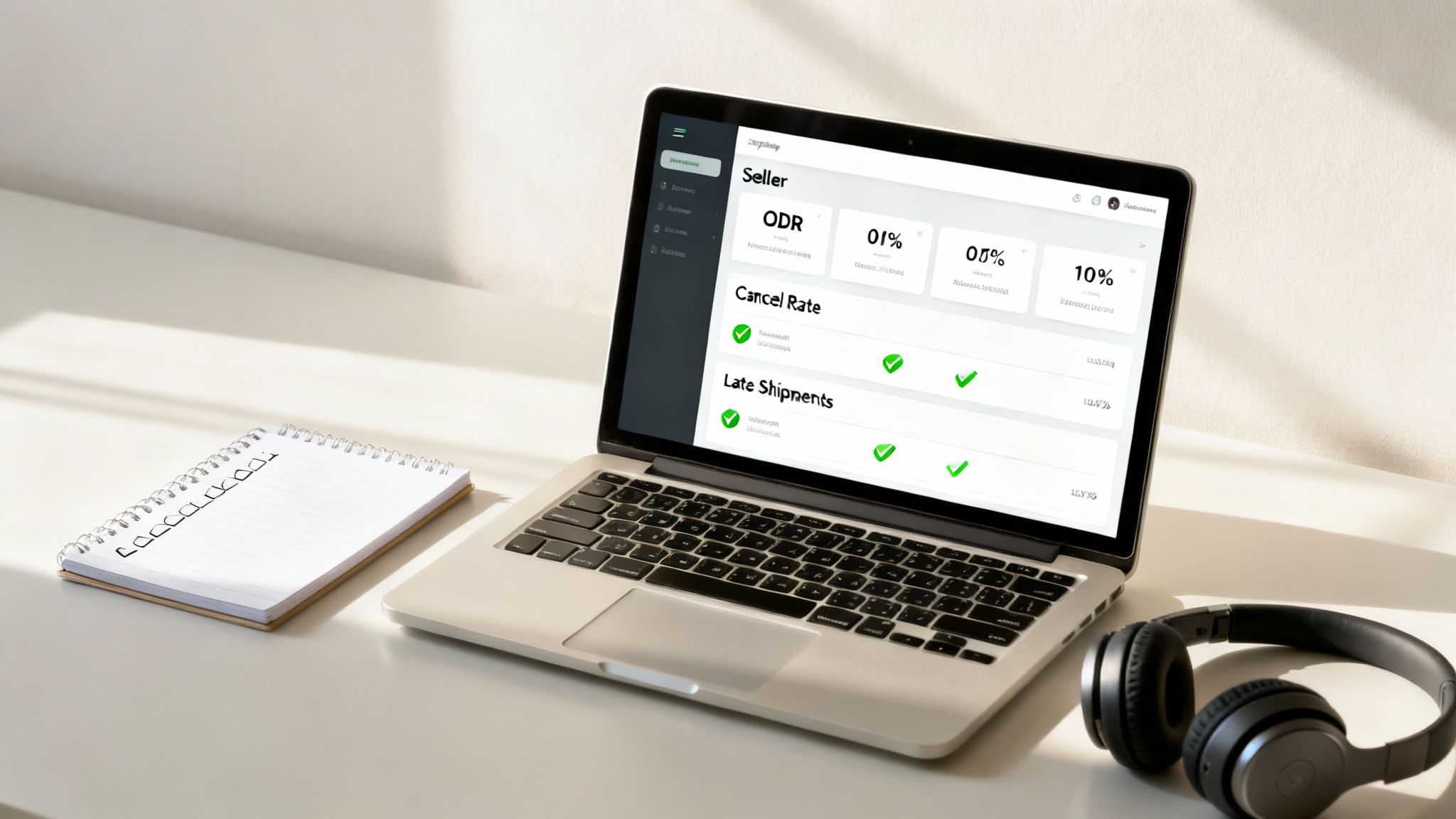
Keeping your seller metrics in check isn’t just about avoiding a suspension. It's a core part of any strategy to dominate your listings. These numbers prove to Amazon that you deliver a top-tier customer experience, making your offer the safest bet for their customers.
The Core Seller Metrics That Actually Matter
Amazon keeps an eye on several key performance indicators (KPIs), but a few have a direct and powerful impact on your Buy Box eligibility. You have to keep these metrics well within Amazon's targets, because even a small slip can get you rotated out of that top spot.
Your main focus should be on these three areas:
- Order Defect Rate (ODR): This is the big one. It’s the ultimate measure of customer happiness, combining negative feedback, A-to-z Guarantee claims, and credit card chargebacks. Amazon demands this stay below 1%.
- Cancellation Rate: This tracks how many orders you cancel before you can ship them. A high rate tells Amazon you can't manage your inventory. You have to keep this below 2.5%.
- Late Shipment Rate (LSR): This measures orders that go out after the expected ship date. It’s a dead giveaway of operational hiccups and must stay under 4%.
Your seller metrics are a direct reflection of your operational discipline. A perfect ODR and a low LSR signal to Amazon that you are a reliable partner, making your offer a safer bet for the Buy Box.
While FBA sellers get a huge leg up here since Amazon handles fulfillment and customer service, FBM sellers need to be obsessive about these numbers. Running regular seller account audits can help you spot issues before they blow up, ensuring you maintain the flawless performance needed to compete.
Proactive Strategies to Protect Your Account Health
Just knowing the target numbers isn’t enough. You need a system to proactively keep your metrics pristine, which means getting ahead of problems before they escalate.
Take the Order Defect Rate, for example. It's heavily influenced by how you handle returns and customer messages. A negative review often starts with a clunky return experience. To get ahead of this, create pre-written customer service templates that are helpful and professional.
A simple, effective template for a return request might look something like this:
Subject: Regarding your return request for [Product Name]
"Hello [Customer Name],
Thank you for reaching out. We're sorry to hear that your order didn't meet your expectations. We've authorized your return request and you can print your prepaid shipping label here: [Link].
Once we receive the item, a full refund will be processed within 24 hours. If there's anything else we can do to help, please let us know.
Best,
[Your Company Name]"
This kind of prompt, professional communication can turn a bad experience into a neutral or even positive one, protecting your ODR in the process. You can dig even deeper by analyzing how your performance stacks up against the market with detailed Amazon sales data.
Building a Bulletproof Daily Workflow
For FBM sellers, keeping your Late Shipment Rate near zero comes down to daily discipline. A simple, repeatable workflow makes all the difference and keeps you from ever missing a shipping deadline.
Here’s a sample daily workflow that just works:
- Morning Sync (9:00 AM): Pull all new orders from Seller Central into your shipping software.
- Pick and Pack (9:30 AM – 1:00 PM): Prioritize orders based on the "ship by" date. Get labels printed and orders packed up in batches.
- Carrier Pickup (3:00 PM): Schedule a daily pickup with your carrier. This ensures everything you packed actually leaves your building on time.
- End-of-Day Check (4:00 PM): Before you call it a day, double-check that all tracking numbers have been successfully uploaded to Amazon.
This structured routine gets rid of the last-minute scramble and helps keep your Late Shipment Rate rock-bottom.
And don't forget, the algorithm is only getting smarter about performance. Metrics like valid tracking rate, return dissatisfaction, and customer response times now carry more weight than ever. If your LSR climbs above 4% or your ODR ticks over 1%, you can be kicked out of the Buy Box, no matter how low your price is.
To stay in the game, you need a valid tracking rate above 95% and have to respond to all customer messages within 24 hours. Perfect metrics aren't just a "nice to have"—they're your ticket to owning the Buy Box for the long haul.
Turn Inventory and Shipping Speed Into Your Secret Weapon
Everyone fixates on price, but two of the most powerful levers for winning the Buy Box are hiding in your warehouse: your inventory levels and your shipping speed. While your competitors are busy racing to the bottom on price, you can build a massive advantage by mastering your operations.
Getting this right is about signaling to Amazon that you offer a reliable, top-tier customer experience. It’s a surefire way to get the algorithm on your side.
This isn’t just about making a sale today; it's about safeguarding your listing's momentum for the long haul.
The True Cost of a Stockout
Going out of stock is one of the most destructive things you can do to your Buy Box eligibility. The immediate effect is obvious—you lose the Buy Box because you have nothing to sell. But the damage runs much deeper, creating a ripple effect that lasts long after you restock.
Amazon’s algorithm craves consistency. A stockout shatters that consistency, wrecking your sales velocity and tanking your keyword rankings. When you finally get more products in, you’re not just picking up where you left off. You're starting from a hole, fighting to regain lost ground.
A stockout is poison for your Buy Box chances. Amazon’s algorithm penalizes inconsistency, and running out of inventory sends a clear signal that your offer is unreliable. This damages your listing’s momentum long after you’re back in stock.
To avoid this disaster, you need a disciplined approach to inventory management. It’s time to stop guessing and start systemizing.
- Set Smart Reorder Points: Figure out your lead time (how long it takes for new stock to arrive) and your average daily sales. Use that to set an automatic reorder point that gives you enough of a cushion to never hit zero.
- Use Inventory Management Software: Tools like Sellics or Jungle Scout can automate your inventory tracking, forecast demand, and ping you when it’s time to reorder.
- Keep Safety Stock: Always maintain a small surplus of inventory to handle unexpected sales spikes or supply chain hiccups. It's your insurance policy against stockouts.
Solid inventory management is a cornerstone of any strategy to grow your sales on Amazon, as it ensures you're always in the game.
Shipping Speed: The FBM Battleground
If you’re a Fulfillment by Merchant (FBM) seller, shipping speed isn't just a performance metric—it’s the main arena where you go head-to-head with FBA offers. Amazon's algorithm doesn't just take your stated shipping time at face value; it digs into your historical data to predict the actual delivery date for a customer.
The metrics that matter most are Shipping Time and On-Time Delivery. Your Shipping Time is a combination of your handling time (how fast you pack and ship) and the carrier's transit time. For On-Time Delivery, you need to be hitting your promised delivery date more than 97% of the time.
Let’s see how this plays out in a real-world scenario.
Imagine two sellers offering the same product at the exact same landed price of $35.
- Seller A (FBM in California): Promises 2-day shipping to anywhere in the US.
- Seller B (FBA): Has inventory stored in Amazon warehouses across the country.
Now, picture a customer in New York. To Amazon’s algorithm, Seller B (FBA) is the obvious winner. Even if Seller A ships the order the very same day, getting a package from California to New York in two days is a huge logistical challenge. Amazon knows its FBA network can deliver from a nearby warehouse, often in a single day.
For that New York customer, Seller B wins the Buy Box. It’s not because they’re cheaper, but because Amazon sees their delivery promise as faster and more dependable for that specific buyer’s location. This geographic calculation happens in an instant for every single shopper.
As an FBM seller, your mission is to make your fulfillment operation ruthlessly efficient. That means getting your handling time down to one day (or less) and choosing shipping services that can reliably meet the delivery promises you make. The closer you can get to mirroring the speed and reliability of FBA, the better your shot at winning the Buy Box.
How to Monitor and Defend Your Buy Box Share
Winning the Buy Box isn’t a one-and-done deal; it's a constant battle. Your competitors are always tweaking their prices and trying to one-up your metrics, which means the landscape can shift in a heartbeat. To protect your hard-won position, you need to be vigilant.
The first step is simply knowing where you stand. Amazon actually gives you this data right inside Seller Central, so there's no need to guess. Just head over to the "Pricing" tab and click on "Pricing Health." There, you'll find your Buy Box Percentage for your entire catalog. This number tells you what percentage of total page views you owned the Buy Box for.
Finding Your Buy Box Percentage
Tracking this metric over time is your best high-level indicator of performance. If you see your overall percentage slide from 85% to 70% in a week, that’s a massive red flag. Something is wrong. It could be anything—a new competitor undercutting you, a dip in your performance metrics, or a pricing problem on a single, high-traffic ASIN.
While Seller Central gives you a decent overview, it’s not built for the kind of real-time reaction you need to stay on top. This is where third-party monitoring tools really shine. These services can ping you with an alert the second you lose the Buy Box on a critical, high-volume ASIN. This lets you investigate and fight back immediately, instead of finding out days later after you’ve already lost thousands in sales.
Your Buy Box share is a living metric. It's not enough to check it once a month. Daily or weekly monitoring is essential to catch issues before they snowball and erase your hard-won sales momentum.
This immediate feedback loop is absolutely crucial for protecting your most profitable products. It flips the script, turning you from a reactive seller into a proactive defender of your digital shelf space.
Building Your Daily Defense Routine
A consistent routine is your best defense against losing the Buy Box. Don't just check stats randomly when you feel like it. Build a simple, repeatable workflow that you or your team can run through every single morning. This kind of discipline ensures nothing important ever slips through the cracks.
Here’s a sample daily workflow that takes less than 30 minutes but can save you from major sales dips:
-
Morning ASIN Check: First thing, review the Buy Box status for your top 10 bestselling ASINs. Are you still winning them? If not, who is, and what are they doing differently?
-
Review Repricer Alerts: Take a look at your automated repricing software for any major alerts or trends. Is one of your products constantly hitting its floor price? That might be a signal to rethink your entire strategy for that item.
-
Scan Account Health: Do a quick scan of your Account Health dashboard in Seller Central. Look for any new dings to your ODR, Late Shipment Rate, or other key metrics that could be putting your eligibility at risk.
-
Clear Customer Messages: Respond to every single pending customer message. Keeping your response time under 24 hours is such an easy win and a powerful signal to Amazon’s algorithm that you provide great service.
This simple checklist helps you spot and fix problems before they can do real damage to your sales. On top of that, a strong monitoring game can also show you where a well-placed ad campaign could help solidify your position. To learn more, check out our guide on what PPC is for Amazon and see how you can use ads to defend your turf.
Common Questions About the Amazon Buy Box
Once you've wrapped your head around pricing, fulfillment, and performance, the real questions start popping up. The day-to-day grind of selling on Amazon always throws a few curveballs. This section is where we tackle those common, nagging questions with clear, straight-to-the-point answers.
Can New Sellers Win the Buy Box?
Absolutely. It's a common myth that you need a long, decorated sales history to even get a sniff of the Buy Box. While experience definitely helps, Amazon's algorithm is much more focused on what you're doing right now.
If you jump in as a new seller using Fulfillment by Amazon (FBA), you’re basically skipping the line. FBA instantly maxes out your scores for critical shipping metrics and makes your offers Prime-eligible—two things Amazon’s algorithm absolutely loves. Combine that with smart pricing and solid inventory management, and you can start grabbing your share of the Buy Box way faster than you might think.
Why Does the Buy Box Rotate Between Sellers?
Think of the Buy Box less like a permanent trophy and more like a shared spotlight. Amazon rotates it among several eligible sellers to spread the sales around and, most importantly, give customers the best possible experience at that exact moment.
The rotation happens for a few key reasons. A big one is geography. A buyer in Florida might see a different seller in the Buy Box than someone in Oregon because Amazon prioritizes the seller who can ship the fastest to that customer's location. Automated repricers constantly adjusting prices also trigger rotations, as do even small dips or improvements in seller performance metrics.
The Buy Box is dynamic. It's not about one single winner. It's a constant, real-time competition where the top sellers get their turn based on price, performance, and how close their inventory is to the customer.
This is exactly why you might see your Buy Box ownership percentage sitting at 80% or 90% instead of a perfect 100%, even when you feel like you're the strongest seller on the listing.
How Does My Price Affect My Chances If My Metrics Are Perfect?
Having stellar seller metrics gives you a massive leg up, but it doesn't make you invincible to pricing. If your performance is flawless—perfect Order Defect Rate, on-time delivery, and speedy customer responses—you can often hold the Buy Box even if your price is a bit higher than a competitor with weaker stats.
But there’s a limit to that power. If your price is wildly higher than other eligible offers, Amazon’s algorithm will almost always side with the better deal for the customer. It's a constant balancing act between your trustworthiness as a seller and the overall value you're offering. The sweet spot is staying competitive on price while letting your top-tier performance metrics seal the deal.
What Is a Suppressed Buy Box?
A "suppressed" Buy Box is when Amazon yanks the "Add to Cart" button from the product page entirely. In its place, shoppers see a much less appealing "See All Buying Options" button. It’s a huge sales killer because it adds friction and kills the impulse-buy convenience Amazon is known for.
This usually happens for one of two main reasons:
- No Seller Meets the Bar: None of the offers on the listing are from sellers who meet Amazon's strict eligibility criteria. This can happen if everyone has poor metrics or if all the sellers are brand new without a proven track record.
- Pricing Issues: This is the most common culprit. Amazon’s algorithm thinks the current lowest price is still too high compared to the product's historical price or its price on other websites. If the offer is flagged as uncompetitive, Amazon will suppress the Buy Box until a seller drops their price to what it considers a fair market value.
Fixing a suppressed Buy Box comes down to two things: ensuring your price is competitive and keeping your account health in excellent shape.
Ready to stop guessing and start winning? Next Point Digital provides the strategic expertise and data-driven execution needed to dominate the Buy Box. We turn complex marketplace challenges into clear, profitable growth. Schedule a free consultation today and discover how our tailored Amazon strategies can elevate your brand.