

So, is selling on Amazon actually worth it?
The short answer is yes—but only if you’re treating it like a real business, not a get-rich-quick scheme. It’s an incredible opportunity to get your products in front of a massive, ready-to-buy audience, but that access comes with fierce competition and a pretty complex fee structure.
The Verdict on Selling on Amazon
Think of Amazon as the world's biggest and busiest shopping mall. By setting up shop here, you get instant foot traffic from millions of customers who are already looking to spend money. You don't have to build a website from scratch or pour thousands into ads just to get noticed.
But that convenience has a price. You're essentially renting a prime spot, and the mall owner (Amazon) has strict rules and takes a sizable cut of every sale you make.
The core trade-off here is simple: access versus control. You gain access to a customer base that would take years to build on your own, but you give up control over the customer relationship, your branding, and how much you pay in fees. The platform is crowded, too. As of 2025, there are around 9.7 million sellers globally, and third-party sellers now make up over 60% of all items sold, according to data from Red Stag Fulfillment. That shows you the scale of the opportunity, but also the intensity of the competition you'll be up against.
The real question isn't "Is selling on Amazon worth it?" It's "Is my business ready for the realities of Amazon's ecosystem?" Success has less to do with the platform itself and more to do with your strategy.
To help you figure that out, let's start with a quick look at the pros and cons you'll need to weigh. This high-level view will set the stage for our deep dive into the costs, potential profits, and strategies you'll need to succeed.
Selling on Amazon At a Glance Pros vs Cons
Before we get into the nitty-gritty details, here’s a quick, scannable summary of the main advantages and disadvantages you can expect when selling on the Amazon marketplace.
| Key Advantages | Key Disadvantages |
|---|---|
| Massive Built-in Customer Base | Fierce Competition & Price Wars |
| Trusted Brand & High Conversion Rates | Complex & Costly Fee Structure |
| World-Class Fulfillment with FBA | Limited Control Over Branding & Customers |
| Global Selling Opportunities | Strict Rules & Risk of Account Suspension |
This table gives you a good starting point, but the real decision comes down to understanding how each of these points impacts your specific business. Let’s break it down further.
Breaking Down the True Cost of Selling on Amazon
If you want to know if selling on Amazon is actually worth it, you have to look past the flashy revenue numbers and get real about the costs. So many new sellers fail, not because they have a bad product, but because they completely underestimate where their money is going. It's never just about your product cost; it's a whole series of fees that chip away at every single sale.
Think of it like running a food truck at a massive, sold-out festival. The festival organizers (Amazon) bring you the giant crowd, but they also take a cut of every taco you sell (that’s the referral fee). They charge you for your prime spot (subscription fee), and for a little extra, they’ll even handle all your payments and cleanup (FBA fees). Each fee makes sense on its own, but man, they add up fast.
This infographic gives you a quick snapshot of the Amazon marketplace, showing just how many sellers are out there and how much they rely on Amazon's services.
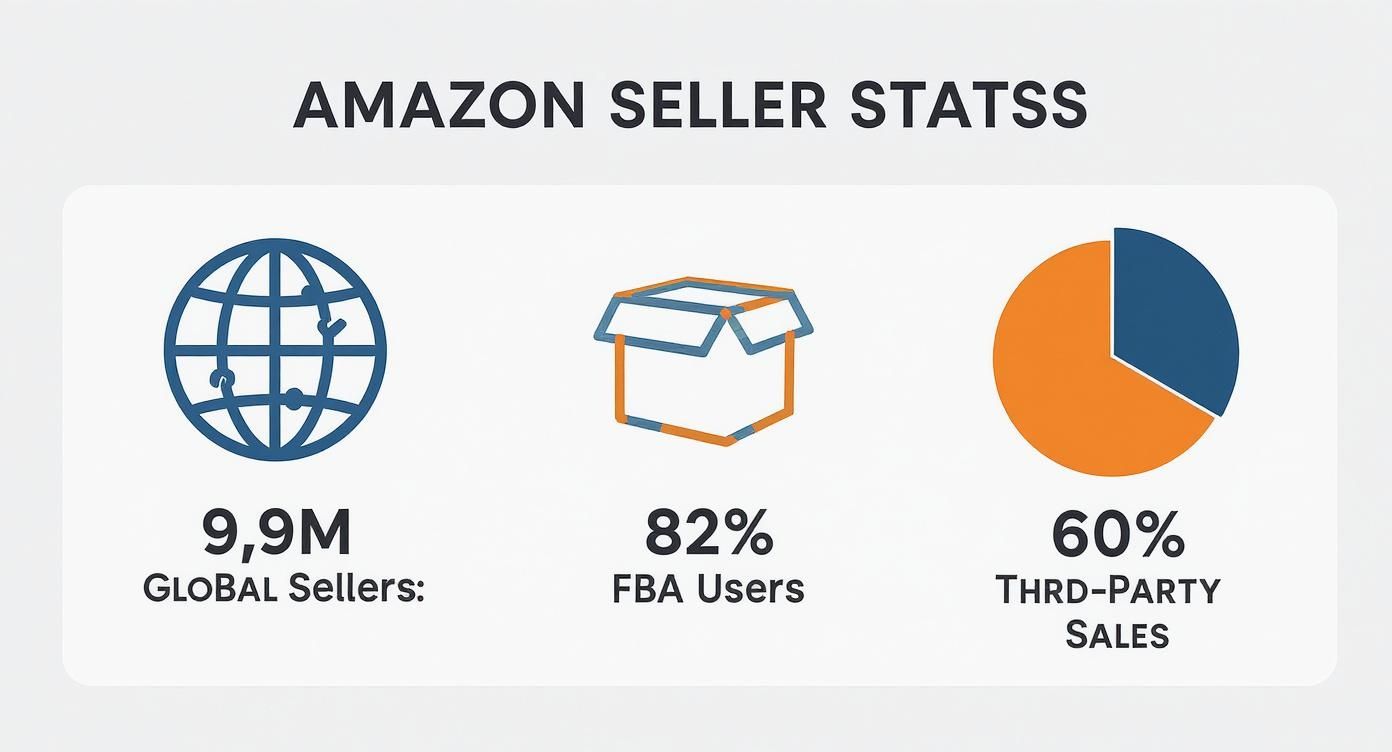
The numbers don't lie. While millions of sellers are competing, a huge majority—over 82%—use FBA. That’s a massive signal that for most serious sellers, the convenience is worth the cost.
The Core Amazon Seller Fees
Let's break down the main costs you’re guaranteed to run into. Forgetting even one of these can turn what looks like a profitable product into a money pit.
- Referral Fees: This is Amazon’s commission for every single item you sell. It’s usually around 15% but can change depending on your product category. For a $30 product, that’s an instant $4.50 right off the top.
- Selling Plan Fees: You’ve got two choices here. The Individual plan is pay-as-you-go ($0.99 per item), but if you’re serious, you’ll need the Professional plan. It’s a flat $39.99 per month, no matter how much you sell. Selling more than 40 units a month? The Professional plan is a no-brainer.
- Fulfillment by Amazon (FBA) Fees: This is a big one. When you use FBA, Amazon stores, packs, ships, and handles customer service for your products. It’s a game-changer for scaling your business, but it's also a major expense calculated based on your product’s size and weight. That same $30 item might have an FBA fee of around $5.00 – $6.50. You can learn more about how the program works in our guide on what Fulfillment by Amazon means.
- Storage Fees: Amazon charges you to keep your products in their warehouses. And don't underestimate this one—your inventory carrying costs can seriously eat into your profits. These fees get much higher during the holiday rush in Q4.
The Hidden Costs You Cannot Ignore
It's not just Amazon's direct fees. There are other expenses that are just as important when you're figuring out your actual profit margin. These are the costs that catch new sellers by surprise.
Advertising, for example, isn't really optional if you want to get noticed. Most successful brands set aside a budget for Amazon PPC (Pay-Per-Click) ads. A good starting point is to budget around 10% of your sale price for advertising. For our example product, that’s another $3.00.
The most common mistake new sellers make is focusing only on the product cost and sale price. True profitability is found in the details—FBA fees, ad spend, storage costs, and even return processing fees.
Let's pull it all together using our hypothetical $30 product.
Cost Breakdown of a $30 Product:
| Expense Category | Estimated Cost | Remaining Balance |
|---|---|---|
| Retail Price | $30.00 | |
| Referral Fee (15%) | -$4.50 | $25.50 |
| FBA Fee (Standard) | -$6.00 | $19.50 |
| Advertising (10%) | -$3.00 | $16.50 |
| Landed Product Cost | -$8.00 | $8.50 (Gross Profit) |
All of a sudden, that $30 sale leaves you with an $8.50 profit. That’s a 28.3% margin before you even think about other business overhead. This simple math shows exactly why understanding the complete cost structure is the first, most critical step to figuring out if selling on Amazon is right for you.
What Realistic Profit Margins Actually Look Like
Profit is the ultimate scorecard, but all the hype around Amazon can create some pretty wild expectations. Before you jump in, it's crucial to understand what real sellers are actually earning. This isn't about getting rich overnight; it's about building a sustainable, profitable business, one sale at a time.
So, what does a healthy profit margin look like? While it definitely varies by category, most successful sellers are aiming for a net profit margin somewhere between 15% and 25%. If you’re dipping below 10%, you’re likely working way too hard for too little reward, with zero cushion for unexpected costs like returns or rising ad spend.

The Timeline to Profitability
Hitting that target margin doesn’t just happen on day one. A huge misconception is that profits start rolling in the second your product goes live. The truth is, the path to profitability is a journey—one that demands both strategic investment and a healthy dose of patience.
Industry data paints a varied but encouraging picture for new sellers. About 58% of sellers manage to become profitable within their first year. A smaller, faster-moving group of 22% actually turn a profit in under three months. On top of that, 57% of all sellers report profit margins above 10%, with an impressive 28% hitting that 20%+ sweet spot. These numbers show what’s possible when you nail your strategy.
Think of your first three to six months on Amazon as an investment period. You're spending on ads, gathering data, and building sales velocity. Profitability is what comes after that initial push.
This means you need to be ready for an early phase where you might just break even or even take a small loss. That’s not a red flag; it’s the cost of entry to get your product established in a ridiculously competitive marketplace.
Key Factors That Dictate Your Margins
Your final profit margin isn't some fixed number—it's the outcome of several moving parts. Mastering these variables is what separates the top earners from everyone else.
Here are the most critical factors you need to get right:
- Product Sourcing Costs: This is almost always your biggest expense. Every dollar you save by negotiating a lower cost per unit goes straight to your bottom line, giving you more breathing room on pricing and advertising.
- Niche Competition: Jumping into a crowded market is a recipe for a price war, and price wars absolutely crush margins. Finding a less saturated niche means you can price your products more sanely and spend less on ads.
- Advertising Efficiency: Your ability to turn ad spend into sales is everything. A well-run PPC campaign can drive sales profitably, but a poorly managed one will bleed your budget dry with almost nothing to show for it.
- Inventory Management: This is a delicate balance. Order too much stock, and you’ll get slammed with storage fees. Order too little, and you’ll run out, lose sales, and watch your search ranking plummet. Smart inventory turnover is non-negotiable.
Ultimately, your profit margin all comes down to careful planning. It starts with forecasting all your expenses and understanding how to determine the price of a product to make sure there's enough room to make money after all the fees and costs. Focus on these core areas, and you can build a financial model that makes selling on Amazon truly worth it.
A Simple Framework to Calculate Your Amazon ROI
Stop guessing and start calculating. The only way to truly know if selling on Amazon is worth it for your specific product is to run the numbers yourself. Moving from abstract fees to a concrete profit estimate is the most critical step you can take before investing a single dollar.
Think of it like building a house. You wouldn't start buying lumber and pouring a foundation without a detailed blueprint. This framework is your financial blueprint, showing you exactly where every dollar goes and what you can expect to have left over. It turns a risky bet into a calculated business decision.
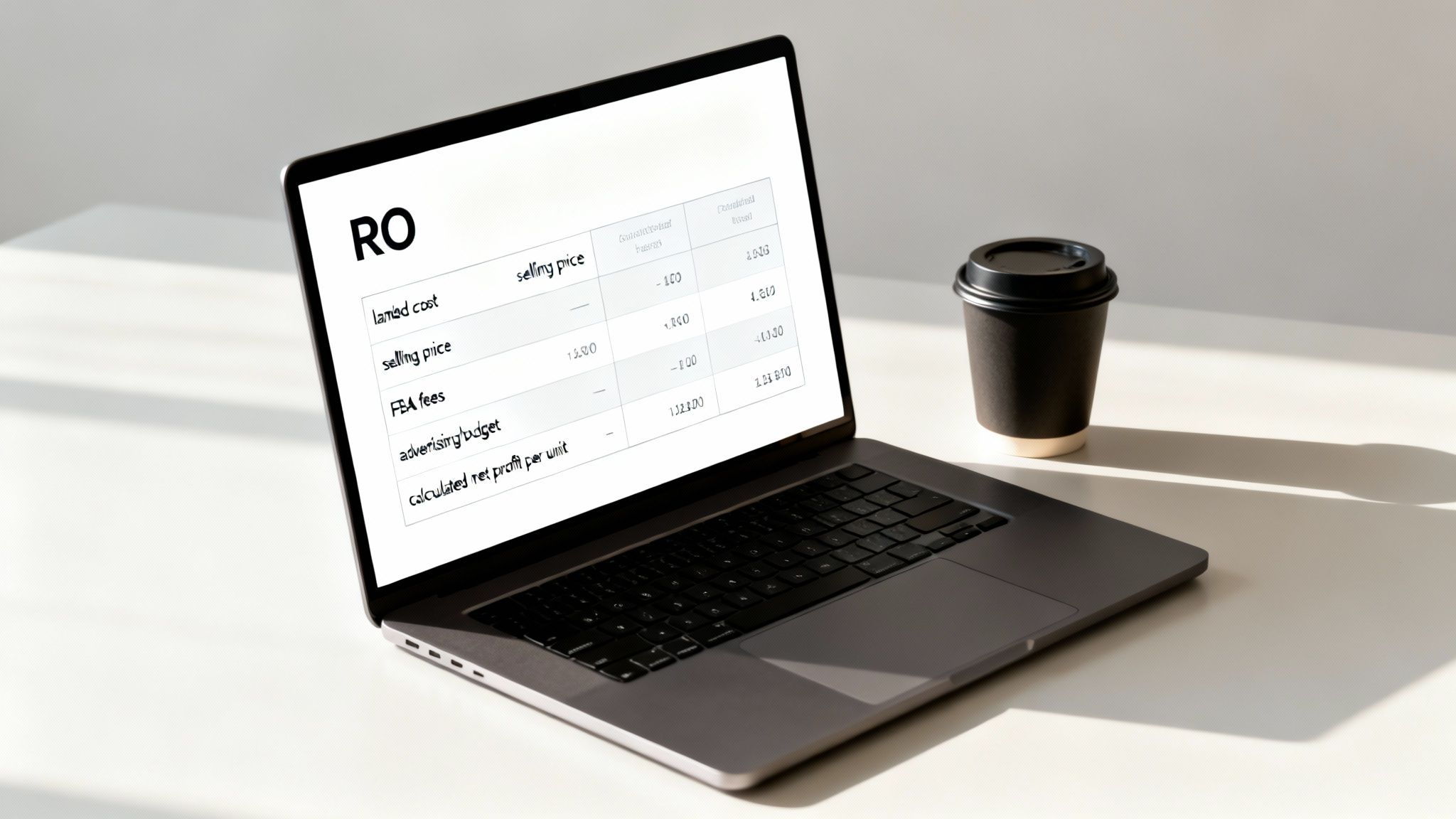
This simple, step-by-step process will help you vet any product idea. All you need are a few key estimates to get started.
Step 1: Gather Your Core Financial Metrics
Before you can calculate anything, you need to lock down your four foundational numbers. Be as realistic as possible here; overly optimistic estimates will only lead to disappointment later. Accuracy is your best friend.
Here’s what you need to figure out:
- Target Selling Price: This is the price you plan to list your product for on Amazon. Research your competitors to find a realistic price point the market will actually support.
- Landed Product Cost: This is the total cost to get one unit from the factory to an Amazon warehouse. It includes manufacturing, shipping, and any import duties or taxes.
- Estimated FBA Fee: Use Amazon's free FBA Revenue Calculator to get a solid estimate for your product's specific size and weight. This fee covers storage, picking, packing, and shipping to the customer.
- Advertising Budget Per Unit: A good rule of thumb is to allocate 10-15% of your selling price to advertising. For a $40 product, that means budgeting $4 to $6 per unit sold for ads.
Once you have these four numbers, you have the raw materials needed to build your profitability forecast.
Your product idea is only as strong as its weakest number. A great product with a high landed cost or a low selling price will never be profitable, no matter how much customers love it.
Step 2: Calculate Your Net Profit Per Unit
Now, let's put those numbers to work. The goal here is to figure out your estimated net profit for every single sale. This calculation reveals your true margin after Amazon takes its cut and you've paid for the product itself.
The formula is straightforward:
Net Profit Per Unit = Selling Price – Referral Fee – FBA Fee – Ad Cost – Landed Cost
Let's walk through an example. Imagine you want to sell a gourmet coffee press.
- Selling Price: $40.00
- Landed Cost: $10.00
- FBA Fee: $7.50
- Referral Fee (15%): $6.00
- Ad Cost (10%): $4.00
Plugging these into the formula: $40 – $6 – $7.50 – $4 – $10 = $12.50 Net Profit.
This means for every coffee press sold, you pocket $12.50. This single number is incredibly powerful, telling you immediately if the product has a fighting chance. This kind of raw data can also be used to understand broader market trends, and you can explore more detailed insights in our guide to Amazon sales data.
Step 3: Project Your Monthly Earnings and ROI
With your net profit per unit nailed down, the final step is to project your potential monthly earnings. This connects your per-unit profitability to your sales goals, giving you a clear picture of your Return on Investment (ROI).
First, set a realistic sales target. Let’s say you aim to sell 150 units in your first month.
Projected Monthly Profit = Net Profit Per Unit x Monthly Sales Target
$12.50 x 150 units = $1,875 per month.
To help you get started, we've created a simple worksheet. Just plug in your own estimates to see where you stand.
Simple Amazon Product ROI Calculator
| Financial Metric | Your Estimate ($) | Description |
|---|---|---|
| A. Target Selling Price | The price you'll list your product for on Amazon. | |
| B. Landed Product Cost | Total cost to get one unit to an Amazon warehouse. | |
| C. FBA Fee | Estimated fee for fulfillment from Amazon's calculator. | |
| D. Referral Fee (15% of A) | Amazon's commission, typically 15% of the selling price. | |
| E. Ad Cost Per Unit (10% of A) | A starting budget of 10% of the selling price for ads. | |
| F. Net Profit Per Unit | A – B – C – D – E | |
| G. Monthly Sales Goal | Your target for units sold per month. | |
| H. Monthly Net Profit | F x G |
This simple framework empowers you to run your own numbers, validate your ideas against real-world costs, and make a confident decision. By replacing guesswork with concrete data, you can finally determine if a product is a genuine business opportunity or just a financial dead end.
How Million-Dollar Sellers Win on Amazon
Success on Amazon isn't about some secret loophole or overnight hack. It’s about executing fundamental business principles with relentless discipline. The sellers pulling in millions don't guess—they build systems. They treat their Amazon store like the serious, data-driven enterprise it is, not a side hustle.
The path to the top is paved with a consistent commitment to doing things right. In 2021, around 40,000 third-party sellers on Amazon broke the $1 million annual sales mark. Fast forward to 2024, and that number has jumped to over 55,000—a 37.5% increase. This shows that while the competition is definitely fierce, the road to serious scale is well-traveled and achievable.
So what really separates these top performers from the rest? It isn't a single magic bullet. It's a mastery of several core disciplines that create a competitive moat others just can't cross.
They Create Defensible Product Moats
Million-dollar sellers know that competing on price is a race to the bottom. Instead, they focus on creating unique value that justifies a premium price tag and builds a loyal following. They obsess over product research, not just to see what’s popular, but to find gaps in the market they can fill better than anyone else.
This usually involves one of these strategies:
- Unique Bundles: Combining complementary products that competitors aren't smart enough to offer together.
- Superior Quality: Investing in better materials or manufacturing to directly address common customer complaints found in competitors' reviews.
- Proprietary Designs: Developing patented products that are legally locked down, making them impossible for copycats to replicate.
By creating a product that is genuinely different and better, they sidestep the brutal price wars that absolutely crush margins in commoditized categories.
The most successful Amazon sellers don't just sell products; they solve problems. Their listings, branding, and customer service all work together to communicate that value, making price a secondary consideration for the buyer.
They Build Brands, Not Just Listings
Anyone can throw up a product listing—it's just digital shelf space. A brand, on the other hand, is a promise to the customer. Top sellers invest heavily in building a cohesive and trustworthy brand identity right on the Amazon platform. They don’t just sell; they build an experience.
The key brand-building tools they master include:
- A+ Content: Using enhanced images and compelling copy to tell a rich brand story and show off product features in a way that basic text can't.
- Amazon Stores: Creating a multi-page, dedicated storefront to showcase their entire catalog and solidify their brand narrative.
- Video in Listings: Leveraging video to demonstrate products in action, build trust, and significantly boost conversion rates.
These efforts transform a simple transactional purchase into a memorable brand interaction. This is a critical piece of any real growth strategy, and you can dig into more tactics in our guide on how to grow your sales on Amazon.
They Master Inventory and Cash Flow
Finally, elite sellers are masters of logistics and finance. They understand that sitting inventory is just cash tied up on a shelf, and mismanaging it can be fatal. They use sophisticated tools and processes to maintain that perfect balance—never stocking out and losing sales velocity, but never overstocking and getting slammed with long-term storage fees.
Their approach is proactive, not reactive. They use historical sales data to forecast future demand with surprising accuracy, ensuring cash is always flowing and ready to be reinvested in growth. To truly win on Amazon and stand out from the crowd, understanding advanced AI-driven Amazon search optimisation strategies is a non-negotiable.
This operational excellence is the unglamorous but absolutely essential engine that powers their multi-million-dollar success.
Thinking Beyond Amazon vs. Building Your Own Store
The debate always seems to pit Amazon against your own ecommerce store, as if you have to pick one side to succeed. That’s a false choice. The smartest brands today don’t see it as Amazon versus Shopify; they see it as Amazon and Shopify, using each channel for what it does best.
Think of it this way: Amazon is like a massive, crowded shopping mall. It’s loud and competitive, but millions of shoppers are already there with their wallets out, actively looking to buy something. Your job is simply to get their attention as they walk past your kiosk.
Your own website, on the other hand, is your private, elegant boutique on a quiet side street. There’s no built-in foot traffic, so you have to work hard to bring every single person through the door. But once they’re inside, the entire experience—from the music to the lighting to the conversation—is yours to control.
The real difference comes down to customer acquisition. Amazon gives you instant access to a massive, built-in audience. Your main challenge there is visibility—beating the algorithm and standing out from a million other sellers. On your own site, the challenge is discovery. You’re responsible for generating every visitor through SEO, social media, paid ads, and content marketing.
Brand Experience and Customer Ownership
This is where the two channels really couldn't be more different. On Amazon, your ability to create a unique brand experience is incredibly limited. You’re stuck using their templates, following their rules, and communicating with customers through their system. You're a guest in Amazon's house, and you absolutely do not own the relationship with the people buying your products.
Your own website completely flips the script. You get total creative freedom over the design, the messaging, and the entire customer journey. You can build an email list, create a loyalty program, and foster a direct connection that turns one-time buyers into lifelong fans. That direct relationship is an asset Amazon will never give you.
The best strategy is a hybrid one. Use Amazon as your powerful customer acquisition engine to drive sales and find new audiences. Then, funnel that energy to your branded website, your profit and loyalty hub, where you actually cultivate those customer relationships for long-term growth.
Plenty of successful brands get their start on Amazon to prove their product works and generate some initial cash flow. Once they're established, they build their own site to capture much higher margins and build a brand that can't be easily copied.
Comparing the Financial Models
The way you make (and spend) money on these two channels is also fundamentally different, hitting your bottom line in very distinct ways.
- Amazon's Model (Commission-Based): Amazon runs on a pay-per-sale model. You mainly pay referral fees (a percentage of each sale) and FBA fees. This means your costs are variable and scale directly with your sales. It’s a lower-risk way to start because you don't pay much until you actually start selling.
- Your Store's Model (Fixed + Variable): With a platform like Shopify, you pay a fixed monthly subscription fee. On top of that, you have to cover all the variable costs yourself—marketing, advertising, payment processing, and fulfillment. Your success is entirely on you and your ability to drive profitable traffic.
This multi-channel thinking isn't just about Amazon and your own site, either. Expanding your marketplace footprint is another powerful move. For instance, learning how to sell on Walmart Marketplace can open up a completely new revenue stream and diversify your business so you aren't so reliant on Amazon.
Ultimately, asking if selling on Amazon is better than building your own store is the wrong question. The right question is: How can you use both strategically to build a resilient, profitable ecommerce business that meets customers wherever they are?
Your Questions About Selling on Amazon, Answered
Even with a solid plan, a few questions are probably still nagging at you. That’s normal. Let’s clear up the most common ones we hear from sellers so you can move forward with confidence.
Do I Need an LLC to Sell on Amazon?
No, you don’t need an LLC to get started. You can absolutely begin as a sole proprietor, using your own name and social security number to get the ball rolling. It’s the simplest way to test the waters.
That said, forming an LLC is one of the smartest things you can do once your business starts gaining traction. It creates a legal wall between your personal assets (like your house and car) and your business, protecting you if things go sideways. Most successful sellers start as sole proprietors and then form an LLC once they’ve proven their idea works.
Can You Still Make Good Money on Amazon in 2024?
Absolutely, but the game has changed. The gold rush days of picking a random product, slapping a label on it, and watching the money roll in are over. The marketplace is crowded and competitive, which just means you have to be smarter about it.
Making real money on Amazon today is all about:
- Building a Brand: Creating something customers remember and come back for.
- Product Differentiation: Offering something unique that solves a problem better than anyone else.
- Smart Advertising: Knowing how to use Amazon's ad tools to reach the right shoppers without burning through your cash.
Sellers who treat it like a real business are still seeing incredible success. In 2024, more than 55,000 independent sellers broke $1 million in sales. The opportunity is definitely still there.
What Is the Minimum Investment to Start?
There’s no magic number, but a realistic starting point is between $3,000 and $5,000. While you could technically start with less, that budget gives you enough room to do things right without cutting dangerous corners.
A classic rookie mistake is underestimating how much inventory you'll need. If you launch, get some sales momentum, and then immediately stock out, you kill your product's ranking before it even has a chance.
Here’s a rough idea of where that initial cash goes:
- Inventory: This is the big one, usually 60-70% of your total budget.
- Amazon Professional Account: A flat $39.99 a month.
- Product Samples & Photography: Non-negotiable for ensuring quality and creating a listing that converts.
- Initial Ad Budget: You have to spend money to make money, especially at launch.
- Branding & Logos: A professional look builds trust from day one.
Can I Use Dropshipping on Amazon?
Yes, dropshipping is allowed on Amazon, but it’s a minefield. Amazon has a very strict Drop Shipping Policy, and the most important rule is that you must be the seller of record. The customer should never see a package or invoice with your supplier’s name on it.
This is where it gets risky. You're putting your entire Amazon account in the hands of a third-party supplier, trusting them to follow Amazon’s rules perfectly on every single order. One mistake on their end—like shipping a box with their logo on it—can get your account suspended. Because of that risk, most serious sellers prefer the control and reliability of FBA.
Ready to stop guessing and start growing? The experts at Next Point Digital build data-driven strategies for Amazon sellers that turn clicks into customers and scale profitability. Learn more about how we can help you win on Amazon at https://npoint.digital.