

Writing a great product description isn't about listing features. It's about translating those features into benefits that solve a real problem or fulfill a deep desire for your customer.
This all starts with digging deep into your target audience, understanding their pain points, and then using their own language to show them how your product makes their life better. This is the foundational work—the stuff that happens before you write a single word of copy—that separates descriptions that convert from those that just take up space.
Building the Foundation for Persuasive Descriptions

It’s tempting to jump right in and start writing. But the most effective descriptions—the ones that actually sell—are built on a solid understanding of your customer’s world. I'm talking about their frustrations, what they're trying to achieve, and the exact words they use to talk about it.
Don't skip this part. Seriously. Research shows that 87% of consumers say product content is extremely important when they're deciding what to buy. And if your descriptions are unclear, you could be losing up to 20% of your customers before they even get to the checkout.
Define Your Ideal Customer Persona
A buyer persona is so much more than just demographics like age and location. A useful persona gets into the psychology behind the purchase. It's a semi-fictional character you create, based on real data, that represents your perfect customer.
To get this right, you have to put on your detective hat and dig for real insights:
- Mine Customer Reviews: Go through your own product reviews and, just as importantly, your competitors'. Look for the specific words people use to describe their problems and what they rave about when they're happy. These phrases are pure gold.
- Hang Out in Online Communities: Find the forums, Reddit threads, and Facebook groups where your audience lives. Don't post—just listen. How do they talk about the exact challenges your product solves?
- Talk to Your Best Customers: Pick up the phone or send an email to a few of your most loyal customers. Ask them what their world was like before they found your product. Their stories will tell you which benefits you need to be shouting from the rooftops.
This whole process isn't just about figuring out who your customer is. It’s about understanding how they think and what they truly value. This insight is also a game-changer when it comes to pricing. To see how this ties together, check out our guide on how to determine the price of a product.
Identify the Core Problem You Solve
Every great product is, at its heart, a solution to a problem. Your job is to nail down the single biggest problem your product solves for that persona you just created.
Forget listing every single feature. Focus on the main pain point. Are you saving them time? Reducing their stress? Making them feel more confident?
The most effective product descriptions don’t sell a product; they sell a better version of the customer. They frame the product as the tool that helps the customer overcome a challenge and achieve their desired outcome.
Once you know that core problem, everything in your description—every headline, bullet point, and sentence—should tie back to it. This creates a focused, powerful message that connects with the right shopper on an emotional level.
Of course, words are only half the battle. You need powerful visuals to back them up. Exploring some AI product photography techniques can help you create stunning images that complement your copy. That one-two punch of targeted messaging and striking visuals is what turns casual browsers into loyal customers.
From Feature to Benefit: A Practical Transformation
This table shows you how to translate dry product features into compelling benefits that resonate with your customers' needs.
| Standard Product Feature | Customer-Focused Benefit |
|---|---|
| Waterproof fabric | Keep your gear dry and protected, no matter the weather. |
| 10-hour battery life | Power through your entire workday without scrambling for a charger. |
| Lightweight aluminum frame | Carry it all day without the shoulder strain. |
| Built-in noise cancellation | Take calls from anywhere without distracting background noise. |
| One-click setup | Get started in under a minute—no complicated instructions. |
See the difference? One is about the product; the other is about the customer's life. Always focus on the benefit.
Mastering Copywriting That Converts

Now that you know exactly who you’re talking to, it’s time to turn those customer insights into words that sell. This is where the magic happens. We're not just listing features; we're painting a vivid picture of how your customer's life improves with your product.
Great copywriting closes the gap between a shopper's problem and your solution. It has to build trust, create desire, and give them a gentle nudge toward the “buy” button. It's a huge deal, too. The copywriting market was valued at nearly USD 27.96 billion in 2025 and is expected to hit USD 42.83 billion by 2030, with ecommerce driving a massive chunk of that growth.
Use Proven Copywriting Formulas
You don’t have to stare at a blank page and reinvent the wheel. The best copywriters lean on proven formulas to structure their writing and make it hit harder. Think of them as recipes for persuasion.
Two of the most effective formulas for product descriptions are:
- PAS (Problem, Agitate, Solve): This one works so well because it taps directly into your customer’s pain points. First, you state the problem they're facing. Then, you agitate it by digging into the frustration it causes. Finally, you swoop in and present your product as the hero.
- AIDA (Attention, Interest, Desire, Action): A classic for a reason. AIDA guides the customer through the entire buying journey. You grab their Attention with a killer headline, build their Interest with compelling details, create Desire by showing them what's in it for them, and then call them to Action.
Here’s a quick look at the PAS formula in action for a portable power bank:
Problem: Sick of your phone dying right when you need it most—like during a crucial call or while navigating a new city?
Agitate: It’s that sinking feeling. The frantic search for an outlet. The anxiety of being disconnected can completely derail your day.
Solve: With the Nomad Power Bank, you’ve got two full charges right in your pocket. Stay connected and in control, no matter where you are.
See how that simple structure makes the product immediately relevant? It solves a real problem.
Write Headlines That Stop the Scroll
Your headline is your first, and maybe only, shot at grabbing a shopper’s attention. If your headline is weak, the rest of your brilliant copy doesn't stand a chance. It needs to be a magnet, promising a clear benefit or sparking enough curiosity to make them pause.
To get this right, focus on the end result for the customer. Instead of something bland like "Durable All-Weather Backpack," go for "The Last Backpack You'll Ever Need." The first is a feature; the second is a powerful promise.
Make Your Bullet Points Scannable and Powerful
Let's be honest: most online shoppers don't read word-for-word. They scan. That makes bullet points your absolute best friend for delivering key info fast. But don't just throw a list of specs up there. Use your bullets to hammer home the benefits.
A simple but powerful trick is to lead with the benefit in bold, followed by the feature that makes it possible.
- Never Lose Your Spot. Our smart bookmark technology automatically saves your page, so you can jump right back in.
- Read Comfortably in Any Light. The anti-glare e-ink display adjusts to your surroundings, from bright sun to a dark room.
- Carry Your Entire Library. With 32GB of storage, you can hold thousands of books, magazines, and audiobooks on one feather-light device.
This format makes the most important information impossible to miss. Nailing these little details is a core part of turning browsers into buyers. You can find more strategies like this in our guide to https://npoint.digital/conversion-rate-optimization-best-practices/.
Find and Refine Your Brand Voice
Your brand voice is your company's personality. Is it professional and authoritative? Or witty and playful? There’s no single right answer, but whatever you choose, it must be consistent and connect with your audience.
If you’re selling high-end artisanal coffee, your voice might be sophisticated and passionate. If you’re slinging quirky novelty socks, it should be fun and lighthearted. A consistent voice builds brand recognition and makes people feel like they're buying from someone they know, not a faceless corporation.
As AI tools get better at drafting copy, that human touch becomes even more critical. To really stand out, you need to learn how to convert AI text to human writing that builds a genuine connection with shoppers.
Weaving SEO into Your Product Descriptions
A powerfully persuasive product description is useless if shoppers can’t find it. This is where search engine optimization (SEO) comes in, acting as the bridge between your product and the customers actively searching for what you sell.
It’s not about stuffing your copy with awkward phrases. It’s about understanding the exact language your customers use and strategically placing it where it matters most.
Think of keywords as the specific language your ideal customer types into the search bar. They aren't just looking for "running shoes." They're searching for "lightweight trail running shoes for wide feet" or "best waterproof marathon shoes." Your goal is to pinpoint these phrases and use them to signal to search engines that your product is the most relevant answer.
Building Your Keyword Strategy
Great keyword research for a product page isn't about finding one perfect term. It's about building a small, focused ecosystem of related phrases that cover the customer’s entire thought process. This approach helps you cast a wider net and capture more potential buyers.
Your keyword list should include a mix of these types:
- Primary Keyword: This is your main, high-volume term that best describes the product (e.g., "bamboo cutting board"). It’s the star of the show and belongs in your title and early in the description.
- Secondary Keywords: These are important variations that add context, like "large wooden chopping block" or "kitchen prep board." They support your primary term and help you show up for a broader set of queries.
- Long-Tail Keywords: These are longer, super-specific phrases, often framed as questions (e.g., "extra large bamboo cutting board with juice groove"). While their search volume is lower, they attract highly qualified buyers who know exactly what they want.
The real magic of SEO happens when you stop thinking about "ranking for keywords" and start thinking about "answering customer questions." When your description directly addresses the needs implied by a long-tail keyword, you don't just improve visibility—you dramatically increase your conversion rate.
This strategic layering of keywords tells search engines that your page is a comprehensive resource for that product. For a deeper dive into optimizing your entire store, explore our complete guide to ecommerce SEO best practices.
Integrating Keywords Naturally into Your Copy
Once you have your target keywords, the art is weaving them into your product description without sounding like a robot. Keyword stuffing—the outdated practice of unnaturally repeating keywords—will get you penalized by search engines and instantly turn off your customers.
Instead, focus on seamless integration. Here are the most critical places to put your keywords for maximum impact:
- Product Title (H1 Tag): This is the single most important spot for your primary keyword. Your title needs to be clear, descriptive, and lead with the most crucial information. Think “Ever-Sharp Bamboo Cutting Board – Large with Juice Groove.”
- Bulleted Benefits: Naturally work your secondary and long-tail keywords into your bullet points. If a keyword is "antibacterial chopping surface," a bullet could read: “Enjoy a Cleaner Prep Space thanks to bamboo’s natural antibacterial properties, creating a safer chopping surface for your family.”
- Main Body Paragraphs: The main description is the perfect place to weave in keywords as part of a story. Talk about the product's origin or paint a picture of it in use, naturally dropping in the phrases your customers are searching for.
- Image Alt Text: This is the short text that tells search engines what an image is about. It's an often-missed SEO opportunity. Instead of a generic filename like "IMG_1234.jpg," your alt text should be descriptive: "Large bamboo cutting board with deep juice groove holding chopped vegetables."
By placing keywords in these strategic locations, you send clear signals to both search engines and human readers about what your product is and who it’s for. This creates a powerful alignment that drives both visibility and sales.
Adapting Your Descriptions for Different Channels
A brilliant product description you wrote for your Shopify store will almost certainly fall flat on Amazon. Why? Because you’re not just selling to different people; you’re playing in entirely different ecosystems. Each one has its own rules, algorithms, and customer expectations.
Thinking you can just copy and paste descriptions across every channel is one of the most common mistakes I see. Not only can it create duplicate content issues that tank your search visibility, but you're also ignoring the unique opportunities each platform gives you to make a sale. To really move the needle, you have to tailor your approach.
Dominating the Amazon Marketplace
Let's get one thing straight: Amazon isn't just a store; it's a search engine. Shoppers land there with a high intent to buy, and your description’s main job is to convince both the customer and Amazon’s A9 algorithm that your product is the best possible match.
That means your focus has to be razor-sharp on two things: keywords and scannability.
The most critical real estate on any Amazon listing is right at the top:
- The Title: This is your heavyweight SEO element. You get around 200 characters, so make every single one count. Lead with your main keyword and brand, then pack it with key features, benefits, and important specs like size or color.
- The 5 Bullet Points: This is where the sale is made or lost. Most shoppers scan these bullets and never even get to the full description below. Each bullet point needs to start with a capitalized, benefit-driven hook, then explain the feature that delivers that benefit. This is also the perfect place to weave in your secondary and long-tail keywords.
Think of your keyword strategy as a funnel. You start broad with primary terms in your title and get more specific with long-tail phrases in your bullets.
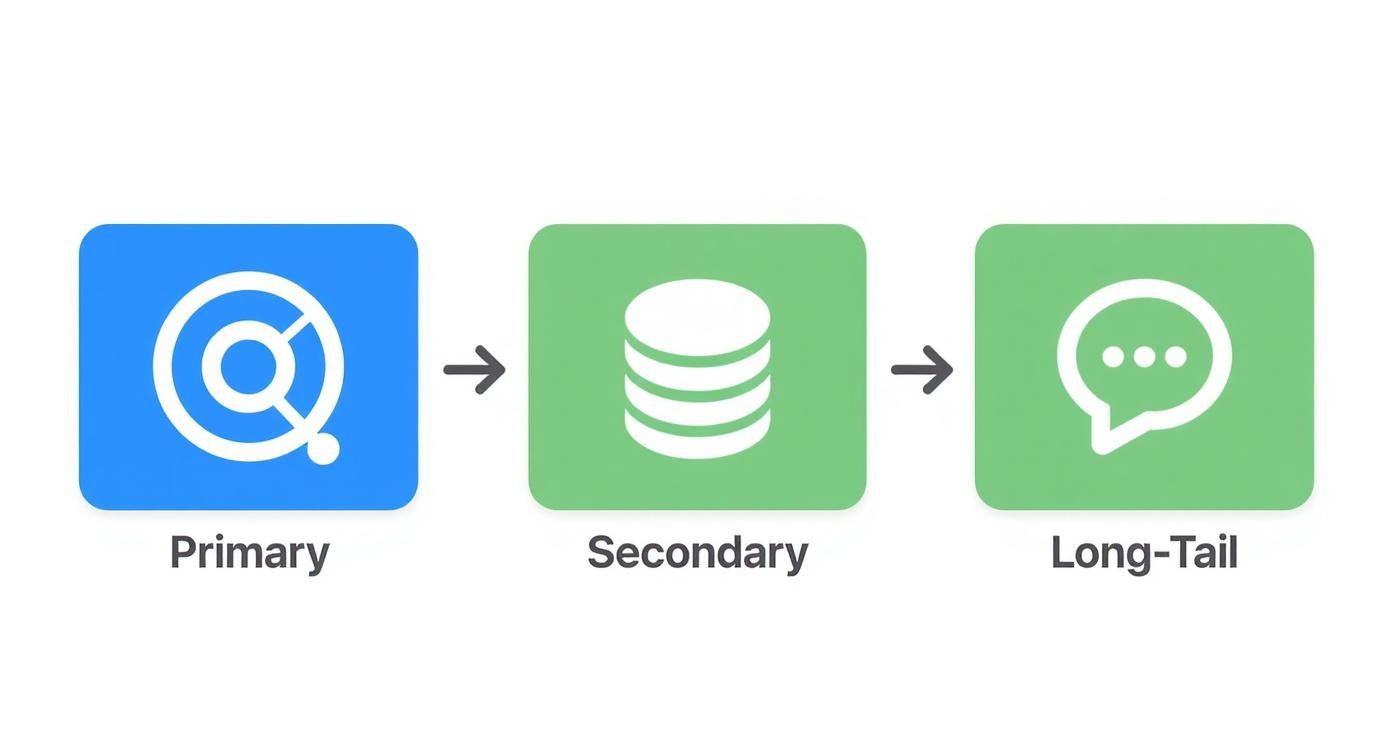
This flow from primary to long-tail keywords helps you capture both the high-volume general searches and the super-specific queries from shoppers who are ready to buy now.
Key Takeaway: On Amazon, your bullet points are your primary sales pitch. Treat them like five mini-headlines, each selling a specific outcome. Don't waste this precious space on dry specs; sell the result.
For brands in the Brand Registry, A+ Content is an absolute game-changer. It lets you break up the wall of text with rich media—high-quality images, comparison charts, and brand story modules—creating a much more engaging experience. Use it to tell a deeper story and visually tackle common customer objections before they even ask. Mastering these elements is non-negotiable, and you can get a detailed breakdown if you learn how to optimize Amazon product listings.
Winning on eBay and Walmart Marketplace
While eBay and Walmart have their own algorithms, their description fields give you a bit more breathing room than Amazon’s standard layout.
For eBay:
eBay’s audience often includes bargain hunters and collectors looking for very specific details. Transparency is everything here. Be painfully honest about the item's condition, upload tons of high-quality photos, and use the description to answer every conceivable question a buyer might have. Structure your text with clear headings and short paragraphs so info on shipping, returns, and item specs is easy to find.
For Walmart Marketplace:
Walmart is aggressively growing its marketplace, and its main focus is on a trustworthy, seamless customer experience. Much like Amazon, Walmart’s algorithm prioritizes structured data. Your title needs to be clear and packed with keywords, and the "Key Features" section (their version of bullet points) has to highlight the top benefits right away. Quality content builds trust, which improves your chances of winning that all-important Buy Box.
Crafting a Brand Story on Your D2C Store
Your own website—whether it’s on Shopify or WooCommerce—is where you have total creative freedom. You aren't boxed in by marketplace rules, so this is your chance to really let your brand’s personality shine. The goal here isn't just a transaction; it's about building a relationship.
On your D2C site, you can:
- Tell a Compelling Story: Talk about why you created the product, the problem it solves, and what your brand stands for.
- Use Rich Media: Embed videos, user-generated content from social media, and even interactive elements.
- Focus on Lifestyle Benefits: Show the product in action with high-quality lifestyle photography. You’re selling an experience, not just an item.
- Optimize for Google: Your SEO strategy here is all about Google, not a marketplace algorithm. That means focusing on user experience, page speed, and building a narrative that satisfies searcher intent.
Your D2C description should feel less like a sales listing and more like a dedicated landing page, designed to pull the customer into your brand’s world and make them feel confident about their purchase.
Channel-Specific Description Cheat Sheet
Juggling these different requirements can get complicated, so here’s a quick-reference table to keep the core strategies straight for each platform.
| Platform | Title Character Limit | Bullet Point Strategy | Main Description Focus |
|---|---|---|---|
| Amazon | ~200 | Benefit-led hooks, keyword-heavy, scannable | A+ Content for brand story & visuals |
| eBay | 80 | Use item specifics instead | Hyper-detailed, transparent, answer all questions |
| Walmart | 50-75 | "Key Features," benefit-focused | Structured, clean, trust-building content |
| D2C (Shopify, etc.) | ~70 (for Google SEO) | Integrated into body copy | Brand storytelling, lifestyle benefits, rich media |
This cheat sheet isn't exhaustive, but it provides a solid starting point for adapting your core product message to fit the unique demands of each channel, ensuring you’re not leaving sales on the table.
How to Test and Optimize Your Descriptions
Great copy isn't written; it's rewritten. The most successful ecommerce brands know that the first version of a product description is just a starting point—a well-researched hypothesis that’s waiting to be tested. Real, sustainable growth comes from letting your data tell you what actually resonates with your customers.
This means shifting your mindset from "write and publish" to a continuous loop of "write, test, and refine." By setting up this process, you can make small, iterative improvements that lead to massive gains in conversion rates over time. It’s how you turn a good description into a great one.
The Power of A/B Testing Your Copy
A/B testing, or split testing, is just a simple way of comparing two versions of a page to see which one performs better. For a product page, you show one version (the control, or 'A') to half your audience and another version with a single change (the variation, or 'B') to the other half.
By measuring how users react, you can say for sure whether the change you made had a positive, negative, or neutral impact. It takes all the guesswork out of the equation.
The trick to effective A/B testing is to only change one element at a time. Seriously. If you change the headline and the call-to-action at the same time, you'll never know which one was responsible for the shift in performance.
Here are a few common elements I always recommend testing in your product descriptions:
- Headlines: Try a benefit-driven headline against one that sparks curiosity.
- Call-to-Action (CTA) Text: Does "Add to Cart" really outperform "Buy Now" or "Get Yours Today"? Test it.
- Story Angles: Pit a description focused on the product's origin story against one that focuses purely on solving the user's problem.
- Tone of Voice: See how a playful, casual tone stacks up against a more professional and authoritative one.
- Bullet Point Order: Does leading with your strongest social proof bullet actually improve conversions? You won't know until you test.
Key Metrics to Track for Optimization
You can monitor dozens of data points, but a few key performance indicators (KPIs) give you the clearest picture of how your descriptions are performing. Focusing on these helps you separate meaningful signals from all the noise.
The goal of testing isn't just to get more clicks; it's to improve the customer's journey. Your KPIs should reflect this, measuring not just interest but actual purchase intent and conversion.
These are the essential metrics to watch:
- Conversion Rate: This is the big one—the percentage of visitors who complete a purchase. It's the ultimate measure of success for any product description. Even a small lift of 0.5% can have a huge impact on your bottom line.
- Add-to-Cart Rate: This shows how many visitors were persuaded enough by the description to take that next step. It’s a powerful indicator of purchase intent.
- Bounce Rate: The percentage of visitors who land on your page and leave without taking any action. A high bounce rate could mean your headline or opening lines aren't engaging enough to hold their attention.
This kind of ongoing optimization has become a specialized skill, and it's driving major growth in the e-commerce world. In fact, the global content writing services market was valued at USD 19.9 billion in 2023 and is projected to hit USD 38.6 billion by 2033. You can explore the full research on this growing market to see just how vital quality, tested content has become.
Product Description FAQs
Even after you’ve got a solid plan, a few questions always seem to pop up right when you’re staring at that blinking cursor. Let's tackle some of the most common hurdles that trip people up, so you can move from a blank page to a finished description with confidence.
Getting these right is key. A few simple tweaks here can completely change how your audience connects with your products.
How Long Should a Product Description Be?
There's no magic number, and anyone who tells you otherwise is selling you a fantasy. The right length comes down to two things: how complex your product is and where you're selling it.
For a simple graphic tee on Instagram, a few snappy lines are probably all you need. The visuals do most of the heavy lifting. But for a high-tech drone or a piece of specialized software on your website? A buyer needs a lot more information to feel confident enough to click "buy."
Here are some good rules of thumb:
- Simple/Impulse Buys: Shoot for 100-300 words. Your goal is a strong hook, scannable bullet points, and a quick, benefit-packed summary.
- Complex/High-Consideration Products: You might need 400+ words. Use that space to dig into detailed specs, tell a compelling story, break down multiple benefits, and proactively answer any objections a skeptical buyer might have.
The golden rule is this: be as thorough as necessary to answer every last question a customer might have, but keep it as tight as possible to hold their attention.
Can I Use AI to Write My Product Descriptions?
Absolutely, but you need to be smart about it. Think of AI tools as a brilliant junior copywriter—they’re fantastic for generating ideas, smashing through writer's block, and knocking out a solid first draft in seconds.
AI can help you:
- Brainstorm a dozen different angles and benefit statements.
- Turn a dry, feature-heavy list into customer-focused copy.
- Crank out multiple headline variations for A/B testing.
But relying on AI for the final version is a huge mistake. The output almost always lacks the unique personality, brand voice, and nuanced understanding of your target customer. For instance, you can use AI tools to improve your site's user journey, and you can learn more about that by checking out the best ecommerce personalization software on the market.
Use AI as a launchpad, not a parachute. Your job is to take that 80% solution from the machine and add the final 20% of human insight, brand personality, and strategic polish that actually makes it sell.
What Are the Biggest Mistakes to Avoid?
Learning how to write great product descriptions is also about knowing what not to do. So many brands make the same unforced errors that kill conversions before a shopper even has a chance to get interested.
Here are the top offenders we see time and time again:
- Listing Features Instead of Benefits: This is the cardinal sin of copywriting. Nobody buys a drill because they want a drill; they buy it because they want a hole. Instead of saying "waterproof polyester," say "Keeps your gear bone-dry through any downpour."
- Using Meaningless Clichés: Phrases like "excellent quality" or "innovative design" are just empty calories. They mean nothing without proof. Instead of telling someone your product is high-quality, show them by describing the premium materials or the meticulous craftsmanship behind it.
- Creating a "Wall of Text": Online readers scan, they don't read. A dense, unbroken block of text is intimidating and will be skipped 99% of the time, especially on a phone. Use short paragraphs, headings, and bullet points to make your copy inviting and easy to digest.
Just avoiding these common pitfalls will instantly put your product descriptions miles ahead of most of your competition.
At Next Point Digital, we specialize in turning product details into compelling narratives that drive sales. If you're ready to elevate your ecommerce presence and convert more shoppers, let's talk. https://npoint.digital