

For sellers laser-focused on growth, the answer is a hard yes—Amazon FBA is absolutely worth it.
Think of it as the ultimate trade-off: you pay higher fees for what is essentially an express pass to the world's largest ecommerce marketplace and its army of loyal Prime customers. It's an investment that removes the massive operational headache of logistics, freeing you up to do what you do best: scale your brand.
Decoding the Value of Amazon FBA
So, is FBA truly worth the cost? The question really boils down to a fundamental business decision: are you willing to exchange a piece of your margin for much higher sales velocity and near-total operational freedom?
For many brands, this trade-off isn't just worth it—it's the key that unlocks exponential growth. We’re going to dig into the data and show you why.
It helps to stop thinking of FBA as just a fulfillment service and start seeing it as a strategic growth lever. When you hand over the entire pick, pack, and ship process to Amazon, you're tapping into a world-class logistics network that would cost millions to build yourself.
This move frees up your most valuable asset—your time—so you can get back to product sourcing, marketing, and actually building your brand.
The Core Trade-Off, Explained
At its heart, the FBA model is a straightforward value proposition. You're paying for access and efficiency, plain and simple.
Before we get into a detailed cost-benefit analysis, here’s a quick look at the core factors that justify the FBA fees.
Amazon FBA At a Glance: Key Decision Factors
This table summarizes the core pros and cons of using FBA, giving you a quick, scannable overview before we dive into the detailed analysis.
| Factor | Why It Makes FBA Worth It | Potential Drawback to Consider |
|---|---|---|
| Prime Customer Access | Instantly tap into 200 million+ loyal Prime members who spend more and convert at higher rates. The Prime badge builds immediate trust. | The fees are non-negotiable and cut directly into your margins on every single sale. |
| Buy Box Dominance | Amazon’s algorithm heavily favors FBA sellers for the coveted Buy Box, where the vast majority of all sales happen. | You lose direct control over your inventory and the customer service experience. |
| Effortless Scalability | Fulfill hundreds or thousands of orders a day without ever touching a roll of packing tape. Amazon handles everything. | Inventory management becomes more complex, with potential for costly long-term storage fees if you overstock. |
With FBA, you gain the operational muscle to compete with established retail giants, even if you’re a solo entrepreneur working from your kitchen table.
FBA transforms your business from a manual, hands-on operation into an automated sales machine. The fees are the fuel for that machine, enabling you to travel farther and faster than you ever could on your own.
Ultimately, the decision comes down to your business goals and product economics. You absolutely have to know your numbers. A critical first step is understanding how to determine the price of a product to ensure your margins can actually support the FBA fee structure while leaving you with a healthy profit.
This article will give you the data and framework to make that calculation with confidence.
How Amazon FBA Actually Works for Your Business
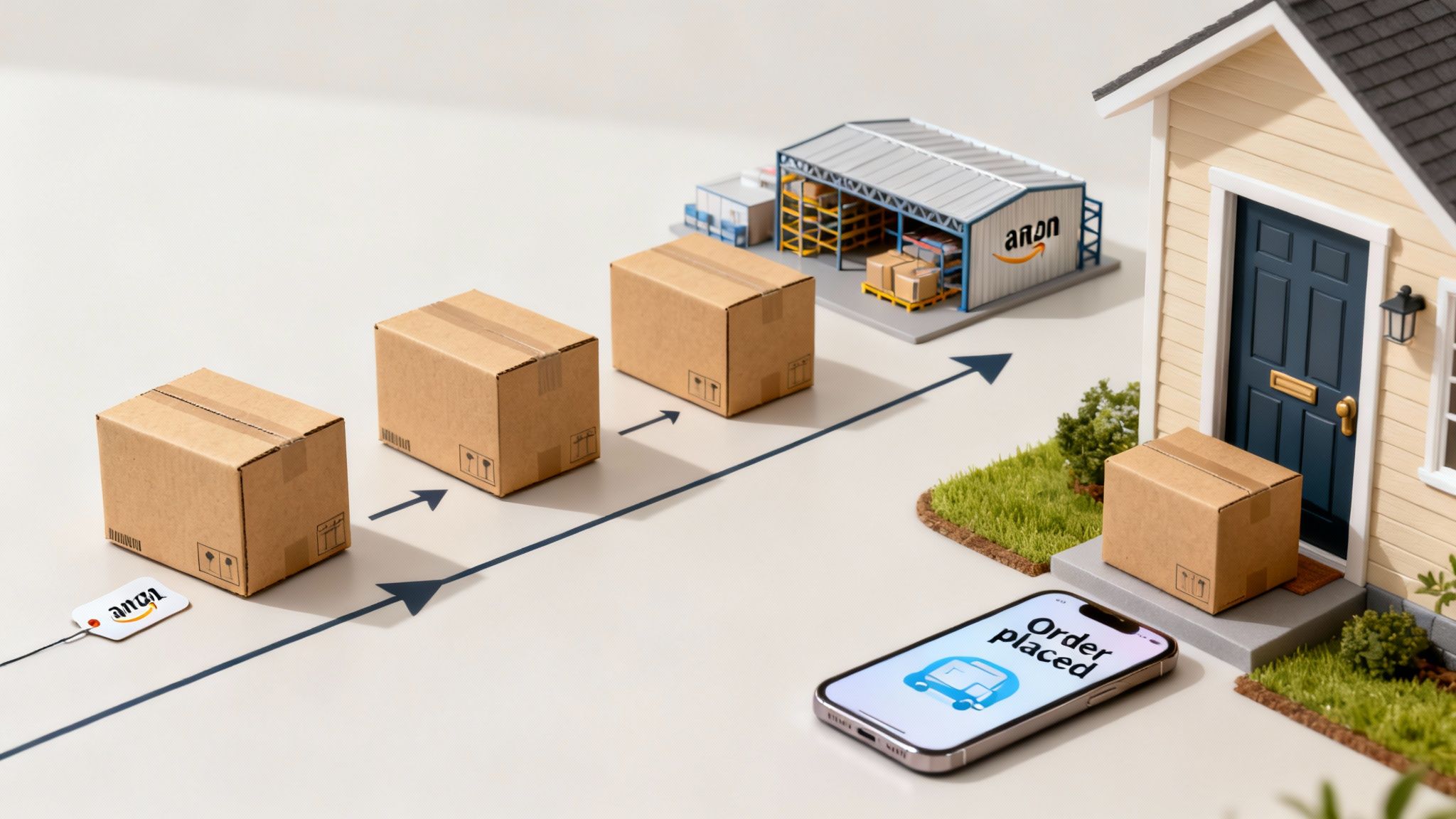
Think of it like hiring a global logistics giant to be your personal warehouse and shipping department. That’s FBA in a nutshell. Instead of your garage overflowing with boxes, you’re plugging into Amazon's massive, fine-tuned infrastructure to handle almost every part of order fulfillment for you.
This model completely flips your role from a hands-on packer and shipper to a strategic business manager. Your main job becomes sourcing great products, marketing them effectively, and digging into performance data, while Amazon’s robots and fulfillment experts do the heavy lifting.
The FBA Journey From Your Supplier to Your Customer
The whole process is surprisingly straightforward and can be broken down into a few key stages. Getting a grip on this flow is the first step in deciding if FBA is actually worth it for your business.
- You Prep Your Products: It all starts with you. You (or your supplier) get your inventory ready according to Amazon's very specific rules—think proper labeling, packaging, and barcoding so everything can be tracked seamlessly in their system.
- You Ship to Amazon: Next, you create a shipping plan in Seller Central and send your products in bulk to one of Amazon's designated fulfillment centers. Forget about individual customer addresses at this point.
- Amazon Stores Your Inventory: Once your shipment arrives, Amazon scans everything into its network and stores it safely. Your inventory is now live and ready to be purchased by millions of customers.
- A Customer Places an Order: When someone buys your product, Amazon’s system automatically takes care of the order. You don’t have to lift a finger; the transaction is handled behind the scenes.
- Amazon Picks, Packs, and Ships: Here’s where the magic happens. Amazon’s team finds your product in the warehouse, packs it up, and ships it directly to the customer—often with that sweet two-day Prime delivery.
- Amazon Manages Customer Service: To close the loop, Amazon also handles most of the post-sale support, like tracking questions and managing returns for your FBA orders.
This all-in-one service is the core reason FBA is so powerful. If you want to dive deeper into the nuts and bolts, our detailed guide on what is Amazon FBA mean breaks down the key terms and concepts for new sellers.
Unlocking the Power of Prime
The single biggest perk of this whole process is getting the Prime badge on your listings. Prime members are Amazon's most loyal, active customers, and they spend way more than non-members.
By using FBA, your products automatically become Prime-eligible. This instantly boosts their visibility and appeal. Customers can filter their searches for Prime items, putting your products right in front of the most engaged buyers on the platform.
Of course, for FBA to really work for you, your product presentation has to be on point. Your images need to be sharp enough to stop a customer mid-scroll. You can find some great tactics in this a guide to photography for Amazon products that sells.
Getting this foundation right is crucial. You're not just selling a product; you're plugging your business directly into Amazon’s ecosystem to hit a scale that would otherwise be impossible for a small or medium-sized brand to build on its own.
Decoding the True Cost of Amazon FBA
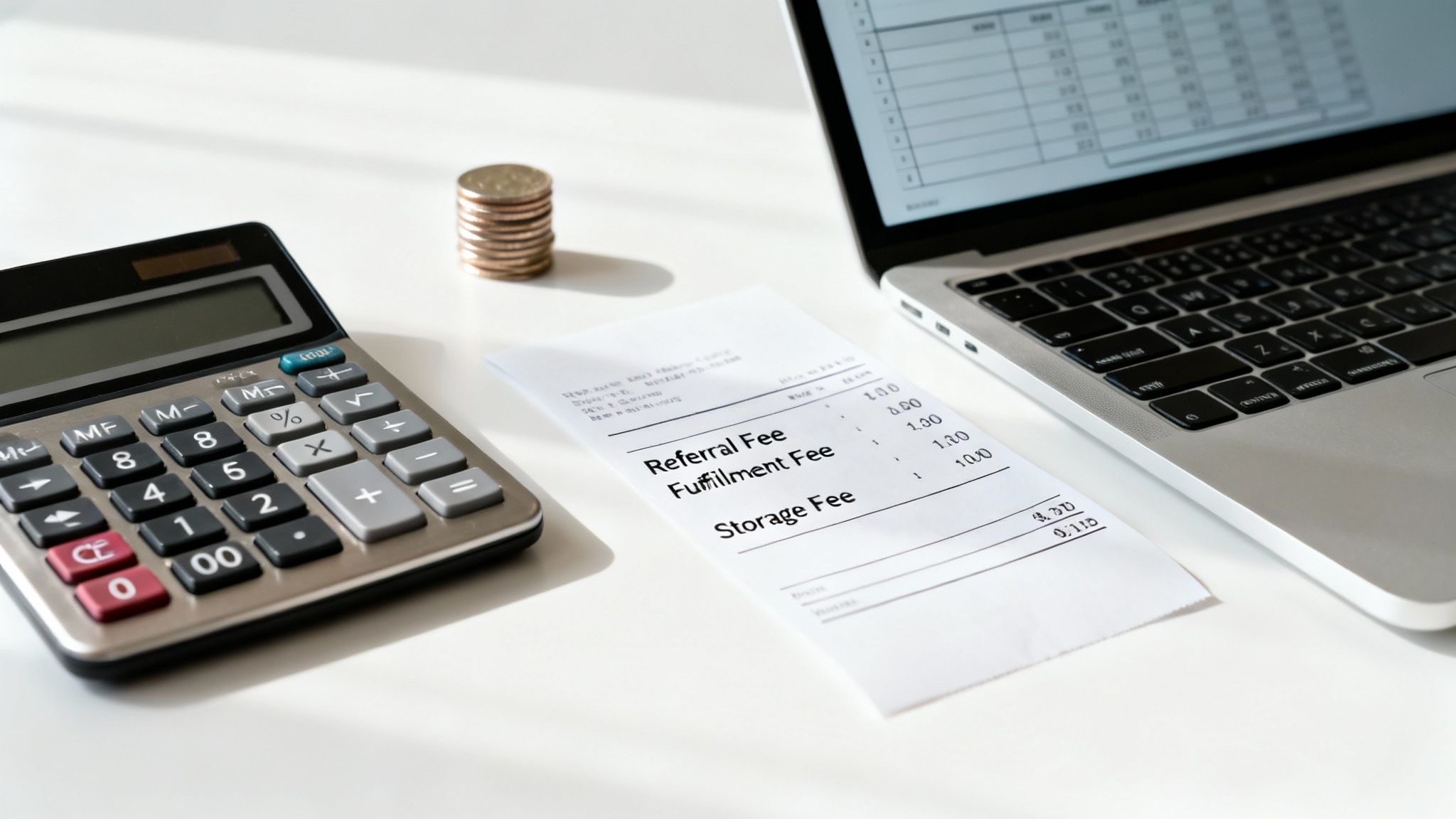
To really answer the question, "is Amazon FBA worth it," you have to look past the sales numbers and get comfortable with the costs. FBA isn't just one fee; it’s a layered system of charges that will directly hit your profit margins. Getting a handle on these is non-negotiable if you want to build a business that lasts.
Think of it this way: selling on Amazon is like renting a prime spot in the world's busiest mall. You get unbelievable foot traffic, but you have to pay the landlord. The fees are simply your cost of admission to this massive customer base.
The Three Core FBA Fees
While a few other charges can pop up, your profitability will mostly hinge on three main costs. These are the ones you’ll see on your statement month after month.
- Referral Fee: This is Amazon's commission on every sale you make, whether you use FBA or not. It's a percentage of the total sales price—including shipping—and usually hovers around 15%, though this can change depending on your product category.
- FBA Fulfillment Fee: This is the big one. It's what you pay Amazon to pick, pack, and ship your products, and it also covers customer service and returns. The fee is based on your product’s size and weight, so bigger, heavier items cost more to handle.
- Inventory Storage Fee: This is the "rent" you pay for shelf space in Amazon’s warehouses. It’s charged monthly and calculated based on how much room your inventory takes up (in cubic feet). Be warned: these rates jump during the Q4 holiday rush.
These three fees are the foundation of your FBA costs. To get a real grip on your numbers, plugging everything into a reliable Amazon FBA profit margin calculator is a must.
Putting It All Together: A Real-World Example
Let's make this tangible. Imagine you sell a small, standard-sized kitchen gadget for $30. Your cost to source it (Cost of Goods Sold, or COGS) is $7. Here’s a quick breakdown of how the fees might look:
- Retail Price: $30.00
- Referral Fee (15%): -$4.50
- FBA Fulfillment Fee: -$4.00 (a rough estimate for a small item)
- Monthly Storage Fee: -$0.20 (an estimated per-unit cost)
- Total Amazon Fees: -$8.70
- Cost of Goods Sold: -$7.00
- Net Profit Per Unit: $14.30
In this scenario, your profit margin is a healthy 47.7%. But this is a simplified view, and other costs can—and will—creep in.
Beyond the Core Fees: Other Costs to Watch
The fee structure doesn’t end with the big three. Several other charges can show up on your statements, and you need to be aware of them to plan your finances accurately.
The question isn't whether FBA has high fees—it does. The real question is whether the sales velocity and operational freedom it provides generate enough profit to make those fees a smart investment.
Keep an eye out for these additional costs:
- Long-Term Storage Fees: If your inventory sits for more than 180 days, Amazon hits you with extra fees. They want their warehouses used for selling, not long-term storage.
- Removal and Disposal Fees: Need to get unsold inventory out of a fulfillment center? Whether you have it shipped back or ask Amazon to toss it, there's a per-item fee.
- Return Processing Fees: While FBA handles the logistics of returns, you can get hit with fees in certain categories, especially for products with high return rates like apparel.
- Advertising Costs: Let's be real—for most sellers, Amazon Advertising (PPC) isn't optional. It's a necessary cost to get seen and drive sales, often accounting for 10-15% of revenue.
Even with all these layers, FBA can be incredibly profitable. Recent data shows that even with Amazon collecting over $150 billion in seller fees, more than 50% of sellers maintain profit margins above 15%. With careful planning and a close eye on your Amazon sales data, you can build a model where the FBA fee structure works for you, not against you.
Of course, here is the rewritten section:
The Hidden Benefits That Justify the Cost
That FBA fee schedule can look intimidating at first glance, but looking at the costs in a vacuum is a huge mistake. The real answer to “Is FBA worth it?” isn’t found on a price list; it’s in understanding the powerful return you get on that investment.
Those fees aren't just an expense. They're what you pay to access three pillars of growth that are nearly impossible for a solo entrepreneur to build from scratch. When you weigh the costs against these benefits, the fees stop being a line item and start looking like a strategic tool for scaling your business—fast.
Let's break down exactly how FBA delivers that return.
Unlocking Unmatched Sales Velocity
The first and most immediate benefit you’ll see is a massive jump in sales velocity. This isn't just about getting more traffic; it's about getting in front of the right shoppers and winning the moments that actually lead to a sale.
The coveted Prime badge is your golden ticket here. It instantly signals trust and fast, free shipping to millions of Amazon's most loyal customers. These are the shoppers who actively filter for Prime-eligible products, meaning your FBA items are immediately placed in front of a high-converting, premium audience.
Beyond the badge, FBA gives you a major leg up in winning the Buy Box. Amazon’s algorithm is built to favor sellers who can deliver the fast, reliable experience its customers demand. Since FBA guarantees that level of service, your listings are far more likely to be chosen as the default option, capturing the vast majority of sales for any given product.
Supercharging Your Conversion Rates
More visibility from Prime and the Buy Box naturally leads to the second major benefit: a serious lift in conversion rates. Prime members aren't just browsing; they’re ready to buy, and they convert at a staggering 74% rate. By using FBA, you’re plugging your business directly into the buying habits of Amazon’s most valuable customers.
These shoppers don't just prefer Prime shipping; they often require it. Faced with a choice between a slightly cheaper FBM (Fulfillment by Merchant) offer that arrives in a week and an FBA offer that arrives in two days, the Prime member almost always chooses FBA.
This preference is powerful. You're essentially paying to have your products shown to an audience that's already predisposed to buy, which means your ad dollars go further and your sales volume grows faster.
Simply put, FBA is an investment in reducing friction for the customer. You're removing shipping costs and delivery time as barriers, making the decision to click "buy" incredibly easy. That means higher conversion rates and more predictable revenue.
And this model works. A staggering 87% of Amazon FBA sellers achieve profitability, a success driven largely by the platform's massive scale and access to its 220 million global Prime subscribers. Third-party sellers, who dominate the FBA ecosystem, now account for over 60% of all products sold. The average US small business seller generates $290,000 in annual sales with a healthy 21% average profit margin. You can find more powerful insights about FBA seller success rates at ThunderBit.com.
Achieving Effortless Operational Scalability
Maybe the most transformative benefit of all is the operational freedom FBA gives you. This is what allows a single person to run a business generating hundreds or even thousands of orders a day without ever touching a shipping box or a roll of packing tape.
Think about the alternative for a second. To ship 100 orders a day yourself, you would need:
- A dedicated warehouse or storage space.
- Staff to pick, pack, and label every single order.
- Daily trips to the post office or a carrier drop-off.
- A system for handling all the customer service calls and returns.
Building that kind of logistics machine is expensive and incredibly time-consuming to manage. FBA lets you outsource that entire operation to one of the most efficient fulfillment networks on the planet. This frees up your most valuable resource—your time—so you can focus on high-impact work like sourcing new products, marketing, and building your brand.
The fees aren’t just for shipping. You’re buying back your time and giving your business the ability to scale without limits.
Choosing Your Fulfillment Strategy: FBA vs. FBM vs. 3PL
Deciding if FBA is right for you means looking at the bigger picture. Your fulfillment model is one of the most critical choices you'll make, defining your costs, your control, and your ability to scale. This isn't just about whether FBA is good or bad; it's about how it stacks up against the other major players: Fulfillment by Merchant (FBM) and Third-Party Logistics (3PL).
Think of it like picking the right engine for your ecommerce business. Each option offers a different balance of power, efficiency, and hands-on control. The best one depends entirely on where you want to go and how fast you plan on getting there.
The Powerhouse Player: Fulfillment by Amazon (FBA)
FBA is the undisputed champion for sellers who want to grow fast, specifically on Amazon. When you choose FBA, you’re plugging your brand directly into Amazon’s world-class logistics network. This instantly gets you the Prime badge, a massive advantage in winning the Buy Box, and the power to fulfill thousands of orders without ever touching a single box.
Of course, there’s a trade-off. You pay premium fees for that access and automation. FBA is tailor-made for high-volume sellers with standard-sized products who are laser-focused on maximizing their Amazon sales velocity. Its dominance is clear, with an 82% adoption rate among active sellers. Digging deeper, 92% of private-label brands on Amazon rely on FBA, which shows just how powerful it is. You can see more on these numbers over at RedStagFulfillment.com.
The Control-Centric Path: Fulfillment by Merchant (FBM)
Fulfillment by Merchant is the do-it-yourself route. With FBM, you handle everything—storing inventory, picking and packing orders, managing shipping, and dealing with customer service. This approach gives you total control over your operations and branding, from custom packaging to direct conversations with your customers.
The biggest upside is cost savings. By handling fulfillment yourself, you sidestep FBA’s fees, which can seriously boost your profit margins. FBM is a great fit for sellers with:
- Unique or oversized items that would be incredibly expensive to store in FBA warehouses.
- Low sales volume, where the cost of FBA just doesn't make sense yet.
- An existing logistics setup, like a retail store or your own warehouse.
The catch? You miss out on the automatic Prime eligibility that drives so many sales, making it much harder to compete. Success with FBM requires near-perfect execution to meet Amazon's strict performance standards.
FBM gives you complete control over your brand experience and margins. But with great control comes great responsibility—every delayed shipment or customer issue falls directly on your shoulders.
The Versatile Hybrid: Third-Party Logistics (3PL)
A 3PL acts as your outsourced warehouse and fulfillment partner, but unlike FBA, it isn't chained to a single marketplace. You send your inventory to their warehouse, and they handle fulfillment for orders from all your sales channels—your own Shopify store, Walmart, eBay, and even Amazon (through Seller Fulfilled Prime, if you qualify).
This model offers a powerful middle ground. You get professional, scalable fulfillment without handing all the control over to Amazon. 3PLs often have more predictable pricing and give you way more flexibility with things like custom packaging and branding. It’s the perfect solution for brands building a multi-channel empire that goes far beyond Amazon. While you'll still need to optimize Amazon product listings to bring in traffic, a 3PL ensures a consistent, high-quality customer experience no matter where someone buys from you.
To make the choice clearer, let's break down how these three models compare head-to-head across the factors that matter most to your business.
Fulfillment Model Comparison: FBA vs FBM vs 3PL
| Criterion | Fulfillment by Amazon (FBA) | Fulfillment by Merchant (FBM) | Third-Party Logistics (3PL) |
|---|---|---|---|
| Best For | High-volume, Amazon-focused sellers with standard-sized products. | Niche sellers, oversized items, low-volume sellers, or those with existing logistics. | Multi-channel brands selling on Amazon, Shopify, Walmart, etc. |
| Prime Eligibility | Automatic. Your biggest advantage for conversions. | Requires Seller Fulfilled Prime (SFP), which has very strict requirements. | Possible through SFP, but not guaranteed. Depends on 3PL capabilities. |
| Costs | Higher per-unit fees (fulfillment, storage) but can be cost-effective at scale. | Lower direct costs (no fulfillment fees), but operational overhead can be high. | Often more transparent pricing. Can be cheaper than FBA for multi-channel. |
| Control | Low. You give up control over packaging, branding, and inventory management. | High. Complete control over every aspect of the customer experience. | Medium. More branding freedom than FBA, but less direct control than FBM. |
| Scalability | Extremely high on Amazon. Seamlessly handles huge order volumes. | Limited by your own infrastructure and team. Scaling can be a major challenge. | High. Designed to scale with your brand across multiple sales channels. |
| Customer Service | Handled entirely by Amazon's 24/7 team. | Your responsibility. Can be a burden but also an opportunity to build relationships. | Typically handled by you, but some 3PLs offer customer service as an add-on. |
| Multi-Channel | Difficult and expensive. FBA's Multi-Channel Fulfillment (MCF) has high fees. | Excellent. You can fulfill orders from any channel with your own system. | Excellent. This is a core strength of the 3PL model. |
Ultimately, there’s no single "best" choice—only the best choice for your business. FBA is built for Amazon-centric speed and scale, FBM is for brands that prioritize margin control and unique products, and a 3PL is for building a resilient, multi-channel brand.
A Decision Framework for Your Business
Moving from theory to action is the most important step. Now that you understand the costs and benefits, it’s time to apply that knowledge directly to your own brand. A smart decision isn’t just about the numbers; it’s about aligning your fulfillment strategy with your specific business model, resources, and long-term goals.
Answering the question "is Amazon FBA worth it?" requires a hard look at your own operations. There is no one-size-fits-all answer, but by asking the right questions, you can land on a conclusion that puts your business on the path to growth.
Key Questions to Guide Your Decision
Before you commit to a fulfillment model, walk through these critical questions. Your answers will reveal the most logical path forward for your brand.
- What is your product profile? Are your products small, lightweight, and standard-sized, or are they large, heavy, or bulky? FBA is most cost-effective for smaller items, while oversized products can rack up steep fees.
- What are your target profit margins? Have you calculated your potential net profit after all FBA fees, advertising costs, and your cost of goods are accounted for? A healthy margin (ideally 15% or more) is crucial for FBA to be sustainable.
- How much time can you commit to logistics? Be honest about your capacity. Do you have the time, space, and staff to manage storing, packing, and shipping orders yourself? If not, FBA’s hands-off model is a powerful advantage.
- Are you building a multi-channel brand? Is your goal to sell only on Amazon, or do you plan to expand to Shopify, Walmart, and other channels? FBA is built for Amazon, while a 3PL is designed for multi-channel success.
This decision tree infographic helps visualize how your answers to these questions point toward the best fulfillment strategy.
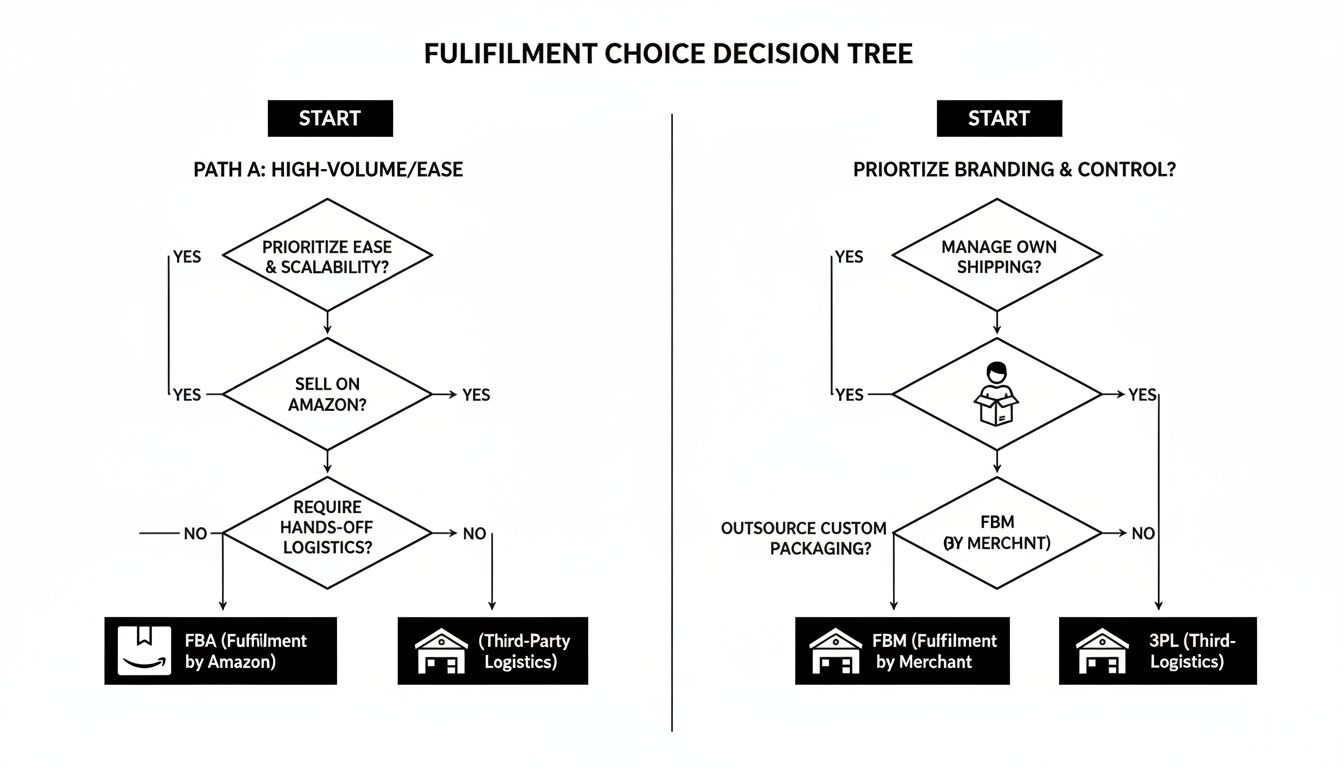
As you can see, a focus on Amazon-centric growth with standard products makes FBA a clear winner, while multi-channel ambitions or unique product types often favor other models.
Identifying Your Seller Profile
Your answers will help you identify which seller profile you fit into, making the decision much clearer.
The right fulfillment strategy is the one that best supports your business’s unique DNA. A high-volume arbitrage seller has vastly different needs than a premium, multi-channel brand.
Consider these common profiles:
- The High-Volume Arbitrage Seller: Your goal is speed and volume on Amazon. You need fast turnover and access to Prime customers. FBA is almost always the best choice.
- The Premium Private Label Brand: You focus on brand experience and may sell across multiple channels. If Amazon is your primary sales driver, FBA is excellent. If not, a 3PL might offer better flexibility. If you're building a scalable brand, check out our guide on how to scale an ecommerce business for broader strategies.
- The Niche or Oversized Specialist: Your products are large, heavy, or have special handling needs. FBM or a specialized 3PL is likely more profitable due to FBA's prohibitive fees for non-standard items.
Got Questions About Amazon FBA?
Even after digging into the details, most sellers have a few lingering questions before they jump into FBA. It’s smart to be skeptical. Getting straight answers to these common concerns is the only way to make a decision you won’t regret later. Let's tackle them head-on.
Can You Still Make Money on Amazon FBA?
Absolutely. But let's be clear: the gold rush days of throwing any product up and making easy money are long gone. Success is still very much on the table, but only for sellers who treat it like a real business.
A massive 87% of FBA sellers are profitable, which proves the model works when you have a solid strategy.
The game has shifted from just finding a product to smart business management. Winning on FBA now comes down to sharp product research to find a defensible niche, effective marketing to cut through the noise, and airtight control over your costs and inventory. The opportunity is real, but it demands a professional approach.
What Is a Good Profit Margin for Amazon FBA?
You should be aiming for a net profit margin between 15% and 25%. While you’ll hear stories of sellers hitting higher numbers in unique niches, this range is a realistic and healthy target after you account for Amazon’s fees, your cost of goods, and what you spend on ads.
A 15-25% net margin gives you a strong buffer against the unexpected, like a sudden spike in storage fees or ad costs. If your numbers dip below 10%, you're operating on a razor's edge where one mistake could wipe out your profit.
Seriously, calculating your potential margins before you spend a single dollar on inventory is the most important thing you can do.
What Is the Biggest Disadvantage of Amazon FBA?
Without a doubt, the biggest disadvantage is the cost. The combination of FBA fulfillment and storage fees can take a serious bite out of your margins. For some products, these fees can eat up over 50% of your revenue before you even factor in the cost of your product.
The other major challenge is giving up control. You're playing in Amazon's sandbox, which means you live by their rules—and those rules are constantly changing. This can lead to nasty surprises like new fees, sudden storage limits, or inventory headaches that are completely out of your hands.
Do I Need an LLC to Start Selling on Amazon FBA?
No, you don’t legally need an LLC to get started. You can begin as a sole proprietor using your Social Security Number. For new sellers just wanting to test the waters, this is often the simplest and fastest way to get up and running.
However, once your business starts to gain traction, forming an LLC is a very smart move. It creates a legal wall between your business and personal assets, which is crucial for liability protection. If something goes wrong—say, a customer sues—this separation protects your personal finances. Plus, an LLC can offer tax benefits and makes your operation look more professional and credible.
Navigating FBA fees, fulfillment strategies, and marketplace optimization is a full-time job. At Next Point Digital, we build data-driven growth strategies that simplify the process and scale your brand profitably on Amazon and beyond. Find out how we can help you convert clicks into sales by visiting us at https://npoint.digital.