

Optimizing your Amazon ads effectively starts with a deliberate, segmented campaign structure. Before you touch a single bid or keyword, organizing your campaigns by product lifecycle, targeting type, and strategic goal is the foundational step to prevent wasted spend. This is what separates guessing from making data-driven decisions that actually scale.
Build a Campaign Structure That Actually Works
Forget the “set-it-and-forget-it” mindset. A chaotic campaign structure, where all your products and targeting types are lumped together, is the number one reason sellers burn through their ad spend with nothing to show for it.
Think of your campaign structure as the architectural blueprint for your entire advertising strategy. If the foundation is weak, everything you build on top of it will eventually crumble.
Real optimization demands a deliberate structure that gives you clear visibility and control. This means breaking down your campaigns based on specific, measurable objectives.
Segmenting for Strategic Clarity
Instead of running one massive, confusing campaign, break your efforts into logical groups. This simple move allows you to allocate budgets more effectively and measure performance against distinct goals. A campaign to launch a new product, for instance, will have entirely different KPIs than one designed to defend your brand keywords from competitors.
Start by thinking in strategic segments:
- Product Lifecycle: Group campaigns for new product launches separately from your mature, best-selling products. Launch campaigns might prioritize impressions and clicks with a higher ACoS tolerance. Campaigns for your established cash cows should be all about profitability.
- Targeting Type: Never, ever mix automatic, keyword, and product targeting (PAT) in the same campaign. Each requires a different bidding strategy and its own flavor of analysis. Separating them is the only way to know what’s working and what isn’t without muddying your data.
- Goal-Oriented Groups: Create distinct campaigns for specific purposes. Think brand defense (bidding on your own brand terms), competitor conquesting (targeting competitor ASINs), and category expansion (targeting broad category keywords to find new customers).
This disciplined approach—moving from broad segmentation to precise targeting and then to detailed analysis—is the only way to get repeatable success.
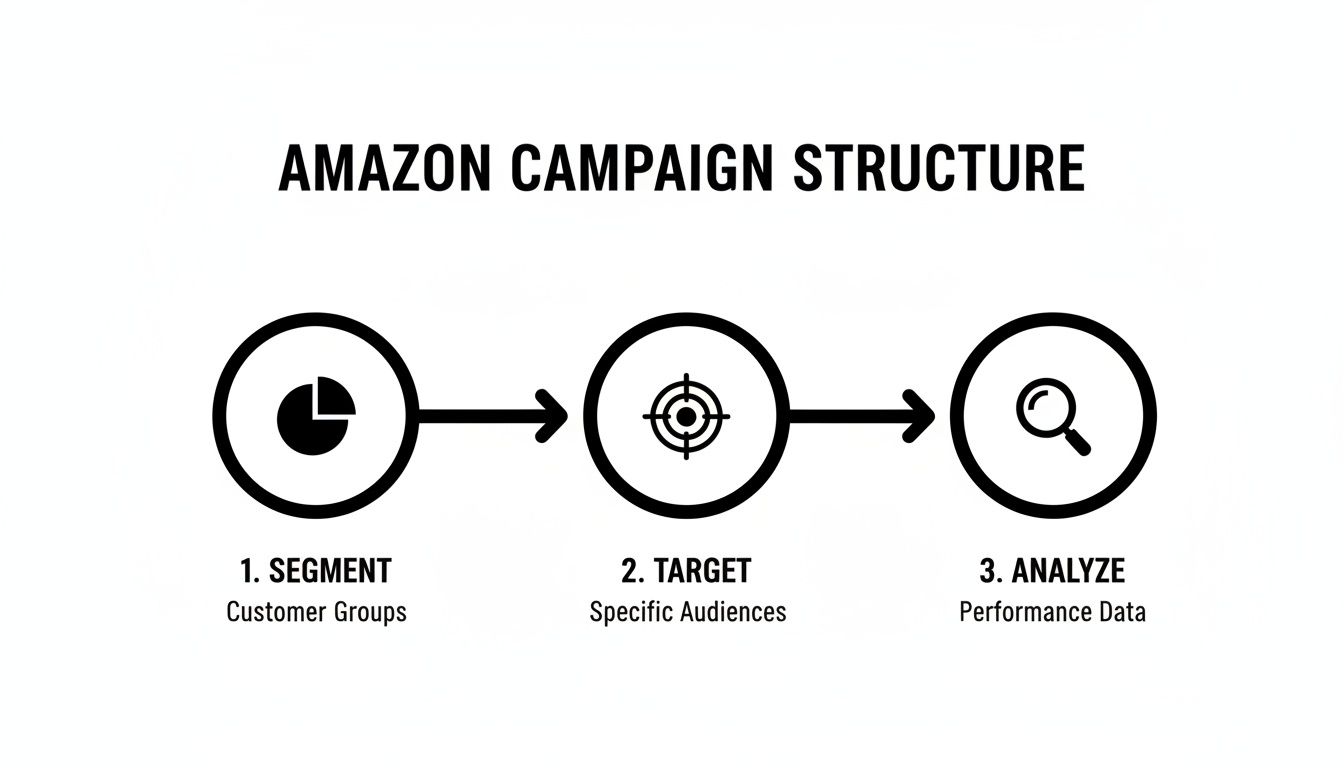
As you can see, a structured flow gives you clarity at every stage.
Structuring Different Ad Types
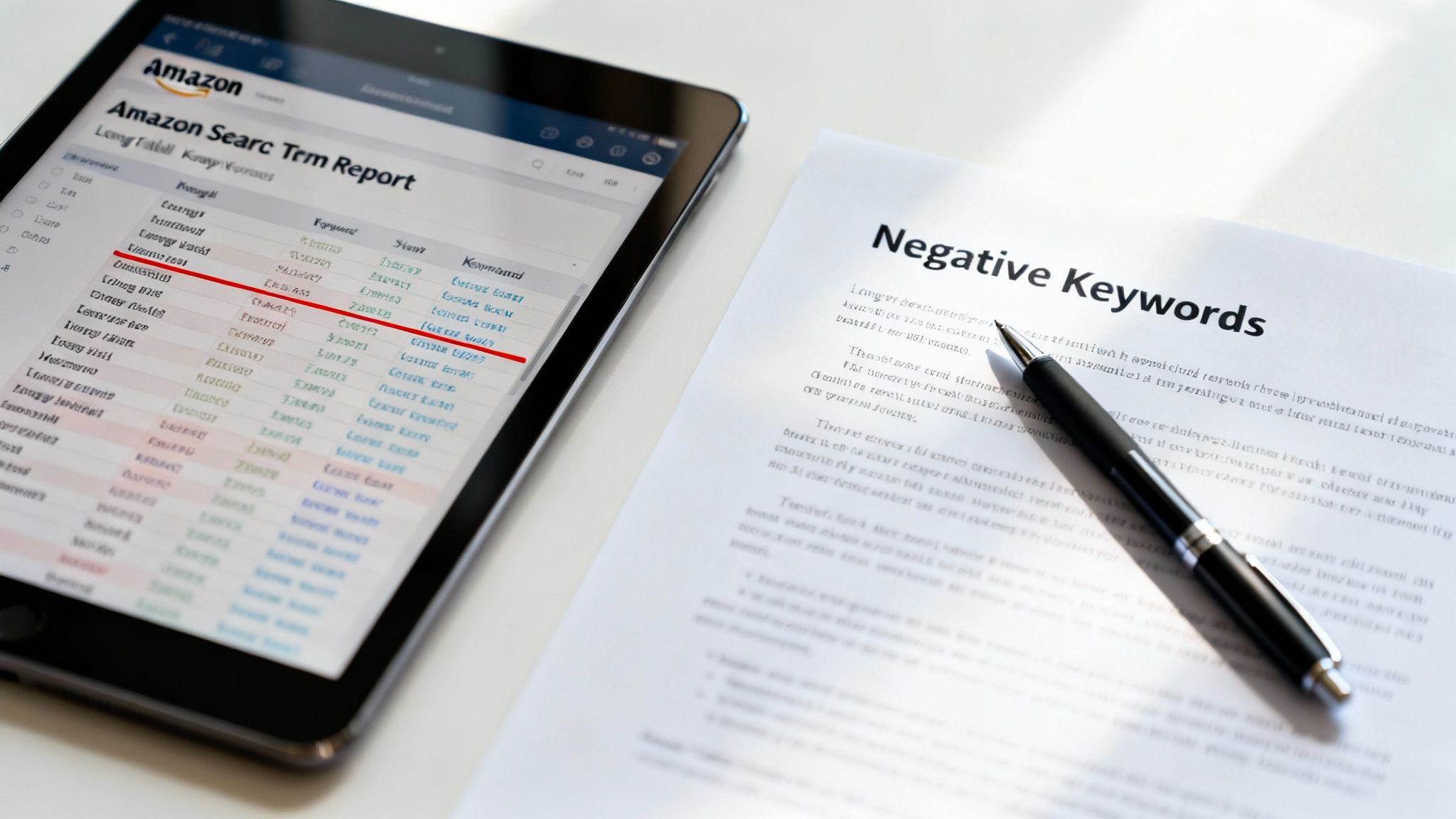
Each Amazon ad type plays a unique role in a full-funnel strategy, and your structure needs to reflect that. Understanding how to organize these different formats is a core part of learning what Amazon PPC is and how to make it work for you.
To get a clearer picture of how this works in practice, here's a simple breakdown of a full-funnel campaign structure.
Full-Funnel Amazon Ad Campaign Structure
| Funnel Stage | Ad Type | Primary Goal | Key Metric to Optimize |
|---|---|---|---|
| Awareness | Sponsored Brands (Video) | Drive brand discovery, reach new audiences | Impressions, Video Completion Rate |
| Consideration | Sponsored Display (Audiences) | Re-engage shoppers who viewed your products | Click-Through Rate (CTR), Detail Page Views |
| Conversion | Sponsored Products | Drive immediate sales from high-intent shoppers | Conversion Rate, ACoS/ROAS |
| Loyalty | Sponsored Display (Remarketing) | Encourage repeat purchases, cross-sell | Purchase Rate, ROAS |
This table maps out how different ad types serve different goals, ensuring your budget is working efficiently at every step of the customer journey.
Sponsored Products are your workhorses. They target shoppers at the bottom of the funnel who have high purchase intent and are essential for driving sales. They make up a massive 68% of Amazon's total ad revenue, which soared to $14.6 billion in a single quarter. That number alone shows how critical it is to get this ad type right.
Sponsored Brands are all about building top-of-funnel awareness and driving consideration. Use them to tell your brand's story, capture attention at the top of search results, and introduce your products to new audiences.
Sponsored Display campaigns are perfect for retargeting and reaching audiences both on and off Amazon. I recommend segmenting these by audience—for example, one campaign for shoppers who viewed your product but didn't buy, and another targeting customers viewing competitor listings.
A well-structured account is your single source of truth. It allows you to quickly diagnose problems, double down on what's working, and confidently scale your advertising without losing control of your budget. Without it, you're just flying blind.
By building this foundational structure, you create a system where every dollar you spend has a clear purpose. This clarity is non-negotiable for anyone serious about optimizing their Amazon ads. It’s what transforms your ad account from a messy expense into a predictable, profit-driving machine.
Master Your Keyword and Targeting Game
Winning on Amazon means getting your product in front of the right shopper at the perfect moment. A solid campaign structure sets the stage, but surgical keyword and audience targeting is what truly drives profitable growth. It’s about moving beyond basic keyword lists and into a dynamic process of discovery, refinement, and defense.
This starts with treating your automatic campaigns not as a primary sales driver, but as a powerful research tool. Think of them as your reconnaissance team, constantly scouting the Amazon landscape for new, high-intent customer search terms your competitors are likely missing.
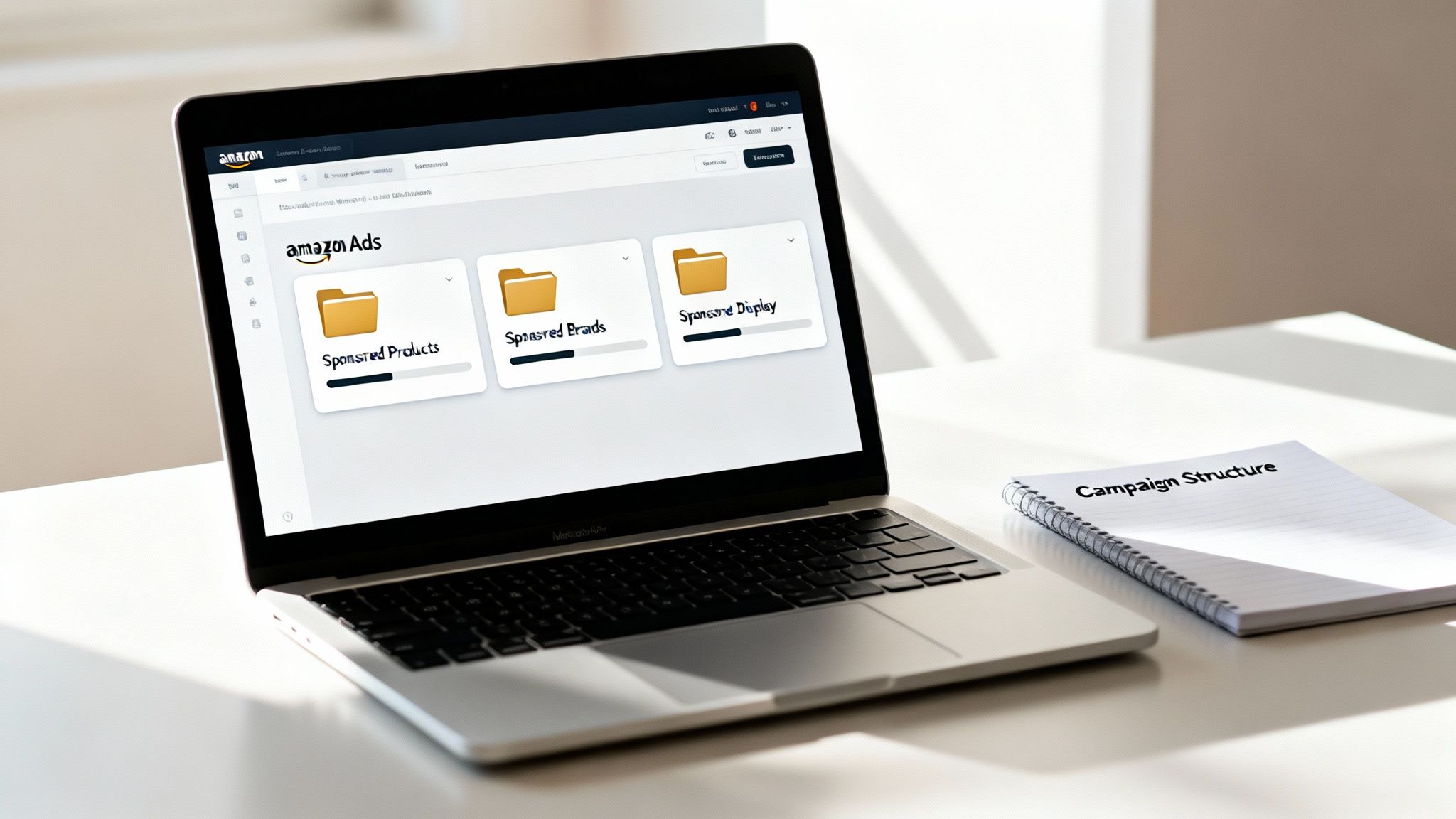
The key to unlocking this data is the Search Term Report. This is your single most valuable resource for understanding exactly what shoppers are typing before they click on your ad and, hopefully, buy your product. Consistent analysis here is non-negotiable for any serious Amazon advertising optimization.
Unearth High-Intent Keywords
Your goal is to dig through the Search Term Report and identify the hidden gems. Look for long-tail keywords—phrases of three or more words—that show clear purchase intent and have led to at least one sale.
There’s a world of difference between a shopper searching for "noise cancelling headphones" and one searching for "Bose QC45 wireless headphones for air travel." The first is browsing; the second is ready to buy.
Let's say you sell a "yoga mat." Your auto campaign might show conversions from a term like "extra thick non slip yoga mat for hot yoga." This is a goldmine. It's far more specific and signals a much higher purchase intent than the broad term "yoga mat."
These are the terms you need to graduate.
The Graduation Process for Search Terms
Once you find a profitable search term in your automatic campaign, you need to move it into a manual campaign where you can control the bid precisely. This "graduation" process ensures you capitalize on what's proven to work.
- Isolate the Winner: Find a customer search term in your auto campaign's report that has a good conversion rate and a profitable ACoS.
- Add to Manual Campaign: Move this exact search term into your corresponding manual campaign as an exact match keyword. This gives you full control over the bid for that specific, high-performing term.
- Create a Negative Match: This is the step most people forget. Add the same term as a negative exact match back in the original automatic campaign. This stops the two campaigns from bidding against each other for the same traffic, keeping your ad spend efficient and your data clean.
This simple feedback loop—discover in automatic, control in manual, and block in automatic—is the engine of continuous keyword optimization. It ensures your budget is constantly shifting toward what is proven to convert.
Build a Powerful Negative Keyword Shield
Just as important as what you target is what you don't target. A robust negative keyword list acts as a shield for your budget, blocking irrelevant clicks from shoppers who were never going to buy your product anyway.
Again, your Search Term Report is your best friend here. Look for search terms that are getting clicks but zero sales. These are budget leaks, plain and simple.
- If you sell premium leather dog collars, you might find you’re spending money on clicks from searches like "cheap nylon dog collars" or "retractable dog leash."
- These terms are irrelevant to your product. Add "cheap," "nylon," and "retractable leash" as negative phrase keywords to block any future searches containing them.
Regularly pruning your campaigns this way prevents death by a thousand cuts and redirects your budget toward clicks that actually matter.
Go Beyond Keywords with Advanced Targeting
While keywords are the core of Sponsored Products, Sponsored Display and Brands open up powerful audience and contextual targeting options. This is where you can strategically place your ads on your competitors' turf.
Product Attribute Targeting (PAT) allows you to show your ads on specific product detail pages, including those of your direct competitors. You can target by:
- Individual ASINs: Target the product pages of your top 3-5 competitors directly.
- Category: Show up on all product pages within a certain category, refined by brand, price point, or star rating. For example, you could target products in the "kitchen gadgets" category with a 4-star-plus rating that are priced higher than yours.
Of course, effective targeting won't do much if your product page isn't ready to convert. To make sure your ads turn clicks into sales, you need to optimize Amazon product listings to be "retail-ready." This synergy between your ads and your product page is what turns shoppers into customers.
Implement Bidding Strategies That Drive Profit
Your bidding strategy is the engine that powers your ad performance. A well-organized campaign structure and sharp keyword targeting get you into the game, but how you bid determines whether you win or lose.
Too many sellers stick with default settings or just guess, leaving a ton of profit on the table. It's time to get intentional and implement data-driven tactics that actually align with your business goals. The first step is understanding the bidding options Amazon gives you. Knowing when to use each is critical for managing your ad spend without burning through your budget.
Choosing Your Bidding Strategy
The choice between manual and dynamic bidding should be a deliberate one, based entirely on your campaign's objective. Are you launching a new product and need aggressive visibility, or are you trying to squeeze every last drop of profit out of a bestseller?
- Manual Bidding (Fixed Bids): This option gives you the most control. You set a bid, and Amazon won't touch it. It’s perfect for mature, stable campaigns where you have a deep understanding of your conversion rates and know exactly what you’re willing to pay per click.
- Dynamic Bids – Down Only: Here, Amazon will lower your bids in real-time for auctions it thinks are less likely to convert. This is the safest automated option and a great starting point for most new campaigns, as it helps prevent wasted ad spend.
- Dynamic Bids – Up and Down: This is the most aggressive choice. Amazon can jack up your bids by up to 100% for top-of-search placements and lower them for others. Use this one sparingly—think new product launches or major sales events like Prime Day, where maximizing visibility is the top priority, even if it means a higher ACoS.
Start new campaigns with ‘Down Only’ to gather performance data safely. Once you have a clear picture of which keywords are converting profitably, you can either switch to manual bidding for more precise control or use ‘Up and Down’ for short, aggressive promotional pushes.
Defining Your Profitability Targets
You can't optimize for profit if you don't know what it actually looks like for your business. This means moving beyond generic ACoS (Advertising Cost of Sale) targets and calculating metrics that are specific to your products.
First up, you need to calculate your break-even ACoS. This is the ACoS where you neither make nor lose money on a sale from an ad. The formula is just your pre-ad profit margin. For example, if your product sells for $50 and your total cost of goods (manufacturing, shipping, fees) is $35, your profit is $15. Your break-even ACoS is $15 / $50 = 30%. Any ACoS below that is profitable.
From there, you can bring in a more advanced metric: Total ACoS (TACoS). This measures your ad spend against your total sales—both from ads and organic purchases. TACoS helps you see the "flywheel effect," or how your ads are lifting your overall organic sales rank and visibility. A decreasing TACoS over time, even with a stable ACoS, is a fantastic sign that your ads are successfully growing your brand's organic presence. If you're looking for more ways to boost your overall sales velocity, check out our guide on https://npoint.digital/how-to-increase-sales-on-amazon/.
Advanced Bidding Adjustments
Once your targets are set, you can start refining your bids with more advanced techniques to make every dollar work harder.
Adjust Bids by Placement
Not all ad placements are created equal. The "Top of search" placement is usually the most valuable, driving much higher click-through and conversion rates. Amazon lets you increase your base bid by up to 900% for these premium spots.
Take a look at your Placement report. If your top-of-search placements are converting profitably, don't hesitate to apply a bid adjustment to win more of that high-value traffic.
Implement Dayparting
Customer shopping habits aren't the same 24/7. Running your ads around the clock might mean you're spending money at 3 AM when conversion rates are in the gutter. This practice, known as dayparting, involves scheduling your ads to run only during peak buying times.
Use third-party tools or dig into your hourly performance data to find your peak conversion windows. You might discover that your product sells best during lunch hours and in the evenings. By focusing your budget on these periods, you can improve your ACoS and make sure your ads are front-and-center when shoppers are most likely to buy.
This is a critical tactic, especially as Amazon's advertising ecosystem continues its explosive growth. To truly master your bidding, it's essential to understand the difference between ad efficiency and overall profitability; you can learn the key differences between ROI vs ROAS. By combining the right bidding model with clear profit targets and smart adjustments, you can turn your ad spend from a necessary cost into a powerful driver of scalable growth.
You can have the most brilliant targeting and aggressive bidding in the world, but if your ads lead to a weak product page, you're just burning cash. That journey from a click to a sale is where so many advertising budgets go to waste. Optimizing this path is a crucial, and often overlooked, piece of any real Amazon advertising optimization strategy.
It all starts with the ad creative itself. For Sponsored Brands and Sponsored Display, your creative is the first handshake with a potential customer. It has milliseconds to stop their scroll and earn a click.
Generic, low-effort creatives get ignored, wasting impressions and driving up your costs. On the flip side, compelling visuals and copy can dramatically improve your Click-Through Rate (CTR), which Amazon’s algorithm sees as a massive positive signal. This can lead to better ad placements and a lower Cost-Per-Click (CPC).
Crafting Ads That Stop the Scroll
Your ad creative needs to tell a story and solve a problem—instantly. For Sponsored Brands, this means nailing the combination of a powerful headline with engaging visuals.
- Headlines: Go beyond just your product name. Use action-oriented language that screams a key benefit. Instead of "Premium Yoga Mat," try "Your Non-Slip Mat for a Perfect Flow."
- Imagery: Use high-quality lifestyle images showing your product in use by your target customer. You want shoppers to see themselves benefiting from what you're selling. A shot of someone happily using your product is always more effective than a sterile product-on-white photo.
- Video: Sponsored Brands Video is an absolute game-changer. A short, 15-30 second video that demonstrates your product's best feature can send engagement and conversion rates through the roof.
But here’s the thing: the only way to know what truly resonates is to test.
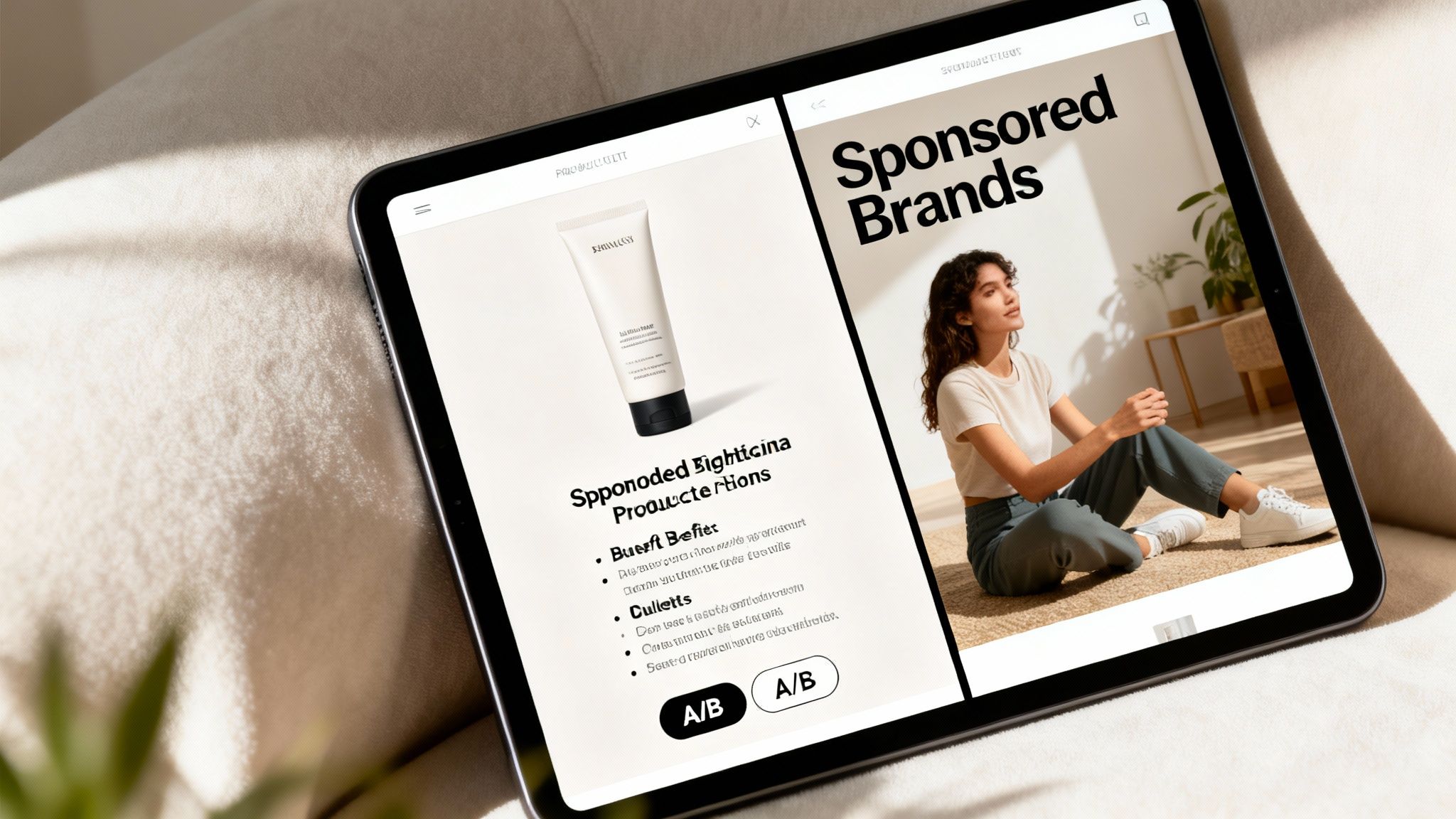
Don't assume you know what your audience wants to see. Set up simple A/B tests for your Sponsored Brands campaigns. Test one variable at a time—like a benefit-driven headline versus a feature-focused one—and let the real data tell you what drives clicks.
A Simple Framework for A/B Testing
You don't need fancy software to get started. Amazon's campaign manager has everything you need for basic experiments.
- Duplicate Your Campaign: Create an identical Sponsored Brands campaign, but change only one thing.
- Isolate One Variable: Test your headline, your main lifestyle image, or the specific set of products you feature. Don't test them all at once.
- Run and Measure: Let both campaigns run for at least two weeks to gather enough data for a fair comparison.
- Analyze the Winner: Look at the CTR and conversion rates. Put your budget behind the winning creative and use what you learned for your next ads.
A/B testing is a great way to let your customers tell you what they want. The table below offers a few simple ideas to get you started on testing different ad components for both Sponsored Brands and Sponsored Display.
Ad Creative A/B Testing Ideas
| Ad Component | Test Idea A | Test Idea B | Success Metric |
|---|---|---|---|
| Headline | Feature-Focused: "Waterproof Hiking Boots" | Benefit-Focused: "Conquer Any Trail in Comfort" | Click-Through Rate (CTR) |
| Main Image | Product on White Background | Lifestyle Image (Product in Use) | Click-Through Rate (CTR) |
| Video Thumbnail | Product Close-Up | Person Using the Product | Video Play Rate, CTR |
| Call to Action | "Shop Now" | "Learn More" | Conversion Rate (CVR) |
| Featured Products | Best-Sellers | New Arrivals | Return on Ad Spend (ROAS) |
Testing these elements one by one will give you clear, actionable insights into what motivates your audience, helping you build more effective campaigns over time.
Your Product Page Is the Final Salesperson
Once you’ve earned that click, your product detail page has to close the deal. All the ad spend in the world is wasted if your listing isn't "retail-ready." Amazon’s algorithm heavily favors listings that convert well because that creates a better experience for their customers.
A high-converting page is rewarded with better organic rank and better ad performance. Think of it as a quality score; the better your page converts, the less you might have to bid to win an ad auction. Improving your listing is a direct lever for lowering your ACoS. This is a fundamental concept covered in depth in many guides on conversion rate optimization best practices.
Run through this quick checklist to make sure your page is primed for conversions.
The Retail-Ready Listing Checklist
- Title: Is it clear, concise, and packed with your most important keywords? Does it immediately tell a shopper what your product is?
- Main Image: Do you have a high-resolution, professional photo on a pure white background? This is your single most critical visual asset.
- Bullet Points: Are you selling benefits, or just listing features? Instead of "Made with 100% cotton," try "Experience breathable, all-night comfort with 100% pure cotton."
- A+ Content: Are you using A+ Content to tell your brand story and visually break down your product’s value proposition? If not, you're leaving money on the table.
- Reviews and Ratings: Do you have a healthy number of reviews with at least a 4-star average rating? Social proof is a massive conversion driver, and shoppers trust other shoppers.
Connecting your ad strategy directly to your listing quality creates a powerful feedback loop. Better ads drive traffic to a page that converts, which leads to more sales. More sales improve your organic and ad ranking, creating a cycle of profitable, sustainable growth.
Great advertisers aren't just guessing; they're detectives, following the clues left in their data. To truly optimize your Amazon advertising, you have to learn how to read the story your ad reports are telling you. This means going beyond a surface-level glance at ACoS and diving deep into the metrics that reveal the real health of your campaigns.
The advertising console is packed with reports, but a few are absolute gold mines for improvement. Mastering these is what separates amateur sellers from professional, data-driven brands.
A solid weekly routine should revolve around digging into these key data sources.
Your Most Valuable Data Sources
Think of these reports as your campaign’s vital signs. They tell you exactly where your money is going and what it’s getting you, helping you make informed decisions instead of reacting emotionally to daily sales dips and spikes.
- Search Term Report: This is your bread and butter for Sponsored Products. It shows you the exact search queries customers typed before clicking your ad. It's your number one tool for finding new keywords to target and, just as importantly, irrelevant terms to add as negatives.
- Placement Report: This one reveals where your ads showed up on Amazon—top of search, somewhere else on the search page, or on product detail pages. It’s crucial for figuring out which placements drive the best results, allowing you to adjust your bids to win more of those high-value spots.
- Purchased Product Report: For auto-targeting and broad match campaigns, this report shows which of your other products were bought after a shopper clicked an ad for a different item. It can uncover powerful cross-selling opportunities you never even knew existed.
Looking Beyond ACoS
While ACoS (Advertising Cost of Sale) is a vital profitability metric, focusing on it exclusively is like trying to drive a car by only looking at the speedometer. You need a full dashboard to see the whole picture.
Two of the most important dials on that dashboard are Click-Through Rate (CTR) and Conversion Rate (CVR).
A low CTR often signals a problem with your main image or ad creative—your ad just isn't compelling enough to earn the click. On the other hand, a high CTR but low CVR points to an issue on your product detail page. You're getting people to the party, but they aren't sticking around to buy.
Diagnosing performance this way lets you fix the root cause of a problem, not just the symptom. You can get an even deeper analysis by pulling your complete Amazon sales data to see how ad performance impacts overall trends.
Your Weekly Optimization Framework
Data is useless if you don't act on it. Carve out time each week to review your reports and make specific, calculated adjustments. This consistent routine is the engine that drives ongoing improvement.
- Cull the Search Term Report: Find the high-spending, low-converting search terms and immediately add them as negative keywords. At the same time, spot the profitable terms and "graduate" them into manual campaigns where you have precise bid control.
- Analyze Placement Performance: Pull up your placement report. Is "Top of search" driving profitable sales? If so, increase your bid adjustment for that placement to capture more of that prime real estate.
- Adjust Bids on Winners and Losers: Gently increase bids (5-10%) on keywords that are highly profitable to gain more impressions. For the keywords that are just burning cash without a single sale, be aggressive—slash those bids or pause them entirely.
- Shift Budget to What Works: Reallocate your budget from underperforming campaigns to the ones consistently hitting your ACoS or ROAS targets. Don't be afraid to cut what isn't working and double down on what is.
To stay sharp, you also need to know what's happening in the broader market. A great way to do this is by using competitor price monitoring software to stay aware of how rivals are positioning themselves. Mastering key metrics is fundamental; optimization hinges on metrics like Cost Per Click (CPC), which averaged $0.99. For profitability, new campaigns should aim for an ACoS under 29%, beating the 30.20% average. This focus connects directly to Amazon’s incredible 9.96% average conversion rate, which is why a data-first approach yields such powerful results.
Common Questions About Amazon Ad Optimization
Even with a solid framework, some questions always pop up. Let's clear up a few of the most common sticking points we see sellers grapple with when they're trying to get their Amazon ads dialed in. These are the real-world queries we answer every day.
How Long Until I See Optimization Results?
You'll probably spot initial shifts in metrics like click-through rates and cost-per-click within a few days of making changes. But real, meaningful optimization results usually take 2-4 weeks to materialize. This gives Amazon's algorithm enough time to gather performance data on your new keywords, bids, or campaign structures.
As for true profitability and efficiency gains—measured by a stable, target ACoS or ROAS—that often requires 60-90 days of consistent management. It’s a marathon, not a sprint. This period is what allows you to build a strong performance history and methodically cut out inefficient ad spend. Be patient, because quick, knee-jerk reactions will almost always lead you astray.
What Is a Good ACoS for Amazon Ads?
Honestly, there’s no magic number. A "good" ACoS depends entirely on your product's profit margin and what you're trying to achieve with your ads.
While a general benchmark for established products often lands between 25-40%, that's just an average. The only number that truly matters is your break-even ACoS.
For example, when launching a new product, a high ACoS (even 50-70%) can be a smart investment to drive initial sales velocity and rack up those all-important reviews. On the flip side, for a mature, profitable product, you should be aiming for a much lower ACoS, maybe in the 15-20% range, to maximize your profit on every sale.
The most critical takeaway here is to know the difference between your break-even ACoS (where you don't make or lose money) and your target ACoS. They are not the same, and your target will change based on your goals for that specific product.
Should I Use Automatic or Manual Campaigns?
The answer is simple: use both. They serve distinct, complementary roles in any sophisticated advertising strategy. Think of them as a research department and an execution department working hand-in-hand.
-
Automatic Campaigns are for Research: Always kick off a new product with an automatic campaign. This is where you let Amazon do the heavy lifting, discovering relevant customer search terms and competitor ASINs for you. It's an incredibly powerful, low-effort way to gather real-world data.
-
Manual Campaigns are for Control: After a week or two, it's time to dig into your auto campaign's Search Term Report. Find the high-performing customer search terms that are actually converting and "graduate" them into a separate manual campaign. This is where you'll target them as exact, phrase, and broad match keywords.
Moving those proven terms into a manual campaign gives you precise control over your bidding strategy. But don't forget the final, crucial step: add those graduated terms as negative exact matches back in the original auto campaign. This stops your campaigns from bidding against each other, keeping your data clean and your spending efficient.
Just keep that auto campaign running on a low budget—it'll continue to be a great source for finding new keyword opportunities over time.
At Next Point Digital, we turn these complex optimization processes into simple, scalable growth. Our team combines data, strategy, and cutting-edge tech to manage everything from campaign structure to dynamic bidding, ensuring your ad spend delivers measurable results. If you're ready to move beyond guesswork and unlock your brand's true potential on Amazon, let's build your growth roadmap together.