

If you’ve spent any time with traditional SEO, you know the goal is to get your website to the top of Google. Marketplace SEO is a completely different beast. It’s all about optimizing your product listings to rank higher inside a specific platform’s own search results—think Amazon, eBay, or Walmart.
It’s not about getting found on Google; it’s about winning the top spot on the digital shelf where customers are already primed to buy. Think of it as securing the best end-cap display in a massive online mall.

Marketplace SEO vs Traditional SEO at a Glance
To really get a handle on this, it helps to see the two approaches side-by-side. The core objectives and ranking factors are worlds apart.
| Factor | Marketplace SEO (e.g., Amazon, Walmart) | Traditional Web SEO (e.g., Google) |
|---|---|---|
| Primary Goal | Drive sales within the platform | Drive traffic to a website |
| User Intent | High commercial intent (ready to buy) | Mixed intent (informational, navigational, commercial) |
| Key Ranking Signals | Sales velocity, conversion rate, reviews, inventory | Backlinks, domain authority, site speed, content quality |
| Content Focus | Product-centric copy, images, and backend attributes | Long-form content, blogs, educational articles, landing pages |
| Algorithm's Purpose | To sell products efficiently | To answer questions and provide relevant information |
| "Off-Page" Factors | External traffic driving sales, seller performance | Backlinks from other reputable websites |
As you can see, one is built to convert browsers into buyers, while the other is built to provide the best possible answer to a query.
The Core Difference From Web SEO
Marketplace algorithms aren't designed to answer questions; they're built to sell products. Period. They aggressively prioritize factors that lead directly to sales, high conversion rates, and happy customers who come back for more.
Imagine someone searching for "organic cotton sheets." On Google, they might be looking for reviews, brand comparisons, or articles on the benefits of organic cotton. But on Amazon, that same search almost always means one thing: they’re ready to buy, right now.
This shift in user intent changes everything.
The ultimate goal for a marketplace's search engine is to connect a ready-to-buy shopper with the product they are most likely to purchase, as quickly and seamlessly as possible. Every ranking factor is engineered to serve this commercial purpose.
This is why keywords are just one piece of a much larger puzzle. The algorithm is constantly looking at other signals—like how fast your product sells and what your reviews say—to decide who deserves that coveted top spot. Understanding these signals is the key to unlocking visibility.
Why This Matters for Your Business
Getting a handle on marketplace SEO is non-negotiable for any brand serious about ecommerce. A high-ranking product doesn't just bring in more organic sales; it builds a powerful momentum that becomes incredibly difficult for competitors to disrupt.
More visibility leads to more clicks, more sales generate more reviews, and this positive feedback loop solidifies your ranking. It's a central pillar in the best ecommerce marketing strategies because it directly fuels:
- Sales Velocity: The speed and volume of your sales, which is a massive ranking signal on platforms like Amazon.
- Customer Trust: Products with a healthy number of positive reviews and high ratings naturally attract more buyers.
- Brand Perception: Showing up at the top of the search results instantly positions your product as a leading option in the category.
At the end of the day, ignoring marketplace SEO means leaving your product buried on page five, where few shoppers ever bother to look. When you take the time to optimize your listings, you're making sure your products get seen by the very people who are actively looking to buy them.
The Foundational Pillars of Marketplace Rankings
To really nail marketplace SEO, you have to move past the theory and get your hands dirty with the elements that actually drive visibility. Think of your product listing like a digital billboard on a jam-packed highway. For it to stand out, it needs the right message, in all the right places, to catch the eye of the right people—and, most importantly, the marketplace algorithm.
These pillars are the non-negotiables. They’re what algorithms on Amazon, eBay, and Walmart use to understand what your product is and who it’s for. Mastering them is your first real step toward climbing the search results.
Keyword Research: The Buyer-Focused Approach
Keyword research for marketplaces is a completely different beast than traditional SEO. You’re not trying to answer questions; you’re targeting high-intent commercial keywords. These are the exact words and phrases people type into the search bar when they’re ready to pull out their wallets and buy.
Your job is to get inside your customer's head. What language are they using? Are they searching for "waterproof running shoes" or "men's trail sneakers for rain"? A tiny difference in how you phrase something can be the difference between landing on page one and getting buried on page ten.
The process usually looks like this:
- Brainstorm Seed Keywords: Start with the obvious. If you sell a yoga mat, your seed keyword is "yoga mat." Simple.
- Use Marketplace-Specific Tools: Fire up tools like Helium 10 or Jungle Scout. They pull real search data from the marketplaces, revealing long-tail keywords people are actually using, like "extra thick non-slip yoga mat for hot yoga."
- Analyze Your Competitors: Look at the top-ranking products in your category. What keywords pop up again and again in their titles and descriptions? That’s your roadmap—it shows you what the algorithm is already rewarding.
Optimizing Your On-Page Content
Once you’ve got your keywords, it’s time to weave them into the parts of your listing that customers actually see. This is how you signal relevance to both the algorithm and the shopper. The trick is to be keyword-rich without sounding like a robot.
Think of on-page optimization as merchandising your digital shelf. You need to make your product look good while making sure the "store manager" (the algorithm) knows exactly where to place it.
Here are the key spots to focus on:
Product Title
Your title is the most powerful piece of SEO real estate you have. Your main keywords need to be right at the beginning, followed by key features, benefits, or what the product is used for.
- Bad Example: Cool Blue Water Bottle
- Good Example: Insulated Stainless Steel Water Bottle (32 oz), Leak-Proof with Straw Lid for Sports & Gym – Cool Blue
Bullet Points (Key Product Features)
This is where you expand on the title. Use each bullet to highlight a feature and then translate it into a real benefit for the customer. This is a great place to sprinkle in your secondary keywords. Think less like a technical manual and more like you’re solving a customer's problem.
Product Description
The product description is your chance to tell a story and answer any questions a customer might still have. Go deeper into the benefits from your bullet points, share your brand’s mission, and work in any long-tail keywords that didn't fit anywhere else. While it needs to be compelling, remember this is also a core part of your overall ecommerce SEO best practices strategy.
The Power of Backend Fields
What the customer sees is only half the battle. Marketplaces give you backend fields that are invisible to shoppers but are read directly by the search algorithm. This is your secret weapon—a place to tell the algorithm exactly what your product is without cluttering up your public-facing copy.
These fields often include:
- Search Terms/Backend Keywords: This is where you dump synonyms, common misspellings, and related keywords you couldn't fit into the title or bullets.
- Subject Matter: Here, you can specify things like the product's intended use, target audience, or relevant themes (e.g., "summer," "gift for dad").
- Attributes: These are structured data fields for things like material type, color, size, and compatibility. Filling these out is critical because it helps customers filter their searches and gives the algorithm precise data points to work with.
Don’t skip this part. Filling out your backend fields gives the algorithm structured data that confirms your product’s relevance for a huge range of searches, which helps you reach more people. For a deeper dive into platform-specific approaches, guides on Amazon Search Engine Optimization are a great resource. By building on these pillars, you create a listing that’s built to win over both shoppers and the search algorithm.
How To Master The Amazon, eBay, And Walmart Algorithms
Knowing the basics of marketplace SEO is a great start, but winning on Amazon, eBay, and Walmart requires a platform-specific playbook. Think of their search algorithms as three totally different customers. You can’t use the same generic sales pitch on all of them; you have to tailor your approach to what each one actually cares about.
A one-size-fits-all strategy is doomed to fail. Why? Because each marketplace built its algorithm to serve its own business goals and customer expectations. Amazon’s A9 algorithm is obsessed with sales, eBay’s Cassini engine puts a huge emphasis on seller reputation, and Walmart’s system rewards rock-solid reliability and competitive pricing. If you can master these nuances, you’ll dominate the search results.
This all comes down to three core pillars: Keywords, your Listing, and the Backend. Get these right, and you're golden.
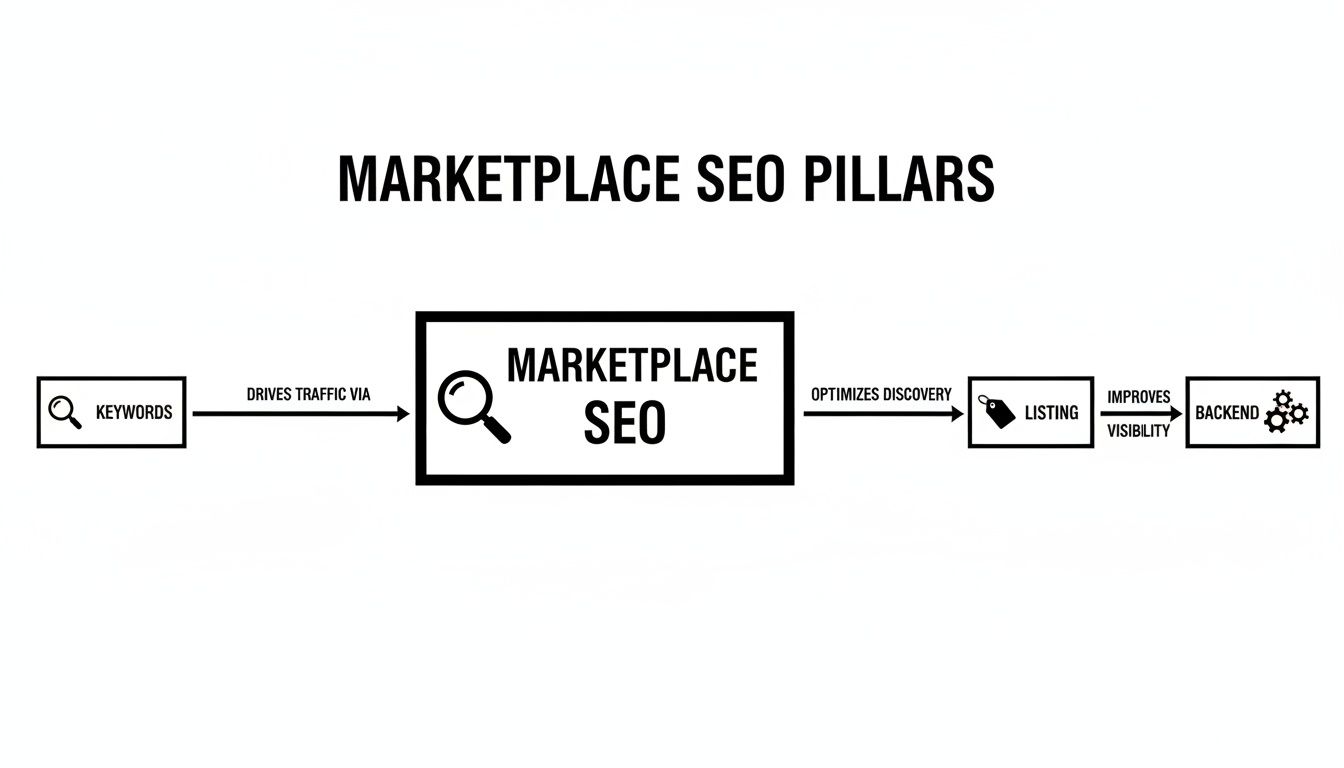
As you can see, these areas work together to prove your relevance and authority to the algorithms, which is what ultimately gets you seen.
Before we dig into each platform, it's helpful to see how their priorities stack up side-by-side.
Key Ranking Factors By Marketplace
Each marketplace's search algorithm has its own unique "personality," prioritizing different signals to decide which products to show shoppers. While the end goal is always a sale, the path to getting there looks a little different on each platform.
The table below breaks down the most important ranking factors for Amazon, eBay, and Walmart, giving you a clear snapshot of where to focus your efforts.
| Ranking Factor | Amazon (A9) | eBay (Cassini) | Walmart |
|---|---|---|---|
| Primary Goal | Maximize conversions & revenue per search | Connect buyers with reliable sellers | Offer the best price & a reliable experience |
| Sales Performance | Critical: High sales velocity & conversion rates | Important: Sales history & recent sales | Critical: Strong sales & conversion rates |
| Keyword Relevance | Critical: Title, bullets, backend search terms | Important: Title & item specifics | Important: Title, description & attributes |
| Seller Reputation | Moderate: Seller feedback & account health | Critical: Seller rating & shipping performance | Important: Pro Seller Badge & performance |
| Pricing | Important: Competitively priced to win Buy Box | Moderate: Value & competitiveness | Critical: Must be price-competitive |
| Listing Quality | Important: High-quality images, A+ Content | Critical: Complete item specifics & photos | Important: Complete content, rich media |
| Inventory | Moderate: Consistent stock levels | Moderate: Stock availability | Critical: Consistent in-stock status |
| Shipping | Important: FBA or fast Prime shipping | Important: Fast & free shipping options | Important: Fast shipping (2-day) |
Understanding these differences is the first step. Now, let’s get into the specifics of what makes each algorithm tick.
Decoding The Amazon A9 Algorithm
Amazon's search engine, A9, is a pure-blooded sales machine. Its one and only job is to show customers the products they are most likely to buy. Period. Because of this, every single ranking factor is tied, in one way or another, to sales performance.
Think of A9 as a meritocracy where only the top performers get rewarded. It boosts products that prove they can turn clicks into cash. The factors it watches most closely are:
- Sales Velocity: This is all about how much you sell and how fast you sell it. A product that flies off the shelves signals to A9 that it’s a hot item, and it gets pushed higher up the ranks.
- Conversion Rate: Known in Seller Central as the Unit Session Percentage, this metric shows how many visitors to your page actually buy something. A high conversion rate is a massive signal that your listing is doing its job.
- Keyword Relevance: This is the price of entry. A9 checks the keywords in your title, bullets, description, and backend fields against what a customer typed into the search bar. If there’s no match, you’re not even in the game.
- A+ Content: If you’re brand-registered, A+ Content (or Enhanced Brand Content) lets you add rich images and detailed visuals to your description. This isn't just for looks; it’s proven to lift conversion rates, which feeds right back into a better A9 ranking.
Winning With eBay's Cassini Search Engine
Unlike Amazon’s laser focus on sales, eBay’s Cassini algorithm takes a more holistic view. It cares a lot about the seller's reliability and the overall customer experience. Cassini wants to connect shoppers with trustworthy sellers who deliver great service from click to doorstep.
For eBay, your reputation is everything. To succeed, you need to zero in on:
- Seller Performance Metrics: Your seller rating, how quickly you ship, your communication response time, and your return policy are all direct ranking factors. Having a Top Rated Seller status is a massive advantage.
- Listing Completeness: Cassini loves a thorough listing. That means filling out every single item specific, uploading plenty of high-quality photos, and writing a clear, detailed description. A complete listing screams quality and gives buyers confidence.
- Shipping Policies: Offering clear, fast, and competitive shipping is non-negotiable. Free shipping, in particular, can give you a major visibility boost since it’s what most buyers are looking for. Knowing what sells on eBay well is often tied to products that can be shipped easily and affordably.
Succeeding On The Walmart Marketplace
Walmart’s algorithm is a bit of a hybrid, mixing Amazon's obsession with sales and eBay's focus on seller trust. But at its core, it’s built on Walmart’s decades-old "Everyday Low Price" promise. That makes competitive pricing the single most important factor for getting seen.
Walmart's algorithm is designed to uphold its brand promise of value. If your product isn't priced competitively, it will struggle to gain traction, regardless of how well-optimized the rest of your listing is.
Here’s where you need to focus to win on Walmart:
- Competitive Pricing: The algorithm is constantly scanning your price against other sellers on Walmart and even other websites. If you want to win the Buy Box and rank well, you have to offer a consistently competitive price.
- Inventory Management: Being out of stock is a huge red flag for the algorithm. It penalizes listings that run out of inventory because that creates a bad experience for the customer. Keeping your products consistently in stock is crucial.
- Pro Seller Badge: Earning this badge is a powerful signal to both shoppers and the algorithm that you’re a top-tier seller with fast shipping and great service. It provides a major boost in trust and visibility, making it a key goal for any serious seller.
Advanced Tactics That Turn Clicks Into Customers

Getting your keywords right helps shoppers find you, but it doesn't close the sale. True mastery of marketplace SEO is about building a listing that doesn't just attract eyeballs—it convinces people to buy. The best sellers know the algorithms reward what customers love, meaning the human experience is just as important as feeding the search bots.
This is where the real conversion tactics come in. Things like your product photos, customer reviews, pricing, and even your inventory levels aren't just back-end details; they're powerful ranking signals. They tell the marketplace algorithm your product is trustworthy, desirable, and a good bet for shoppers, which gets you bumped up in the search results.
Harnessing the Power of Visuals
Think of your product images and videos as your 24/7 sales team. Shoppers can't touch or feel your product, so high-quality visuals have to do all the heavy lifting to build trust and show off value. They’re often the very first thing a person looks at and can be the deciding factor in whether they click or keep scrolling.
Marketplace algorithms are watching how users interact with your listing. Clicks, zooms on your images, and the time someone spends on your page are all positive signals. Great visuals are what drive that engagement.
- High-Resolution Images: Use a mix of professional, multi-angle shots. Add lifestyle photos showing the product in action and infographics that highlight the best features.
- Product Videos: A quick video can do wonders for your conversion rate, demonstrating how your product works in a way static photos just can't. And it's not just about the listing; learning about making product demo videos that convert can seriously boost sales and even cut down on returns.
Building Trust Through Reviews and Ratings
Customer reviews are today’s word-of-mouth marketing, and they're one of the heaviest-hitting ranking factors on every platform. A consistent flow of positive reviews tells shoppers and algorithms that your product actually lives up to the hype.
A product with hundreds of 4.5-star reviews will almost always outrank one with a handful of 5-star reviews. Why? Because algorithms value both quality and quantity. It proves you’re delivering a great experience over and over again.
This social proof is non-negotiable for building credibility. Actively ask for reviews with post-purchase emails or a simple insert in your packaging. And make sure you respond to feedback—both good and bad—to show future buyers you stand behind your product.
Strategic Pricing to Win the Buy Box
On cutthroat marketplaces like Amazon and Walmart, your price is a massive lever for visibility. That coveted "Buy Box" (the main "Add to Cart" button) goes to the seller offering the best overall deal, and price is a huge part of that equation. Winning it is everything, since over 80% of sales happen there.
Your pricing can't be set-it-and-forget-it. Use repricing tools to automatically adjust your price based on what your competitors are doing. This keeps you in the game without slashing your margins to zero. At the end of the day, the algorithm wants to make a sale, and a competitively priced item is way more likely to convert. For brands that want to dominate, pairing solid organic SEO with smart advertising is a game-changer. You can learn more about how that works in our guide on what is PPC Amazon.
The Critical Role of Inventory Management
Going out of stock is the fastest way to kill your ranking momentum. Simple as that. When your product is unavailable, your listing vanishes from search, and your sales velocity flatlines. This tells the algorithm you’re no longer a reliable choice for its customers, and it can take weeks—or even months—to climb back to where you were.
Solid inventory management isn't just an operational task; it's a core part of marketplace SEO. You need a reliable system for tracking stock and forecasting demand. This keeps the buying experience smooth for customers and signals to the algorithm that you're a dependable seller who deserves to rank high.
Tracking Your Performance With the Right Tools

Optimizing your listings is only half the battle. If you’re not tracking your performance, you’re just flying blind. You have no real way of knowing if your keyword updates, new images, or pricing tweaks are actually moving the needle.
This is what separates the sellers who thrive from those who get left behind: creating a data-driven feedback loop. Measuring what matters connects your efforts directly to results. It turns marketplace SEO from a guessing game into a calculated strategy, giving you the confidence to make decisions that fuel real growth.
This is a big reason why the global SEO services market is booming, with marketplaces fueling the demand. Brands are investing heavily because they know tracking and optimization are non-negotiable. You can read more about the trends in the global SEO services market to see just how big this has become.
Key Metrics to Monitor for Marketplace Success
To really get a handle on your performance, you need to speak the algorithm's language. Each platform has its own dashboard, but a handful of universal metrics will always tell you how healthy your listings are.
These aren't just numbers on a screen; they’re direct signals of how well your products are connecting with both shoppers and the platform's search engine.
- Keyword Rank: This is your most direct SEO report card. Tracking where your product shows up for your target keywords tells you if your optimizations are working. A jump from page three to page one is a clear win.
- Sessions and Page Views: This metric shows you how many unique shoppers are landing on your product detail page. If you optimize your listing and see a spike in sessions, you know you're successfully pulling in more traffic from search.
- Conversion Rate (Unit Session Percentage): This is arguably the most important metric of all. On Amazon, it's called the Unit Session Percentage, and it tells you what percentage of visits turn into a sale. A high conversion rate is a massive signal to the algorithm that your listing is doing its job, which is a powerful ranking factor in itself. For more on what drives conversions, you can dig into key Amazon sales data.
- Best Seller Rank (BSR): This rank compares your product’s recent sales volume to others in the same category. It’s not a direct ranking factor and it bounces around a lot, but a consistently improving BSR is a fantastic indicator that you have positive sales momentum.
Essential Tools for a Competitive Edge
Trying to track these metrics manually across dozens of products and keywords is a recipe for disaster. This is where specialized software becomes an absolute necessity, giving you the data you need to compete.
Think of these tools as your mission control center. They give you a real-time view of the competitive landscape, identify new opportunities, and alert you to potential problems before they derail your progress.
A solid toolkit helps you manage every part of your marketplace SEO strategy, from the initial research all the way to ongoing performance analysis.
Top Tools for Marketplace Sellers
- Helium 10: This is the all-in-one suite that has become the industry standard for serious Amazon sellers. It offers incredible tools for keyword research (Magnet, Cerebro), rank tracking (Keyword Tracker), and listing optimization (Scribbles).
- Jungle Scout: Another titan in the space, Jungle Scout provides powerful features for product research, keyword discovery (Keyword Scout), and sales analytics. Its browser extension is especially handy for doing quick competitor analysis on the fly.
When you combine the right metrics with the right tools, you can fine-tune your marketplace SEO with precision. Every change you make becomes a calculated step toward better rankings and more sales.
Got Questions About Marketplace SEO? We've Got Answers.
Even with a solid game plan, you're bound to have questions when you start digging into marketplace SEO. This is where the rubber meets the road, and getting straight answers is what gives you the confidence to move forward, set the right expectations, and invest your resources wisely.
Let's cut through the noise and tackle the most common questions brands ask about timelines, budgets, and when to call in the pros.
How Long Does It Take to See Results?
This is the million-dollar question, isn't it? Unlike paid ads where you get feedback almost instantly, marketplace SEO is a long game. The honest answer is: it depends. Your product category, how fierce the competition is, and the current state of your listings all play a huge role.
Generally, you can expect to see some initial movement in your keyword rankings and organic traffic within three to six months.
Don’t expect a massive sales spike in the first 30 days. Think of this initial phase as laying the foundation. You're optimizing keywords, sharpening your images, and gathering those first crucial reviews. These actions build the momentum that pays off down the road, creating a stable, lasting stream of organic traffic.
But for those game-changing results—like snagging a top-three spot for a keyword everyone is fighting for—you're typically looking at six to twelve months of consistent work. Patience is your best friend here. The goal is to create a powerful feedback loop where more visibility drives more sales, which in turn boosts your ranking even higher.
Should I Use Both SEO and PPC?
Absolutely. Thinking of marketplace SEO and Pay-Per-Click (PPC) ads as an either/or choice is one of the biggest mistakes brands make. The smartest sellers know they are two sides of the same coin, working together to completely own the search results page.
When you combine them, you create a powerful synergy that pushes growth way faster than either strategy could on its own.
Here’s how they feed each other:
- PPC Gives You Instant Data: An ad campaign tells you right now which keywords are actually converting into sales. You can then take those proven, money-making keywords and weave them into your product title and bullets to boost your organic rank.
- SEO Delivers Long-Term Growth: Ads give you a quick hit, but a strong organic ranking is what brings in free, sustainable traffic day in and day out. As your SEO gets stronger, you can often pull back on your ad spend without losing momentum.
- The "Halo Effect": Every sale you make from a PPC ad contributes to your overall sales velocity. And since sales velocity is a massive ranking factor on platforms like Amazon, running ads can directly lift your organic position over time.
This one-two punch lets you grab traffic from both the sponsored and organic sections, effectively doubling your visibility and boxing out the competition.
When Should I Hire an Agency?
Deciding whether to keep your marketplace SEO in-house or bring in an agency is a big deal. It really boils down to your resources, your team's expertise, and your growth goals. While the DIY route can save you money upfront, it often costs you in time and rookie mistakes.
It’s probably time to consider a specialized agency when:
- You Lack In-House Expertise: Marketplace SEO isn't just "SEO." It's a unique beast with its own rules. If your team isn't living and breathing platform-specific algorithms, an agency can bridge that knowledge gap from day one.
- You Just Don't Have the Time: Good optimization isn't a "set it and forget it" task. It’s a constant cycle of research, tweaking, and analysis. If you're busy running the rest of the business, this critical work can easily get pushed to the back burner.
- Your Growth Has Stalled: Feeling like you've hit a wall with organic sales? An experienced agency brings a fresh set of eyes, advanced tools, and proven playbooks to bust through those performance plateaus and find new pockets of growth.
Bringing on an agency isn't just about handing off tasks. It's about getting a strategic partner who is 100% focused on navigating the marketplace jungle for you.
Ready to turn clicks into customers and dominate the marketplace? The team at Next Point Digital specializes in creating data-driven SEO strategies that deliver measurable results. Learn how we can help you scale your brand.