

If you want to boost your Amazon sales, you have to get three things right: your product listings, your ad campaigns, and your inventory. It’s not about mastering one; it’s about making them work together. Get it right, and you create a powerful flywheel where better visibility drives more sales, which improves your ranking and juices your ad performance.
A Real-World Playbook for Amazon Growth
Growing on Amazon isn't some secret hack. It's about building a sustainable, interconnected engine for your brand. This guide is your playbook, moving beyond generic tips to show you the actual strategies top sellers use to build unstoppable momentum.
First, let’s get a high-level view of the core pillars. Understanding the 'why' behind each action is what separates the pros from the amateurs. This is your roadmap.
This diagram breaks down how listings, ads, and inventory connect to drive sales and keep the momentum going.
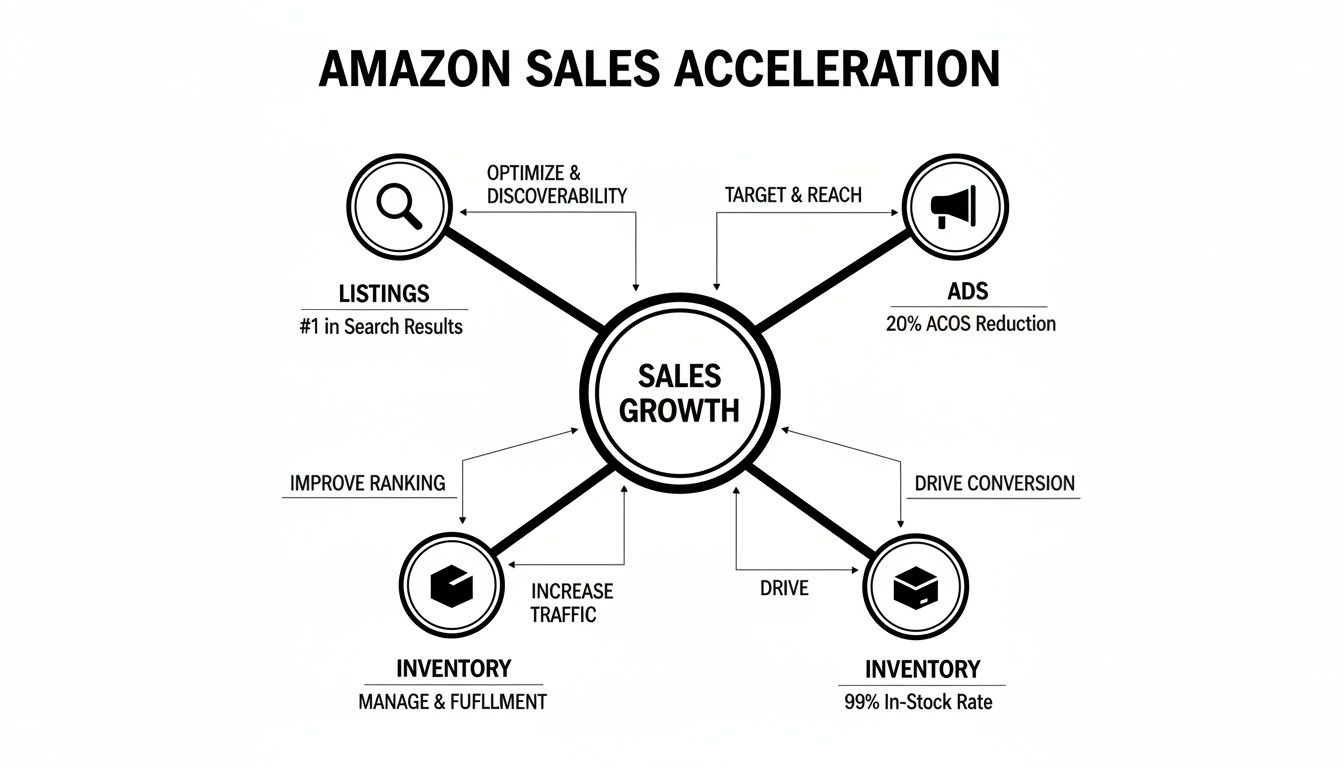
The key takeaway here is that none of these pieces work in isolation. They feed off each other, creating a cycle of continuous improvement that pushes your brand forward.
The Three Pillars of Amazon Dominance
If you really want to learn how to boost Amazon sales, you need to see the big picture. Success on this platform is built on three critical areas that have to be managed in sync. If you let one slip, it will drag the others down with it, stalling your growth before you even get started.
These are the non-negotiables:
- Listing & Keyword Optimization: Think of this as your digital storefront. It’s all about deep keyword research, compelling copy, and high-quality images that appeal to both Amazon's A9 algorithm and actual shoppers.
- Amazon PPC & Advertising: Paid ads are your accelerator. A well-built PPC strategy amplifies your organic reach, sends traffic to your perfectly optimized listings, and gives you priceless data on what customers are searching for.
- Inventory & Fulfillment: This is the operational backbone of your business. Smart inventory management prevents the stockouts that kill sales velocity and tank your rankings, making sure your best products are always ready for buyers.
The best sellers don’t just perform these tasks—they build systems. Strong PPC performance boosts organic rank, which drives more sales, which then validates their inventory forecasts. It’s a self-reinforcing loop that separates the seven-figure sellers from everyone else.
Tapping into Amazon's massive U.S. market, where sellers generated a staggering $438 billion in net sales in 2024, is a huge opportunity. With U.S.-based sellers now capturing 38.4% of that revenue, a finely-tuned strategy is vital. To stand out among over 353 million products, marketplace SEO and listing optimization are no longer optional—they’re essential.
To give you a clearer picture, this table breaks down how each core strategy contributes to your overall growth on the platform.
Core Amazon Sales Growth Strategies Overview
| Strategy Area | Primary Objective | Key Performance Indicator (KPI) |
|---|---|---|
| Listing Optimization | Improve organic search ranking and conversion rate (CVR). | Organic Rank, Click-Through Rate (CTR), Unit Session Percentage |
| Amazon PPC | Drive targeted traffic, increase sales velocity, and gather keyword data. | Advertising Cost of Sales (ACoS), Total ACoS (TACoS), Return on Ad Spend (RoAS) |
| Inventory & Fulfillment | Maintain optimal stock levels to prevent stockouts and maximize sales. | Inventory Performance Index (IPI), Sell-Through Rate, In-Stock Rate |
By keeping an eye on these KPIs, you can measure the health of each pillar and make sure they're all working together to drive sustainable growth.
Of course, your Amazon efforts don't exist in a vacuum. They're part of a much bigger picture. To see how this all fits together with your broader digital marketing, check out our guide on the best ecommerce marketing strategies.
Mastering Your Product Listings for Maximum Visibility
Your product detail page is your digital storefront. It’s the single most important place where a shopper decides to click “Add to Cart” or bounces to a competitor. To really move the needle on Amazon, you need a listing that speaks to both the A9 algorithm and your ideal customer at the same time.
It all starts with deep keyword research—and I don’t mean just grabbing the obvious one-word search terms. Seasoned sellers know the real gold is in the high-intent, long-tail phrases that your competitors are probably ignoring. These are the specific queries people type in when they’re much closer to buying.
Uncovering High-Intent Keywords
Good keyword research is really about understanding what a customer is thinking. Are they just browsing, or are they ready to pull the trigger? The language they use tells you everything you need to know.
- Broad Keywords: Sure, a term like "yoga mat" gets a ton of searches, but the competition is insane and the purchase intent is low. Trying to rank here is an uphill battle that’s often not worth the ad spend.
- Long-Tail Keywords: Now, a phrase like "extra thick non-slip yoga mat for bad knees" is a different story. This shopper has a specific problem and is looking for a specific solution. Nail this, and you’ll see much higher conversion rates.
Tools like Amazon's Product Opportunity Explorer can show you some interesting search trends, but don't forget to put yourself in the customer's shoes. Dig into competitor listings, read their reviews (especially the bad ones), and scroll through the Q&A sections. The exact words your customers use are your best source for keyword ideas.
The goal isn't just to find keywords; it's to find the right keywords. A highly specific, low-volume keyword that converts at 25% is far more valuable than a high-volume keyword that converts at 1%. This targeted approach is the foundation of smart Amazon SEO.
Crafting Compelling Titles and Bullets
Once you've got your list of target keywords, it's time to weave them into your copy. Your title carries the most weight with the A9 algorithm and it’s the very first thing a shopper reads. You have to make it count.
A winning title formula usually looks something like this:
- Brand Name
- Main Product Identity (e.g., "Pour Over Coffee Maker")
- Key Feature or Benefit (e.g., "with Permanent Filter")
- Important Details (e.g., "34 oz, Glass Carafe")
Your bullet points are where you sell the benefits, not just list the features. Each bullet should be a direct answer to a potential customer's problem. Don't just say, "Durable Borosilicate Glass." Instead, try something like, "Enjoy Perfectly Brewed Coffee for Years with Our Shatter-Resistant Borosilicate Glass." That kind of benefit-driven language connects with what a customer actually wants and drives them to buy. We cover more of these techniques in our detailed guide on how to optimize Amazon product listings.
The Power of High-Quality Visuals and A+ Content
Words can only take you so far. In the world of ecommerce, amazing visuals aren't a luxury—they're a requirement. Your image stack needs to tell a story and answer questions before a customer even thinks to ask them.
- Main Image: This is non-negotiable. It has to be a crystal-clear shot on a pure white background.
- Lifestyle Images: Show your product in action. Help customers imagine it in their own lives.
- Infographics: Call out key features, dimensions, or benefits with text and icons. Make the info easy to scan and digest.
- Product Video: A short demo video can be a massive boost for engagement and conversions.
If you’re brand-registered, A+ Content (what used to be called Enhanced Brand Content) is a total game-changer. It lets you use beautiful images, comparison charts, and formatted text to tell a richer brand story right on your product page. This isn't just about looking good; it builds trust and can lift conversion rates by up to 10%.
A+ Content helps you transform a simple listing into a premium brand experience, setting you apart from the sea of competitors. After all, the third-party seller ecosystem is what makes Amazon tick, and it's never been more competitive. With 9.7 million sellers registered worldwide and 1.9 million actively selling, killer content is what helps small businesses and startups level the playing field. Focusing on quality is how U.S. sellers manage to capture a 38.4% revenue share in a marketplace where you have to constantly innovate to stay ahead.
Building a Profitable Amazon Advertising Strategy
If your optimized listings are the engine attracting organic traffic, then a smart advertising strategy is the fuel that accelerates your growth. Mastering Amazon Pay-Per-Click (PPC) is non-negotiable if you want to seriously boost sales. It’s how you put your products right in front of motivated buyers the second they’re ready to pull out their wallets.
Think of your ad strategy as a targeted conversation with shoppers. The goal isn’t just to get clicks; it's to get the right clicks that actually convert to sales. This takes a structured approach that makes every single ad dollar work harder for you.
Understanding the Three Core Ad Types
Amazon gives you a whole suite of advertising tools, and each one has a specific job. Knowing when and how to use them is the first step toward building a campaign structure that actually makes you money.
- Sponsored Products: These are the ads you see most often, sprinkled throughout search results and on product detail pages. They are absolute workhorses for driving direct sales on specific items, targeting shoppers with high purchase intent based on their keyword searches.
- Sponsored Brands: Sitting at the top of the search results, these ads showcase your brand logo, a custom headline, and a small collection of your products. Use these to build brand awareness and drive traffic to your Amazon Storefront, not just a single product page.
- Sponsored Display: These ads follow shoppers around, appearing both on and off Amazon. They let you retarget people who have already viewed your products or similar items, making them perfect for re-engaging interested customers and staying top-of-mind.
A balanced strategy usually involves all three, creating a full-funnel approach that catches customers at every stage of their buying journey. For a deeper dive, our guide on what Amazon PPC is breaks down the fundamentals in more detail.
To make sense of these options, it helps to see how they stack up. Each ad type serves a different purpose, so choosing the right one depends entirely on your campaign goals.
Amazon Ad Type Comparison for Sellers
| Ad Type | Best Used For | Targeting Options | Placement |
|---|---|---|---|
| Sponsored Products | Driving direct sales of specific products | Keywords, ASINs, Categories | Search results, product detail pages |
| Sponsored Brands | Building brand awareness and driving traffic to a Storefront | Keywords, ASINs, Categories | Top of search results, within search results |
| Sponsored Display | Retargeting past viewers and reaching new audiences | Audiences, product/category views | On and off Amazon (third-party sites/apps) |
As you can see, a combination of these ad types allows you to build a comprehensive strategy that captures shoppers whether they’re just browsing, actively searching, or have already shown interest in your products.
Structuring Campaigns for Scalable Growth
One of the most common mistakes I see sellers make is just dumping all their keywords into a single, messy campaign. A scalable structure needs to start broad and get progressively more refined.
It all begins with an Automatic Campaign. Here, you’re letting Amazon's algorithm do the heavy lifting, automatically showing your ad for a wide range of search terms it thinks are relevant. Think of this as your data-mining phase.
Let that run for a couple of weeks, then dive into the Search Term Report. This report is a goldmine—it shows you the exact search queries customers used that led to clicks and, more importantly, sales.
Now you’ll use that data to create two types of Manual Campaigns:
- Broad/Phrase Match Campaign: Take your best-performing but still somewhat general keywords and move them here. This gives you more control over your bids while still letting you discover new variations of winning search terms.
- Exact Match Campaign: Isolate your absolute top-performing, high-conversion keywords. These are the money-makers you want to bid most aggressively on because you know they drive sales.
This tiered structure gives you maximum control. The automatic campaign continuously feeds you new keyword ideas, which you then graduate to your manual campaigns for precise bid management. It’s a self-sustaining system for growth.
The Critical Role of Negative Keywords
Knowing what to bid on is only half the battle. Knowing what not to bid on is where you protect your profits. That's where negative keywords come in. They stop your ads from showing up for irrelevant searches, which is hands-down the biggest cause of wasted ad spend.
For example, if you sell "leather phone cases," your automatic campaign might show your ad for searches like "plastic phone cases" or "cheap phone cases." If you check your reports and see those terms aren't converting, you’d add "plastic" and "cheap" as negative keywords.
This one simple action does two powerful things:
- It immediately stops you from throwing money away on unqualified clicks.
- It improves your campaign's relevance, which can lead to a better click-through rate (CTR) and a lower Advertising Cost of Sales (ACoS).
Make it a habit to review your search term reports regularly to find and add new negative keywords. This ongoing cleanup is a non-negotiable part of maintaining a profitable ad strategy that consistently boosts your Amazon sales.
Nailing Your Pricing and Inventory Management
Let's talk about the unsung heroes of Amazon success: strategic pricing and flawless inventory. You can have the most dialed-in listing and the sharpest ad campaigns, but if your price is wrong or you run out of stock, you're dead in the water. Get these right, and you maintain momentum. Get them wrong, and you're either leaving cash on the table or killing your sales velocity entirely.
Finding the pricing sweet spot is a balancing act. It’s not about being the cheapest guy on the block; it's about offering the most competitive value. Before you even think about a price, you have to know your numbers inside and out—FBA fees, storage costs, ad spend, everything. This is the only way to make sure every sale is actually a profitable one.
Dynamic Pricing and Promotions That Actually Work
Manually adjusting your prices every day? That's slow, inefficient, and just not scalable. Automated repricing tools can be a total game-changer, but you have to use them smartly to avoid a race to the bottom that demolishes your margins.
Instead of just setting a rule to beat the lowest price, a much smarter approach is to:
- Set a floor price. You need to establish a minimum based on your break-even point. This is non-negotiable and protects your margins from getting wiped out.
- Price against the Buy Box. Configure your tool to price just a little above or below the current Buy Box winner, not just the absolute lowest offer on the listing.
- Factor in your seller feedback. If your seller rating is miles better than a competitor's, you can often win the Buy Box even with a slightly higher price. Shoppers pay for trust.
Beyond repricing, promotions are your best friend for creating urgency and driving sales during key periods. Lightning Deals and coupons can give you a massive short-term boost, which is perfect for launching a new product or clearing out seasonal inventory before long-term storage fees kick in. Setting a price is a complex decision, and for a deeper dive, check out our guide on how to determine the price of a product.
Your pricing strategy should never be "set it and forget it." You need to be constantly testing different price points, watching what your competitors are doing, and using promotions with a clear goal in mind. The objective isn't just to make a sale; it's to make the most profitable sale possible.
Flawless Inventory: The Backbone of Sales Velocity
Even the most perfect pricing strategy is worthless if you run out of stock. A stockout is one of the most destructive things that can happen to your Amazon business. It doesn’t just stop sales cold; it screams to the A9 algorithm that your product is unreliable, and your search ranking will absolutely plummet.
Good inventory management starts with solid demand forecasting. Dig into your historical sales data, but don't forget to account for seasonality and any promotions you have planned. This helps you keep just enough stock to meet demand without getting hammered by Amazon's long-term storage fees.
Keeping your Inventory Performance Index (IPI) score high is critical. Amazon uses this metric to see how well you’re managing your FBA inventory. A score above their threshold means you get unlimited storage space. A low score? You'll face costly restrictions that can strangle your growth.
For international sellers, logistics can get tricky. If you're looking to sell directly to Canadian customers on Amazon.ca, understanding the Non-Resident Importer Canada program is a huge strategic advantage. It directly impacts your fulfillment and inventory strategy for that entire marketplace.
The importance of this planning gets amplified during massive sales events. Take Prime Day—in 2024, U.S. sales hit a staggering $14.2 billion. That kind of surge shows just how crucial it is to prepare with smart advertising, creative testing, and, most importantly, precise inventory management. Proper planning ensures you capitalize on that flood of traffic instead of stocking out on day one and watching your competitors eat your lunch.
Cultivating Reviews and Managing Your Brand Reputation
On Amazon, social proof is everything. A steady stream of positive reviews isn't just a vanity metric—it's the fuel that drives your conversion rate, search ranking, and your shot at winning the Buy Box. Think of your star rating as the first billboard a shopper sees. A good one gets them to click; a bad one sends them straight to your competitor.
This is why you need a proactive, Amazon-compliant game plan for generating feedback. You can't just cross your fingers and hope for good reviews. The top sellers build a system to encourage satisfied customers to share their experiences, building the trust new buyers need to finally click "Add to Cart."
Proactively Generating Customer Feedback
Waiting for reviews to trickle in on their own is a painfully slow way to grow. The most successful brands have a simple, repeatable process for requesting feedback that stays well within Amazon's rules.
The best tool for the job is Amazon’s own “Request a Review” button. This feature sends a standardized, compliant email to a customer between 5 and 30 days after their order is delivered. It’s a clean, simple message that asks for both seller feedback and a product review.
Sure, you could do this manually for every single order, but that’s not a scalable strategy. The smart move is to use third-party automation tools like Helium 10 or Jungle Scout that can "press" this button for every eligible order automatically. This one simple action ensures you’re consistently asking every customer for their opinion, which dramatically stacks the odds of building a strong rating in your favor.
Handling Negative Reviews Like a Pro
No matter how great your product is, a negative review is going to happen. It's inevitable. The real test is how you respond. You can't just delete a bad review, but you can absolutely turn it into a public display of fantastic customer service.
When a negative review pops up, don't panic. Just follow this framework:
- Respond Publicly and Professionally: Acknowledge their frustration without getting defensive. A simple, "We're sorry you had this experience" goes a long way.
- Offer a Solution: If it’s something you can fix, offer to make it right. That could mean a replacement, a refund, or just direct support to help them solve their problem.
- Take the Conversation Offline: Give them a clear, easy way to contact your customer service team so you can resolve the specifics privately.
A professional and genuinely helpful response to a bad review can be more powerful than a dozen 5-star ones. It shows potential customers that you stand behind your product and will take care of them, even when things go wrong. That builds incredible brand trust.
Turning Feedback into a Growth Asset
Your reviews are so much more than just a star rating. They're a direct line to what your customers are really thinking. This is a goldmine of unfiltered feedback that can guide your product development and marketing strategy.
Pay close attention to the patterns. Are customers constantly raving about a specific feature? You need to move that benefit front and center in your bullet points and A+ Content. Are they complaining about a minor flaw or a confusing instruction manual? That’s your signal to call your supplier and get it fixed for the next production run.
By treating customer feedback as a critical source of business intelligence, you create a powerful growth loop. You use their insights to improve your product and your listing, which leads to happier customers, which in turn leads to even better reviews. This is how you turn your brand reputation into a self-sustaining engine for growth.
Using Data to Continuously Refine Your Strategy
The most successful Amazon sellers I know operate on data, not guesswork. Strategies that actually move the needle aren't static; they have to evolve. If you want to build a thriving brand, you need a system for continuous improvement, turning the raw numbers from Seller Central into real, actionable insights.
This creates a powerful feedback loop. You implement a change—like a new ad campaign or a title tweak—then you measure the results, analyze what happened, and refine your approach based on what you’ve learned. This is what separates the sellers who hit a plateau from the ones who consistently grow, month after month.
Demystifying Your Key Performance Metrics
Seller Central throws a ton of data at you, but you really only need to zero in on a few key metrics to get a clear picture of your business's health. These are the numbers that tell the true story.
- Unit Session Percentage (Conversion Rate): This is the percentage of visits that turn into a sale. If this number is low, something is likely off with your price, images, or listing copy. It’s a direct measure of how persuasive your page is.
- Advertising Cost of Sale (ACoS): This shows how much you spend on ads for every dollar of revenue they bring in. It's a straightforward measure of how efficient your campaigns are. Simple.
- Total Advertising Cost of Sale (TACoS): This one is huge. It divides your total ad spend by your total revenue (both organic and ad-driven). TACoS gives you the big-picture view, showing if your ad spend is actually lifting your overall sales, not just the sales directly attributed to ads.
Understanding how these numbers relate is where the magic happens. For instance, if your ACoS is low but your TACoS is creeping up, it could mean your ads aren't creating that "halo effect" on your organic sales like they should. Digging into your Amazon sales data is the first step toward making smarter decisions.
Implementing A/B Testing for Informed Decisions
How do you really know if a new main image or a different headline will perform better? You test it. Amazon's "Manage Your Experiments" tool is a gift to brand-registered sellers, allowing you to run simple A/B tests on the most critical parts of your listing.
This takes the guesswork completely out of the equation and replaces it with cold, hard evidence. Instead of changing things based on a hunch, you can systematically test variations to find out what truly gets customers to click that "Add to Cart" button.
Don't try to test everything at once. Pick one thing—your main image, title, or A+ Content—and run a test for at least two weeks. This gives you clean data to make a confident decision that will actually impact your bottom line.
A huge part of refining your strategy comes down to knowing how to analyze sales data in Excel to spot trends, find opportunities, and pinpoint areas that need fixing.
Creating a System for Iterative Growth
The end goal here is to build a repeatable process for improvement. It’s a simple loop that you can run over and over again.
Here’s what that system looks like in action:
- Hypothesize: Start with a clear theory, like, "I bet changing my main image to a lifestyle shot will boost my click-through rate."
- Implement: Run the A/B test or make the strategic change you've planned.
- Measure: Keep a close eye on your key metrics. Did the change move the needle on your Unit Session Percentage or your ACoS?
- Analyze: Figure out if the change actually produced the result you wanted.
- Refine: Based on what you learned, either make the change permanent or head back to the drawing board with a new hypothesis.
This continuous cycle of testing and refining is the real engine of sustainable growth on Amazon. When you let data guide your decisions, you stop hoping for success and start systematically engineering it. That's how you build a brand that not only survives but thrives.
Frequently Asked Questions
Still have some questions? You’re not alone. Here are a few of the most common things sellers ask when they’re trying to scale on Amazon. We've got clear, no-nonsense answers to help you make smarter decisions for your brand.
How Long Does It Take to See Results From Amazon SEO?
This is the million-dollar question, and the honest answer is: it depends. You might see some quick wins—a better main image can boost your click-through rate almost overnight.
But the real, lasting impact of Amazon SEO doesn't happen in a day. It’s a slow burn. We typically see significant organic ranking improvements take hold anywhere from a few weeks to a couple of months. Amazon's algorithm needs time to see your changes, index them, and most importantly, reward you for the new sales they generate.
Consistency is everything. The more consistent sales you drive on your target keywords, the faster the algorithm will recognize your listing as relevant. Patience and persistent tracking are your best friends here.
What Is a Good ACoS for My Amazon PPC Campaigns?
There’s no magic number here. A "good" Advertising Cost of Sale (ACoS) is completely tied to your product's profit margin and what you're trying to accomplish right now.
The best starting point is to figure out your break-even ACoS. For example, if your product has a 30% profit margin, then an ACoS of 30% means you’re essentially breaking even on your ad spend for that sale.
But breaking even isn't always the goal. If you're launching a new product, you might be willing to run a much higher ACoS to build sales history, get those crucial early reviews, and climb the organic rankings. For a mature, profitable product, you’ll want that ACoS as low as possible.
The right ACoS isn't a fixed number; it's a strategic choice. A high ACoS might be a smart investment for a new product, while a low ACoS is essential for maximizing profit on a mature one. Your goal dictates the target.
Should I Use Fulfillment by Amazon (FBA) or FBM?
For most sellers who are serious about growth, this isn't even a debate—FBA is the way to go.
Enrolling your products in FBA makes them Prime-eligible, which is one of the biggest conversion drivers on the entire platform. That little Prime badge builds instant trust and is practically a requirement for winning the Buy Box. Beyond that, FBA takes the entire headache of storage, packing, shipping, and customer service off your plate.
Sure, FBM (Fulfillment by Merchant) gives you more hands-on control. But the sales velocity, customer trust, and operational freedom you get from the Prime badge usually make FBA the more profitable and scalable choice.
At Next Point Digital, we build data-driven strategies that turn clicks into customers. If you're ready to scale your brand on Amazon and beyond, let's talk. Explore our ecommerce growth services.