

Improving your ecommerce conversion rate is all about one thing: systematically hunting down and eliminating friction in your customer's journey. It’s about making it as simple and compelling as possible for a visitor to go from "just browsing" to clicking that final "buy" button. While the average store floats around a 2-3% conversion rate, the top players consistently blow past that by obsessively understanding their numbers and optimizing every single touchpoint.
Understanding Your Starting Line in Ecommerce CRO
Before you can improve anything, you need an honest, unfiltered look at where you stand today. Conversion Rate Optimization (CRO) isn't about chasing some magic, universal "good" number. It’s about figuring out what a healthy conversion rate looks like for your business, in your industry.
Think about it: a 1.5% rate for a luxury watch brand with a $5,000 average order might be wildly more profitable than a 4% rate for a CPG brand selling $15 items. Context is everything. Your journey starts by establishing a solid baseline—not just one number, but a collection of KPIs that tell the real story of how customers move through your store.
Defining Your Core Conversion Metrics
Your overall conversion rate (Total Sales / Total Visitors) is the headline, but it doesn't tell you much on its own. The real insights are hiding in the supporting metrics. It's like a doctor diagnosing a patient; they don't just check your temperature. They look at your blood pressure, heart rate, and other vitals to get the full picture.
Start by digging into these crucial data points:
- Add-to-Cart Rate: What percentage of people actually add something to their cart? If this number is low, it’s a massive red flag pointing to problems on your product pages, with your pricing, or how customers find products in the first place.
- Checkout Completion Rate: Of all the shoppers who start the checkout process, how many actually finish? A big drop-off here is a clear sign of friction in your payment or shipping steps. It's the ecommerce equivalent of a long line at a physical store.
- Revenue Per Visitor (RPV): This one is gold. It balances your conversion rate with your average order value (AOV), giving you a much truer sense of profitability. Sometimes, a tweak that slightly lowers your conversion rate but bumps up your AOV can lead to a higher RPV and more money in the bank.
The goal is to get past a single, generic conversion figure. By breaking the user journey down into these micro-conversions, you can pinpoint exactly where you’re losing people and focus your energy where it'll make the biggest difference.
To put your numbers in perspective, it helps to see how you stack up against others in your space.
Ecommerce Conversion Rate Benchmarks by Industry
This table gives you a quick reference for average conversion rates across key ecommerce sectors. Use it to benchmark your performance and identify where to focus your optimization efforts.
| Industry | Average Conversion Rate | Key Optimization Focus |
|---|---|---|
| Food & Beverage | 6.11% | Subscription models, easy reordering, cross-selling complementary items. |
| Health & Beauty | 3.03% | User-generated content, tutorials, detailed product benefits. |
| Fashion & Apparel | 2.44% | High-quality imagery, size guides, seamless returns process. |
| Home Goods & Furniture | 1.56% | AR viewers, detailed dimensions, customer photos in reviews. |
| Luxury & Jewelry | 1.19% | Brand storytelling, trust signals, premium customer service. |
Seeing these benchmarks makes it clear that a "good" conversion rate is highly dependent on what you sell.
How Traffic Sources Shape Your Numbers
Not all traffic is created equal. This is a lesson every marketer learns, often the hard way. A visitor who lands on your site from a hyper-specific paid search ad for "buy red running shoes size 10" is worlds away from someone who stumbled onto your blog from a random social media share. Their intent is completely different, and so is their likelihood to convert.
When you're analyzing your baseline, you have to segment your conversion rate by channel:
- Paid Search: Usually brings in high-converting traffic because the user intent is crystal clear. They’re looking to buy.
- Organic Search: Also has strong intent, but can include more informational queries, which naturally lowers the conversion rate a bit compared to paid.
- Email Marketing: Converts like a charm with your existing customer base but can be hit-or-miss with new acquisition campaigns.
- Social Media: Often has the lowest conversion rate. People are there to browse and discover, not necessarily to shop.
Understanding these differences stops you from making bad assumptions. For example, if you're pulling sales reports from a marketplace, you'll see that traffic from sponsored ads converts very differently than organic search traffic. Our guide on how to interpret Amazon sales data dives deeper into these kinds of nuances.
This foundational knowledge is your launchpad. It’s what allows you to set realistic goals and build a data-driven CRO strategy that’s actually tailored to your business, whether you’re selling on Shopify, Amazon, or Walmart.
Building a Repeatable CRO Framework for Growth
Randomly changing button colors and hoping for a conversion lift isn't a strategy—it's just gambling with your ad budget. The secret to sustainably improving your conversion rates is to stop guessing and start implementing a structured, repeatable process. A solid framework turns optimization from a series of one-off tactics into a systematic engine for growth.
This framework is built on a simple, battle-tested loop: Research → Hypothesize → Test → Iterate. It’s a cycle that forces you to listen to your customers, act on real data, and make changes that have a measurable impact on your bottom line. Forget gut feelings; this process is about building a case for every change you make.
Uncovering the Why with Qualitative Research
Before you can fix a problem, you have to understand it from the customer's perspective. Your quantitative data, like Google Analytics reports, tells you what is happening. For example, it might show that 70% of users abandon their carts. But qualitative research tells you why it's happening.
This is where you put on your detective hat. These tools are your magnifying glass:
- Heatmaps: These show you exactly where users are clicking, moving their mouse, and how far they scroll. A heatmap might reveal that everyone is clicking on a non-clickable image, signaling a major UX blind spot.
- Session Recordings: Watch anonymized recordings of real user sessions on your site. You might witness firsthand a customer struggling to find shipping information or getting stuck in a checkout loop. This is raw, unfiltered evidence of friction.
- Surveys and Polls: Just ask direct questions. An exit-intent poll on the checkout page asking, "What's stopping you from completing your purchase today?" can yield golden insights, like unexpected shipping costs being the number one deal-breaker.
This initial foundation of calculating your baseline, benchmarking against it, and setting clear goals provides the structure for your entire CRO program.
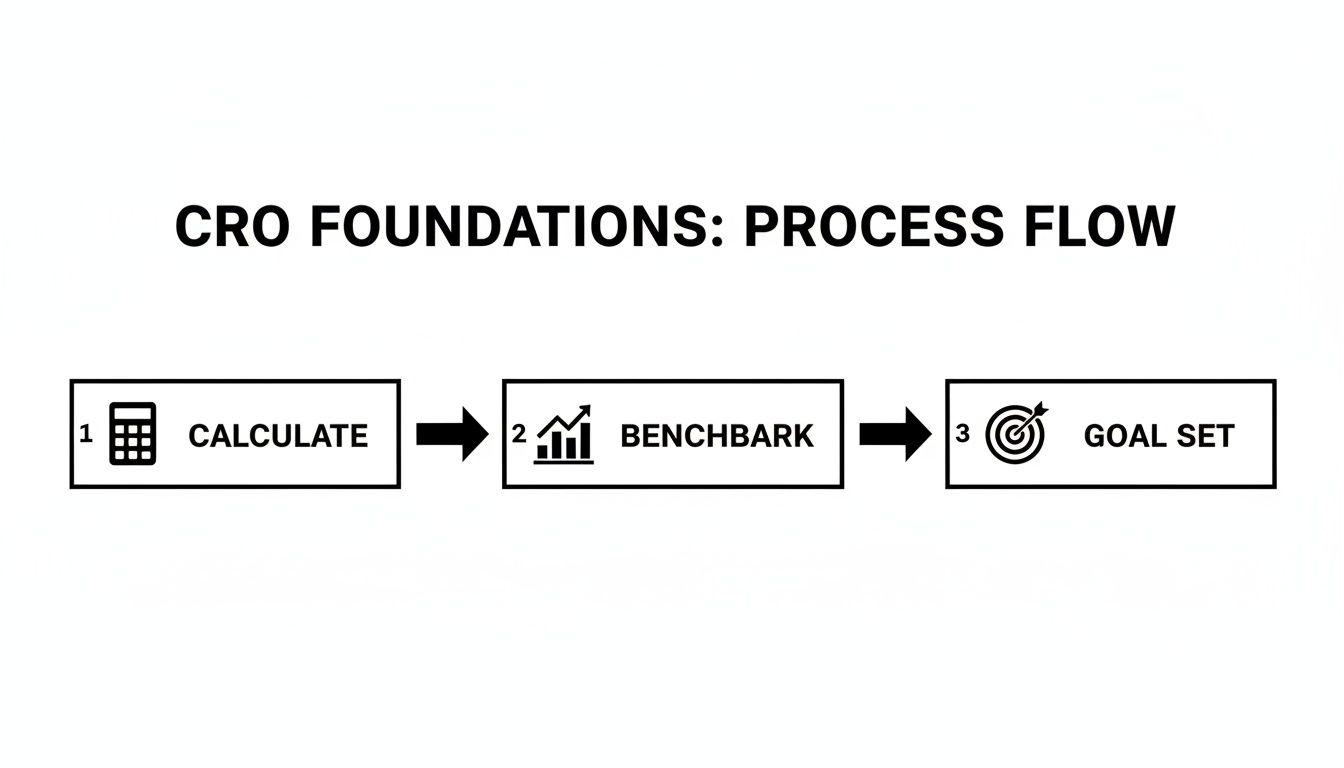
This process visualizes how you move from raw numbers to actionable targets, ensuring your optimization efforts are always grounded in clear business objectives.
Forming a Powerful, Testable Hypothesis
Once your research uncovers a problem, the next move is to form a hypothesis. A good hypothesis isn't some vague idea; it's a specific, measurable prediction that connects a proposed change to an expected outcome, all backed by a clear rationale.
It follows a simple but powerful structure: "If we [implement this change], then [this outcome will happen], because [of this reason]."
Let’s make this real. Your session recordings show users repeatedly hesitating on the payment page. They scroll up and down, hovering over the credit card fields before bailing. Your research suggests they feel insecure.
Weak Idea: "Let's just add some trust badges."
Strong Hypothesis: "By adding Visa, Mastercard, and Norton Security badges directly below the 'Place Order' button, we will reduce checkout abandonment by 15% because it will address customer security concerns at the final point of friction."
See the difference? The strong hypothesis is specific, measurable, and directly tied to the problem you actually identified. Now you have a clear experiment to run. Prioritizing which tests to run first is a critical step, and for a deeper dive into building your roadmap, you can explore these effective conversion rate optimization strategies.
The Test and Iterate Loop
With a strong hypothesis in hand, you're ready to test. This is usually done with an A/B test, where you show the original page (the Control) to one segment of your traffic and the new version (the Variation) to another. The goal is simple: see which one performs better against your target metric, like the checkout completion rate.
But once a test concludes and you have a statistically significant winner, the work isn't over.
- If your hypothesis was correct: Awesome. Implement the winning change permanently. Then, document what you learned. What does this win tell you about your customers?
- If your hypothesis was incorrect: This isn't a failure; it’s a learning opportunity. Dig into why it didn't work. Did you misunderstand the problem? Was the execution flawed?
This is the "iterate" part of the loop. Every single test, win or lose, provides fresh data that feeds right back into the research phase. It’s this continuous cycle of learning and refining that separates high-growth ecommerce stores from the ones that stagnate and wonder why nothing is working.
Optimizing Marketplace Listings to Convert Browsers into Buyers

When you're selling on a competitive marketplace like Amazon, Walmart, or eBay, your product listing is everything. It's your digital storefront, your best salesperson, and your brand ambassador, all rolled into one. To win here, you have to go way beyond just listing product features. You need a smart strategy that turns the massive traffic these marketplaces get into actual sales for your brand.
It all starts with getting found. If shoppers with high buying intent can't find your product, you can't possibly convert them. This means doing keyword research that digs deeper than the obvious, high-level terms. You have to think exactly like your customer.
Targeting long-tail keywords like "lightweight waterproof hiking backpack for women" brings in shoppers who already know what they want and are much closer to making a purchase. Weaving these specific phrases naturally into your title, bullet points, and backend search terms is the first critical step to improving conversion rates for your ecommerce products.
Crafting Titles and Bullets That Sell
Your product title is arguably the most important piece of real estate on your entire listing. It’s what shoppers see in a crowded search results page, and it has to do all the heavy lifting to earn that click. A title that converts is a perfect blend of your main keywords and a value proposition that is impossible to ignore.
Don't just write "Hiking Backpack." Instead, try something like "SummitPro 40L Hiking Backpack – Lightweight & Waterproof for Day Trips." This version instantly tells the shopper about key benefits and the product's ideal use, attracting the right kind of buyer from the get-go.
Once they click, your bullet points need to take over. This is no place for a dry, boring list of technical specs. Think of each bullet point as a mini-sales pitch, structured to solve a customer's problem or highlight a benefit they can't live without.
- Lead with the benefit: Always start with what the customer gets. Instead of "Made with ripstop nylon," frame it as "Stay Dry on the Trail: Crafted from fully waterproof ripstop nylon to protect your gear in any weather." See the difference?
- Answer questions before they're asked: Scour your customer reviews and competitor listings for common questions and address them right in your bullets. This builds trust and smashes purchase friction.
- Help them visualize it: Use language that helps the shopper imagine themselves using your product and having a great experience. It’s a surprisingly powerful conversion driver.
Leveraging A+ Content to Build Trust and Value
On Amazon, Enhanced Brand Content (EBC), or A+ Content, is your chance to tell a richer brand story and show off your product’s value in a way that text and basic images just can't. This is where you build a real connection with the shopper, which is absolutely essential for justifying a higher price point and overcoming last-minute hesitation.
The best-performing A+ Content almost always includes:
- Lifestyle Imagery: Show your product being used in the real world. A photo of a hiker smiling on a beautiful trail while wearing your backpack is infinitely more persuasive than a static shot on a white background.
- Comparison Charts: These are fantastic for helping shoppers choose the right product from your lineup. By comparing features, sizes, and uses across different models, you prevent "analysis paralysis" and guide them straight to the perfect fit.
- Your Brand Story: Briefly share your mission or what makes your company different. People connect with stories, and that emotional hook can be the deciding factor that justifies a premium price.
By using A+ Content to visually answer questions and showcase your product's unique value, you build the trust required to secure the sale. It’s a powerful tool that functions much like an in-store demonstration, allowing you to control the narrative and highlight what truly matters.
Ultimately, a well-oiled marketplace listing acts as a complete sales funnel. The title grabs attention, the images and bullets build desire, and the A+ Content seals the deal by establishing trust. For anyone selling on Amazon, mastering these elements is non-negotiable. Dive deeper with our complete guide on how to optimize Amazon product listings.
It's also worth noting where your conversion efforts are best spent. While social media gets a ton of buzz, its direct impact on sales can be underwhelming. To put it in perspective, customer referrals convert at an incredible 5.4%, while social media lags far behind at just 0.7%. This just goes to show how critical it is to build trust through credible channels and perfectly crafted listings that speak directly to serious buyers.
Enhancing Your Direct-to-Consumer Website Experience

Unlike a crowded marketplace where you’re just another tile in a search result, your direct-to-consumer (D2C) website is your brand’s home turf. You own the entire experience, from the moment a shopper lands on your site to the final thank-you email. This complete control is a massive opportunity to guide the customer journey and nail your ecommerce conversion rate optimization.
The goal here is simple: create a seamless, intuitive, and confidence-building path to purchase. Every single element—from your site’s navigation menu to the fine print on a product page—either builds momentum or creates friction. Get it right, and even small tweaks can lead to some seriously impressive lifts.
Crafting Product Detail Pages That Actually Sell
Think of your Product Detail Pages (PDPs) as the digital equivalent of a customer picking up an item in a store. This is the moment where casual interest turns into real purchase intent, and your PDP has to do all the heavy lifting to close the deal. A few generic descriptions and static images just won't cut it anymore.
High-converting PDPs absolutely nail three things:
- High-Quality Media: Your visuals have to replace the physical experience of touching and feeling a product. Go beyond basic photos and include high-resolution images from every angle, 360-degree views, and short videos that show the product in action. If you sell apparel, show it on different body types. If you sell furniture, let shoppers use AR to see it in their own space.
- Powerful Social Proof: It's no secret that over 90% of consumers read reviews before buying. Don't bury your best customer reviews behind a tab—feature them prominently. Showcase user-generated content (UGC), like photos of real people using your products, to build the kind of authenticity and trust that stock photos never can.
- Crystal-Clear Information: Leave no stone unturned. Answer every possible question a shopper might have before they even think to ask it. Provide detailed specs, materials, dimensions, and care instructions. A clear, friendly return policy displayed right on the PDP can be the final piece of reassurance a hesitant buyer needs.
Streamlining the Infamous Checkout Process
Nowhere is the battle for conversions won or lost more decisively than in the checkout. The average cart abandonment rate still hovers around a staggering 70%. Why? Most of the time, it comes down to a clunky, surprising, or untrustworthy checkout experience. Making this final step as smooth as possible is one of the highest-impact changes you can make.
Your checkout shouldn't feel like filling out tax forms. It should be a smooth, fast, and reassuring final step. The less your customer has to think, the more likely they are to complete their purchase.
Take a hard look at your own checkout process. Are any of these common friction points slowing things down?
- Forced Account Creation: Always, always offer a guest checkout option. Forcing users to create an account before they can give you their money is a notorious conversion killer.
- Too Many Form Fields: Only ask for what is absolutely essential. Every extra field is another tiny reason for someone to give up. Use auto-fill options for addresses wherever you can.
- Limited Payment Options: Don't stop at Visa and Mastercard. Integrating express payment options like Apple Pay, Google Pay, and PayPal can slash checkout time and give your mobile conversion rates a serious boost.
- Surprise Costs: Surprise shipping fees are the number one reason for cart abandonment. Be transparent and display all costs—including shipping and taxes—as early as you can, preferably right in the cart summary.
Of course, a great checkout doesn't matter if your landing pages aren't compelling. A crucial part of your D2C strategy is applying practical landing page design best practices that actually boost conversions to ensure the journey from ad click to checkout is completely seamless.
High-Impact CRO Tests for D2C Websites
Not sure where to start testing on your D2C site? Some experiments tend to deliver bigger wins than others. The table below outlines a few high-impact tests that often move the needle for ecommerce brands.
| Test Area | Hypothesis Example | Primary Metric to Track |
|---|---|---|
| Homepage CTA | Changing the primary CTA from "Shop Now" to "Discover Our Best-Sellers" will increase clicks to category pages. | Click-Through Rate (CTR) |
| Product Page Layout | Placing social proof (reviews, UGC) above the fold will increase the "Add to Cart" rate by building trust faster. | Add-to-Cart Rate |
| Checkout Flow | Implementing a single-page checkout instead of a multi-step process will reduce cart abandonment. | Cart Abandonment Rate |
| Navigation Menu | Simplifying the main navigation from 10 items to 5 core categories will improve user journey and session duration. | Pages per Session |
| Offer Pop-ups | Triggering an exit-intent pop-up with a 10% discount will capture more email sign-ups from abandoning visitors. | Email Capture Rate |
| Shipping Threshold | Displaying "You're only $12 away from free shipping!" in the cart will increase the Average Order Value. | Average Order Value (AOV) |
Remember, every audience is different. What works for one brand might not work for another, so always test your assumptions before rolling out site-wide changes.
Boosting AOV with Smart Personalization and Upsells
Improving your conversion rate isn't just about getting more people to buy—it's also about increasing the value of each sale. AI-driven personalization and intelligent upselling are your best friends for boosting Average Order Value (AOV) without feeling pushy.
Personalization tailors the shopping experience to the individual. By using data on past purchases and browsing behavior, you can recommend products that are genuinely helpful, moving beyond generic "You might also like…" sections to something that feels more like a personal shopper. If you're looking to dive deeper, our guide on the best ecommerce personalization software is a great place to start.
Smart upsells and cross-sells can also add significant value when they're done right. The key is to be helpful, not aggressive.
- Upsell: Suggest a slightly better, more premium version of the product they're already looking at (e.g., "Upgrade to the pro model for just $20 more").
- Cross-sell: Offer complementary items that make the original purchase even better (e.g., "Customers who bought this tent also bought this sleeping bag").
Finally, pay attention to where your best customers are coming from. Across 14 industries, paid search traffic tends to convert at the highest rate of 3.2%, followed closely by referrals and organic search. Knowing this helps you focus your optimization efforts where they'll have the biggest impact—on the traffic that's most likely to convert.
Aligning Ad Campaigns with Conversion Goals
Getting traffic to your ecommerce store is easy. Getting the right traffic? That’s what separates the campaigns that burn cash from the ones that print money. A winning ad strategy is about so much more than clicks and impressions; it’s about crafting a seamless journey from the moment someone sees your ad to the second they hit "complete purchase."
This alignment is everything. Think about it: when a user clicks an ad for "50% Off Winter Coats" but lands on a page full of full-price jackets, you’ve created instant friction. That disconnect kills the sale before it even has a chance. To really move the needle on conversions, you have to deliver on the promise you made in the ad. The creative, the copy, and the landing page must all tell the same story.
From Vanity Metrics to Profitable Actions
For too long, marketers got hooked on vanity metrics like clicks and impressions. Sure, those numbers look good in a report, but they don’t pay the bills. The real game is shifting your focus to metrics that actually matter for an ecommerce business: Cost Per Acquisition (CPA) and Return On Ad Spend (ROAS).
When you start obsessing over ROAS, you're forced to connect every single ad dollar to the revenue it generates. This mindset shift is the first step toward building campaigns that don't just attract visitors, but attract buyers. It’s about being ruthlessly efficient with your budget to make sure it delivers tangible, measurable sales.
Targeting High-Intent Audiences
The secret to a high-converting ad campaign isn't just a great offer; it's getting that offer in front of shoppers who are already looking to buy. This is where modern ad platforms have become incredibly powerful. Forget broad, shotgun-style targeting. We can now zero in on high-intent audiences with tools like predictive bidding and automated keyword optimization.
Let's get tactical:
- Predictive Bidding: This isn't guesswork. AI-driven bidding strategies analyze thousands of signals in real-time to figure out which users are most likely to convert. This lets you bid more aggressively for the clicks that count and pull back on the ones that won't.
- Automated Keyword Optimization: Instead of manually wrangling a massive keyword list, automated systems can find and target long-tail keywords that scream purchase intent. Think "women's waterproof size 8 hiking boots" instead of just "boots."
These data-driven marketing strategies allow your campaigns to learn on the fly, constantly refining your targeting to hit the most profitable customer segments.
When your ads are shown to people who have already signaled they want to buy, your conversion rates naturally climb. You're no longer interrupting their day—you're providing the exact solution they were already searching for.
Dynamic Creative and Platform-Specific Optimization
Let’s be real: not all customers respond to the same message or visual. Dynamic creative testing takes the guesswork out of the equation. It automatically tests thousands of ad variations—different headlines, images, calls-to-action—to find the winning combinations for specific audiences.
It’s also critical to remember that user behavior changes dramatically depending on the device. For example, desktop conversion rates often hover around 3.9%, while mobile is stuck at 1.8%. Since mobile traffic dominates most stores, that gap represents a massive opportunity. Your ad campaigns and landing pages need to be built for each platform to close that gap and maximize every click.
By aligning every piece of your ad campaign with your ultimate conversion goals, you build a powerful and efficient sales engine. To keep refining your ad game, check out a modern guide to E-commerce advertisement that actually converts. This consistent, user-focused approach is what it takes to achieve profitable, scalable growth.
Common Questions We Hear About Ecommerce CRO
Even with a solid framework, you're bound to hit some roadblocks when you're in the trenches trying to improve conversion rates. We get asked about these challenges all the time, so here’s a quick rundown of the most common questions and how we think about them.
How Long Does It Take to See CRO Results?
This one comes up a lot, and the honest answer is: it depends. The timeline for seeing results from CRO is tied directly to your site's traffic and how quickly you can run a statistically sound test. A high-traffic store might validate an A/B test in just a few weeks, while a smaller site could need a month or more to collect enough data.
It’s better to think of CRO as an ongoing program, not a one-and-done project. Sure, quick wins like fixing a broken link can give you an immediate lift, but the real, sustainable growth comes from building a culture of continuous learning. A well-structured CRO program usually starts delivering a measurable return within three to six months as your successful experiments start to compound.
What Are the Most Common Mistakes in Ecommerce CRO?
So many brands stumble over the same hurdles when they start out. Honestly, avoiding these common pitfalls is half the battle.
Here are the biggest mistakes we see over and over:
- Testing based on opinions: Running experiments based on a gut feeling or because you saw a competitor do it. Your tests should always come from data-backed hypotheses from your own research.
- Ending tests too early: This is a big one. Calling a test before it reaches statistical significance will give you false conclusions and completely waste your time. Patience is critical here.
- Ignoring the big picture: Obsessing over minor tweaks like button colors while your checkout flow is a confusing mess. Focus on the major user experience issues first.
- Failing to segment results: A change might be a huge win for mobile users but a total disaster on desktop. If you don't segment your results, you'll miss these game-changing insights.
One of the most overlooked errors is ignoring qualitative feedback. Session recordings and customer surveys give you the "why" behind the numbers, turning abstract data into real human stories you can act on.
Should I Focus on Mobile or Desktop First?
Your own analytics will give you the final answer, but a "mobile-first" approach is almost always the right move these days. Desktop conversion rates are often higher, but mobile traffic dominates most ecommerce stores now.
That gap between mobile traffic and mobile conversions usually points to a clunky, frustrating mobile experience—and that makes it your single biggest opportunity for growth. Start by improving your mobile navigation, page speed, and checkout usability. A fantastic mobile experience almost always translates well to desktop, but the reverse is rarely true. Check your traffic split; if mobile volume is high but the conversion rate is low, you know exactly where to start.
How Can I Boost My Add-to-Cart Rate?
Getting more people to add items to their cart is a critical first step in the sales funnel. If shoppers aren't even doing that, you have a major problem at the consideration stage.
Your product detail pages (PDPs) are where you need to focus. Use high-quality images and video to make up for the fact that people can't touch the product in person. Make your social proof impossible to miss by featuring your best reviews and user-generated content right where people can see them. Finally, write benefit-driven descriptions that answer the question, "What's in it for me?" instead of just listing specs.
Interestingly, stats show the average add-to-cart rate is around 7.5%, which leaves a ton of room for improvement with things like personalization and smart cross-sells. You can learn more about how conversion rates vary by industry on Ruler Analytics. Even a small lift here can have a huge impact on your bottom line.
Ready to stop guessing and start growing? At Next Point Digital, we build data-driven strategies that turn more of your clicks into customers. Let's create a practical roadmap to scale your ecommerce business. Start your growth journey with us today.