

Getting an Amazon listing right is a mix of art and science. It’s about more than just throwing in a few keywords; it’s a detailed process that pulls together sharp keyword integration, top-notch visuals, and copy that sells. The whole thing kicks off with some deep-dive keyword research to figure out exactly how customers are searching. From there, you strategically place those terms everywhere that matters—your title, bullets, and even the backend fields.
This is what gets your product seen in the right searches, which is the first step to driving real visibility and sales.
Your Foundation for Amazon Success
Welcome to the definitive playbook for mastering your Amazon listings. We're going to skip the fluff and get straight to the strategic framework that separates the seven-figure sellers from everyone else. A perfectly tuned listing isn't just a nice-to-have; it's the absolute core of your growth on the platform.
Here, we'll unpack how Amazon's A9 algorithm thinks, rewarding listings that don't just get clicks but consistently turn shoppers into paying customers.
To win, you have to think like a search engine and a customer. Amazon’s algorithm is all about relevance and performance. That means your listing needs to be easy to find (that’s the SEO part) and convincing enough to make shoppers buy (that’s conversion rate optimization). These two things feed each other: better conversions can boost your search rank, creating a powerful cycle of growth. For a deeper look at this, there's a comprehensive guide to optimizing Amazon product listings that digs into even more strategies.
The Core Pillars of Optimization
Your journey to a top-performing listing is built on three pillars. Nail these, and you're ahead of 90% of sellers.
- Compelling Copy: This is your silent, 24/7 salesperson. It's your title, bullet points, and product description, all working together to answer questions and shout out the benefits.
- High-Converting Visuals: On Amazon, your pictures do most of the talking. High-res photos, helpful infographics, and lifestyle shots are what build trust and help a shopper picture your product in their own life.
- Strategic Keywords: Keywords are the bridge connecting your product to people who are ready to buy. Getting the research and placement right isn't optional—it's essential for getting seen.
This flowchart breaks down how these three elements work together in a simple, visual way.
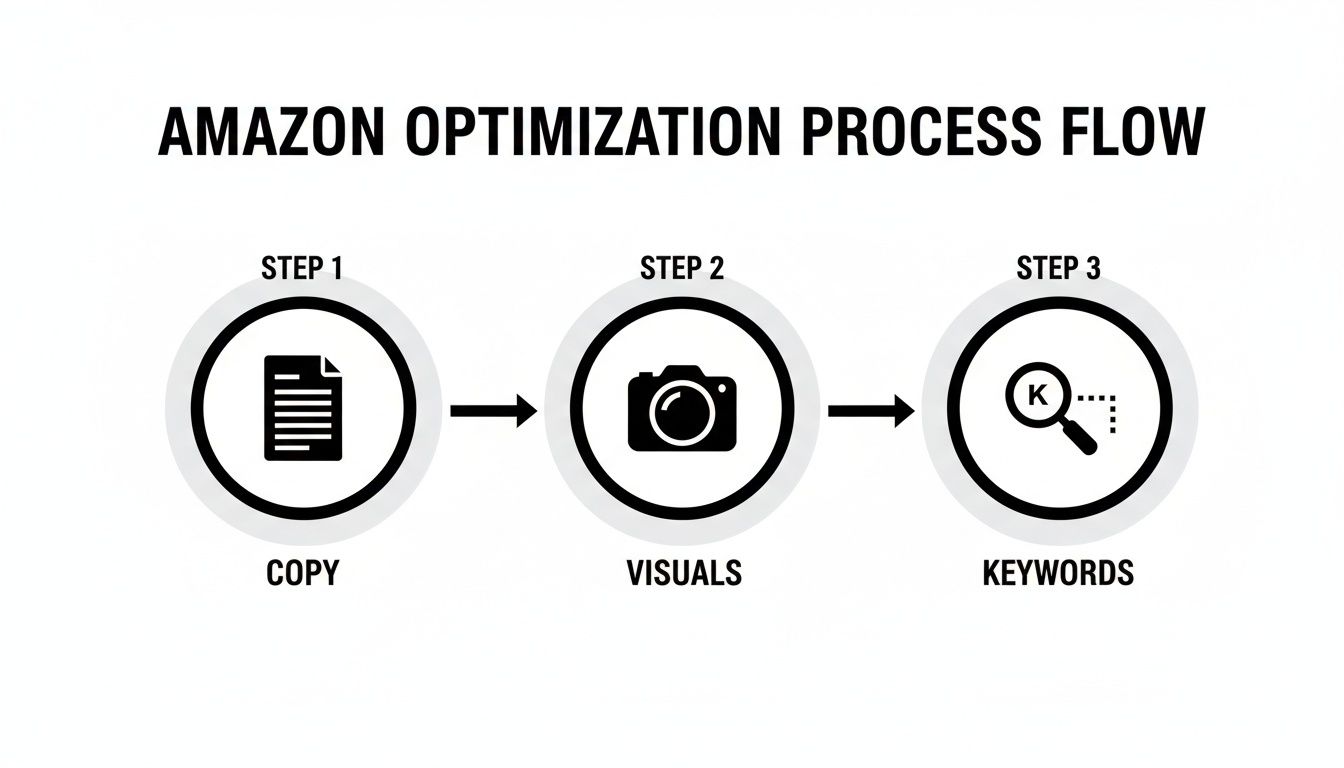
As you can see, optimization is a step-by-step process. Great copy, powerful visuals, and the right keywords all build on one another to create a listing that actually performs.
Why a Holistic Approach Matters
One of the biggest mistakes I see is sellers focusing on just one thing, like cramming a bunch of keywords into the title and calling it a day. The A9 algorithm is way smarter than that. It looks at sales velocity, customer reviews, and conversion rates, too.
This is why you need a balanced strategy that covers all the bases. It even helps to understand the operational side of things. For example, if you're trying to streamline your shipping and logistics, learning what Amazon FBA means gives you critical context for how fulfillment impacts your listing's performance and the customer experience you deliver.
A meticulously optimized listing is not an expense; it is the single most important investment you can make in your Amazon business. It directly impacts your visibility, conversion rate, and ultimately, your profitability.
Think of this guide as your roadmap. By mastering each piece of the puzzle, you’ll build a listing that doesn't just rank well but also creates a brand that customers learn to trust and come back to again and again.
Mastering Amazon Keyword Research and Placement
Think of keywords as the lifeblood of your Amazon listing. They're the direct bridge connecting a customer's search to your product's solution. Getting this right isn’t just about guessing what people are typing into the search bar. It's a methodical process of discovery and strategic placement that convinces both shoppers and Amazon’s A9 algorithm that your product is the most relevant result.
A powerful keyword strategy is all about balance. You need a mix of different search term types to cast the widest, most effective net.
- Seed Keywords: These are the broad, foundational terms that define your product, like "yoga mat" or "water bottle." They pull in a ton of traffic but come with intense competition.
- Long-Tail Keywords: These are the more specific, multi-word phrases that signal clear buying intent—think "extra thick non slip yoga mat for hot yoga." The search volume is lower, but the conversion rates are often much higher because the shopper knows exactly what they want.
The sweet spot is a blend of both. Seed keywords build visibility, while long-tail keywords deliver those profitable conversions.
Building Your Keyword Arsenal
First things first, you need to compile a master list of every possible term a customer might use. This takes a combination of powerful software and some good old-fashioned detective work. Don't just rely on one method; a multi-pronged approach is how you'll uncover the hidden gems your competitors are missing.
Start simple. Type your main seed keywords directly into the Amazon search bar and pay close attention to the auto-suggestions that pop up. These are real, popular searches that give you instant insight into how customers think and talk about your product. Next, meticulously analyze the titles and bullet points of the top 10 listings for your main keywords. What common phrases and features do they all seem to highlight?
To get more data-driven, tools like Helium 10 or Jungle Scout are essential. They let you reverse-engineer competitor listings to see exactly which keywords are driving their sales, complete with estimated search volumes and competition levels.
The Art of Strategic Keyword Placement
Once you have your master keyword list, the next critical step is keyword mapping. This isn't about "stuffing" keywords wherever they’ll fit. It’s about placing the right terms in the right fields to maximize their impact on the A9 algorithm. Each part of your listing carries a different weight in Amazon's eyes.
A common mistake I see sellers make is repeating the same keywords across their title, bullets, and backend terms. Amazon’s algorithm only needs to index a keyword once for your listing. Redundancy wastes valuable space that could be used for other relevant search terms.
Here’s how to prioritize your keyword placement for the biggest impact:
| Listing Section | Primary Role in Optimization | Best Practice for Keywords |
|---|---|---|
| Product Title | Highest SEO weight. This is your single most powerful ranking factor and the first thing shoppers see. | Place your top 3-5 most important, highest-volume keywords here. Weave them into a readable, compelling title that makes sense. |
| Bullet Points | High SEO weight. These are indexed for search and are absolutely crucial for converting shoppers by highlighting benefits. | Naturally integrate your secondary and long-tail keywords. Focus on benefit-driven language that solves a problem or answers a question. |
| Backend Search Terms | Indexed for search, but invisible to customers. This is prime real estate for keywords that don't fit naturally into your copy. | Use this space for synonyms, common misspellings, and related terms you couldn’t use elsewhere. Never repeat keywords from the title or bullets. |
Effective keyword placement is a core skill for both marketplace and traditional web search. The principles of identifying user intent and matching it with relevant content are universal, forming the bedrock of solid ecommerce SEO best practices on any platform. To really go deep on refining your product pages to rank higher and attract more clicks, learn how to optimize Amazon product listings for maximum sales, which covers everything from keyword research to A+ Content. Mastering this process is how you turn searches into sales.
Writing Copy That Turns Clicks Into Customers

You’ve done the hard work of digging up the right keywords. Now it’s time to weave that raw data into copy that actually sells. Your product title, bullet points, and description are your 24/7 digital salesperson, and their only job is to turn casual browsers into paying customers.
Great copy doesn't just describe a product—it solves a problem and builds trust. Every word you write needs to serve two masters: Amazon's A9 algorithm and the human shopper. Nail that balance, and you're well on your way to a listing that not only ranks but converts.
Crafting a High-Performance Product Title
Let's be clear: your product title is the single most important piece of copy on your entire listing. It carries the most SEO weight and is often the only thing a shopper reads before deciding whether to click on your product or your competitor's. A weak title is a massive missed opportunity, plain and simple.
The goal is to blend your most critical, high-volume keywords with essential product info in a way that’s both readable and compelling. A proven formula usually looks something like this:
[Brand Name] + [Main Keyword/Product Type] + [Key Feature/Benefit] + [Size/Color/Quantity]
For example, a title like "Yoga Mat" is basically invisible. But an optimized title like "ZenFlow Extra Thick Non-Slip Yoga Mat for Hot Yoga – Eco-Friendly TPE, 72" Long (Ocean Blue)" is a powerhouse. It hits the brand, main keyword, key benefits (non-slip, extra thick), material, size, and color, checking all the boxes for both the algorithm and the shopper.
Writing Bullet Points That Answer Questions Before They're Asked
Think of your five bullet points as your elevator pitch. Most shoppers scan these before they even consider reading the full description, so they need to hit hard and fast. This is your chance to highlight your product's best features and shut down any potential objections.
A classic mistake is just listing features. Don't do that. Instead, translate every feature into a clear benefit for the customer.
- Feature-focused (Weak): "Made with TPE Material"
- Benefit-focused (Strong): "Eco-Friendly & Odorless: Crafted from premium TPE material, our mat is non-toxic and free from harsh chemical smells, ensuring a clean and healthy practice every time."
See the difference? This approach answers the shopper's unspoken question, "What's in it for me?" Framing your points this way connects your product directly to their needs. For a deeper dive into these techniques, check out these conversion rate optimization best practices that apply just as well here.
Pro Tip: Start each bullet point with a capitalized, bolded phrase that sums up the benefit. This makes your listing super scannable and lets customers grab the key takeaways in seconds.
Telling a Story with Your Product Description and A+ Content
While the title and bullets do the heavy lifting for SEO and quick scans, the product description and A+ Content are where you build a real connection. If a shopper has scrolled this far, they're seriously interested and just need a little more convincing to hit "Add to Cart."
Use this space to expand on the benefits you touched on in the bullets. Paint a picture of how your product will fit into—and improve—the customer's life.
- Share your brand's origin story or mission.
- Give detailed instructions for use or care.
- Compare your product to cheaper, inferior alternatives to showcase its value.
For brands in the Amazon Brand Registry, A+ Content is a total game-changer. It lets you break up the wall of text with rich formatting, high-quality images, and comparison charts. This creates a much more engaging, premium-feeling experience that can seriously boost your conversion rates. When you combine compelling copy with strong visuals, you build a complete brand narrative that gives shoppers the confidence they need to make a purchase.
Optimizing Images and A+ Content for Impact
Once your keywords and copy are dialed in, it’s time to shift focus to what often makes or breaks a sale: your visuals.
In the world of online shopping, your product images and A+ Content are the closest a customer gets to actually holding your product. They do the heavy lifting of building trust, demonstrating value, and stopping a scroller dead in their tracks.
Poor visuals can kill an otherwise perfectly optimized listing. On the flip side, a stellar visual presentation can convince a hesitant shopper, answer critical questions before they’re even asked, and dramatically lift your conversion rate. This is where you transform a simple product page into a rich, immersive shopping experience.
Building Your Essential Image Stack
Every Amazon listing needs a complete set of images that work together to tell a story. Just uploading a few basic photos of your product against a white background isn’t enough to compete anymore. You need a strategic mix of visuals designed to engage, inform, and convert.
Think of your image block as a visual sales pitch. Each slot is a fresh opportunity to highlight a different angle, feature, or benefit. A well-rounded image stack gives shoppers the confidence they need to finally click "Add to Cart."
A common mistake is treating images as an afterthought. Your visuals aren't just decoration; they're a core part of your conversion strategy. Each image should serve a specific purpose, from showcasing quality to demonstrating the product in a real-world context.
For instance, one real-world case study saw a yoga mat listing achieve a stunning 156% increase in its conversion rate in just 60 days after a full optimization overhaul. A huge part of that success came from upgrading to nine high-quality images, including lifestyle shots and infographics that directly addressed customer pain points. You can read more about these Amazon optimization tips to see just how powerful a holistic approach can be.
Essential Image Types for Your Amazon Listing
To build a high-converting visual experience, you need to go beyond the basics. The table below outlines the seven crucial image types that every top-performing listing should include. Think of it as a checklist for your visual strategy.
| Image Type | Purpose and Best Practice |
|---|---|
| Main Image | This is your hero shot on a pure white background. It has to be crystal clear, high-resolution, and show the entire product without any props or text. This is often your only chance to earn the click from the search results page. |
| Lifestyle Images | Show your product in action. These photos help customers visualize themselves using the item, which creates an emotional connection. For a portable blender, show it on a hiking trail, not just sitting on a kitchen counter. |
| Infographics | Use text and icons to call out key features and benefits. An infographic can quickly communicate your product's top selling points, like "Waterproof up to 50 Meters" or "Made with 100% Organic Cotton," in a visually digestible format. |
| Comparison Chart | Visually compare your product against a competitor or an older model. This is a powerful way to justify a higher price point and highlight your unique value without making the customer do their own research. |
| Instructional Images | Show how to use or assemble the product. This preemptively answers customer questions and cuts down on negative reviews related to usability issues. Think of it as a mini user manual. |
| Scale and Size Image | Give a visual reference for the product's dimensions. Placing a small electronic device next to a common object like a coin or a smartphone helps manage expectations and prevent returns due to size surprises. |
| Packaging Image | A high-quality photo of your product's packaging can convey a premium feel and is especially important for products often given as gifts. It reinforces your brand's quality and attention to detail. |
Covering all these bases ensures you leave no stone unturned, answering questions visually and building the confidence needed for a purchase.
Transforming Your Listing with A+ Content
For sellers enrolled in Amazon's Brand Registry, A+ Content (what used to be called Enhanced Brand Content) is one of the most powerful tools in your arsenal. It lets you replace the standard, text-only product description with a visually rich, modular layout of high-quality images, custom text placements, and comparison charts.
This is your opportunity to build a miniature landing page right on your product listing. You can dive deeper into your brand story, showcase your product's technology, and create a premium brand experience that generic listings simply can't match. Our own case studies on product optimization for maximum impact show just how significant these visual upgrades can be for sales.
Using A+ Content effectively is about more than just adding pretty pictures. It's about structuring a narrative. Use the different modules to guide the customer on a journey, from understanding your brand's mission to seeing detailed breakdowns of your product's most innovative features. This visual storytelling builds immense trust and makes your product feel like the superior choice.
Advanced Tactics for a Competitive Edge
Once you've nailed the fundamentals of compelling copy and sharp visuals, it's time to pull the levers that separate the top one percent of sellers from everyone else. These advanced strategies go beyond just getting seen; they're about building a self-sustaining growth engine for your product.
Mastering these tactics is how you turn a good listing into a category leader. It means diving into the less glamorous—but critically important—parts of your Amazon presence.
Unlocking the Power of Backend Search Terms
Think of your backend search term fields as a secret weapon. You get 249 bytes of prime real estate that's totally invisible to shoppers but fully indexed by Amazon’s A9 algorithm. It’s the perfect spot for all those valuable keywords that didn't quite make sense in your title or bullet points.
The single biggest mistake I see sellers make here is redundancy. Never, ever repeat keywords that are already in your visible copy. Instead, this space is for:
- Synonyms and Variations: If you sell a "laptop stand," this is where you add terms like "computer riser" or "notebook holder."
- Common Misspellings: Don't sleep on this. You'd be amazed how many people misspell common words. Capturing that traffic is a free win.
- Foreign Language Terms: Selling in a market with a large Spanish-speaking population? Add relevant Spanish keywords here to broaden your reach.
Your goal is to maximize your reach without keyword stuffing. Use single spaces between words, avoid commas, and never repeat a term. Every single byte is an opportunity to get discovered by a new customer.
Winning and Holding the Buy Box
Over 80% of all Amazon sales happen through the Buy Box. It's easily the most valuable digital real estate on the entire platform. Winning it isn't just about being the cheapest; Amazon’s algorithm is smarter than that and weighs several factors.
Here’s what you need to focus on for Buy Box eligibility and, eventually, dominance:
- Competitive Pricing: Your landed price (item price + shipping) has to be in the ballpark. Automated repricing tools are a lifesaver here, keeping you competitive without you having to manually adjust bids 24/7.
- Fulfillment Method: Fulfillment by Amazon (FBA) is king. The algorithm heavily favors FBA because of its fast, reliable shipping. It's a massive advantage.
- Inventory Availability: You can't win the Buy Box if you're out of stock. It's that simple. Consistent, sharp inventory management is completely non-negotiable.
- Seller Metrics: Your account health matters. Low order defect rates, positive seller feedback, and a clean bill of health are all crucial.
Maintaining healthy stock levels is absolutely paramount. A stockout doesn't just cost you today's sales; it kills your sales velocity, which signals to Amazon that your product is losing steam. This can tank your organic rank, creating a deep hole that’s incredibly difficult to dig out of.
Creating a Powerful Sales Flywheel with PPC
Amazon Advertising, or Pay-Per-Click (PPC), is so much more than a way to buy traffic. When used right, it creates a powerful flywheel effect that actually boosts your organic ranking. It works like this: paid traffic drives sales, which increases your sales velocity. Amazon's algorithm sees that momentum and rewards your listing with higher organic search positions.
This organic lift, in turn, makes your PPC campaigns more efficient. You’re no longer fighting for every single click. For a deeper dive, check out this excellent guide on what Amazon PPC is and how it all works. The synergy between paid and organic is a core growth driver for every top seller I know.
Proactively Managing Social Proof
Your customer reviews and the Q&A section are incredibly powerful forms of social proof. Don't just let them sit there—manage them actively. Jump on questions quickly and professionally. Your answers become a permanent part of your listing, helping future shoppers make a decision.
When a negative review comes in, address the customer's concern publicly if you can. It shows you stand behind your product and genuinely care about customer satisfaction. This kind of proactive management builds trust and can even turn a negative experience into a positive one for everyone watching.
Still Have Questions About Amazon Listing Optimization?

Diving into Amazon listing optimization always brings up a few common questions. Getting clear, practical answers is the only way to move forward with confidence and make changes that actually move the needle.
Let's cut through the noise and tackle some of the most frequent queries we hear from sellers. Think of this as your quick-reference guide for those nagging uncertainties.
How Long Does Listing Optimization Take to Show Results?
This is the classic "it depends" question, but you're not left waiting in the dark forever. You can usually spot initial shifts in traffic and impressions within a few weeks as Amazon's A9 algorithm re-indexes your changes. These early signs are a good signal that your updates are being noticed.
But the real magic—meaningful improvements in conversion rates and sales velocity—typically becomes clear within 60 to 90 days. Just remember, optimization isn't a one-and-done task. It's a continuous cycle of monitoring, testing, and refining your approach.
What’s the Single Most Important Thing to Optimize First?
If you only have time to focus on one thing, make it the product title. It carries the most weight for keyword ranking with the A9 algorithm and it’s the very first thing a shopper sees in the search results. Hands down, it's the most critical piece of real estate on your entire listing.
A well-crafted title that blends high-volume keywords with benefit-driven language can dramatically improve both your visibility and click-through rate. It lays the groundwork for everything else, making it the perfect place to start.
Should I Repeat Keywords in My Title, Bullets, and Backend?
Absolutely not. Resist the urge to keyword stuff. Amazon’s algorithm only needs to index a keyword once to connect it to your product. Any repetition just wastes precious character space that you could be using for other relevant search terms.
This is where strategic keyword mapping comes in. Put your heaviest hitters—the highest-volume keywords—in the title. Weave secondary keywords and long-tail phrases into your bullet points. Use the backend search term fields for everything else you couldn't fit into your visible copy, like common misspellings, synonyms, or foreign language equivalents.
How Do I Know if My Optimization Is Actually Working?
You can't improve what you don't measure. The only way to know if your changes are having a real impact is by tracking key performance indicators (KPIs) right inside your Seller Central account.
Pay close attention to these four metrics:
- Sessions: This is your raw traffic. If it's going up, your visibility is improving.
- Unit Session Percentage: This is just Amazon’s fancy term for conversion rate. A rising percentage means more of your visitors are turning into buyers.
- Keyword Rank: You'll need a third-party tool for this, but tracking your rank for top search terms directly measures your SEO progress.
- Sales Velocity: This is the rate at which your product sells over time. Consistent sales are a huge signal to Amazon that your product is relevant.
If you see a sustained lift in these metrics after making changes, you're on the right track. For more concrete proof, use Amazon's "Manage Your Experiments" tool to A/B test different versions of your copy and images.
Optimizing an Amazon listing requires a deep understanding of keywords, copy, and analytics. At Next Point Digital, we build data-driven strategies that turn clicks into customers and scale your brand profitably. Learn how we can simplify your growth at https://npoint.digital.