

Think of an FBA freight forwarder as a dedicated travel agent, but for your inventory. They're the logistics partner who manages the entire complex journey your products take, from the factory floor all the way to an Amazon fulfillment center. Trying to handle this yourself can lead to costly delays, customs nightmares, and frustrating shipment rejections that kill your sales momentum.
Why You Need an FBA Freight Forwarder
So, you've just placed your first big inventory order with a supplier in China. Awesome. But now those products are sitting in a factory thousands of miles away. How, exactly, do you get them from there, across an ocean, through U.S. customs, and finally delivered to a specific Amazon warehouse—all while following Amazon's notoriously strict rules?
This is precisely where an FBA freight forwarder becomes your most valuable player. They do more than just move boxes; they orchestrate a complicated global supply chain on your behalf.
Without one, you're the one stuck juggling multiple companies—truckers, ocean liners, customs brokers, and delivery services—often in different languages and time zones. One tiny mistake on the paperwork can get your shipment stuck at a port for weeks, racking up insane storage fees and causing a stockout on your best-seller.
Your Logistics Command Center
A good FBA freight forwarder acts as your single point of contact for the entire shipping maze. They bundle all the messy parts of international logistics into one smooth, managed service, which frees you up to focus on what actually grows your business: marketing, developing new products, and taking care of your customers.
Here's a glimpse of what they handle behind the scenes:
- Coordination: They organize the product pickup from your supplier and book the right space on a ship or airplane.
- Documentation: They manage all the critical paperwork like the bill of lading, commercial invoice, and packing list, making sure every detail is perfect for customs.
- Customs Clearance: They handle the entire customs process, paying duties and taxes for you to ensure your inventory sails right through without a hitch.
- Amazon Compliance: They make sure your shipment meets all of Amazon's specific requirements for labeling, palletizing, and delivery appointments to avoid getting turned away at the warehouse door.
A skilled FBA freight forwarder doesn't just ship your goods; they protect your investment. By expertly managing customs and compliance, they prevent the very issues that lead to stockouts, lost sales velocity, and damaged seller rankings on Amazon.
The True Value Beyond Shipping
At the end of the day, using an FBA freight forwarder is all about managing risk and boosting efficiency. The global shipping world is a chaotic place, full of unexpected port delays and wild price swings. A solid forwarder uses their industry connections and years of experience to shield you from most of that chaos.
They'll guide you on the most cost-effective shipping methods, help you decipher complex price quotes, and act as your buffer when things go wrong. If you're new to the FBA game, you might want to learn more about how it all works in our article explaining what Amazon FBA means for sellers.
Teaming up with a reliable forwarder is one of the smartest moves you can make to build a scalable and resilient e-commerce brand from day one.
Your Product's Journey from Factory to FBA Warehouse
Getting your inventory from the factory to Amazon is the backbone of your business, but it's a multi-stage marathon, not a sprint. Every handoff is a potential hurdle. A good FBA freight forwarder acts as your logistics quarterback, making sure your products clear every obstacle smoothly, from the factory floor all the way to Amazon’s receiving dock.
Let's walk through the typical path your products take, breaking down each critical phase of the FBA inbound shipping process.
The flow chart below shows just how central an FBA freight forwarder is in connecting your supplier to Amazon's fulfillment network.
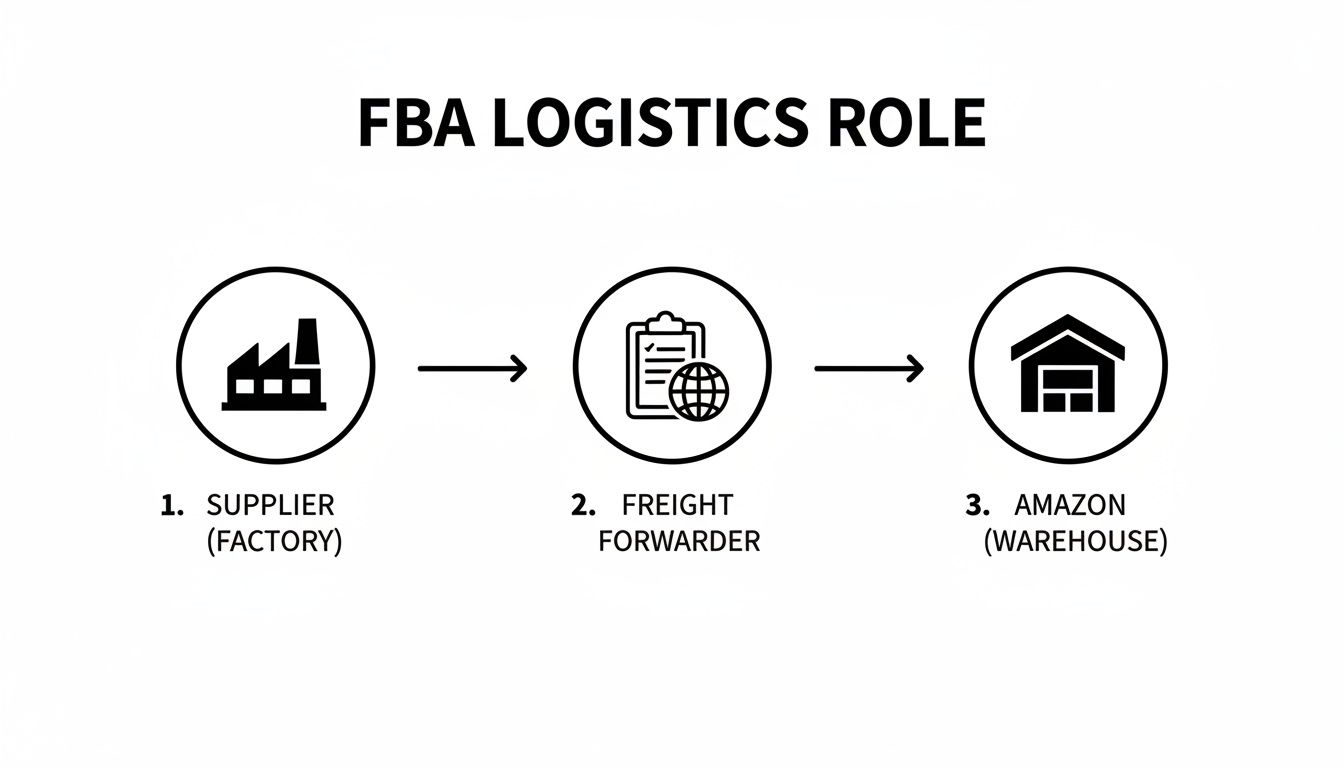
As you can see, the forwarder is the critical link managing all the complex steps between production and final FBA check-in. Without this partner, you'd be stuck coordinating every single one of these steps on your own.
Stage 1: The First Mile and Port Departure
The journey kicks off the moment your supplier gives you the thumbs-up that your order is ready. This first leg, often called the "first mile," is all about getting your goods from the factory to the port or airport they'll depart from.
Your FBA freight forwarder orchestrates this entire step. They'll line up a local trucking company to pick up the cargo, making sure it’s loaded properly and transported securely to the correct port.
At the same time, your forwarder is handling all the export documentation required by the origin country. This paperwork is what legally clears your goods to leave, and trust me, it can become a huge bottleneck if you don’t have an expert handling it.
Stage 2: The Ocean or Air Transit
Once your cargo arrives at the port, it's either grouped with other shipments (if you're using LCL) or loaded into its own dedicated container (FCL). Your forwarder has already booked space on a ship or plane with a carrier, locking in a good rate and a reliable schedule.
This is the longest part of the journey. Here’s what’s happening behind the scenes:
- Ocean Freight: Your products will spend several weeks at sea. Delays can pop up from bad weather, port congestion, or sudden carrier schedule changes.
- Air Freight: While much quicker (usually 5-10 days), air transit is a lot more expensive. It's typically reserved for high-value, lightweight items or when you desperately need to restock.
A good forwarder will provide tracking updates throughout this phase, so you always know where your shipment is and when it’s expected to arrive. This visibility is vital for inventory planning and is a cornerstone of learning how to scale an ecommerce business without constant stockouts.
Stage 3: Customs Clearance in the Destination Country
This is easily the most complex and high-stakes part of the whole process. When your shipment lands at a U.S. port, it has to be officially cleared by U.S. Customs and Border Protection (CBP).
Your freight forwarder, or their customs broker, submits all the necessary paperwork for you. This includes the commercial invoice, packing list, bill of lading, and the Importer Security Filing (ISF).
Key Takeaway: A mistake on your customs paperwork is one of the most expensive errors an Amazon seller can make. A simple typo or an incorrect product classification (HS Code) can trigger inspections, fines, and weeks of delays, completely wrecking your inventory flow.
The forwarder also ensures your import duties and taxes are calculated and paid correctly, allowing your goods to get released from the port without any drama. As your operation grows, looking into supply chain automation can help minimize the human error that often causes these documentation nightmares.
Stage 4: The Final Mile to Amazon
After clearing customs, your inventory enters the "final mile." Your freight forwarder arranges for another trucking company to pick up your goods from the port or a warehouse where they were unloaded.
From there, the shipment is hauled to the specific Amazon fulfillment center you designated in your FBA shipping plan. This isn't as simple as just dropping it off; carriers have to book a precise delivery appointment through Amazon's portal. An FBA-savvy forwarder knows this system inside and out and gets your delivery scheduled properly.
It’s no surprise Amazon’s system is so strict when you realize that 78% of Amazon sellers use FBA. This huge volume is exactly why you need a specialized forwarder who can navigate Amazon's inbound rules and help you avoid the costly delays that lead to stockouts and angry customers.
From start to finish, the FBA freight forwarder acts as your logistics expert, coordinating every player to get your inventory safely into Amazon's hands so you can focus on selling.
How to Select the Best FBA Freight Forwarder for Your Business
Picking a logistics partner is one of the most important decisions you’ll make as an Amazon seller. Seriously. Think of it like hiring a COO for your entire supply chain—the right choice leads to smooth sailing and predictable growth.
The wrong one? It can sink your cash flow with delays, surprise fees, and a whole lot of headaches. This is why you have to go way beyond just comparing price quotes.
You're not just looking for a service provider; you need a partner who acts like an extension of your own team. That means you have to vet potential forwarders on a much deeper level to find one whose expertise, communication style, and services are a perfect match for your business.
Evaluate Their Amazon FBA Expertise
Not all freight forwarders are created equal. Far from it. Many are generalists who handle all kinds of cargo, but a select few are true specialists in the weird and wonderful world of Amazon FBA. You absolutely, positively need one from that second group.
An FBA freight forwarder lives and breathes Amazon’s constantly changing rulebook.
They get the tiny details of Amazon’s packaging, labeling, and pallet requirements that trip up so many others. They also have real experience with Amazon’s Carrier Central portal for booking delivery appointments—a common point of failure for inexperienced forwarders that can get your entire shipment rejected at the warehouse door.
To figure out who's the real deal, ask them pointed questions:
- How do you handle Amazon’s specific pallet requirements for different product categories?
- What’s your process for booking delivery appointments at notoriously busy fulfillment centers?
- Can you share a recent example of how you helped a client avoid an FBA shipment rejection?
Their answers will tell you everything. A true expert will give you detailed, confident responses drawn from actual experience. A generalist will stumble or give you vague, textbook answers.
Communication and Tracking Systems Are Key
When your inventory is floating somewhere in the middle of an ocean, silence is not golden. Transparent, proactive communication isn't a "nice-to-have"; it's a non-negotiable.
The best forwarders give you access to a digital platform or portal where you can see real-time updates on your shipment's status, from the moment it leaves the factory to its final delivery scan.
A great FBA freight forwarder doesn’t wait for you to ask for an update. They proactively inform you of milestones and potential delays, giving you the information needed to manage your inventory and cash flow effectively.
Look for a partner who gives you a single point of contact. Having a dedicated account manager who knows your business and can actually solve problems is a game-changer. There's nothing worse than being bounced between different departments when you have an urgent question about a shipment stuck in customs.
Scrutinize Their Network and Insurance Options
A forwarder is only as strong as its network of carriers, customs brokers, and trucking companies. An established FBA freight forwarder has deep relationships that help them lock in better rates and secure space on ships and planes, especially during peak seasons when things get crazy.
And please, don't overlook cargo insurance. Standard carrier liability is often just pennies on the dollar and won't come close to covering your costs if a container gets damaged or falls off a ship. A professional forwarder will offer comprehensive, all-risk insurance options and be totally transparent about what is and isn't covered.
When sizing up potential partners, it also helps to understand the different kinds of logistics providers out there by comparing 3PL vs 4PL models. This little bit of research can clarify the level of service and integration your business really needs.
This is a massive industry. We're talking about a global freight forwarding market that hit USD 325.18 billion and is expected to climb to USD 536.51 billion. Players like DHL and FedEx move staggering volumes, and this growth just underscores how vital these logistics networks are for connecting sellers like you to Amazon's warehouses.
Finally, before you sign anything, ask for references from other Amazon sellers. Talking to their current clients is the single best way to get an unfiltered look at a forwarder’s reliability, communication, and problem-solving skills. On your end, analyzing Amazon sales data can also give you a better handle on your sales velocity, helping you choose a forwarder who can actually keep up with your inventory demands.
Comparing FBA Freight Forwarder Types
Choosing between a massive global company and a smaller, specialized agency can be tough. Each has its own strengths and weaknesses, and the best fit really depends on your business's size, complexity, and specific needs. Here's a quick breakdown to help you see the difference.
| Feature | Large Global Forwarder (e.g., DHL, FedEx) | Specialized Boutique FBA Forwarder |
|---|---|---|
| FBA-Specific Knowledge | General logistics expertise; FBA may be one of many services offered. | Deep, specialized knowledge of Amazon's strict requirements, portals, and receiving processes. |
| Service Model | Often standardized, one-size-fits-all processes. You're a small fish in a very big pond. | Highly personalized service, often with a dedicated account manager who knows your business. |
| Communication | Can be bureaucratic, with call centers and multiple points of contact. | Direct, proactive communication. They anticipate FBA-specific issues and keep you in the loop. |
| Flexibility & Problem Solving | Rigid systems can make it slow to adapt to unique issues or Amazon's sudden policy changes. | Nimble and quick to resolve FBA-related problems like rejected shipments or appointment issues. |
| Pricing | Can offer competitive rates on high-volume routes due to scale. | May have slightly higher rates, but often saves you money by preventing costly FBA compliance errors. |
| Best For | Large enterprises with diverse, multi-channel logistics needs beyond just Amazon. | Small to medium-sized Amazon sellers who need a true partner focused entirely on the FBA ecosystem. |
Ultimately, while the big names offer incredible scale, a specialized FBA forwarder often provides the focused expertise and hands-on support that Amazon sellers truly need to avoid costly mistakes and keep their supply chain running smoothly.
Decoding Your FBA Freight Forwarding Invoice
Getting your first freight forwarding invoice can feel like trying to read a foreign language. It's often a long list of confusing acronyms and line items that make it nearly impossible to figure out what you're actually paying for. Worse, hidden fees can sneak in and quietly eat away at your profits.
Understanding this document isn’t just an accounting task—it’s a critical skill for protecting your bottom line. Think of the invoice as a detailed receipt for your product's entire journey, from the factory floor to the Amazon fulfillment center.
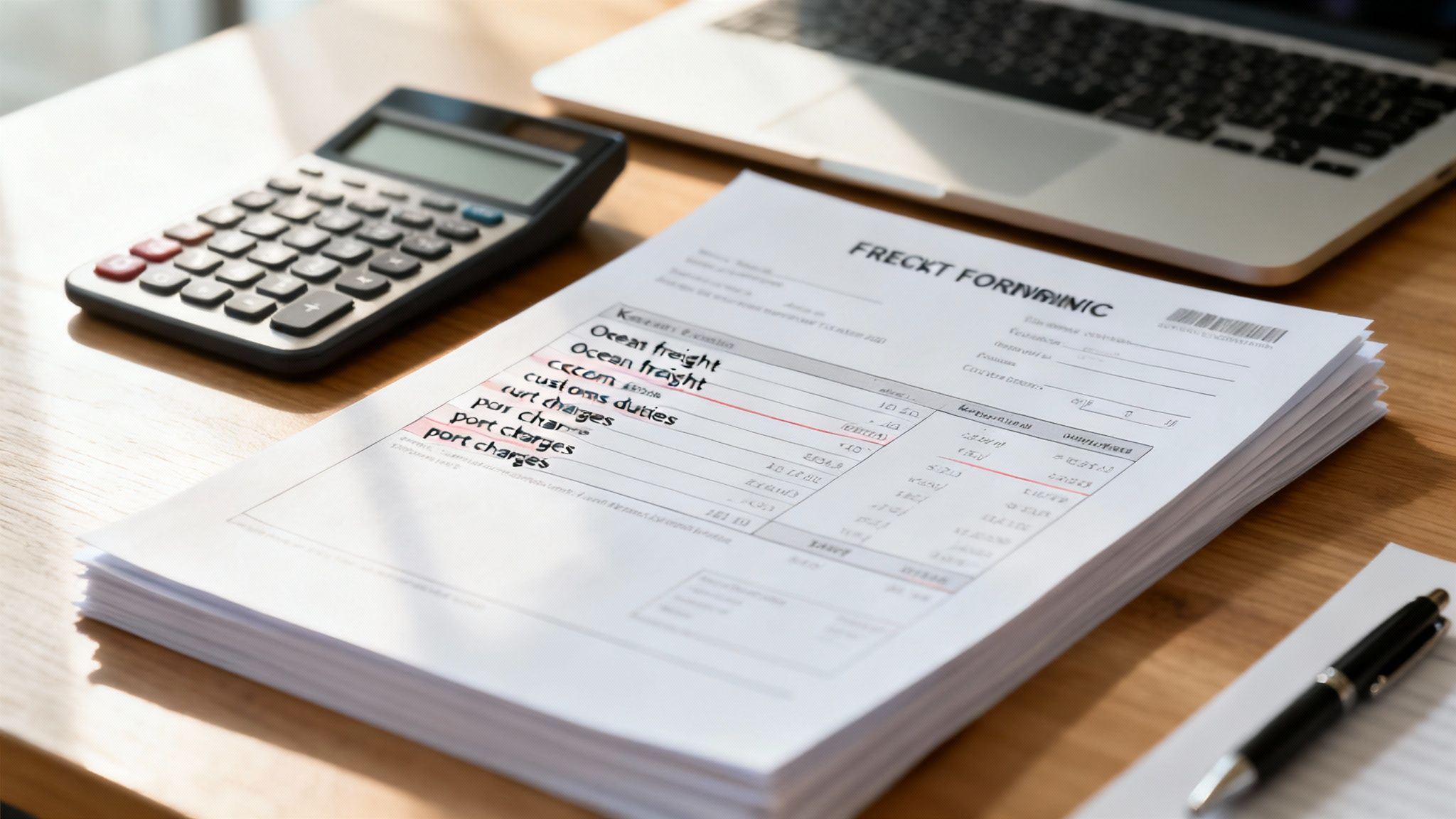
Each line item represents a specific service or fee paid at different stages of the trip. Let's break down what you can expect to see.
Primary Shipping Costs
These are the big-ticket items that make up most of your shipping expenses. They cover the main leg of your product's journey across the ocean or through the air.
- Ocean or Air Freight: This is the core charge for moving your cargo from the port of origin to the port of destination. Rates are anything but stable; they swing wildly based on demand, seasonality, and fuel prices. For instance, shipping a 40-foot container (FEU) from Asia to the US West Coast can jump from $2,000 to over $15,000 depending on the market.
- Customs Duties and Taxes: This is the fee charged by U.S. Customs and Border Protection (CBP) to import your goods. It’s calculated as a percentage of your products' value and can vary drastically depending on the product’s official HS Code classification.
- Cargo Insurance: An absolutely essential cost to protect your inventory against loss or damage in transit. While it might be listed as optional, skipping it is a huge risk that no serious seller should ever take.
Ancillary and Destination Fees
Beyond the main freight charges, you'll find a series of smaller fees covering all the handling and administrative services at both ends of the journey. These are often the "hidden" costs that catch new importers by surprise.
Don't be fooled by a low initial freight quote. A reputable FBA freight forwarder will give you an all-inclusive or "landed cost" estimate that includes these ancillary fees upfront. This gives you a much more accurate picture of your total expense.
Here are a few common ancillary charges:
- Port Charges (THC): Terminal Handling Charges cover the cost of loading and unloading your container at the ports.
- Fuel Surcharge (BAF): The Bunker Adjustment Factor is a variable fee carriers add to cover fluctuating fuel costs.
- Customs Clearance Fee: This is what your forwarder charges for preparing and submitting all the necessary customs paperwork on your behalf.
- Final-Mile Delivery: This covers the cost of trucking your goods from the destination port to the final Amazon FBA warehouse.
Calculating Your True Landed Cost
Once you have all these figures, you can finally calculate your landed cost per unit. This number represents the total cost of getting a single unit of your product from the factory into Amazon's hands, ready to be sold.
To find it, you just add up every single shipping-related fee and divide that total by the number of units in your shipment.
This metric is absolutely vital. If you don't know your true landed cost, you can't price your product correctly, which can lead to selling at a loss without even realizing it. Our guide on how to determine the price of a product dives deeper into this crucial step.
By demanding a transparent, itemized quote from your FBA freight forwarder, you gain the clarity needed to build a profitable and sustainable Amazon business.
Common Shipping Mistakes and How to Avoid Them
A single shipping mistake can snowball into weeks of delays and thousands of dollars in surprise fees. Navigating international freight can feel like walking through a minefield; one wrong step can trigger a chain reaction of problems that stalls your inventory, kills your sales velocity, and damages your brand’s reputation.
The journey from your supplier's factory to an Amazon warehouse is littered with potential traps. From customs holds triggered by tiny paperwork errors to catastrophic losses from bad insurance, the risks are very real. Let's break down the most common—and costly—mistakes Amazon sellers make and, more importantly, how a good FBA freight forwarder helps you sidestep them completely.
Incomplete or Inaccurate Documentation
This is, hands down, the number one reason for customs delays. U.S. Customs and Border Protection (CBP) is notoriously strict, and even a small mismatch between your commercial invoice, packing list, and bill of lading can raise a red flag.
A simple typo in a product description or an incorrect HS code can get your entire shipment pulled for a physical inspection. That means weeks of delays and hundreds, if not thousands, in exam fees. Your freight forwarder is your documentation expert, meticulously reviewing every piece of paper to make sure it's all perfectly aligned before it’s ever submitted.
Choosing Inadequate Cargo Insurance
Many sellers assume that the standard carrier liability will cover them if something goes wrong. Big mistake. In reality, it offers almost no protection, often paying out just a few dollars per kilogram.
If your container falls off a ship, gets damaged, or is stolen, you could lose your entire investment with virtually no way to recover it. A professional FBA freight forwarder will always insist you get comprehensive, all-risk cargo insurance. It’s a small upfront cost that provides total financial protection, turning a business-ending disaster into a manageable hiccup.
Never assume your goods are protected. Always opt for full cargo insurance. The risk of losing tens of thousands of dollars in inventory to save a few hundred on a policy is a gamble you can't afford to take.
Misunderstanding Critical Incoterms
Incoterms are the universal rules that define who is responsible for the goods at every stage of the journey. Picking the wrong one can saddle you with unexpected costs and logistical headaches.
For example, new sellers often get lured in by the low price of EXW (Ex Works) terms. They don't realize until it's too late that they are now responsible for arranging and paying for everything from the factory to the port in a foreign country—a nightmare if you don't know what you're doing.
An experienced forwarder will steer you toward terms like FOB (Free On Board), where the supplier handles all the origin-country logistics. This clarity prevents surprise bills and simplifies your role. As your brand grows, knowing these fundamentals is a key part of learning how to increase sales on Amazon by keeping your products consistently in stock.
By partnering with the right expert, you can proactively avoid these common mistakes and build a reliable supply chain that actually supports your business's growth instead of holding it back.
Frequently Asked Questions About FBA Freight Forwarding
Even with a solid plan, international logistics can throw you a curveball. Every Amazon seller, from first-timers to seven-figure pros, hits a point where they have questions about their supply chain. This section cuts through the noise with direct answers to the most common questions we hear, helping you manage your FBA shipping with a lot more confidence.
Think of this as your go-to cheat sheet for the important stuff. We’ll clear up key roles, weigh your shipping options, and make sure you’re set for a smooth ride from your supplier’s factory to Amazon’s warehouse.
What Is the Difference Between a Freight Forwarder and a Customs Broker?
This is easily one of the most common points of confusion for new importers. While their jobs are closely related and often overlap, they handle two very different parts of your shipment's journey.
Think of your FBA freight forwarder as the general contractor building your house. They're the project manager coordinating everything—hiring the truckers, booking space on the container ship, and making sure the whole project stays on schedule. Their job is to manage the physical movement of your products from point A to B.
A customs broker, on the other hand, is like the specialized attorney who handles all the city permits and legal paperwork. Their one and only focus is making sure your shipment legally clears the border. They classify your products with the right codes and file all the necessary documents with U.S. Customs and Border Protection (CBP).
While some large freight forwarders have customs brokers on staff, many partner with outside firms. The good news is your forwarder manages this relationship for you, so the entire process feels seamless. You don't need to go out and hire a broker separately.
Should I Use Air Freight or Sea Freight for My FBA Shipments?
Picking between air and sea really boils down to one simple trade-off: speed versus cost. There’s no single “best” answer here—the right choice completely depends on your product, profit margins, and current inventory levels.
Sea Freight:
- Cost: This is by far the most economical way to ship goods internationally. It often costs 4 to 6 times less than sending the same shipment by air, making it the default choice for most Amazon products.
- Time: The trade-off is time. A typical sea shipment from Asia to the U.S. can take anywhere from 30 to 45 days (or longer) from the time it leaves the factory until it's checked in at an FBA warehouse.
- Best For: Bulkier, heavier products and routine inventory replenishment where you can plan well in advance.
Air Freight:
- Cost: It's significantly more expensive, and that cost can absolutely crush the profit margins on lower-priced items.
- Time: Speed is the main advantage. Air shipments can arrive in as little as 7 to 10 days, which is a lifesaver in urgent situations.
- Best For: Lightweight, high-margin products or emergency restocks when a bestseller is about to go out of stock.
A smart strategy many sellers use is a hybrid approach. They'll use sea freight for the bulk of their inventory and keep air freight in their back pocket for launching a new product or dodging a costly stockout.
Which Incoterms Are Best for Amazon FBA Sellers?
Incoterms are the universal rules that define who is responsible for what—and when—in an international shipment. Choosing the right one is critical if you want to avoid surprise costs and logistical headaches.
For most Amazon sellers importing from overseas, FOB (Free On Board) is the gold standard.
With FOB, your supplier handles all the costs and risks of getting your products from their factory to the port and loaded onto the ship. The moment your goods are safely on board the vessel, the responsibility flips over to you.
This is the ideal setup because it leaves the tricky local logistics—like trucking and export customs in China—to your supplier, who knows the lay of the land. It gives you full control over the main international shipping leg, which is exactly what your FBA freight forwarder is there to manage for you.
You'll also run into EXW (Ex Works). It might look cheaper on the invoice, but it makes you responsible for everything, including picking up the goods from the factory floor. This can quickly turn into a nightmare if you don't have people on the ground. Unless you have a very good reason, just stick with FOB.
How Do I Prepare My Goods for FBA Shipment?
Amazon is famously strict about how products need to be prepped, packaged, and labeled before arriving at their fulfillment centers. If you don't follow their rules to the letter, they'll reject your shipment, leaving you with costly delays and fees.
Here's a quick rundown of the basics:
- Individual Unit Prep: Every single item needs a scannable barcode (a UPC or an FNSKU label). Anything fragile needs bubble wrap, and liquids need double seals to prevent any chance of leaking.
- Case Pack Labeling: Each master carton that holds your products needs an FBA box label. You'll generate these right inside your FBA shipping plan in Seller Central.
- Palletization: For larger LTL or FCL shipments, your boxes must be stacked on pallets according to Amazon's very specific rules. This includes pallet size, height (max 72 inches), and weight (max 1,500 lbs).
- Provide Documentation: Make sure your freight forwarder gets a copy of your commercial invoice, packing list, and the FBA box labels. They need this paperwork to ensure a smooth final delivery to Amazon.
Managing a global supply chain is a critical part of scaling a successful ecommerce brand. At Next Point Digital, we help sellers optimize every part of their Amazon business, from inventory planning to marketplace growth. If you're ready to build a more resilient and profitable operation, we can help you connect the dots. Learn more about our ecommerce solutions at https://npoint.digital.