

To really move the needle on your Amazon sales, you need to think beyond simple tricks and isolated tactics. Real, sustainable growth comes from a holistic strategy built on three core pillars: driving targeted traffic, maximizing on-page conversions, and fostering customer loyalty for repeat business.
When these three areas work together, they create a powerful engine for growth, ensuring every part of your Amazon presence is pulling in the same direction.
The Framework for Sustainable Amazon Growth
Jumping onto Amazon without a solid plan is like setting sail without a map. Too many sellers get hyper-focused on one area, like pouring money into PPC ads, while completely neglecting the foundation—their actual product detail page. This is a recipe for wasted ad spend and missed opportunities.
A winning Amazon strategy is structured and multi-faceted, with each component supporting the others. It’s not just about getting more clicks; it’s about turning those clicks into sales and, eventually, into loyal customers who come back again and again.
It all starts with getting your product detail page "retail-ready" and having a crystal-clear picture of your ideal customer. Once that foundation is solid, you can build out the three pillars that work in concert to build momentum and drive predictable revenue.
The Three Pillars of Amazon Success
A truly effective strategy weaves traffic, conversion, and retention into a single, cohesive system. If you neglect one pillar, you’ll find the others just don’t perform as well as they should. For instance, what's the point of driving a ton of traffic to a product page that can't convert? It's just throwing money away.
This table breaks down how these three pillars function and the key actions associated with each.
Core Pillars of Amazon Sales Growth
| Pillar | Objective | Key Strategies |
|---|---|---|
| Driving Targeted Traffic | Bring qualified shoppers to your product listings. | Amazon PPC, external marketing, robust keyword optimization, social media promotion. |
| Maximizing On-Page Conversions | Persuade visitors to click "Add to Cart." | Compelling images & video, benefit-driven copy, A+ Content, competitive pricing, positive reviews. |
| Fostering Customer Loyalty | Turn one-time buyers into repeat customers and brand advocates. | Excellent customer service, proactive review management, smart promotions, email marketing. |
By viewing your strategy through this lens, you can ensure every action you take is reinforcing your overall growth goals.
The biggest mistake sellers make is treating these pillars as separate to-do lists. True growth happens when they operate as an interconnected system. The data from your PPC campaigns should inform the keywords on your listing, and the feedback from customer reviews should guide your next product improvement.
The opportunity for brands who get this right is massive. With US ecommerce sales on Amazon projected to climb from $309.48 billion in 2020 to an incredible $540.29 billion by 2025, having a strategic approach is non-negotiable if you want to capture your piece of the pie. You can dive deeper into Amazon's growth trends over at Oberlo.com.
When you put this three-pillar framework into practice, you shift from playing defense to playing offense. You stop reacting to problems and start building a resilient, predictable, and profitable Amazon business. For more advanced strategies on this front, check out our complete guide on how to scale an ecommerce business.
Engineering Product Listings That Convert
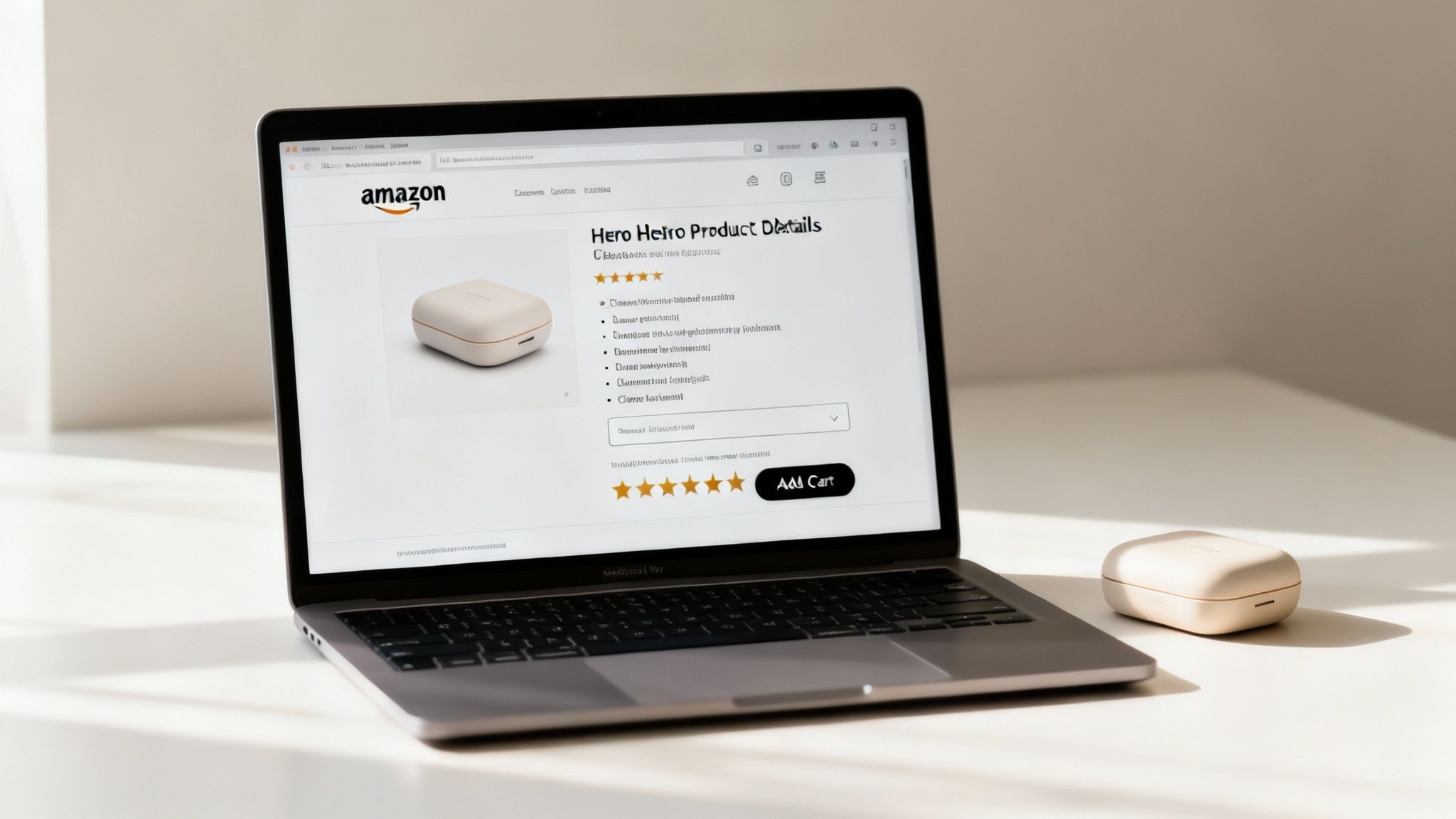
Think of your product detail page as your digital storefront, your best salesperson, and your brand ambassador, all rolled into one. It’s the exact spot where a shopper decides whether to hit “Add to Cart” or click over to a competitor. If you want to improve Amazon sales consistently, you can't just set it and forget it. You have to treat your listing like a high-performance sales engine that needs constant tuning.
Every single element—from the first word in your title to the last bullet point—plays a huge role in discoverability (SEO) and persuasion (conversion). A listing stuffed with keywords but written like a robot won't convert. On the flip side, beautiful images and slick copy are useless if nobody can find your product. The magic happens when you nail the balance between the two.
Crafting a Title That Captures Clicks
Your product title is arguably the most critical piece of real estate on the entire page. It's the first thing shoppers see in search results and a massive factor in Amazon's A9 search algorithm. A great title is a keyword-rich headline that instantly tells a potential buyer what they need to know.
Put yourself in the shopper's shoes: they're scrolling through dozens of nearly identical products. What information do they need to see right now to make them stop and click on yours?
- Lead with your brand and core keyword: [Brand Name] + [Main Product Name]
- Sprinkle in key features or benefits: Think material, size, color, or a primary use case.
- Add compatibility if it's relevant: For instance, "Case for iPhone 15 Pro."
A weak title like "Yoga Mat" gets completely lost in the noise. But a powerful title like "ZenFlow Pro Non-Slip Yoga Mat – 6mm Thick, Eco-Friendly TPE, with Carrying Strap – Ideal for Hot Yoga & Pilates" tells a full story. It hits multiple keywords and answers key questions before the shopper even clicks.
Writing Bullet Points That Solve Problems
Right after the title and main image, shoppers scan the bullet points. This is your chance to stop listing dry features and start selling the benefits. Remember, customers don't buy a drill bit; they buy the hole it creates. You need to frame your bullet points around solving their problems.
Don’t just list what your product is. Explain what your product does for the customer. Transform features into tangible benefits that resonate with their needs and desires. This subtle shift in perspective is a cornerstone of effective conversion copywriting.
Instead of just saying, "Made from 100% Cotton," try something like, "Breathe Easy with Ultra-Soft 100% Hypoallergenic Cotton – Perfect for sensitive skin and a comfortable night's sleep." See the difference? One is a boring fact; the other is a solution.
Leveraging Visuals and A+ Content
We're visual creatures. High-quality images, infographics, and videos are absolutely non-negotiable for building trust and showing your product's true value. Show your product from every possible angle, show it in use, and use text overlays to call out key features. A short video can be a game-changer for conversion rates by demonstrating the product in action.
For brand-registered sellers, A+ Content is where you can really pull away from the competition. It lets you swap out the plain-text description with a visually rich landing page, complete with slick images, comparison charts, and brand storytelling. This is your opportunity to build a deeper connection, answer common questions, and seal the deal.
Getting this right is crucial, especially now that independent sellers power 66% of Amazon's total sales volume. With over 55,000 independent sellers in the U.S. surpassing $1 million in sales in 2024, a professional-looking listing is the bare minimum. You can explore more about Amazon's marketplace dynamics with these valuable insights from ECDB.
By meticulously engineering every piece of your product detail page, you create a smooth journey from discovery to checkout. To go even deeper into this process, check out our guide on how to optimize Amazon product listings for maximum impact.
Use Smart Amazon PPC to Drive Real Growth
An optimized product listing is a fantastic conversion tool, but it can't do its job if shoppers never find it. This is where Amazon Pay-Per-Click (PPC) comes in. Effective advertising isn't about throwing more money at ads than your competitors; it's about smart, strategic investments that deliver profitable growth you can actually measure.
A lot of sellers see PPC as just another expense, maybe even a money pit. But when you run it the right way, it's one of the most powerful data-gathering tools you have. It gives you direct, unfiltered feedback on which keywords are actually converting, how customers react to your pricing, and which of your product images make them stop scrolling. That kind of intel is gold for refining not just your ads, but your entire product strategy.
Matching the Ad Type to Your Goal
Amazon gives you a whole suite of advertising options, and each one is built for a different job. The first step to building a campaign that doesn't just drain your budget is knowing which tool to pull out of the toolbox.
- Sponsored Products: These are the ads you see everywhere—right in the search results and on product detail pages. They are the workhorse of most PPC strategies and are perfect for driving direct sales of specific products. If you have a product you want to move, you start here, targeting high-intent keywords.
- Sponsored Brands: Think of these as a digital billboard at the top of the search results. They feature your brand logo, a custom headline, and a collection of your products. They’re fantastic for building brand awareness and funneling traffic to your Amazon Storefront, introducing shoppers to your whole lineup.
- Sponsored Display: This is your retargeting engine. These ads let you follow shoppers who’ve viewed your products (or similar ones) as they move across Amazon and even onto other websites. Use these to stay top-of-mind and bring back potential customers who were close to buying but got distracted.
By weaving these ad types together, you can build a full-funnel strategy that engages shoppers whether they're just browsing, comparing options, or ready to buy.
Your Foundation: Deep Keyword Research
The success or failure of your campaigns rests on targeting the right keywords. This means you have to go deeper than just the obvious, high-volume terms. You need to dig for the long-tail keywords that signal a customer is ready to buy.
Think about it. Someone searching "running shoes" is just browsing. But a shopper searching for "men's trail running shoes size 11 wide" is holding their credit card.
Start by brainstorming a seed list of every term you can think of related to your product. Use the autocomplete feature in Amazon's search bar to see what real customers are actually typing. From there, use a third-party tool to flesh out that list and get data on search volume and competition. Group your keywords into super-specific ad groups (like "waterproof hiking boots" vs. "lightweight hiking boots") so your ads are always hyper-relevant. For a detailed guide on platform-specific strategies, check out this practical guide on advertising on Amazon.
The goal of keyword research isn't just to find popular terms. It's to uncover the precise language your ideal customer uses when they are actively looking to solve a problem that your product addresses.
Once your campaigns are up and running, you need to live inside your Search Term Report. This report is a goldmine—it shows you the exact search terms shoppers used right before clicking your ad. You'll almost always find unexpected but highly profitable keywords you can pull out and put into their own manual campaigns for more control. For a deeper dive into the mechanics, explore our guide that answers the question, "what is PPC on Amazon?"
Optimize for Profit, Not Just Clicks
Launching a campaign is easy. The real work—and the real profit—comes from constant, relentless optimization. One of the most important jobs is managing your negative keywords. These are the terms you specifically tell Amazon not to show your ads for.
For example, if you sell premium leather phone cases, you'd add "cheap," "plastic," and "silicone" as negative keywords. This simple step stops you from wasting money on clicks from shoppers looking for something you don't even sell, protecting your budget and improving your ad's relevance score.
Another critical task is analyzing your Advertising Cost of Sale (ACoS). ACoS tells you how much you're spending on ads for every dollar of revenue you generate. While a lower ACoS is generally good, the "right" number depends entirely on your profit margins and your goals. If you're launching a new product, you might be perfectly happy with a higher ACoS to get those crucial first sales and reviews.
The scale of Amazon advertising is staggering. Amazon's ad revenue shot up 22% year-over-year to $17.6 billion in Q3 2025, which is a massive signal that smart, data-driven campaigns are the main way to grow on the platform. With independent sellers in the US averaging over $290,000 annually, you can't afford not to use targeted ads if you're serious about scaling. Treat PPC as a continuous cycle of testing, analyzing, and refining, and you'll turn your ad spend into a predictable, profitable growth engine.
Winning the Buy Box with Smart Pricing and Promotions
Let's be honest, competing on price alone is a dangerous game on Amazon. It’s a fast track to shrinking your margins and making your brand feel cheap. While you absolutely have to be price-competitive to win the coveted Buy Box, the smartest sellers know that pricing is a strategic tool, not a race to the bottom.
It's all about striking a delicate balance. You need to keep a close eye on your direct competitors—and not just their prices. Look at their stock levels, seller ratings, and fulfillment methods. Amazon's algorithm weighs all of these factors, which is why the lowest price doesn't always win the sale.
Using Dynamic Pricing to Stay Competitive
Manually adjusting prices for dozens or hundreds of products is a nightmare. This is where dynamic pricing tools, often called repricers, become your best friend. These automated systems adjust your prices in real-time based on a set of rules you define.
For instance, you could set a rule to price your product $0.01 below the current Buy Box winner, but only if that price stays above your minimum profit margin. This keeps you in the game without ever selling at a loss.
A good repricer lets you:
- Set a Floor and Ceiling: Always establish a minimum price (your floor) to protect your margin and a maximum price (your ceiling) to take advantage of moments when competitors sell out.
- Analyze Competitor Metrics: Set up your repricer to only compete against sellers with similar stats, like those also using FBA or sellers with a rating above 95%.
This automated approach lets you react to market shifts 24/7, giving you a massive edge and helping you improve Amazon sales while you're focused on other parts of your business.
Deploying Promotions for Strategic Growth
Beyond day-to-day price tweaks, Amazon’s promotional tools are powerful levers for driving sales velocity, clearing out old inventory, and grabbing the attention of new customers. But don't just throw discounts out there randomly; every promotion should have a clear, strategic goal.
Promotions aren't just about offering discounts. Think of them as investments in sales velocity and visibility. A successful Deal or Coupon campaign can dramatically improve your Best Seller Rank (BSR), leading to sustained organic traffic long after the promotion ends.
This infographic breaks down the core process for using paid strategies, like promotions and PPC, to fuel your growth.
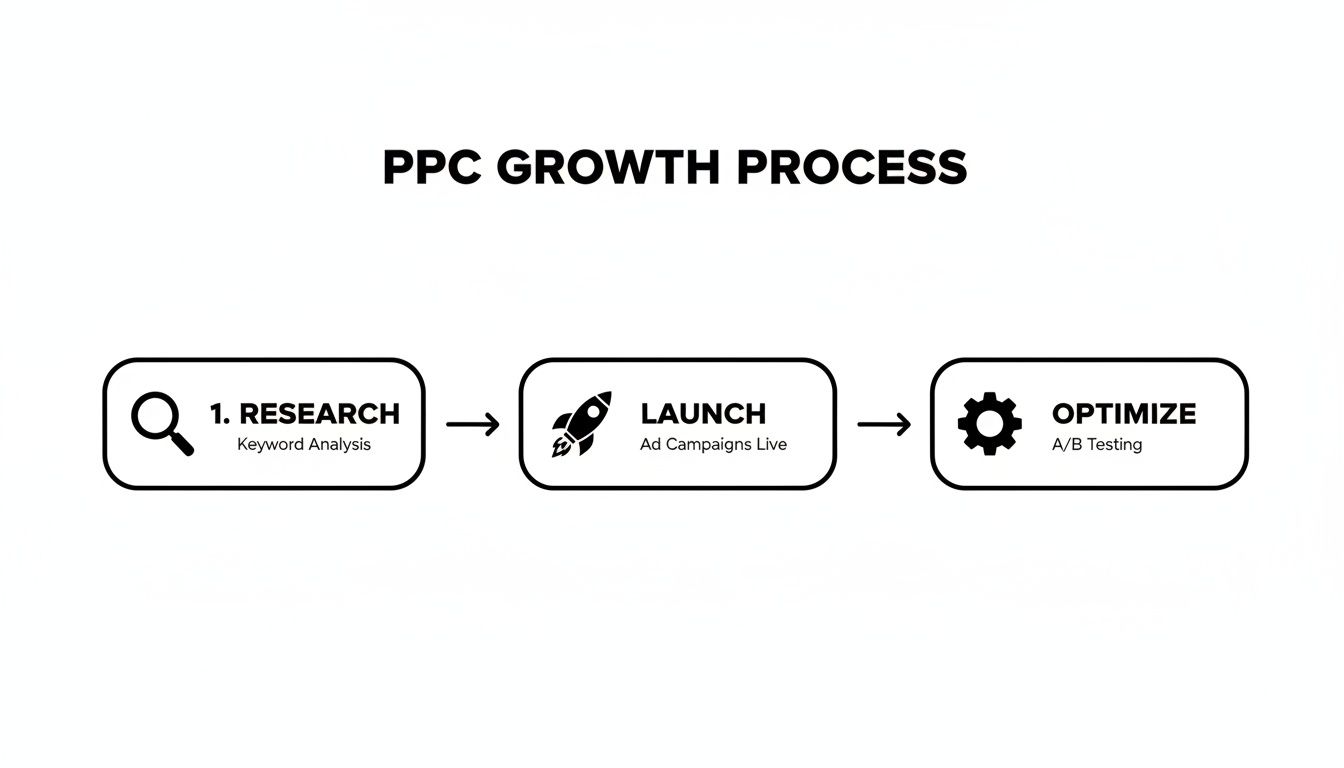
It shows that successful campaigns follow a clear cycle: research, launch, and optimize. This is just as true for your promotions as it is for your PPC ads.
Choosing the Right Promotional Tool
Amazon offers several ways to run special offers, and each one is suited for a different goal. Knowing which tool to use—and when—is the key to maximizing your return and avoiding unnecessary margin erosion. For a deeper dive into setting your prices, you can learn more about how to determine the price of a product in our detailed guide.
Here are a few of the most popular options:
- Coupons: Those little orange tags you see on the search results page are digital coupons. They're fantastic for increasing click-through rates because they make your listing stand out. They're perfect for giving a new product an initial sales bump or breathing life into a slow-mover.
- Deals (e.g., Lightning Deals, 7-Day Deals): These are time-sensitive promotions featured on Amazon's popular Deals page. They do require an inventory commitment and a fee, but they can deliver a massive, short-term spike in sales and visibility. They work great for clearing out seasonal stock or launching a flagship product.
- Subscribe & Save: If you sell consumable products, this is a non-negotiable. Offering a discount for recurring deliveries builds a base of loyal, repeat customers and creates a predictable revenue stream. It's one of the best tools for improving customer lifetime value (CLV).
By combining smart, automated pricing with a well-planned promotional calendar, you can win the Buy Box more often, drive strategic growth, and build a more resilient brand on the Amazon marketplace.
Strengthening Your Backend with Smart Fulfillment
A perfectly optimized listing with stunning images and compelling copy sells absolutely nothing if the product is out of stock. It's easy to get caught up in the front-end marketing, but if you want to consistently improve Amazon sales, you have to master the less glamorous side of the business: inventory and fulfillment.
This is where you build the operational muscle that supports real growth and keeps customers happy. Your fulfillment strategy impacts everything, from your Prime eligibility to your profit margins. Making the right choice isn't just a logistical decision; it's a strategic one that defines your customer experience. The two main paths are Fulfillment by Amazon (FBA) and Fulfillment by Merchant (FBM).
Choosing Your Fulfillment Model: FBA vs. FBM
For many sellers, FBA feels like the default choice. You ship your products in bulk to Amazon’s warehouses, and they handle everything else—storage, picking, packing, shipping, and even customer service. The biggest win here is that your products automatically become Prime-eligible, which is a massive conversion driver. Of course, this convenience comes with storage and fulfillment fees that will eat into your margins.
On the other hand, FBM puts you in complete control. You store your own inventory and are responsible for shipping every single order directly to the customer. This route can offer much better margins, especially on large, heavy, or slow-moving items where FBA storage fees would be punishing. The trade-off is the immense operational responsibility and the pressure of meeting Amazon's strict shipping standards on your own.
To help you decide which model fits your business, here’s a quick look at how they stack up.
FBA vs. FBM: A Quick Comparison
| Feature | Fulfillment by Amazon (FBA) | Fulfillment by Merchant (FBM) |
|---|---|---|
| Prime Eligibility | Automatic, boosting visibility and conversions. | Difficult to achieve (requires Seller Fulfilled Prime). |
| Logistics | Amazon handles all storage, packing, and shipping. | You manage all inventory, packing, and shipping. |
| Customer Service | Handled by Amazon for all fulfillment issues. | You are responsible for all customer inquiries. |
| Costs | Fulfillment fees, monthly storage fees, and long-term storage fees. | Shipping costs, packaging materials, and labor. |
| Best For | High-volume sellers, standard-sized products, and those wanting a hands-off approach. | Sellers with large/heavy items, multi-channel operations, or those with existing logistics capabilities. |
Ultimately, the right choice depends on your products and your scale.
A brand selling small, fast-moving items might thrive with FBA, while a furniture seller would almost certainly find FBM more cost-effective. Some sellers even use a hybrid approach, putting their bestsellers in FBA and fulfilling niche or oversized products themselves.
If you're already using FBA or thinking about it, our guide on what is Amazon FBA offers a much deeper dive into how it all works.
Mastering Inventory Management to Prevent Stockouts
Just picking a fulfillment method isn't enough. You need a solid inventory management system to protect your sales momentum. Running out of stock is one of the most damaging things that can happen to a successful listing. When you go out of stock, you lose sales, and your Best Seller Rank (BSR) plummets, making it incredibly difficult to regain visibility once you're back.
Effective inventory management all comes down to accurate demand forecasting. Dig into your historical sales data, factoring in seasonality and promotional spikes, to predict how much stock you'll need and when. This prevents both costly overstocking (hello, long-term storage fees) and those damaging stockouts. A recent survey found that 23% of shoppers abandoned their carts simply because delivery was too slow—a problem often tied directly to poor inventory placement and stock levels.
Another critical metric for FBA sellers is the Inventory Performance Index (IPI). This score, ranging from 0 to 1,000, measures how well you're managing your FBA inventory. Amazon uses it to determine your storage limits, and a low IPI score can severely restrict how much inventory you can send in, effectively throttling your growth.
To keep your IPI score high, you need to focus on:
- Maintaining a healthy sell-through rate.
- Fixing any stranded inventory issues immediately.
- Avoiding excess and aged inventory like the plague.
By building a lean, efficient backend, you create a stable foundation that allows all your marketing and optimization efforts to actually pay off. It ensures a great product is always there for a great customer.
Building Social Proof with Reviews and Reputation
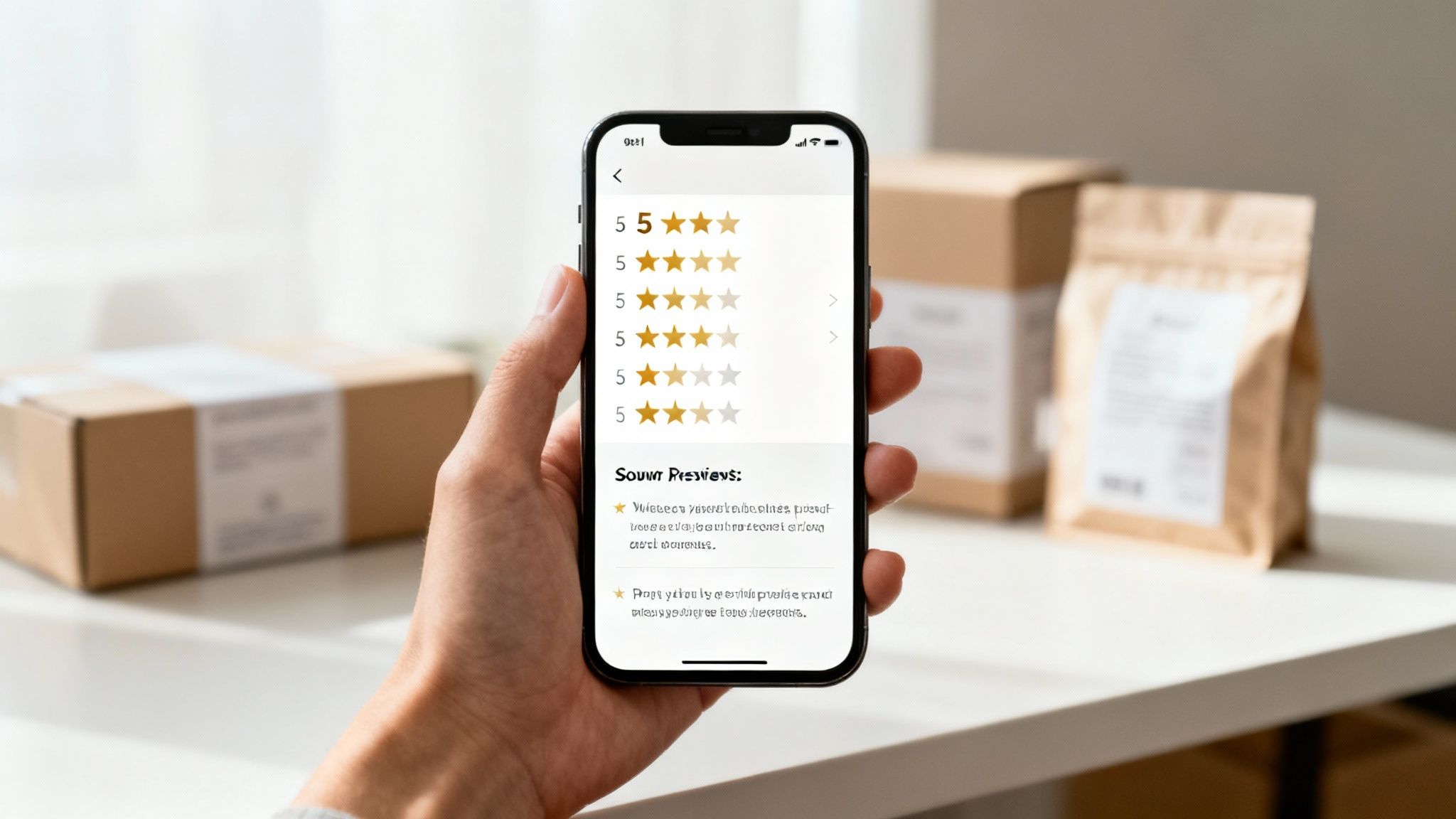
Positive reviews are the digital version of a friend’s recommendation, and they’re absolutely critical to improve Amazon sales. In a marketplace flooded with similar-looking products, a solid collection of authentic reviews is often the final push a shopper needs before clicking “Add to Cart.”
Social proof isn't just a bonus; it's a powerful currency that builds trust and directly lifts your conversion rate.
Amazon is notoriously strict about review manipulation, so your strategy has to be 100% compliant. The good news is, they give you legitimate tools to build momentum. The "Request a Review" button on your order details page is the simplest, most direct option. Clicking it sends a standardized, Amazon-branded email to the buyer asking for both a product review and seller feedback.
Proactive and Compliant Review Generation
While the "Request a Review" button is a good start, you can get more strategic. For new products or listings that need a jumpstart, consider the Amazon Vine Program to Boost Sales With Trusted Reviews.
Vine invites a hand-picked group of Amazon's most trusted reviewers to get your product for free in exchange for an honest, unbiased review. These reviews get a special "Vine Voice" badge, which adds a ton of credibility right out of the gate.
Another powerful tactic is simply providing excellent, proactive customer service. Great service naturally leads to positive feedback. Instead of just reacting to problems, you can:
- Use Product Inserts: A clean, well-designed card in your packaging can thank the customer, offer support info, and gently remind them that their feedback matters. Just make sure you avoid any language that even hints at incentivizing a positive review.
- Engage with Questions: Promptly and helpfully answer questions in your product's Q&A section. This not only helps the person asking but also shows every future visitor that you're an engaged, reliable brand.
Managing Your Online Reputation
Your reputation isn't just built on good reviews; it's also defined by how you handle the bad ones. Ignoring a one-star review is a huge missed opportunity. A professional, empathetic response shows other potential customers that you stand behind your product and actually care about satisfaction.
A thoughtful response to a negative review can sometimes be more powerful than a five-star review. It demonstrates transparency and a commitment to customer service, turning a potential negative into a display of your brand's integrity.
When you respond to negative feedback, always thank the customer for their input, apologize for their bad experience, and offer a way to make things right offline. This public display of accountability builds immense trust.
By actively managing your reputation and ethically encouraging feedback, you create a powerful flywheel of social proof that fuels long-term, sustainable growth.
Got Questions About Growing Your Amazon Sales?
If you're feeling a bit stuck trying to navigate the Amazon maze, you're not alone. Most sellers run into the same roadblocks. Let's tackle some of the most common questions head-on so you can get back to growing your business.
How Long Does It Take to Actually See Sales Improve?
There's no magic wand here, but if you’re putting in the work, you should start seeing real, meaningful changes within 30 to 90 days.
Simple tweaks, like rewriting your title and bullet points, can sometimes move the needle in just a few weeks as Amazon's algorithm takes notice. But for something more complex, like a new PPC campaign, you’ll want to give it at least a full month to collect enough data before you can really start optimizing for profit.
Remember, improving Amazon sales is a marathon, not a sprint. A quick sales bump from a promotion is nice, but long-term, sustainable growth comes from constantly testing, learning, and refining your strategy over time.
FBA vs. FBM: Which One is Actually Better for Growth?
The right call here really depends on your specific product and business model. There’s no single "best" answer, but here’s how to think about it:
- Fulfillment by Amazon (FBA): This is usually the go-to choice for growth-focused sellers. Why? Because it automatically makes your products Prime-eligible, which is a massive conversion booster. It’s perfect for standard-sized, fast-moving items where you’d rather let Amazon handle the logistics.
- Fulfillment by Merchant (FBM): If you're selling large, heavy, or slow-moving products, FBM is often the smarter move. You avoid the hefty FBA storage fees that would eat into your margins and get to keep more control over your inventory.
Plenty of successful brands actually use a hybrid approach. They put their top-selling products in FBA to get maximum visibility and fulfill their more niche items themselves via FBM.
Can I Really Succeed on Amazon Without Running PPC Ads?
Technically, it's possible. Realistically? It’s incredibly tough in today’s market.
Organic sales are the foundation of any healthy Amazon business, but Amazon PPC is what lights the fire. It's the best tool you have for launching new products, accelerating growth, and discovering what keywords your customers are actually using to find you.
Without ads, you’re just waiting for people to find you organically, which can be a painfully slow and unpredictable process. PPC gives you the power to put your product right in front of shoppers who are ready to buy.
At Next Point Digital, we build data-driven strategies that turn clicks into loyal customers. If you're ready for significant, measurable growth on Amazon and beyond, let's talk. https://npoint.digital