

Seller Fulfilled Prime (SFP) is a program that lets qualified Amazon sellers put the Prime badge on their listings while shipping orders directly from their own warehouse or with a third-party logistics (3PL) partner.
This gives brands the visibility that comes with Prime without handing over all their inventory and operational control to Fulfillment by Amazon (FBA). It’s a strategic choice for sellers who already have their logistics dialed in and want to own their customer experience from click to unboxing.
What Seller Fulfilled Prime Means for Your Brand Today
After a long pause, the return of Seller Fulfilled Prime (SFP) is a pretty big deal for established sellers on Amazon. The program’s reopening gives serious brands a powerful alternative to FBA. It's your chance to earn that coveted Prime badge—a symbol of trust and fast shipping for millions of shoppers—without losing direct control over your inventory, packaging, and brand presentation.
This isn't just another fulfillment option; it's about strategic flexibility. With SFP, you can finally:
- Centralize Your Inventory: Manage stock for all your sales channels from a single location, which means no more splitting inventory between your warehouse and FBA.
- Control Your Brand: Use custom packaging and inserts to create a unique unboxing experience. That's something you just can't do with a standard FBA shipment.
- Potentially Lower Costs: For certain products—especially oversized, heavy, or slow-moving items—SFP can help you sidestep FBA’s pricey long-term storage and fulfillment fees.
The Strategic Advantage of SFP
Let’s be clear: SFP is best for sellers who already have a well-oiled logistics machine. The program demands near-perfect performance, including hitting nationwide two-day delivery promises without fail. It's a high-stakes, high-reward system.
The competition on Amazon is fierce. With over 4.5 billion items shipped via FBA in 2023 alone, standing out is non-negotiable. Earning the Prime badge through your own operations gives you a massive competitive edge and is one of the best ways to learn https://npoint.digital/how-to-increase-sales-on-amazon/.
This visual really gets to the heart of SFP. It bridges the gap between maintaining operational control and getting access to Amazon's most loyal customers.
Since SFP is a highly specialized version of e-commerce fulfillment, it helps to understand the bigger picture. Getting familiar with different Ecommerce Order Fulfillment Services can give you some valuable context. Before jumping in, you need to take a hard, honest look at your current operations to see if this program truly aligns with your business goals.
Getting Your Account Ready for Amazon's SFP Trial
Before you even dream of getting into the Seller Fulfilled Prime trial, your account needs to be a shining example of operational excellence. Amazon doesn't just hand out invitations to anyone; they demand a proven track record of reliability, measured by several non-negotiable performance metrics.
Think of these requirements as your ticket to even get on the SFP waitlist. Your seller account must be a professional one and in good standing, but this isn't just a vague suggestion—it’s all backed by hard data that shows you can keep customers happy, consistently.
Core Account Health Benchmarks You Can't Ignore
Amazon is obsessed with the customer experience, and that obsession is the driving force behind these tough requirements. To even be considered, your account has to show strong performance in three critical areas over the last 30 days.
- Order Defect Rate (ODR): You need to keep this below 1%. ODR is the master metric that bundles negative feedback, A-to-z Guarantee claims, and credit card chargebacks. It's Amazon’s top-line measure of your overall customer service quality.
- Pre-fulfillment Cancel Rate: This rate has to stay under 2.5%. It tracks how often you cancel an order before shipping, which usually points to stockouts. A low rate tells Amazon your inventory management is on point.
- Late Shipment Rate: You must keep this below 4%. This metric is simple: it’s the percentage of orders shipped after the expected date. It’s a direct reflection of how efficiently your warehouse operates.
You can check where you stand on all of these by heading to the Account Health dashboard in Seller Central. If any metric is heading in the wrong direction, you need to fix the root cause before you even think about applying. For a deeper dive into what drives performance, check out guides on analyzing your Amazon sales data.
Here's a quick checklist to see if you're ready to apply for the SFP trial.
SFP Eligibility Checklist Before You Apply
| Metric | Required Standard | Where to Check in Seller Central |
|---|---|---|
| Order Defect Rate | Below 1% | Account Health > Customer Service Performance |
| Pre-fulfillment Cancel Rate | Under 2.5% | Account Health > Shipping Performance |
| Late Shipment Rate | Below 4% | Account Health > Shipping Performance |
| Account Type | Professional | Settings > Account Info > Your Services |
| Account Status | Good Standing | Account Health > Policy Compliance |
If you're hitting all these targets consistently, you're in a great position to get started.
The logic here is pretty straightforward: if you can't meet these basic standards with your regular FBM orders, there's no way you'll handle the intense pressure of SFP. Amazon sees your past performance as a predictor of your future success.
Meeting the New Era of SFP Standards
And the bar is only getting higher. Amazon is rolling out even stricter operational demands that are changing what it takes to succeed with SFP. Starting June 29, 2025, sellers will need to ship a minimum of 100 SFP packages per month. If you can't hit that volume, Amazon might automatically cap your daily Prime orders. You can learn more about these big SFP updates over at gobrandwoven.com.
Once you get past the initial checks and into the SFP trial, the expectations ramp up even more. During this probationary period, you have to prove you can operate at a Prime level. That means maintaining a 99% on-time shipping rate using Amazon Buy Shipping. This trial is your live audition, and you have to prove you can deliver on the Prime promise, every single time.
Navigating the SFP Trial and Enrollment Process
Getting into Seller Fulfilled Prime isn’t as simple as filling out a form. It's a demanding trial period where Amazon puts your entire operation under a microscope to see if you can truly deliver on their promise of speed and reliability. This journey starts long before you ever ship a Prime order, requiring careful planning from the moment you hit "join waitlist."
Once you’ve met the pre-qualification metrics and are on the SFP waitlist, the real prep work starts. The second Amazon sends that coveted invitation, you need to be ready to move. Your first order of business is to get your Prime shipping templates configured perfectly. This isn't a "set it and forget it" task; you’ll be defining precise shipping regions, nailing down accurate transit times, and establishing daily order cut-off times, which are typically around 2:00 PM local time.
From there, you'll need to strategically assign specific SKUs to your new Prime template. A common mistake I see sellers make is enrolling their entire catalog at once. Don't do that. Start with a small, manageable selection of your best-selling products—the ones that are easy to pick, pack, and ship. This focused approach lets your team perfect the workflow before you even think about scaling up.
Succeeding During the SFP Trial Period
The trial period is your live audition, and believe me, Amazon is watching every single move. You won't have the Prime badge visible on your listings just yet, but you're expected to meet Prime performance standards from day one. This "silent performance phase" is designed to test your consistency under real-world pressure.
To pass, your warehouse operations need to be flawless. This really boils down to mastering a few key areas:
- Order Cut-Off Discipline: Every Prime order that comes in before your cut-off time absolutely must ship the same day. There is zero room for error here.
- Weekend Operations: Fulfilling and shipping orders on Saturdays is non-negotiable. Make sure you have the staffing and carrier pickups scheduled to handle it without a hitch.
- Buy Shipping Mandate: You are required to purchase 100% of your shipping labels for Prime orders through Amazon’s Buy Shipping service. This is critical for tracking and protecting your metrics if a carrier messes up.
This flow chart shows the core metrics you have to maintain to pass the trial and, ultimately, keep your SFP status.
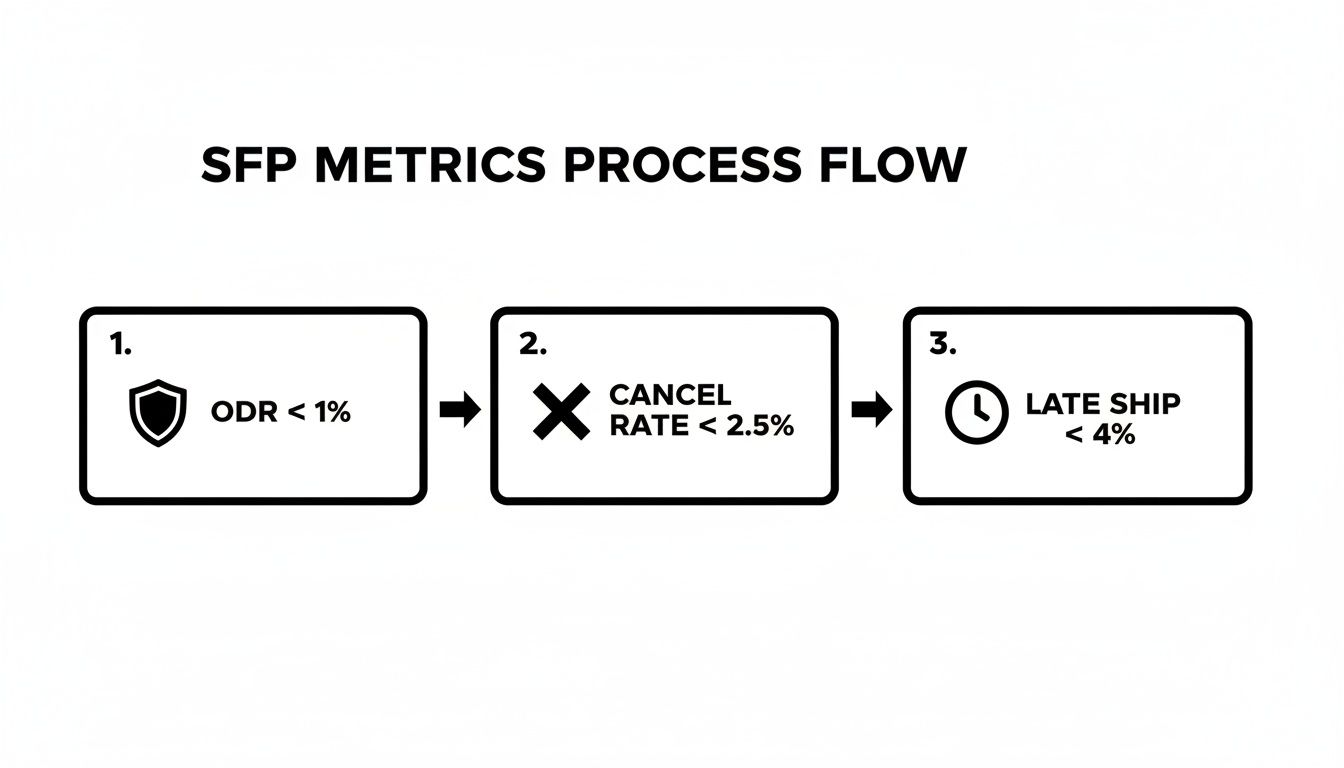
As you can see, the tolerance for failure on metrics like Order Defect Rate, Cancel Rate, and Late Shipment is razor-thin, which underscores the need for complete operational precision.
Preparing for Graduation and Beyond
Think of the trial as a marathon, not a sprint. Amazon is also strict about when you can graduate. For example, you can't complete your trial and earn the badge during peak shopping seasons, like the month leading up to Black Friday. You're also limited to just three trial attempts per calendar year, so it’s vital to get it right the first time.
The SFP trial isn't just about hitting metrics for 30 days. It's about building a scalable system that can sustain Prime-level performance indefinitely. Your goal should be to create workflows that make meeting these standards second nature for your team.
Once you graduate, the real work begins. Your performance will be monitored constantly, and any dip below the required thresholds can lead to a suspension of your Prime badge. The skills and discipline you build during the trial are the foundation for long-term success with your seller fulfilled prime fulfillment strategy. For more tips on making your products stand out, check out our guide to optimize Amazon product listings.
Mastering Your SFP Shipping and Logistics
Your success with Seller Fulfilled Prime lives and dies by your operational execution. Unlike FBA, where you hand off logistics to Amazon, SFP puts the entire responsibility of meeting the Prime promise squarely on your shoulders.
This isn't a small task. It requires a near-flawless system for picking, packing, and shipping every single day.
The cornerstone of this entire operation is Amazon's Buy Shipping service. Using it isn't optional; it's a mandatory requirement for 100% of your SFP orders. More importantly, it acts as your primary defense against carrier-related dings to your performance metrics.
When you purchase an "OTDR Protected" label through Buy Shipping and the carrier delivers it late, Amazon won't count that against your On-Time Delivery Rate. It's your get-out-of-jail-free card for carrier delays.

Building an Efficient Warehouse Workflow
Speed and accuracy are everything. Your warehouse needs to be set up to handle SFP orders from the moment they drop until the carrier scans them at the end of the day. To really nail this, you need to think like a finely tuned machine, implementing strategies from a solid pick and pack fulfillment playbook.
Your daily workflow should prioritize SFP orders to meet the strict cut-off times, typically around 2:00 PM local time. This means having a clear process:
- Immediate Order Identification: Use filters or dedicated queues in your order management system to flag SFP orders the second they arrive. Don't let them get lost in the shuffle.
- Optimized Pick Paths: Arrange your warehouse layout to minimize travel time for your most popular SFP products. Every second saved is a win.
- Dedicated Packing Stations: Equip these stations with all necessary supplies—boxes, tape, dunnage—and make sure packers can quickly generate labels via Buy Shipping without any friction.
- End-of-Day Scan Forms: Always generate a manifest or scan form for your carriers. This proves you handed off the packages on time, which is your only defense if a dispute arises.
Crafting a Smart Carrier Strategy
Hitting nationwide two-day delivery targets without destroying your profit margins is the biggest puzzle of SFP. A single-carrier strategy rarely works. Instead, you need a dynamic approach that leverages the strengths of different carriers based on destination and service level.
You might find that UPS Ground is reliable and cost-effective for commercial addresses within a two-day radius, while USPS Priority Mail offers better rates for residential deliveries. The key is to use the options available in Buy Shipping to select the most affordable service that still meets the two-day promise for each specific order.
A common mistake is assuming you need expensive air services for every cross-country shipment. With a well-placed warehouse or a smart multi-carrier strategy, you can often meet delivery promises with ground services, saving you a significant amount on shipping costs.
Managing Saturday operations is another non-negotiable part of SFP. You must have a plan for picking, packing, and securing carrier pickups on Saturdays. This often means coordinating with your local USPS post office for a weekend drop-off or scheduling a dedicated Saturday pickup with UPS.
As you plan your operations, you can find more guidance in our article about how to scale an ecommerce business.
SFP vs FBA A Strategic Cost and Control Analysis
Choosing between Seller Fulfilled Prime (SFP) and Fulfillment by Amazon (FBA) is one of the biggest forks in the road for any Amazon seller. It’s a classic tug-of-war between operational control and sheer convenience, and there's no single right answer. This decision goes way beyond just who puts the product in the box—it's a strategic move that shapes your brand, your customer's experience, and your profit margins.
There's a reason FBA is the default for so many. In 2025, an estimated 82% of active Amazon sellers will be using FBA, a number that speaks volumes about its appeal. While this highlights how easy it is to let Amazon handle the heavy lifting, it also shines a light on just how high the operational bar is for alternatives like SFP. You can dig into more on FBA adoption rates on redstagfulfillment.com.
Breaking Down the True Costs
On the surface, comparing the costs seems simple, but FBA and SFP are built on entirely different financial models. FBA bundles everything into a suite of fees: fulfillment fees for every unit, monthly inventory storage fees, and those dreaded long-term storage fees that punish slow-moving stock. If you want a deep dive into these charges, you can learn more about what Amazon FBA means for your finances.
SFP flips the script, putting the cost burden squarely on your shoulders. You’re now responsible for:
- Shipping Costs: This means negotiating your own carrier rates and footing the bill for that nationwide two-day delivery promise.
- Labor: You're paying your own team to pick, pack, and ship every single order that comes through.
- Overhead: Don't forget the warehouse rent, utilities, and the endless rolls of packing tape and boxes.
If you’re selling bulky, heavy, or slow-moving items, SFP can be a total game-changer, letting you dodge FBA’s punitive storage fees. But for small, lightweight, fast-selling products, FBA’s massive scale often makes it the more economical choice.
The Battle for Brand Control
Here’s where the two paths really diverge. With FBA, your meticulously crafted product arrives in a generic, Amazon-branded brown box. It’s fast and reliable, sure, but it does absolutely nothing to build your brand. It’s Amazon’s experience, not yours.
SFP, on the other hand, puts you in complete command of the unboxing. Want to use custom packaging? Go for it. Want to include a marketing insert or a handwritten thank-you note? You can. That moment of arrival is a powerful touchpoint for creating a loyal customer who remembers your brand, not just Amazon.
The trade-off is crystal clear: FBA gives you unparalleled logistical simplicity but strips away your brand control. SFP demands operational mastery but empowers you to own the entire customer relationship, from the first click to the final unboxing.
Ultimately, the decision to go with a seller fulfilled prime fulfillment strategy comes down to this balance. If your brand is built on a unique customer experience and you have the warehouse and team to back it up, SFP offers a path to that coveted Prime badge without sacrificing your identity. If your priority is getting to market fast and keeping things simple, FBA is still the undisputed champion.
Seller Fulfilled Prime vs Fulfillment by Amazon
Deciding between SFP and FBA isn’t just about logistics; it’s a fundamental choice that impacts your costs, control, and brand identity. The table below breaks down the key differences to help you see which model truly aligns with your business goals.
| Feature | Seller Fulfilled Prime (SFP) | Fulfillment by Amazon (FBA) |
|---|---|---|
| Inventory Control | Full control: You manage your own stock in your own warehouse. | Limited control: Amazon manages your inventory in their fulfillment centers. |
| Shipping | Seller responsible: You handle picking, packing, and nationwide 2-day shipping. | Amazon handles: Amazon takes care of all shipping and logistics. |
| Brand Experience | High control: Use custom packaging, inserts, and build your brand. | No control: All orders ship in standard Amazon-branded packaging. |
| Fees | Variable costs: You pay for shipping, labor, and warehouse overhead. | Fixed fees: Pay per-unit fulfillment fees and monthly storage fees. |
| Best For | Bulky, heavy, or slow-moving items; sellers with established logistics. | Small, lightweight, fast-selling items; sellers prioritizing convenience. |
| Flexibility | High flexibility to manage multi-channel inventory from one location. | Limited to Amazon's network; requires separate stock for other channels. |
Choosing the right path requires a hard look at your products, operational capacity, and long-term brand vision. While FBA offers a plug-and-play solution, SFP provides the control needed to build a lasting brand experience directly with your customers.
Your Top SFP Questions, Answered
If you're thinking about Seller Fulfilled Prime, you probably have a lot of questions about how it actually works day-to-day. Getting straight answers is the only way to know if this program is right for your business.
Let’s tackle some of the most critical questions we hear from brands weighing the pros and cons of SFP.
Can I Use a 3PL for Seller Fulfilled Prime Fulfillment?
Yes, and it’s actually a very common strategy. But you have to be incredibly careful about who you partner with. Your 3PL must be able to hit SFP’s unforgiving requirements day in and day out—no exceptions.
This isn't just about a promise on their website; it's about their operational reality. They'll be responsible for:
- Using Amazon's Buy Shipping API: This is non-negotiable for all SFP orders.
- Hitting Same-Day Cut-Offs: Every single order that comes in before 2:00 PM local time has to go out the door that same day.
- Weekend Operations: Prime doesn’t take Saturdays off, and neither can your fulfillment partner.
Before you even think about signing a contract, you need proof. Ask to see their performance metrics for other SFP clients. Verify their warehouse network can actually provide the national coverage you need. Remember, a slip-up on their end hits your account health, so a rock-solid service level agreement (SLA) is an absolute must.
What Happens If My SFP Trial Performance Drops?
If your metrics dip below the required standards during the trial period, don't expect Amazon to just let it slide. You'll likely get a warning, and they might even suspend your Prime eligibility on SFP items temporarily.
The trial itself will get extended until you can prove you can consistently meet—or beat—the performance targets for a continuous period, usually around 30 days.
This isn't just a slap on the wrist. If you repeatedly fail to meet the bar, Amazon can remove you from the trial altogether. That means you’ll have to go back to the end of the line and re-apply later. It’s absolutely critical to live in your SFP dashboard every day and jump on any issues immediately.
Is SFP a Good Strategy for Oversized Items?
It can be, and it can be very profitable. But it’s also a logistical beast. The biggest win here is avoiding FBA's hefty storage and fulfillment fees for large, bulky products. For the right seller, that can be a massive boost to your margins.
The catch? The shipping is way more complicated. You can't just rely on standard carrier rates; they'll eat you alive. You need to have cost-effective shipping contracts already in place with carriers who specialize in oversized goods.
Honestly, this strategy is best for sellers who already have a sophisticated logistics network for large items. If you’re already fluent in the language of freight and dimensional weight pricing, you’re in a good position to make it work. If not, you might be biting off more than you can chew.
Navigating the complexities of SFP requires a deep understanding of marketplace dynamics and operational efficiency. At Next Point Digital, we help brands build scalable fulfillment strategies that align with their growth goals. Learn how we can optimize your operations and drive profitable sales on Amazon by visiting https://npoint.digital.