

A winning Amazon pricing strategy is about more than just a race to the bottom. It’s a calculated plan that balances market dynamics, your costs, and your business goals to drive both profit and sales velocity. It all starts with defining your objectives—like market share growth or pure profit maximization—and setting a non-negotiable price floor based on every last cost.
Building Your Foundational Amazon Pricing Strategy
Jumping into automated repricing without a solid game plan is a recipe for disaster. Before you even look at tools or tactics, you have to define what success actually looks like for your business. Your entire approach will shift depending on whether your main goal is maximizing profit on a flagship product, aggressively grabbing market share for a new launch, or liquidating slow-moving inventory before those long-term storage fees kick in.
Getting this right from the start prevents reactive, emotional decisions later. A brand focused on profitability is going to react very differently to a competitor's price drop than one laser-focused on market penetration.
Calculate Your True Break-Even Point
This is the most critical step, and it's where so many sellers go wrong. Calculating your true break-even point isn’t just about knowing your Cost of Goods Sold (COGS). A common mistake is completely forgetting the mountain of fees that eat away at your margins. To set a reliable price floor, you have to account for every single cost:
- Cost of Goods Sold (COGS): The direct cost of sourcing or manufacturing your product.
- Amazon Referral Fees: The percentage Amazon skims off every sale, which varies by category but is typically 8% to 15%.
- FBA Fees: This covers everything from fulfillment (picking, packing, shipping) to monthly inventory storage.
- Shipping & Inbound Costs: The expense of getting your products from your warehouse to Amazon's fulfillment centers.
- Advertising Spend: You need to factor in your average Advertising Cost of Sale (ACoS) or Total ACoS (TACoS).
- Overhead: A slice of your business's other expenses, like software subscriptions or employee salaries.
Adding all these up gives you a non-negotiable minimum price. Setting this "floor price" in any repricing tool is your ultimate safety net, making sure you never sell a product at a loss, no matter how heated the competition gets.
Align Strategy with Your Product Type
Your product’s position in the market fundamentally dictates your pricing flexibility. The strategy for a unique, private-label item is a world away from that of a reseller fighting for the Buy Box on a widely available product.
If you're a private-label seller, you have more control. You can focus on value-based pricing, using strong branding, superior quality, and glowing reviews to justify a premium price. Since your competition is indirect, you aren't forced into constant, tiny price adjustments. To really nail this, learning how to determine the price of a product based on its perceived value is a crucial skill.
On the other hand, resellers are often in a direct, head-to-head battle for the Buy Box. For these products, competitive pricing is the name of the game. A fundamental part of setting your initial prices involves a well-defined Amazon anchor pricing strategy to position your offer effectively right from the start.
Key Takeaway: Answering this one question—"Am I a brand owner or a reseller?"—is the first step to choosing the right pricing model. It clarifies whether your primary lever is brand value or competitive positioning, preventing you from applying the wrong tactics to the right product.
Understanding this distinction early on helps you build a resilient framework. It ensures every pricing decision, whether manual or automated, aligns with your product’s market reality and your overarching business goals, paving the way for profitable, long-term growth on the platform.
Choosing The Right Pricing Model For Your Products
Once you've defined your goals and nailed down your cost floor, it's time to pick a pricing model that will actually do the heavy lifting for you. The right Amazon pricing strategy isn’t some one-size-fits-all template; it’s a specific framework you choose to match your product, your position in the market, and what you’re trying to achieve.
Pick the wrong one, and you could be bleeding margin or, just as bad, leaving sales on the table.
Most successful sellers operate on one of three core models: competitive, value-based, or dynamic. Each has its own strengths and is built for different situations, so let's break down how they work so you can make a smart, profitable choice.
Competitive-Based Pricing
This is the go-to for most resellers, and for good reason. Competitive-based pricing is all about positioning your price in relation to what your direct competitors are doing on the same ASIN. The goal is simple and direct: win the Buy Box by presenting the most compelling offer.
But "most compelling" doesn't always mean "cheapest." A smart competitive strategy looks beyond just the price tag. Your fulfillment method, for instance, is a huge factor. As an FBA seller, you can often price a bit higher than a Fulfilled by Merchant (FBM) competitor and still snag the Buy Box because Amazon's algorithm loves Prime eligibility. If you're not clear on the mechanics, our guide on what Amazon FBA means for your business explains why it gives you such a powerful edge.
The biggest trap here is the infamous "race to the bottom." When a bunch of sellers all set their repricers to simply undercut the lowest price, margins can vanish in the blink of an eye. This model works best when it's driven by intelligent rules, not just blind price matching.
This decision tree helps visualize how your goals and product type guide you toward the right starting point.
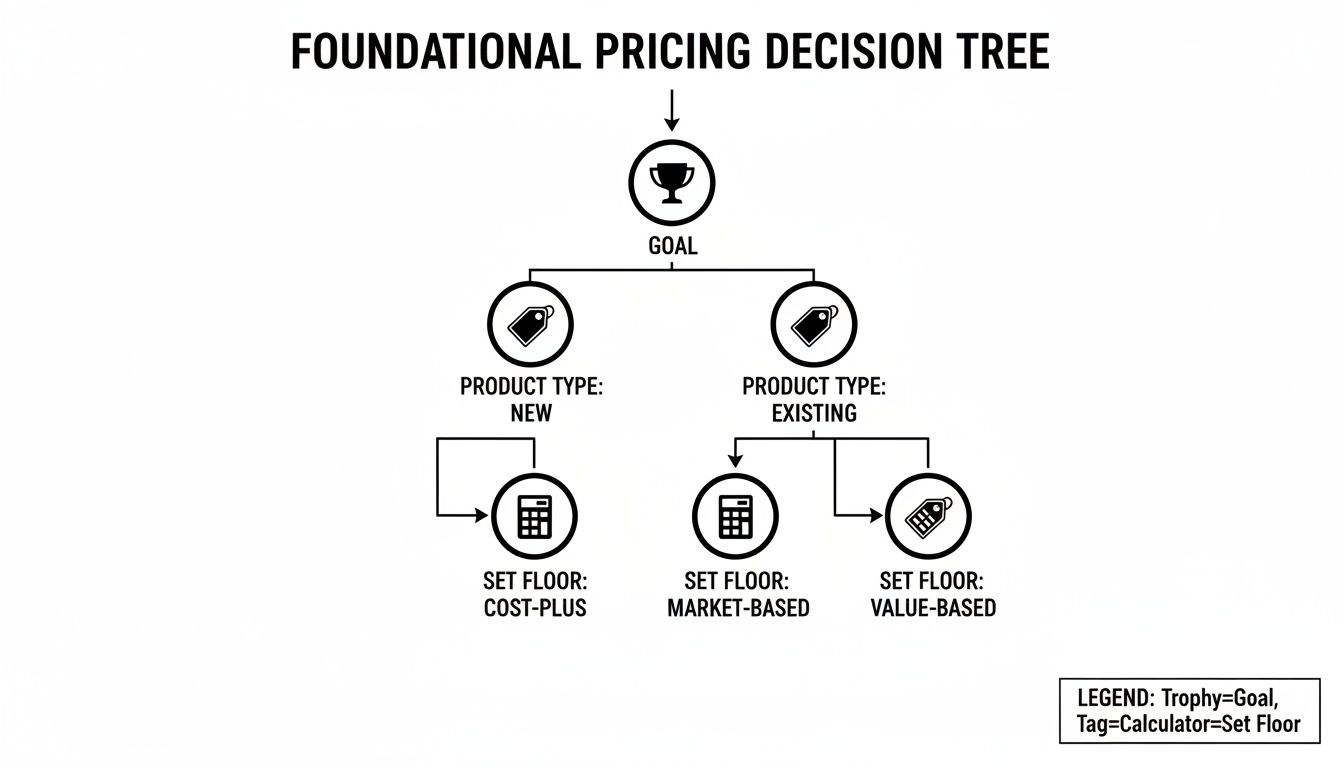
As you can see, everything flows from that first big decision: are you chasing profit, sales volume, or market share? That answer will shape every move you make from here.
Value-Based Pricing
If you're a private label brand or you're selling something truly unique, forget what the other guys are doing. Value-based pricing is your playground. This model sets your price based on the perceived value you're delivering to the customer, not what a competitor is charging.
So, how do you build that value?
- Brand Reputation: A brand people know and trust can always command a higher price.
- Superior Quality: Is your product built better, does it last longer, or does it work more effectively? Customers will pay a premium for that.
- Unique Features: If you have functionalities or a design that no one else can offer, that's value you can price for.
- Glowing Customer Reviews: That social proof is gold. A wall of five-star ratings and detailed, positive reviews justifies a premium price tag all on its own.
This approach gets you out of the daily price skirmishes. Your energy shifts from constantly watching competitors to communicating your product’s unique story through your listing, A+ Content, and customer interactions. It’s about owning your corner of the market, not just fighting for the Buy Box.
Pro Tip: A value-based strategy needs constant care and feeding. You have to keep investing in your brand, maintaining product quality, and actively gathering customer feedback to defend your price point over the long haul.
Dynamic And Algorithmic Pricing
Now we get to the most sophisticated approach: dynamic pricing. This is where you use real-time data and automation to make constant, intelligent price adjustments. It's the exact strategy that turned Amazon itself into the behemoth it is today.
Amazon's own algorithms are legendary, capable of changing prices as often as every 10 minutes based on an analysis of over 2.5 million different variables. They're looking at everything from competitor pricing and inventory levels to demand spikes and even a shopper's browsing history.
For third-party sellers, this level of sophistication is accessible through advanced repricing tools. These aren't your basic "beat by a penny" repricers. Modern algorithmic tools analyze dozens of data points to pinpoint the absolute best price at any given moment to hit your goal, whether that’s maximizing sales or boosting profit. This data-first approach takes emotion and guesswork out of the equation, letting you compete 24/7 with ruthless efficiency.
To help you decide which model fits best, here's a quick comparison of the three main approaches.
| Comparison of Amazon Pricing Models | |||
|---|---|---|---|
| Pricing Model | Best For | Key Advantage | Potential Drawback |
| Competitive-Based | Resellers and wholesale sellers on listings with multiple competitors. | Directly targets winning the Buy Box, which drives immediate sales. | High risk of price wars and margin erosion if not managed with smart rules. |
| Value-Based | Private label brands, unique products, or items with a strong brand identity. | Frees you from price competition and allows for much higher margins. | Requires significant investment in branding, quality, and marketing to justify the premium price. |
| Dynamic/Algorithmic | High-volume sellers or those in highly competitive, fast-moving categories. | Maximizes sales or profit automatically using real-time data, 24/7. | Can be complex to set up and requires a subscription to a sophisticated repricing tool. |
Ultimately, the best model depends entirely on your product and your goals. A reseller will lean on competitive pricing, a unique brand will thrive with a value-based approach, and a high-volume seller will get the most out of a dynamic strategy. Choosing wisely from the start sets the entire foundation for your success on the platform.
Putting Your Repricer to Work (The Smart Way)
If you're still changing prices by hand on Amazon, you're falling behind. In today's marketplace, you absolutely need an automated repricing tool working for you 24/7. But here’s the catch: just turning on a repricer and telling it to "match the lowest price" is a fast track to tanking your profit margins.
The real magic happens when you create intelligent, nuanced rules that actually support your business goals.
Smart automation isn't about a blind race to the bottom. It’s about strategic positioning. A good repricer executes a sophisticated pricing strategy around the clock, snagging sales you’d otherwise miss while shielding your profits from needless price wars.
Go Beyond Basic Price Matching
The default setting on most repricers is to simply undercut the competition. This almost always triggers a "race to the bottom," where sellers keep lowering prices until nobody is making any real money. A much smarter approach is to build rules based on specific competitive scenarios.
Instead of just looking at the price, your rules need to weigh the other critical factors Amazon’s algorithm cares about for the Buy Box.
- Fulfillment Method: An FBA offer carries far more weight than an FBM offer.
- Seller Rating: A seller with a 99% positive feedback score is a much safer bet than one with 92%.
- Shipping Time: Prime eligibility and fast shipping are huge advantages.
- Inventory Levels: A competitor on the verge of stocking out isn't a long-term threat.
When you program your repricer to account for these variables, you start making much more intelligent moves. A well-configured tool can help you win the Buy Box without always having to be the cheapest offer on the listing. A solid pricing strategy is just one piece of the puzzle; understanding how to increase your sales on Amazon requires looking at your whole operation.
Crafting Intelligent Repricing Rules
Let's walk through some practical examples of intelligent rules that blow basic price matching out of the water. These are the kinds of settings that turn a simple tool into a strategic powerhouse.
Scenario 1: The FBA Advantage
You’re an FBA seller, and your main competitor is an FBM seller with a slightly lower price but a worse seller rating.
- Weak Rule: Match the FBM seller's price.
- Intelligent Rule: Set your price to be 2% to 3% higher than the FBM competitor. Amazon’s algorithm heavily favors FBA for the Buy Box, so you can often win it at a higher, more profitable price point.
Scenario 2: The Low-Rated Competitor
You're up against a seller whose feedback score has dropped below 95%.
- Weak Rule: Undercut their price by $0.01.
- Intelligent Rule: Price above the low-rated competitor. Your higher rating signals trustworthiness to both Amazon and its customers, which gives you more pricing power.
Scenario 3: The Buy Box Winner Stocks Out
The current Buy Box winner is running low on inventory and is about to sell out.
- Weak Rule: Keep competing with the low-stock seller's price.
- Intelligent Rule: Create a rule to automatically and aggressively raise your price to match the next highest competitor the moment the current Buy Box winner stocks out. This lets you capture the Buy Box at a much healthier margin.
Key Takeaway: Your repricing rules have to reflect the realities of the Amazon marketplace. Never treat all competitors the same. Differentiate based on their fulfillment method, seller rating, and stock levels to maximize both your Buy Box share and your profit.
The Rise of AI-Powered Repricers
While rule-based repricers are a massive improvement over manual pricing, the next evolution is AI-powered repricing. These advanced tools don't just react to what competitors are doing right now; they use machine learning to predict what’s likely to happen next.
An AI repricer chews through massive datasets, looking at things like:
- Historical sales data for the ASIN
- Seasonal demand swings
- Competitor pricing patterns over time
- Buy Box ownership trends
By spotting these patterns, an AI tool can make proactive adjustments. For instance, it might notice a certain competitor always tanks their price at 10 PM. Instead of just reacting, the AI could preemptively adjust your price to capture sales before the drop, or it might hold firm, knowing the competitor’s price will pop back up in the morning.
This predictive power enables a truly dynamic pricing strategy. The tool is always learning and adapting, searching for that sweet spot that balances sales velocity and profitability—all without you having to constantly babysit dozens of complex rules. For sellers with big catalogs or those in fast-moving categories, this tech is a serious competitive advantage.
Weaving Promotions And Advanced Tactics Into Your Strategy
A smart Amazon pricing strategy goes way beyond just the number on your product page. When you start weaving in promotions and other advanced tactics, you can seriously crank up your sales velocity, make your products look more valuable, and get a real leg up on the competition. These aren't just tools for clearing out old inventory; they're strategic weapons.

Think about it. Cleverly timed coupons, limited-time offers, and Lightning Deals create a sense of urgency that gets people to buy now. They can be a fantastic way to boost your Best Seller Rank (BSR) without permanently cheapening your brand. The trick is to use them with a clear goal in mind, not just as a constant crutch to lean on.
Strategic Use Of Coupons And Deals
Coupons are one of the simplest, most effective promotional tools Amazon gives you. That little orange badge is a powerful visual hook that can make a huge difference in your click-through and conversion rates.
Here are a few ways I’ve seen them used to great effect:
- Launching New Products: A 10% or 15% off coupon is perfect for getting those first crucial sales and reviews that help a new product find its footing.
- Outplaying a Competitor: If you and a rival are priced exactly the same, a small 5% coupon can be all it takes to tip the scales in your favor.
- Juicing Your BSR: Combine a targeted coupon campaign with a solid PPC push, and you can create a sales spike that sends your ranking climbing. For more on that, check out our guide on what PPC is and how it works on Amazon.
Lightning Deals are another beast entirely. By offering a steep discount for a very short window, you can drive a massive wave of traffic and sales. These are especially potent during big events like Prime Day. To really nail this, it helps to understand what makes shoppers tick. Digging into the psychological triggers behind Amazon Prime Day's success can give you some incredible ideas for creating offers people can't refuse.
The Art Of Product Bundling
Product bundling is a genius move for standing out and boosting your average order value (AOV). When you create a unique bundle of related products under a new ASIN, you’ve built an offer that your competitors can't match on price alone.
This move forces them to compete with you on value, and that's a game where you write the rules. For instance, don't just sell a yoga mat. Bundle it with a foam roller and a resistance band to create a "Yoga Starter Kit." Suddenly, you’re providing more value and effectively locking out anyone just selling the mat.
Pro Tip: Make sure your bundles are logical and offer a clear savings over buying the items separately. That perceived value is what makes the customer feel like they're getting a great deal and makes it an easy "yes."
Managing MAP Policies
For brands and authorized resellers, keeping a handle on your Manufacturer’s Advertised Price (MAP) is essential. It protects your brand's integrity and keeps your relationships with distributors healthy. A MAP policy is simply an agreement that stops resellers from advertising your product below a certain price.
If MAP isn't enforced, you risk kicking off price wars that can erode your brand's value and alienate your partners. You need to keep an eye on the marketplace for violations and have a clear enforcement process ready to go. This ensures everyone is playing on a level field and protects the premium feel of your brand, allowing your value-based pricing to shine.
How To Measure And Optimize Your Pricing Performance
Let’s be honest: setting up a clever Amazon pricing strategy isn't a "set it and forget it" task. The marketplace shifts daily, competitors are always tweaking their tactics, and the rules that worked last month might be quietly eating into your margins today. If you want to stay ahead, you need a solid system for measuring performance and continuously fine-tuning your approach.

This is how you turn pricing from a reactive guessing game into a proactive cycle of improvement. By tracking the right data, you can finally see the real-world impact of every price change and start making smarter, more profitable decisions.
Pinpointing Your Key Performance Indicators
To get a clear picture of how your pricing strategy is really doing, you have to look beyond the big, flashy revenue number. A handful of key performance indicators (KPIs) work together to tell the full story of your profitability and where you stand against the competition.
Get laser-focused on these core metrics:
- Buy Box Win Percentage: For most sellers, this is the holy grail. It tells you exactly what percentage of the time your offer is the one in the Buy Box when a customer lands on the page. If this number is climbing, your pricing rules are likely working.
- Unit Session Percentage (Conversion Rate): This metric shows how many units were bought for every session on your product page. It's a direct reflection of how compelling your entire offer is—price, shipping, and reviews included.
- Total Sales and Revenue: It might seem obvious, but it’s crucial to track this alongside everything else. Sure, a price drop might boost your Buy Box win rate, but did it actually lead to a meaningful jump in sales, or just a few extra units sold at a lower profit?
- Gross Profit Margin: This is your bottom line, period. You have to know how each price adjustment hits your margin per unit and your overall profitability. Aggressively pricing for sales volume is only a winning strategy if your margins stay healthy.
Watching these KPIs isn't just a monthly check-in. It requires a deep dive into your Amazon sales data to connect the dots between the pricing moves you make and the results you get.
Analyzing The Impact Of Pricing Changes
Once you start tracking these KPIs, you can begin asking smarter questions. For instance, you might notice your Buy Box win rate for a key ASIN dropped from 80% to 65%. That’s a signal to dig deeper. Did a new competitor jump on the listing? Did an existing one switch to FBA?
This is where historical data becomes your best friend. Even a slight price adjustment can have a major impact on sales velocity and profitability. By looking back at how your metrics changed after previous price adjustments, you can start to see patterns and understand cause and effect.
Key Insight: Don’t analyze KPIs in a vacuum. A drop in your conversion rate after a price increase might seem like a failure at first. But if your gross profit per sale jumped enough to more than offset the lower sales volume, it could actually be a huge win for your business. The real story is always in how the metrics relate to each other.
Running Controlled Pricing Experiments
The absolute best way to sharpen your pricing strategy is to move from just analyzing data to actively experimenting with it. Running controlled A/B tests lets you gather concrete evidence on how price changes affect customer behavior for your specific products.
Here’s a simple framework to get you started:
- Form a Hypothesis: Start with a clear question you want to answer. For example: "I believe I can increase the price of my flagship product by 5% without tanking my conversion rate, leading to a higher gross profit."
- Establish a Baseline: Before you touch anything, record your key metrics—Buy Box win %, conversion rate, sales, profit margin—for a set period, like two weeks. This is your control group data.
- Implement the Change: Make the one price change you want to test. In this case, you’d increase the price by 5%.
- Measure the Results: Let the test run for the same amount of time as your baseline period (two weeks in this example). Keep collecting the same KPI data.
- Analyze and Conclude: Now, compare the "before" and "after" data sets. Did the conversion rate drop? If so, by how much? Most importantly, did the boost in profit per unit make up for any lost sales volume?
This data-first approach takes the emotion and guesswork out of your decisions. By continuously testing small, incremental changes, you can methodically find the sweet spot that perfectly balances sales velocity and profitability, ensuring your strategy is always evolving and improving.
Got Questions About Amazon Pricing? We’ve Got Answers.
Jumping into an Amazon pricing strategy can feel like you’re opening a can of worms. The marketplace never sits still, with prices and competitors changing by the minute. Getting straight answers to the most common questions is the fastest way to ditch the confusion and start making confident, profitable moves.
A lot of sellers get hung up on a "magic number" for how often they should be repricing. The honest answer? It really depends on what you're selling and who you're up against.
How Often Should I Change My Prices On Amazon?
The right frequency for price changes boils down to how competitive your category is. If you're in a crowded space with dozens of resellers, prices can swing every few minutes. In that kind of environment, an automated repricer isn't just a nice-to-have; it's a survival tool.
On the flip side, if you’re selling private label products with little to no direct competition, you can afford to be more deliberate. You might only tweak prices weekly or when something specific happens, like a competitor running out of stock.
The real key is to be responsive. A dynamic or algorithmic pricing strategy, hooked up to a solid repricer, is the smartest way to stay competitive without babysitting your listings 24/7. It does the heavy lifting by reacting to market data in real-time.
Will Lowering My Price Always Win The Buy Box?
This is probably one of the most dangerous myths on Amazon, and it can absolutely wreck your profit margins. While price is a huge piece of the Buy Box puzzle, it's far from the only one. Slashing your price is no guarantee you'll win the coveted spot.
Amazon’s algorithm is way more sophisticated than that. It’s looking at the whole picture and gives a ton of weight to other factors:
- Fulfillment Method: Fulfillment by Amazon (FBA) almost always beats Fulfilled by Merchant (FBM).
- Shipping Speed: Fast delivery and Prime eligibility are non-negotiable for the algorithm.
- Seller Feedback Rating: A high rating proves you're a trustworthy seller.
- Inventory Levels: Amazon loves sellers who can consistently keep products in stock.
Think about it this way: a seller using FBA with a 99% feedback score can often hold the Buy Box even if their price is a bit higher than an FBM competitor with a shaky rating. The goal isn't just to be the cheapest—it's to have the best overall offer in Amazon's eyes.
What Is A Pricing Floor And Why Is It Important?
Your pricing floor, or "min price," is the absolute lowest you’re willing to go on a product while still turning a profit. This is, without a doubt, the most critical setting in any automated repricing tool. It’s your safety net.
To get this number right, you have to factor in everything: your cost of goods, Amazon's referral fees, every single FBA fee (storage, fulfillment, you name it), inbound shipping, and even a slice of your ad spend and overhead.
Setting a rock-solid pricing floor ensures that even if a price war breaks out, your repricer will never sell you into the red. It's the single most important rule you can set to protect your margins.
Can I Use A Manual Pricing Strategy On Amazon?
Technically, yes. Realistically, you shouldn't. A manual pricing strategy is incredibly impractical for anyone with more than a handful of SKUs. The Amazon marketplace is a beast, with millions of price changes happening every single day.
Trying to keep up with competitors manually is a surefire way to burn yourself out. By the time you’ve updated one price, a competitor’s repricer has probably already reacted and changed theirs again, making your effort pointless. If you want to compete effectively and actually scale your business, automation is the only way to go.
Executing a sophisticated, data-driven Amazon pricing strategy requires expertise and constant optimization. Next Point Digital helps brands convert clicks into sales by combining advanced strategy with cutting-edge technology to scale your growth profitably.
Discover how we can simplify your growth and future-proof your performance on npoint.digital