

Getting your products from a factory overseas to an Amazon warehouse can feel like trying to cross a minefield blindfolded. For Amazon FBA sellers, a freight forwarder isn't just another vendor—they're a strategic partner who can make or break your entire operation. Think of them as your secret weapon for growth.
Why a Great Freight Forwarder is Your FBA Secret Weapon
So many Amazon sellers pour all their energy into product sourcing and marketing, only to hit a massive logistical wall the moment their first big shipment is ready. This is where the real value of a top-notch freight forwarder for Amazon FBA becomes crystal clear.
They aren't just a courier service. They're the logistical backbone of your import business and a true extension of your team.
Their job is to orchestrate the entire shipping process, making sure your inventory gets from the factory floor in another country all the way to a specific Amazon fulfillment center without a hitch. This journey is packed with potential pitfalls, from booking cargo space on a ship to coordinating trucks at both ends of the trip.
Navigating the Logistical Maze
Let's walk through a common scenario. You’ve just paid for 5,000 units of your hot new product from a supplier in China, timed perfectly to land for the Q4 holiday rush. If you don't have a skilled forwarder, you're on your own.
That means you are now responsible for:
- Arranging a truck to get the goods from the factory to the port.
- Clearing the shipment through Chinese customs.
- Negotiating rates and booking space on a container ship (good luck during peak season).
- Handling all the mind-numbing import paperwork for U.S. customs.
- Organizing the final truck delivery to a specific Amazon FBA warehouse, which has its own ridiculously strict appointment system.
One tiny mistake—like an incorrect HS code on a customs form or a missed delivery appointment—can trigger a catastrophic domino effect. Your shipment could get stuck at the port for weeks, racking up thousands in demurrage fees and making you miss the entire peak selling season.
A great forwarder stops these disasters before they even have a chance to happen.
A freight forwarder’s real job is to transform a chaotic, multi-step international supply chain into a single, managed process for you. They don't just move boxes; they eliminate the friction and risk that holds your business back.
More Than Just Shipping
Beyond just moving your stuff, specialized FBA forwarders handle the critical details that most sellers overlook. They live and breathe Amazon’s famously strict receiving requirements for labeling, palletizing, and packaging.
They make sure your shipment is compliant before it even leaves the origin country. This simple step prevents costly rejections and re-work fees when your inventory finally arrives in the U.S.
The sheer scale of FBA makes their role indispensable. Over 82% of Amazon's active sellers use FBA to get that coveted Prime badge and streamline their logistics. With millions of sellers sourcing from overseas, a reliable forwarder is the only way to navigate customs and avoid getting slammed with peak season surcharges.
Thinking of your freight forwarder as just another line item expense is a huge mistake. They are an investment in your operational stability and your ability to scale. By taking the complex, high-stakes process of international shipping off your plate, they free you up to focus on what you actually do best: finding great products and growing your brand.
To really get why this matters, it helps to understand exactly what Amazon FBA means and how this entire ecosystem works.
Decoding FBA Freight Forwarder Services
Not all logistics partners are created equal, especially when you're playing by Amazon's strict rulebook. A freight forwarder who truly gets the FBA world offers a specific set of services designed to get your inventory from the factory floor to a fulfillment center without any drama. Nailing this down is the first step to properly comparing quotes and finding a partner you can trust.
At its core, their job is to own the entire logistics process. We're not just talking about booking space on a ship. It's a complex dance of coordination, paperwork, and compliance. From the second your goods leave your supplier, your forwarder should be in the driver's seat.
Think of them as the critical bridge in your supply chain.
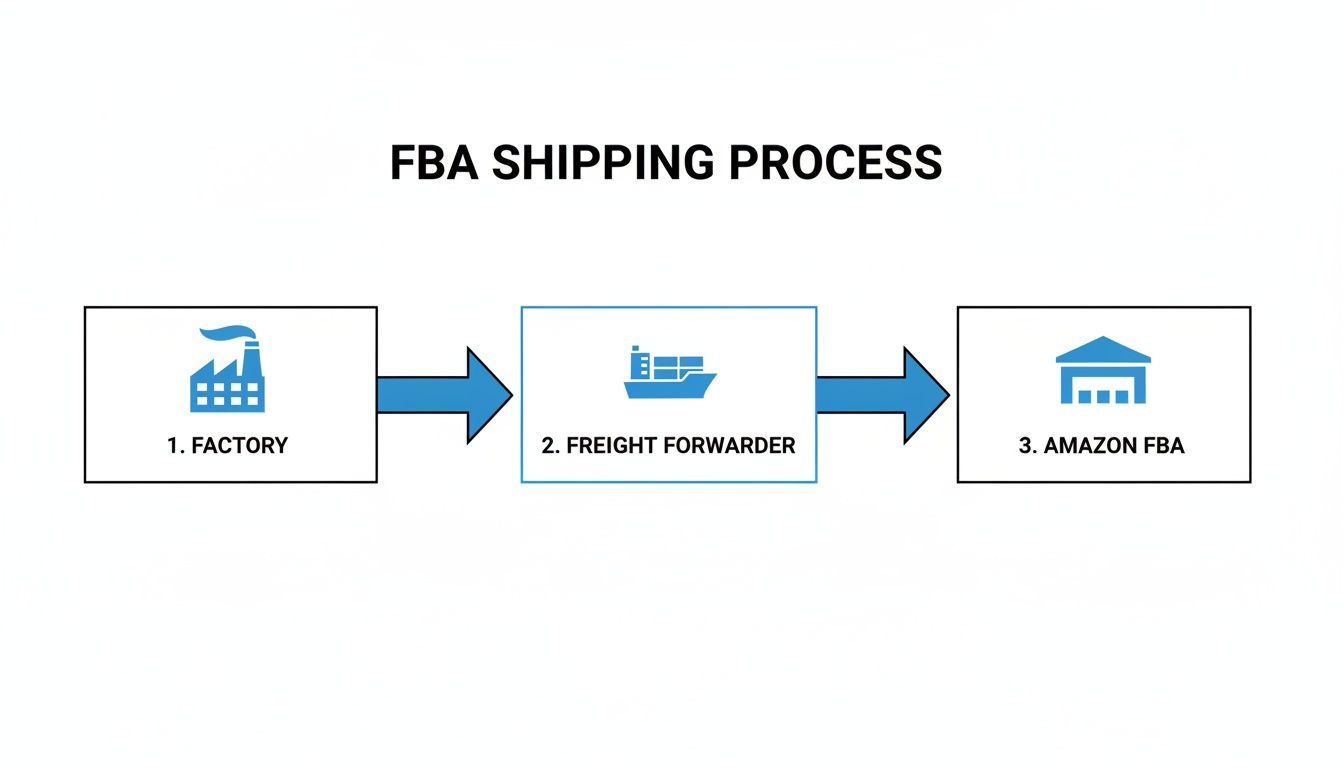
This diagram shows just how central they are. They manage the handoff from your manufacturer and make sure your shipment is prepped and ready for a smooth check-in at Amazon.
Understanding Your Responsibilities With Incoterms
One of the most confusing parts of international shipping is the jargon, especially Incoterms. These are basically universal rules that spell out who is responsible for the shipment—and who pays for what—at every single stage. Get this wrong, and you could be looking at thousands of dollars in surprise costs.
Let's walk through a real-world example. Imagine you’re shipping 200 cartons of garlic presses from a supplier in Shenzhen, China, to an FBA warehouse in California. Here's how different Incoterms would play out.
Key Incoterms for Amazon FBA Sellers Explained
The table below breaks down the most common Incoterms you'll encounter. It clarifies who's responsible for the costs and risks at each step, so you can choose the right one for your business.
| Incoterm | Seller's Responsibility | Buyer's (Your) Responsibility | Best For |
|---|---|---|---|
| EXW (Ex Works) | Makes goods available at their factory. Nothing else. | Everything from factory pickup, export customs, main freight, import customs, duties, and final delivery. | Experienced importers who want full control and have local logistics contacts at the origin. |
| FOB (Free On Board) | Delivers goods to the origin port and loads them onto the vessel. Covers all origin-side port and export fees. | Everything from the moment the goods are on the ship: ocean freight, insurance, U.S. customs, duties, and final delivery. | Most Amazon sellers. It offers a great balance of cost, control, and manageable risk. |
| DDP (Delivered Duty Paid) | Handles the entire process from their factory to the final destination (your FBA warehouse), including all duties and taxes. | Paying the single, all-inclusive invoice. You have minimal involvement. | New sellers who want simplicity, but it often hides costs and offers zero control if problems arise. |
For most Amazon sellers, FOB hits the sweet spot. It gives you the power to choose your own freight forwarder—one who works for you, not your supplier. This means you get competitive shipping rates and transparent handling of U.S. customs instead of dealing with your supplier’s marked-up, black-box shipping arrangements.
Non-Negotiable Services to Look For
Beyond just moving boxes from Point A to B, a true FBA-focused forwarder provides several critical services that protect your business and your inventory. These aren't fancy add-ons; they're essential for any successful FBA import strategy.
Customs Brokerage
This might be the single most important service they offer. A licensed customs broker handles the legal side of getting your goods into the country. They classify your products with the correct HS codes, calculate the duties and taxes you owe, and file all the right paperwork with Customs and Border Protection (CBP). A good broker is what stands between you and a costly shipment hold.
Cargo Insurance
Never, ever ship without it. The standard liability that carriers offer is basically worthless, often just pennies on the dollar if something goes wrong. Proper cargo insurance protects the full value of your inventory against loss or damage while it’s in transit. Your forwarder should offer a clear, comprehensive insurance option.
Final-Mile Delivery to Amazon
Getting your shipment to a U.S. port is only half the battle. Your forwarder absolutely must be an expert in Amazon's notoriously difficult delivery appointment system. This means they need to know how to palletize your shipment to FBA standards and book a delivery slot through Amazon's Carrier Central portal. Without this expertise, your inventory could sit for weeks just miles from the warehouse.
A huge part of your forwarder's job is to keep you in the loop. For sellers sourcing from overseas, knowing where your cargo is gives you peace of mind. Learning how to track packages from China can give you valuable insight into this part of the supply chain, so you always feel in control.
How to Vet and Choose Your FBA Forwarding Partner
Choosing the right freight forwarder is one of the most consequential decisions you'll make as an FBA seller. I'm not exaggerating. The wrong partner can sink your business with lost inventory, surprise fees, and even account suspensions.
The right one, however, becomes a powerful asset that enables smooth, predictable growth. This isn't just about finding the cheapest quote. It's about finding a reliable partner who understands the high-stakes game of Amazon logistics.
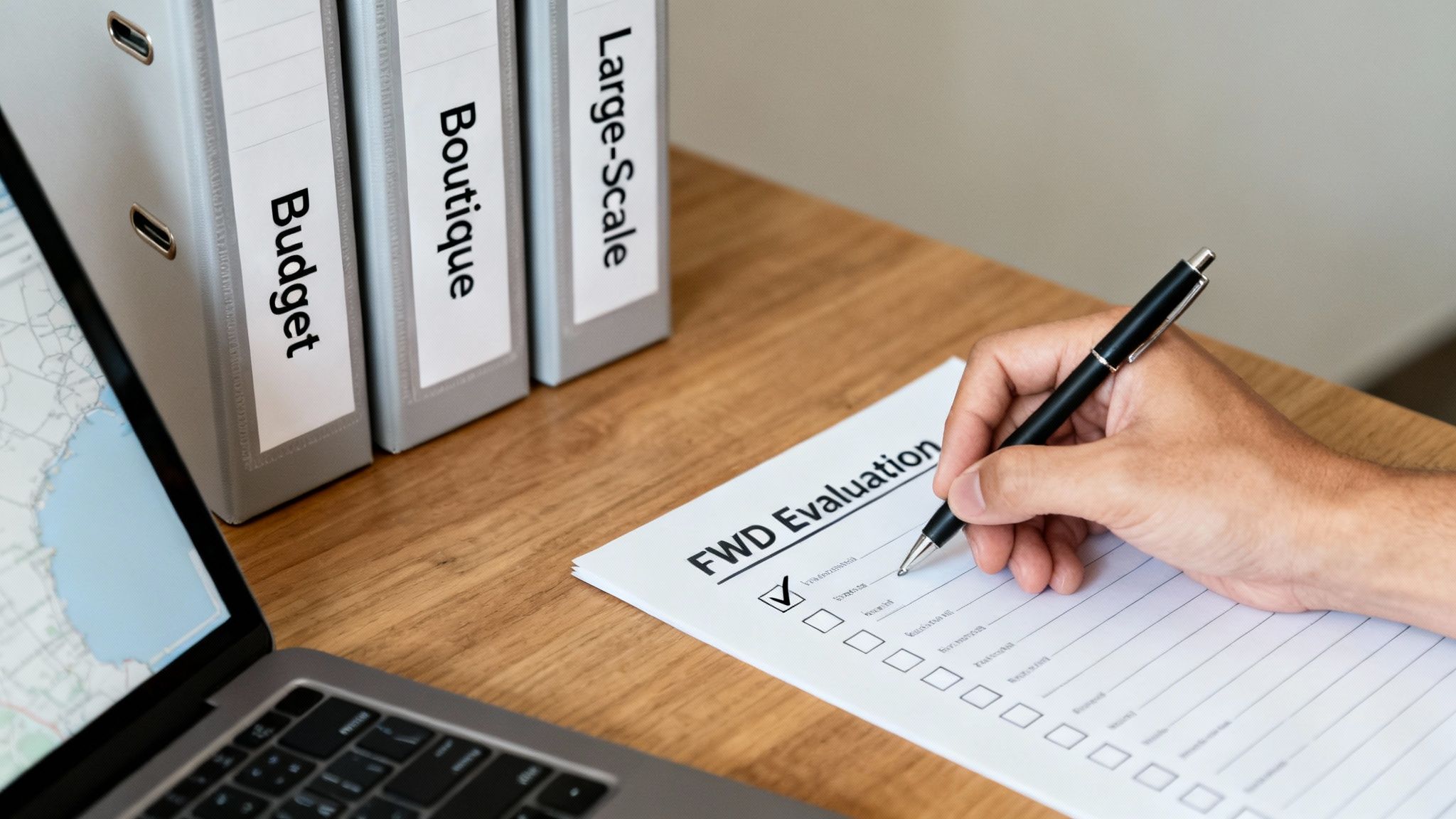
The vetting process needs a structured approach. I always recommend starting by shortlisting at least three different types of forwarders to get a feel for the market: a large-scale global operator, a smaller boutique firm specializing in FBA, and a budget-friendly option.
This comparison will give you a clear picture of the trade-offs between cost, service, and expertise.
Core Evaluation Criteria
Before you even start asking for quotes, you need a clear framework for your evaluation. Don't get distracted by a low price tag; focus on these non-negotiable pillars of competence.
1. Verifiable Amazon FBA Experience
This is the big one. Ask them directly how many FBA shipments they handle per month and which specific fulfillment centers they deliver to most often. A forwarder who truly specializes in FBA will be able to talk about Amazon's Carrier Central portal, delivery appointment nuances, and palletization requirements without missing a beat.
2. Communication and Responsiveness
When your shipment is on the other side of the world, silence is terrifying. Gauge their communication style from your very first interaction. Do they respond to emails within a reasonable timeframe? Is there a dedicated point of contact for your account? A forwarder who is slow to respond during the sales process will be even slower when a real problem pops up.
3. Comprehensive and Transparent Quoting
A quote should be a clear, all-inclusive document, not a confusing list of acronyms. It must break down every single cost from origin to destination, including customs duties, port fees, and final-mile trucking. If a quote seems too good to be true, it’s probably missing key charges that will magically appear on your final invoice.
Key Questions to Ask Potential Forwarders
Once you have your shortlist, it's time to dig deeper. Use these questions to cut through the sales pitch and get a real sense of how they operate. Their answers will reveal their actual expertise and whether they're a good fit for your business.
- FBA Specifics: "Can you walk me through your process for booking a delivery appointment with an Amazon FBA warehouse?"
- Problem Solving: "What's your standard procedure if a shipment is flagged for a customs inspection or gets rejected by Amazon at delivery?"
- Hidden Fees: "Are there any potential surcharges not listed on this quote, like peak season fees, fuel surcharges, or general rate increases?"
- Compliance: "How do you make sure my cartons and pallets meet Amazon’s strict prep and labeling requirements before they arrive?"
- Insurance: "What type of cargo insurance do you offer, what does it cover, and what's the process for filing a claim?"
Their responses to these questions are far more telling than the price on their quote. Look for detailed, confident answers that show real-world experience, not vague promises.
The goal isn't just to move a box from China to the U.S. It's to find a partner who will proactively solve problems, communicate clearly, and protect your inventory as if it were their own. This mindset shift is crucial for long-term success.
The sheer scale of the FBA marketplace makes this vetting process essential. In Q3 2025 alone, third-party sellers generated $36.51 billion in sales, and 78% of them relied on FBA. This incredible volume means that forwarders who specialize in FBA are not just a convenience—they're a necessity for navigating crowded ports and complex customs. These experts turn potential logistical nightmares into smooth, predictable operations. For more on this, you can discover more insights about Amazon marketplace seller statistics on amzprep.com.
Comparing Your Options: A Practical Scenario
Let's say you get three quotes for a shipment of 50 cartons. The budget option is $1,500, the boutique FBA specialist is $2,200, and the large global firm is $2,500. Don't just jump on the lowest price.
Think it through. The budget forwarder might be using a less reliable ocean carrier, offer zero support if customs holds your shipment, and leave you to figure out the final FBA delivery on your own.
The FBA specialist, while more expensive, includes door-to-door service, proactive communication, and expertise in handling Amazon's delivery system. The large firm offers a robust network but might be less personal and slower to respond.
For most sellers, the FBA specialist provides the best balance of cost, service, and peace of mind. Investing that extra $700 upfront can save you thousands in potential delays, fees, and lost sales down the line. Making the right choice here is a foundational step as you learn how to scale an ecommerce business.
Nailing FBA Prep and Shipping Plan Compliance
Let's be blunt: Amazon's inbound requirements are notoriously strict. They have to be. One tiny mistake on a shipment can create a domino effect of delays, surprise fees, or even get your inventory flat-out rejected at the fulfillment center door. Getting your FBA prep and labeling right isn't just a "best practice"—it's fundamental to protecting your profit margins.
This is exactly where a freight forwarder specializing in Amazon FBA becomes your most valuable player. They're your first line of defense, making sure every single box, label, and warning sticker meets Amazon's rigid standards before it even thinks about leaving the country of origin.
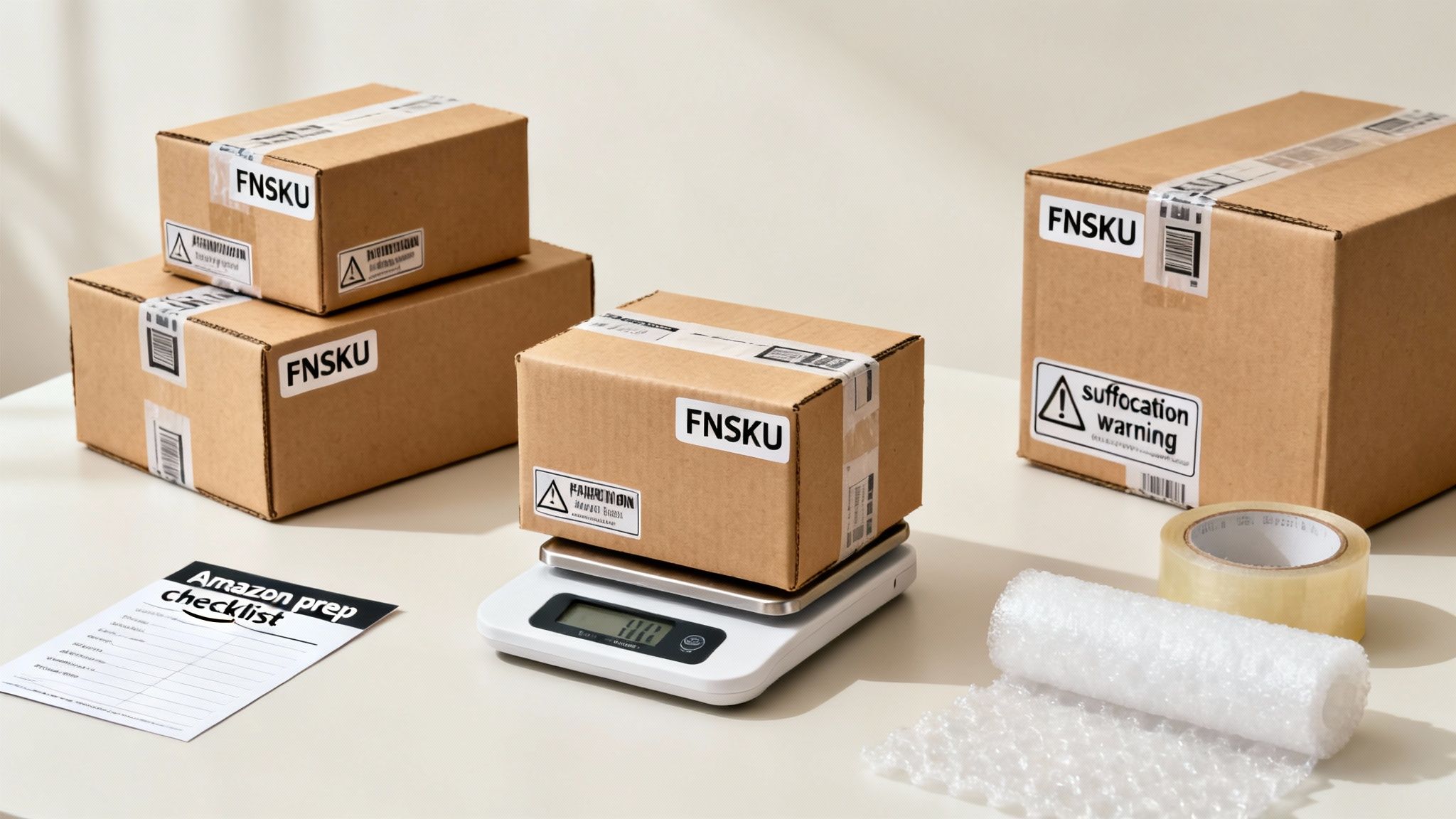
The Devil is in the Details Your Forwarder Handles
Think of FBA prep as the specific rulebook your products have to follow to get into Amazon's ecosystem. Your forwarder can either handle these tedious tasks for you or, just as importantly, verify that your supplier actually did them correctly.
Here are the non-negotiables:
- FNSKU Labeling: Every single unit needs its own unique Amazon barcode (the FNSKU). This label must cover up any existing manufacturer barcodes. It’s how Amazon tracks your specific inventory, and there's zero wiggle room on this.
- Suffocation Warnings: If you're using a poly bag with an opening of 5 inches or more, it needs a clear suffocation warning label. Simple rule, but easy to forget and costly if you do.
- Carton Rules: Master cartons have strict limits. Generally, they can't exceed 50 lbs or be longer than 25 inches on any side unless the box contains a single oversized item.
- Fragile Item Prep: Anything that can break—glass, ceramics, you name it—needs serious protection like bubble wrap or a sturdy inner box. It has to be able to survive a drop test, and hope is not a strategy here.
Trusting your forwarder to manage this at their warehouse is almost always the smart play. They live and breathe these rules every day. A supplier juggling hundreds of orders for different clients with different needs? Far less reliable.
Supplier Prep vs. Forwarder Prep: A Real-World Scenario
Imagine you're selling a beautiful set of ceramic coffee mugs. You can ask your supplier to prep them, or you can have your freight forwarder do it.
Path 1: Supplier Prep
Your supplier in China agrees to apply FNSKU labels and bubble wrap each mug for a super low fee. Sounds great, right? But they use the thinnest bubble wrap imaginable and stick the FNSKU label on the outside of the wrap, where it can easily rip off. The shipment arrives at Amazon, mugs are broken, labels are missing, and your entire inventory gets flagged for expensive, time-sucking "unplanned prep services."
Path 2: Forwarder Prep
Your forwarder receives the bulk-packed mugs at their warehouse. Their trained crew wraps each mug in thick, proper bubble wrap, puts it in a protective inner box, and applies the FNSKU label directly to that box. It's flawless. Your inventory checks in at the FBA center without a hitch. Yes, it cost a bit more upfront, but you just sidestepped thousands in potential Amazon fees and weeks of sales-killing delays.
Entrusting FBA prep to a specialized forwarder is an investment in predictability. You're paying for their expertise to eliminate the risk of human error from a supplier who doesn't have Amazon's rulebook memorized.
Creating and Sharing Your Shipping Plan
Once your inventory is prepped and ready to go, the final piece is creating a shipping plan in Amazon Seller Central. This is the digital manifest that tells Amazon exactly what’s coming, how much of it, and where it's coming from.
After you create the plan, Amazon will tell you which fulfillment center(s) to send your shipment to. Your final task is to download the FBA box labels that Amazon generates and get them to your forwarder immediately.
These labels are everything. They contain the specific barcodes that the warehouse team will scan to receive your inventory into stock. A good forwarder knows exactly what these are and will ensure every box is marked for its correct destination. Clear communication here means a smooth delivery appointment and a fast check-in, getting your products live and making you money that much faster. And once those products are live, you'll want to be sure you optimize Amazon product listings to make sure they sell.
Breaking Down Costs and Timelines for FBA Shipments
Understanding the true landed cost of your products is one of the most critical parts of running a profitable FBA business. Hidden fees and unexpected delays are the silent killers of cash flow.
A freight quote is much more than a single number; it's a multi-layered puzzle of charges you need to dissect with confidence.
When you get a quote from a potential freight forwarder for Amazon FBA, it's your job to look beyond the big number at the top. A suspiciously low quote often means critical components are missing—and they will absolutely show up on your final bill. A professional forwarder will always provide a detailed, itemized breakdown.
What's Really Inside Your Freight Quote
To avoid sticker shock, you need to know exactly what charges to look for. Each line item represents a specific service or fee required to get your inventory from the factory floor to Amazon's doorstep.
Let's break down the most common components you'll see:
- Ocean or Air Freight: This is the core transportation cost of moving your goods from the origin port to the destination port. It's usually the biggest single charge, but it's far from the total cost.
- Customs Duties and Tariffs: These are taxes imposed by the U.S. government on imported goods, calculated based on your product's value and its HS code. A good forwarder will help you classify your products correctly so you're not overpaying.
- Port Fees and Terminal Handling Charges (THC): Both the origin and destination ports charge fees for loading, unloading, and handling your container. These are standard operational costs.
- Customs Clearance and Bond: This fee covers the service of a licensed customs broker who files the necessary import paperwork for you. You'll also need a customs bond, which is basically an insurance policy guaranteeing the government gets paid its duties.
- Final-Mile Delivery: This is the cost of trucking your shipment from the destination port to a specific Amazon FBA fulfillment center. This can vary a lot based on distance and warehouse location.
Understanding these costs is vital for accurately tracking your business performance. Many sellers use detailed financial dashboards to get a clear picture of their profitability, which you can learn more about in our guide to analyzing Amazon sales data.
Planning for Realistic Shipping Timelines
Just as important as cost is time. A shipment arriving two weeks late can mean stocking out of a bestseller and losing your sales rank for good. You have to build realistic timelines into your inventory planning, accounting for every single step of the journey.
Sea Freight (Example: China to U.S. West Coast)
- Production & Origin Transit: 5-10 days
- Ocean Transit: 14-20 days
- Customs & Port Unloading: 3-7 days
- Final Delivery to FBA: 3-5 days
- FBA Check-In: 3-10 days
- Total Estimated Time: 30-50 days
Air Freight (Example: China to U.S.)
- Production & Origin Transit: 2-4 days
- Air Transit: 1-3 days
- Customs Clearance: 1-2 days
- Final Delivery to FBA: 1-3 days
- FBA Check-In: 2-7 days
- Total Estimated Time: 7-20 days
Keep in mind, these are just estimates. Unforeseen events like port congestion, bad weather, or customs exams can add significant delays. Always build a buffer into your replenishment schedule.
Your goal isn't just to get the cheapest quote; it's to achieve the most predictable and reliable landed cost and delivery window. That predictability is what allows you to scale your inventory without constant stockouts or cash flow crises.
Pricing can vary dramatically between forwarders. A recent survey of high-volume sellers on Shanghai-to-U.S. routes found quotes ranging from $3,850 to $4,300 for the same shipment, highlighting the need for detailed comparisons.
Top forwarders ensure swift customs clearance and manage inland trucking efficiently, which is critical amid changing tariffs and peak season surcharges. To effectively budget and plan, using a reliable shipping cost calculator can provide accurate estimates for FBA shipments.
Common Questions About FBA Freight Forwarding
When you're first navigating international logistics, it feels like there are a million questions and very few clear answers. Getting things straight from the start is the best way to move forward with confidence and avoid mistakes that can cost you thousands.
Here are the most common questions sellers have when they start working with freight forwarders for Amazon FBA, along with actionable answers to help you get unstuck.
Forwarder vs Customs Broker What Is the Difference
A lot of sellers use these terms interchangeably, but they’re two totally different—and equally vital—roles in your supply chain. Knowing who does what is critical when something goes wrong and you need to know who to call.
Think of a freight forwarder as your logistics project manager. They're the ones arranging the entire physical journey of your products, from booking space on a container ship or cargo plane to coordinating the final truck delivery to Amazon.
A customs broker, on the other hand, is a licensed specialist who deals exclusively with the legal side of getting your shipment into a country. They're the experts who talk to government agencies like Customs and Border Protection (CBP), classify your products with the right HS codes, and make sure all duties and taxes are paid correctly and on time.
Many larger freight forwarders have their own customs brokers in-house or offer it as part of a package deal, but the jobs are separate. The forwarder moves your goods; the broker clears them through customs.
How to Calculate Customs Duties for FBA Products
Customs duties are a huge chunk of your landed cost, and getting this calculation wrong can completely wipe out your profit margins. Estimating them accurately from the get-go is non-negotiable.
The process boils down to three key pieces of information:
- Find the Harmonized System (HS) Code: This is a universal code used to classify your exact product. Your supplier should know it, but a good forwarder can help you verify it.
- Determine the Product Value: This is simply the price you paid for the goods, which is listed on the commercial invoice.
- Apply the Duty Rate: Every HS code is tied to a specific duty rate (a percentage). You apply that rate to your product's value to figure out what you owe.
For example, say your shipment of stainless steel water bottles has a commercial value of $10,000. If the duty rate for that specific HS code is 4.5%, your base customs duty would be $450. Always keep an eye out for additional tariffs, which can add a hefty percentage on top of that base rate.
Should I Use Air Freight or Sea Freight
This is probably one of the biggest strategic decisions you'll make as an FBA seller. There's no single right answer—it’s always a trade-off between speed, cost, and what your business needs right now.
Air freight is your express lane. It’s fast, with transit times often between 5-10 days, but you pay a premium for that speed. It’s perfect for launching a new product where timing is everything, testing the market with a small batch, or rushing an emergency restock to avoid going out of stock and killing your sales velocity.
Sea freight is the workhorse of global trade for a reason: it’s way more cost-effective, especially for larger and heavier shipments. The catch? You're looking at transit times of 30-45 days or more. This route demands meticulous inventory planning, but your profit margins will thank you for it. Many savvy sellers use a hybrid strategy, which is a fantastic way to go if you're learning how to increase sales on Amazon.
What Happens if Amazon Rejects My Shipment
Getting a shipment rejected at an FBA warehouse is every seller's nightmare. It’s frustrating, expensive, and almost always comes down to a simple compliance mistake—improperly stacked pallets, wrong FNSKU labels, or a missed delivery appointment.
When a rejection happens, your freight forwarder is the first to know. Their immediate job is to get a truck back to the warehouse, pick up your inventory, and move it to a temporary 3PL warehouse for safekeeping.
That’s when the real work starts. The forwarder’s team has to figure out exactly what went wrong, fix the issue (which could mean re-labeling thousands of units or re-stacking pallets to meet Amazon's strict standards), and then book a new delivery appointment. This mess racks up extra costs for transport, storage, and labor, which is exactly why paying for an experienced FBA forwarder is worth every penny.
At Next Point Digital, we help brands master their entire ecommerce operation, from supply chain strategy to marketplace growth. Our experts provide the guidance you need to optimize your listings, manage inventory effectively, and scale your sales profitably on Amazon and beyond.
Learn how our ecommerce growth services can simplify your path to success.