

If you want to improve your Amazon sales rank, you have to get one thing straight: it's all about sales velocity. More specifically, it's about recent sales.
Amazon's Best Sellers Rank (BSR) isn't a lifetime achievement award for your product. It’s a real-time momentum score. This means a sudden spike in purchases from a well-timed promotion can shoot your product up the rankings in a matter of hours.
Understanding Amazon's Best Sellers Rank to Win More Sales
Before you can start climbing the BSR ladder, you need to understand how the game is played. Forget total sales volume for a minute and focus on recent sales momentum. Think of it as a live popularity contest where the most recent purchases carry the most weight.
A sudden surge in orders can catapult your product up the charts, while consistent, steady sales help maintain a stable position in your category over the long haul. This is exactly why a flash sale or a targeted ad campaign can have such a dramatic and immediate impact.
The A9 algorithm is built to spot what’s "hot" right now, and it rewards products that show accelerating demand. So, your strategy shouldn't just be about selling; it needs to be about when and how fast you sell.
The Link Between BSR and Sales Volume
It's simple: a lower BSR means you're selling more units. A lot more. While the exact numbers vary wildly from one category to the next, the principle is universal.
For example, a product sitting at a BSR of 50,000 might be moving a couple of units a day. But if you can break into the top 5,000, you could be looking at dozens or even hundreds of sales daily.
This chart shows just how quickly sales can take off as a product's rank gets better.
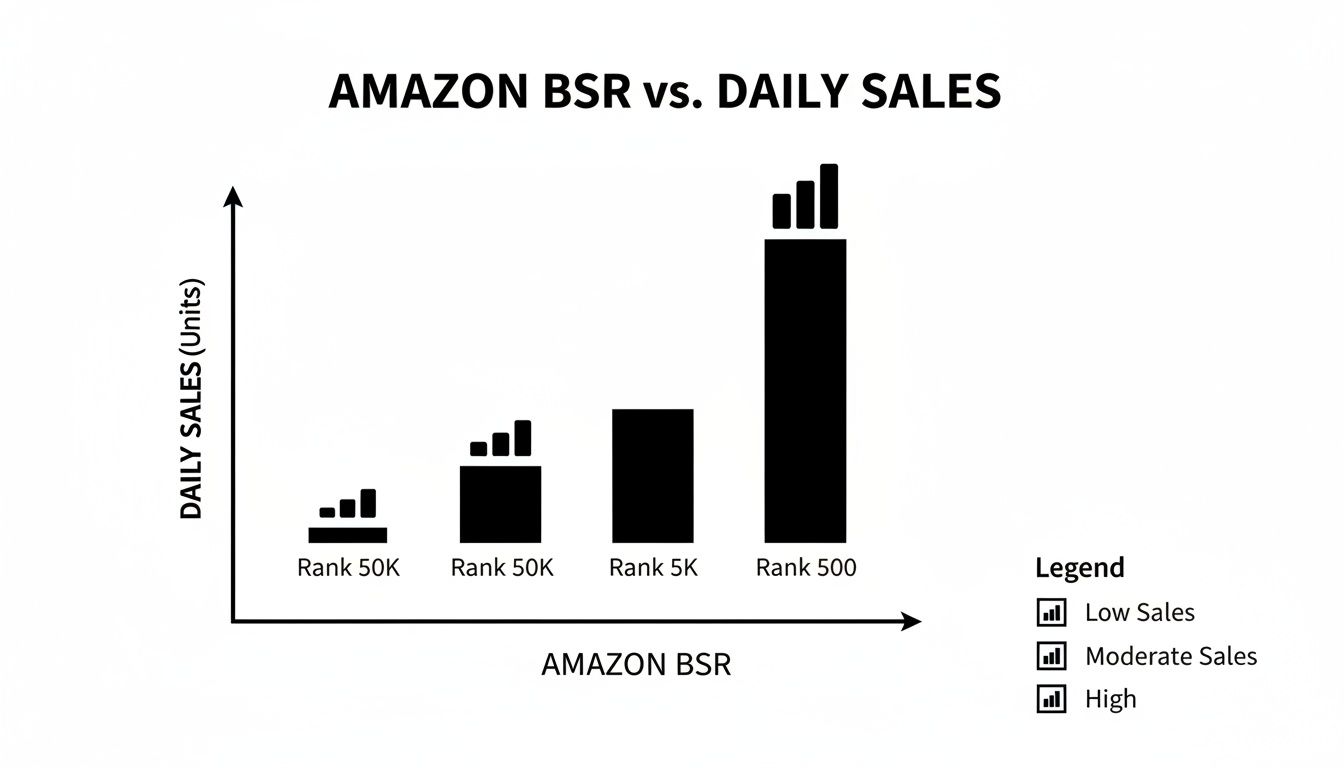
The key thing to notice here is that the growth isn't linear. The jump in daily sales from a BSR of 5,000 to 500 is exponentially greater than the jump from 50,000 to 5,000. Every little improvement at the top of the charts pays off big time.
Let's look at how this plays out with some real-world estimates. The table below breaks down how even small rank improvements can translate into a massive increase in sales velocity.
BSR vs Estimated Daily Sales in a Major US Category
| Best Sellers Rank (BSR) | Estimated Daily Sales | Strategic Implication |
|---|---|---|
| 50,000 | 2 – 4 | Your product has a pulse, but it's not getting much organic visibility. This is the starting point for most new products. |
| 10,000 | 10 – 15 | You're starting to gain some traction. At this level, you might appear on later pages of search results for relevant keywords. |
| 5,000 | 25 – 40 | Now you're in the game. You’re likely getting consistent organic sales and have a chance to rank for more competitive terms. |
| 1,000 | 100 – 150 | Your product is a serious contender. You're getting significant organic traffic and likely appearing on the first page for high-volume keywords. |
| 100 | 500+ | You've reached "best seller" status. Your product dominates its subcategory, benefiting from a self-sustaining cycle of visibility and sales. |
As you can see, the rewards for climbing the ranks are huge. Focusing your efforts on moving from a BSR of 10,000 to 5,000, for instance, could more than double your daily sales volume.
Decoding BSR for Strategic Advantage
Getting a handle on this metric is more than just watching a number go up or down. Your product’s BSR is a powerful indicator of its performance, driven primarily by recent sales velocity with a little stabilization from historical data.
For perspective, a product that achieves a BSR under 5,000 in a competitive category like Home & Kitchen often translates to over 4,000 units sold per month.
Sellers who nail the timing of their promotions can see their rank improve within hours. For lower-volume items, even a single new sale can cause a noticeable drop in rank. It’s that sensitive.
Key Takeaway: Your goal isn't just to make sales, but to create concentrated bursts of sales activity. This sends the strongest possible signal to Amazon's A9 algorithm that your product is relevant and in demand, which improves your visibility and fuels a cycle of more organic sales.
By analyzing rank charts, you can get ahead of seasonal trends—like the holiday shopping frenzy—and spot opportunities your competitors might miss. Sometimes, a small rank improvement in a niche subcategory is all it takes to unlock significant new revenue. For a deeper dive into the numbers, check out our guide on how to analyze Amazon sales data.
Fine-Tuning Your Listing to Drive Conversions
Think of your product listing as more than just a page. It's your digital storefront, your best salesperson working 24/7, and the single biggest lever you can pull to improve your conversion rate. A weak, uninspired listing is like a leaky bucket—you're pouring ad spend and traffic in, but potential sales are just dripping away, dragging your BSR down with them.
To climb the Amazon sales ranks, you need to turn that listing into a finely-tuned engine that speaks to both Amazon's A9 algorithm and the real, live shoppers you want to reach.

The goal is a steady upward climb, just like in the image above, and it all starts with perfecting the elements that shoppers see first.
Nail the Title—It's Your First Impression
Your title is your one shot to grab a shopper’s attention on a crowded search results page. It has to be crystal clear, descriptive, and loaded with the most important keywords people are actually typing into the search bar. But just cramming in keywords isn't the answer; it has to be readable and persuasive for a human, too.
A solid title structure usually follows a pattern like this:
[Brand Name] [Main Product Name] – [Key Feature 1], [Key Feature 2], [Primary Benefit], [Size/Color/Quantity]
For instance, a title like "Yoga Mat" is a complete waste of space. A title that actually sells would be:
"ZenFlow Pro Yoga Mat – Extra Thick 6mm Non-Slip TPE, Eco-Friendly with Carry Strap for Pilates & Floor Exercises, 72-Inch, Midnight Blue"
See the difference? This version instantly tells the shopper everything they need to know, hitting multiple high-value keywords along the way. It satisfies the algorithm while directly addressing what a customer is looking for.
Write Bullet Points That Solve Problems
Right after the title and main image, your bullet points are where the real selling happens. Shoppers are scanners, so these points need to be benefit-driven, not just a dry list of features. Each bullet should anticipate a customer's question and answer it before they even have to ask.
Instead of a boring feature like, "Made from TPE material," frame it as a solution:
- ECO-FRIENDLY & BODY-KIND: Enjoy your practice knowing our mat is made from non-toxic, biodegradable TPE material that's gentle on your skin and the planet.
This connects the feature (TPE) directly to a benefit the customer cares about (it's safe and good for the environment), which is far more powerful. Use all five bullet points to show off what makes your product the obvious choice.
Pro Tip: Capitalize the first few words of each bullet point to create a mini-headline. This simple trick makes them incredibly easy to scan and pulls the reader's eye to the most compelling part of each point.
Master Your Visuals with Killer Images and Video
On Amazon, shoppers can't touch, feel, or test your product. Your images have to do all of that work for them. A staggering 75% of online shoppers depend on product photos to make a purchase decision. If your images are blurry, poorly lit, or just plain boring, you're killing your conversion rate.
Your image stack should tell a visual story. It needs to include:
- The Hero Image: Your product, crisp and clear, on a pure white background. No exceptions.
- Infographics: Use text and graphics to call out key features, dimensions, or specs. Make the info easy to digest.
- Lifestyle Shots: Show your product in action, being used by your ideal customer. Help shoppers imagine it in their own lives.
- Comparison Charts: Stack your product up against competitors or other models in your line. Make the decision easy for them.
- Product Video: A short, punchy video can demonstrate features and benefits in a way that static images just can't.
You can also use newer tools to build trust and make your listing stand out. For example, creating authentic-looking AI-generated UGC product videos for e-commerce can provide powerful social proof and seriously boost engagement.
Go Deeper with A+ Content
If you're brand-registered, A+ Content is an absolute game-changer. It lets you swap out that boring, plain-text product description with a rich, custom layout of images, comparison charts, and branded text. This is where you get to tell your brand story, tackle common objections, and give your listing a premium feel.
A well-executed A+ Content layout can bump your conversion rate by up to 10%. It elevates your brand far above competitors who are still stuck with a wall of text.
For a deeper dive into crafting every element of your page, you can find in-depth guidance on how to fully optimize Amazon product listings here.
Using Strategic Pricing and Promotions to Spike Sales
When you need to create the kind of sales velocity Amazon’s algorithm loves, price and promotions are your most direct tools. But this isn't about being the cheapest option on the page. A race to the bottom on price is a losing game—it kills your profit margins and can make your brand look cheap in the long run.
The real key is to use dynamic pricing and targeted promotions to engineer controlled sales spikes. These deliberate bursts of activity send a powerful signal to the A9 algorithm that your product is hot, which is exactly what you need to improve your Amazon sales rank.
This approach is all about finding the sweet spot between sales volume and profitability. It’s how you build sustainable growth instead of chasing short-term gains.
The Psychology of Smart Pricing
Your product's price tag does a lot more than just bring in revenue; it speaks volumes about your product's quality. Price it too low, and shoppers might assume it's poor quality. Price it too high without a clear reason, and you'll scare away potential buyers before they even click.
Understanding a little pricing psychology can help you position your product just right. Simple techniques like charm pricing—ending a price with .99, like $24.99 instead of $25.00—are proven to boost conversion rates. It’s a small tweak that can make a real difference.
Of course, none of this matters if your cost calculations are off. Before you set any price, you need to know your true landed cost. For a deep dive into what that includes, check out this a complete guide to DDU DDP Incoterms to get clear on your responsibilities for duties and taxes. A solid pricing strategy has to be built on a solid financial foundation.
We also have a full guide on how to determine the price of a product that walks you through setting the right price from day one.
Engineering Sales Spikes with Promotions
Amazon gives you a whole suite of promotional tools designed to create urgency and drive sales right now. When you use them strategically, they are one of the fastest ways to give your BSR a shot in the arm, especially for a new product launch or a listing that has stalled.
Some of the most effective tools in the playbook are:
- Coupons: That little orange badge that appears on your listing in the search results is a click magnet. Offering even a small discount, like 5% or 10% off, can seriously increase your click-through and conversion rates.
- Lightning Deals: These are time-sensitive promotions that get featured on Amazon's popular "Today's Deals" page. They create a powerful sense of urgency and can drive a massive volume of sales in just a few short hours. You’ll typically need a strong sales history and plenty of inventory to get approved, but the payoff can be huge.
- Promotions: You can also run "Percentage Off" or "Buy One, Get One" deals. These are fantastic for clearing out aging inventory or encouraging shoppers to buy multiple units, which bumps up your average order value.
A well-timed Lightning Deal can generate more sales in six hours than you might typically see in a week. This massive spike in sales velocity is exactly what you need to shoot up the rankings and gain valuable organic visibility long after the deal has ended.
Product Bundling for Higher Order Value
Here's another powerful strategy many sellers overlook: bundling complementary products. This move does two things at once—it increases the perceived value for the customer and it raises your average order value (AOV).
For instance, if you sell a high-quality yoga mat, why not create a new, bundled listing that includes a yoga block and a carrying strap? You're not just selling products; you're selling a complete solution.
Here’s why bundling is so effective:
- Increased AOV: A single transaction brings in more revenue, which directly impacts your total sales figures and BSR.
- Reduced Competition: Your unique bundle is an entirely new product in Amazon's catalog. You’re no longer in a head-to-head price war with sellers of the individual items.
- Enhanced Customer Experience: You’re making life easier for your customers by offering an all-in-one package. That convenience often leads to better reviews and more repeat business.
By combining a smart pricing foundation with strategic promotions and clever bundling, you create a powerful system for generating consistent sales velocity. This doesn't just help improve your Amazon sales rank; it builds a more profitable and resilient business.
Fueling Your Rank with Amazon Advertising
Think of Amazon advertising as pouring gasoline on a fire. While a perfectly optimized listing and sharp pricing build the initial flame, paid ads are the accelerator that turns it into an inferno. Every single sale from an ad is a direct signal to the A9 algorithm that your product is what customers want, giving your organic rank an immediate jolt.
This isn't just about trading ad dollars for sales; it's about kickstarting a powerful flywheel. Ads bring in targeted shoppers, those shoppers convert to sales, the sales improve your BSR, and a better BSR gets you more organic visibility. That visibility, in turn, leads to even more sales. It's a self-feeding cycle that can quickly leave your competitors in the dust.
Structuring Campaigns for BSR Growth
One of the most common mistakes I see is sellers throwing everything into one giant, messy campaign. To really move the needle on your Amazon sales rank, your ad strategy needs to be surgical. You have to structure your campaigns around clear, specific goals.
- Launch Campaigns: For a brand-new product, the mission is simple: get seen and get sales, fast. Run a broad automatic campaign to let Amazon's algorithm find keywords for you, but also run a manual campaign targeting your top 5-10 core keywords. Your initial Advertising Cost of Sale (ACoS) will likely be high, but don't panic. You're paying for critical data and sales velocity.
- Rank-Booster Campaigns: Are you stuck on page two for a keyword that gets a ton of traffic? Create a hyper-focused campaign targeting only that single keyword. Bid aggressively to lock down a top-of-search spot. The idea is to create a concentrated blast of sales for that specific term, proving to the algorithm that you deserve a higher organic position.
- Defensive Campaigns: You've got to protect your turf. Always bid on your own branded keywords to stop competitors from stealing customers who are looking for you. You should also run Product Attribute Targeting (PAT) ads on your own listings to cross-sell related items and keep shoppers in your ecosystem.
Key Insight: Amazon Pay-Per-Click (PPC) isn't just an expense; it's an investment in data and rank. The initial costs of a launch campaign are buying you invaluable keyword insights and the sales velocity needed to start climbing the BSR ladder.
Advanced Targeting for a Competitive Edge
Once your campaigns are up and running, the real work starts. The sellers who truly dominate are the ones constantly tweaking their targeting to squeeze every drop of performance out of their ad spend. This is where you graduate from basic advertising to a sophisticated growth engine.
One of the most effective tactics is keyword harvesting. You need to be digging into your automatic campaign's search term report every single week. This report shows you the exact phrases real customers are typing to find and buy your product.
- Find the high-converting search terms from your automatic campaign.
- Move those proven winners over to a dedicated manual campaign as exact-match keywords. This gives you total control over your bids.
- Add those same terms as negative exact-match keywords in your original automatic campaign. This is crucial—it stops your campaigns from bidding against each other and wasting your money.
This simple process systematically funnels your ad spend toward what’s already working, pushing your ACoS down and focusing your budget on the terms that directly fuel sales and improve your rank.
Using Product Targeting to Steal Sales
Beyond keywords, Product Attribute Targeting (PAT) is your secret weapon for getting in front of motivated buyers at the perfect moment. Instead of bidding on what people search for, you target specific products or categories.
Let's say you sell a premium coffee grinder. You can set up a PAT campaign to show your ad directly on the product detail pages of your top three competitors. Just as a customer is about to buy their product, your ad pops up as a compelling alternative. This is a killer strategy if your product has better features, a higher star rating, or a more competitive price.
For a deeper dive into these ad types, you can check out this guide to understand Amazon PPC campaigns and their impact.
Analyzing Reports to Optimize and Scale
In the world of Amazon advertising, data is your best friend. Your ad reports are a goldmine telling you exactly what to do next to cut waste, boost performance, and send your BSR soaring.
Get comfortable with these metrics in your search term reports:
| Metric | What It Tells You | Actionable Step |
|---|---|---|
| ACoS (Advertising Cost of Sale) | Your ad spend as a percentage of ad-generated revenue. | A lower ACoS means better profitability. Hit your target ACoS by lowering bids on keywords that aren't performing. |
| CTR (Click-Through Rate) | The percentage of people who see your ad and actually click it. | A low CTR could mean your keyword is irrelevant or your main image is weak. Test new images or pause low-CTR keywords. |
| CVR (Conversion Rate) | The percentage of clicks that turn into a sale. | A low CVR often points to a problem on your listing. Your price might be too high or your bullet points aren't convincing. |
By checking this data regularly, you can systematically cut the fat from your ad spend, double down on what’s working, and continuously refine your strategy. This data-driven approach transforms your ad budget from a blind expense into a precision tool for dominating your category.
Building Social Proof with a Smart Review Strategy
On Amazon, trust is everything. And what's the currency that buys that trust? Customer reviews.
A strong review profile isn't just a vanity metric; it directly fuels your conversion rate. When shoppers see a high star rating and a healthy number of reviews, it gives them the confidence to click "Add to Cart." That click is what drives the sales velocity you need to climb the Amazon sales rank.
Let's walk through a compliant and effective strategy for generating a consistent flow of authentic feedback—the kind of social proof that wins over new customers.
Stick to Amazon's Official Review Channels First
Amazon gives sellers some powerful, policy-compliant tools to encourage feedback. Your safest bet is always to start with these built-in systems. They completely eliminate any risk of getting your account suspended for review manipulation.
The easiest method is the "Request a Review" button. You'll find it right on the order details page in Seller Central. One click sends a standardized, Amazon-branded email to a customer asking for both a product review and seller feedback. It's a manual process, but it's incredibly effective and should be part of your daily routine.
If you're brand-registered and launching a new product, Amazon Vine is a game-changer. This program lets you send free products to a hand-picked group of trusted reviewers, called Vine Voices, to get those first few detailed and unbiased reviews. Getting those initial reviews on the board can seriously speed up a new product's launch and its initial BSR climb.
Using Off-Platform Communication (the Right Way)
While Amazon's tools are great, you can also use product inserts and careful follow-up messages to encourage reviews. But you have to tread very carefully here. Amazon's communication guidelines are strict: you can never offer incentives, discounts, or free gifts in exchange for a review.
- Product Inserts: A simple, professionally designed card included in your packaging can work wonders. Just keep the message neutral. Thank the customer for their purchase and gently ask them to share their experience by leaving a review on Amazon. That's it.
- Follow-Up Messaging: You can use Amazon's Buyer-Seller Messaging service for a post-purchase follow-up. Again, neutrality is key. A single message thanking them for their order and asking for honest feedback is acceptable. Don't use any language that feels pushy or asks specifically for a positive review.
Never, ever ask a customer to contact you before leaving a negative review. This is a direct violation of Amazon's policies and can get you in serious trouble. The goal is to get authentic feedback, not filter it.
How to Handle Negative Feedback Gracefully
Negative reviews are going to happen. It's just part of the game. But how you handle them says a lot about your brand's commitment to customer satisfaction. A bad review isn't always a lost cause; sometimes, it's an opportunity.
First, check if the review violates Amazon's community guidelines. If it contains obscene language, personal information, or is just about the seller (e.g., "shipping was slow"), you can request to have it removed. Amazon will often strike through seller feedback that has nothing to do with the product itself.
If the review is legitimate, consider responding publicly. A calm, professional reply that acknowledges the customer's issue and offers a solution shows potential buyers that you stand behind your product. This can neutralize the negative impact and even build more trust than if the bad review never happened.
By putting these strategies together, you create a system that consistently builds social proof. That foundation of trust makes your listing more attractive, boosts your conversion rate, and keeps the flywheel spinning to push your sales rank higher.
Drive External Traffic for a Serious Competitive Edge
Most sellers are stuck fighting over the same pool of shoppers already on Amazon. While they’re battling it out, a massive opportunity is waiting just outside Amazon’s walls. When you drive high-quality external traffic to your product listing, you're sending a powerful signal to the A9 algorithm that your product has mainstream appeal. It's one of the best ways to improve amazon sales rank.
Amazon loves when you bring new customers into its ecosystem. It sees these external sales as a huge plus, giving your BSR a unique and powerful boost that on-platform advertising just can't match.
Tap Into Social Media and Search Engines
Platforms like TikTok, Instagram, and even Google are packed with potential buyers. Running targeted campaigns on these channels lets you meet customers where they already spend their time and attention.
Think about it: a slick TikTok campaign showing your kitchen gadget in a viral-style video could drive thousands of clicks overnight. On the other hand, well-targeted Google Ads can capture buyers with high purchase intent who are actively searching for the exact solution your product offers.
Key Takeaway: The goal isn't just any traffic; it's qualified traffic. An external visitor who actually buys something sends a much stronger ranking signal than someone who just clicks and leaves. Focus your campaigns on audiences that look just like your ideal customer.
But to really know what's working, you have to measure everything. This is where a game-changing tool comes into play.
Measure Everything with Amazon Attribution
Flying blind with external traffic is a fast way to burn through your ad budget. Amazon Attribution is a free tool for brand-registered sellers that completely solves this problem. It lets you create special tracking links for all your external marketing campaigns.
With these links, you can finally see exactly which channels are driving sales:
- Did that Instagram influencer collaboration actually lead to conversions?
- Is your Google Ads campaign actually profitable?
- Which email in your newsletter sequence drove the most "Add to Carts"?
This data is gold. It lets you optimize your campaigns and double down on what works instead of guessing. Even better, qualified traffic tracked through Attribution can make you eligible for the Brand Referral Bonus. Amazon literally gives you a bonus equivalent to a percentage of the sales from that traffic, effectively lowering your referral fees. To get the most out of these efforts, check out some of the best ecommerce marketing strategies to build a well-rounded approach.
Find the Right Niche for Your External Campaigns
Before you spend a single dollar on ads, make sure you're targeting the right market segment. A smart strategy is to analyze historical data to find niches with low competition but steady demand.
There are tools that track Amazon's 16,000+ categories, revealing subcategories where hitting a top-10 BSR only requires 5-10 sales per day. Compare that to massive categories where you need over 100 units just to sniff the #1 spot. In markets like the US and Germany, launching a new product into a "stale" category—where the top sellers haven't changed in years—can lead to 30-50% rank improvements. You can discover more insights about using historical data to find profitable niches on kindlepreneur.com.
By combining smart niche selection with a measured external traffic strategy, you create a powerful and sustainable engine for climbing the sales ranks and building a brand that's hard to beat.
Frequently Asked Questions About Amazon Sales Rank
When it comes to Amazon Best Sellers Rank, there's a lot of confusion floating around. Let's clear up a few of the most common questions sellers have.
How Is Amazon Sales Rank Calculated?
Amazon's BSR algorithm is all about sales velocity, but with a twist. It gives way more weight to recent sales than it does to older ones.
This means a sudden sales spike from a promotion or a viral moment can shoot your rank up much faster than slow, steady sales over several months. Think of it as a reflection of your product's current momentum compared to everything else in its category.
Does BSR Directly Improve Sales?
Not directly, no. It’s a common misconception to think a good BSR causes more sales. The reality is the other way around: strong sales performance results in a good BSR.
A high rank can definitely help, though. It might land your product on a coveted Best Seller list, which increases visibility and can create a positive feedback loop where more visibility leads to more sales, which then improves your rank even further.
Key Insight: BSR is a lagging indicator of success, not a direct driver of it. If you want to improve your Amazon sales rank, your real focus should be on the fundamentals—driving traffic, boosting your conversion rate, and generating consistent sales velocity. More sales will naturally lead to a better BSR.
Ready to stop guessing and start growing? Next Point Digital combines data, strategy, and expert execution to turn your marketplace challenges into profitable opportunities. Let's build your growth roadmap together.