

Ready to boost your Amazon sales? The key isn't finding a single magic trick—it's building a complete system where every part works together.
Think of it like this: your Amazon store is an engine. When you optimize each component—product visibility, conversion rates, and smart advertising—the whole machine runs smoothly and powers consistent growth. This guide is your roadmap to getting every part in sync.
Your Blueprint for Amazon Sales Growth
Every successful Amazon seller has mastered a few core pillars. It all starts with getting the right shoppers to find you in a massively crowded marketplace.
Once they find you, you've got to convince them to hit "Add to Cart." This is where compelling listings come in. From there, smart advertising amplifies your reach, bringing in even more high-intent buyers. And behind the scenes, you need your operations locked down to keep up with demand.
These elements don't work in isolation. For example, solid keyword research doesn't just boost your organic rank; it also makes your PPC campaigns way more efficient and affordable. When you see how it all connects, you can build a true growth engine.
The Four Pillars of Amazon Success
A winning strategy balances visibility, conversion, and advertising on a foundation of solid operations. This isn't just a checklist of tasks—it's an interconnected system.
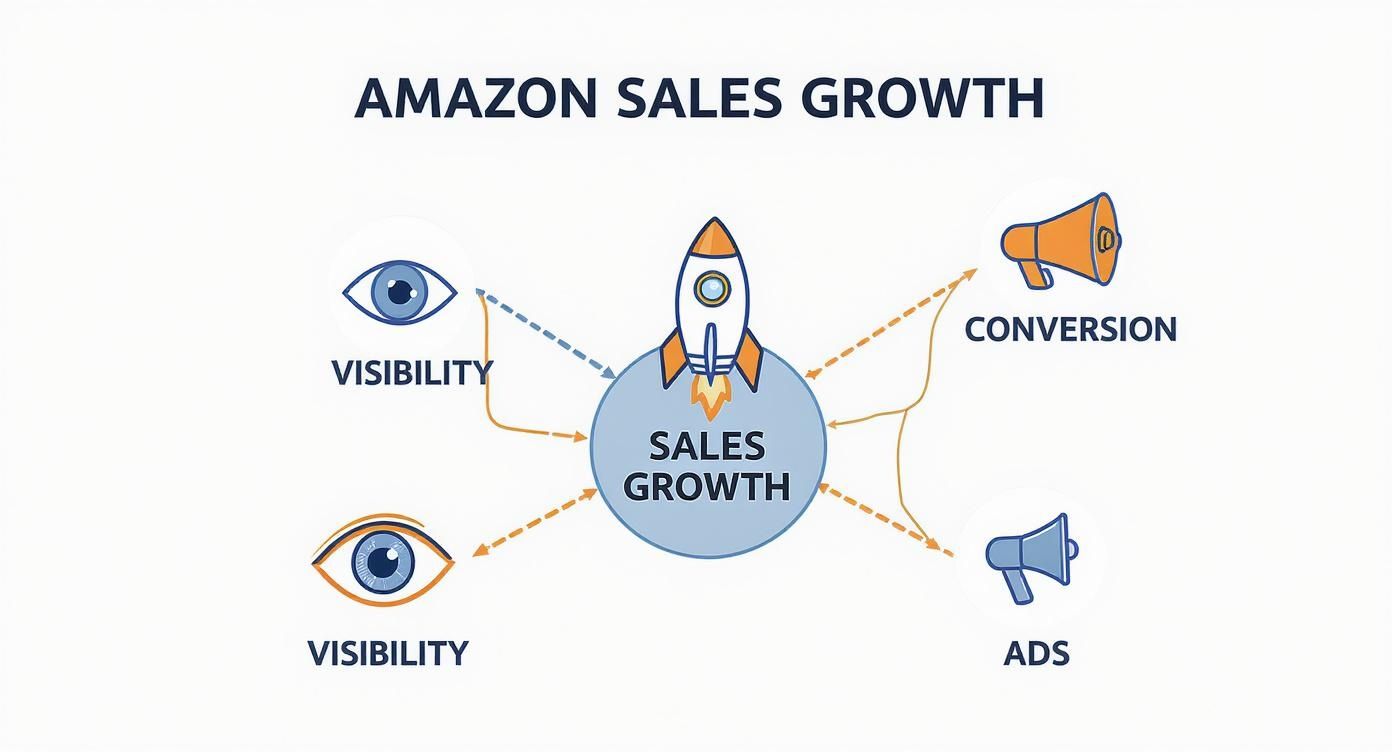
As you can see, real growth happens when you stop treating these pillars as separate jobs. You attract shoppers (visibility), you convince them to buy (conversion), and you use ads to scale it all up. It's a flywheel.
And you have to move fast. On Amazon, 28% of purchases happen in under three minutes. Think about that. Nearly half are done in less than 15 minutes. This platform thrives on impulse buys, which means your listings have to be scannable, persuasive, and crystal clear. You can dig deeper into these powerful ecommerce growth strategies to see how these principles apply beyond Amazon, too.
To truly improve sales on Amazon, you have to shift from putting out fires to building a proactive growth system. Stop reacting to problems and start creating a framework that anticipates what customers want and keeps you one step ahead of the competition. The goal is a seamless journey from discovery to checkout.
Amazon Sales Growth Quick-Start Checklist
Feeling overwhelmed? Don't be. Here's a quick look at the most impactful actions you can take right now to get the ball rolling.
| Growth Area | High-Impact Action | Why It Works |
|---|---|---|
| Visibility | Master long-tail keywords. | They attract high-intent shoppers who know exactly what they want, leading to better conversion rates. |
| Conversion | A/B test your main image. | Your main image is your first impression. A compelling one can dramatically increase click-through rates from search results. |
| Advertising | Launch a low-bid auto PPC campaign. | This is a cheap and effective way to discover new, profitable keywords you might have missed in your manual research. |
| Reviews | Use the "Request a Review" button. | It's a simple, Amazon-compliant way to prompt recent buyers for feedback, which builds social proof and trust. |
This checklist isn't exhaustive, but it's designed to give you immediate traction. Focusing on these high-impact tasks first will build momentum and set a strong foundation for the more advanced strategies we'll cover next.
Mastering Product Listings for Maximum Visibility
Your product listing is your digital storefront on Amazon. Think of it as a balancing act: you need to feed Amazon's A10 algorithm the data it craves while also convincing a real person to click "Add to Cart." When you get this right, your product doesn't just get seen—it gets sold.
And the scale of that challenge is massive. In the U.S. alone, Amazon moves over 143 products every second. That’s a staggering 8,600 items flying off the virtual shelves every single minute. To stand out, your listing has to be a high-performance sales engine.

A well-structured listing, like the one above, instantly grabs attention by showing the most critical info: the title, key benefits, and visual proof. That clarity is what turns a casual scroll into a considered purchase.
Uncovering High-Intent Keywords
Great keyword research is the bedrock of any successful listing. You're not just hunting for popular terms; you're digging for the exact phrases high-intent buyers are typing into the search bar. The sweet spot is where high search volume meets manageable competition.
Forget about broad, "short-tail" keywords like "yoga mat." Sure, they get tons of traffic, but they're incredibly competitive and attract casual browsers. Instead, your goldmine is in "long-tail" keywords that reveal a shopper's specific need.
- "extra thick non slip yoga mat for bad knees"
- "eco friendly cork yoga mat with alignment lines"
- "lightweight foldable travel yoga mat"
These longer phrases are used by shoppers who are much further along in their buying journey. They know exactly what they want, and if your product is the answer, the sale is practically a done deal. You can even find these terms in Seller Central's Search Query Performance dashboard to see what customers are actually using to find you.
Strategic Keyword Placement
Once you've got your keywords, you need to put them where they'll make the biggest impact on both the algorithm and the customer. Think of your listing as having different zones, each with its own level of importance.
The Product Title
Your title carries the most SEO weight. It needs to be packed with your primary keywords but still be readable and compelling to a human. A solid formula to follow is: Brand + Main Keyword + Key Feature/Benefit + Size/Color/Quantity.
For example, "Durable Coffee Mug" is forgettable. A much stronger title is: "Everest Mugs – 16 oz Insulated Stainless Steel Coffee Mug with Spill-Proof Lid – Navy Blue." This version is loaded with searchable terms and gives shoppers all the essential details right away.
Don't make the rookie mistake of "keyword stuffing" your title. Jamming in repetitive terms or creating an unreadable string of words is a turn-off for shoppers, and Amazon's algorithm is smart enough to understand variations and synonyms anyway. A spammy-looking title will cost you clicks.
Bullet Points and Descriptions
Your five bullet points are prime real estate for selling. I always tell clients to lead each bullet with a capitalized, benefit-driven header, then explain the feature that delivers on that promise. This is the perfect place to naturally weave in your secondary keywords.
The product description is where you can use your remaining long-tail keywords and proactively answer customer questions. It's not as heavily weighted for ranking as the title and bullets, but it's still indexed by Amazon and is crucial for closing the deal with detail-oriented shoppers. This is just one piece of a bigger puzzle, which you can read more about in our guide to ecommerce SEO best practices.
Backend Search Terms
This is your hidden advantage. The backend search term fields in Seller Central aren't visible to customers, but they are fully indexed by Amazon. Fill this space with keywords you couldn't fit into the main listing.
Think about including:
- Common misspellings
- Synonyms or alternative words (e.g., "pouch" for a "bag")
- Spanish or other language equivalents if they're relevant to your market
The Power of Persuasive Visuals
Words can only take you so far. High-quality images and video are absolutely non-negotiable for success on Amazon. Since shoppers can't physically touch your product, your visuals have to do all the heavy lifting. A huge part of this is optimizing your Amazon product photos to meet the platform's standards while also appealing to buyers.
Your main image must be on a pure white background, but your other image slots are where you can tell a story. Show your product in use with lifestyle shots, highlight key features with text overlays on infographics, and show it from every angle. This builds trust and answers questions before they're even asked.
Fueling Growth with Strategic Amazon PPC
An optimized product listing is a solid foundation, but if you really want to improve sales on Amazon, you need to pour some fuel on the fire. That fuel is Amazon Pay-Per-Click (PPC).
Gone are the days when you could coast on organic traffic alone. In today's marketplace, paid advertising is non-negotiable for launching new products, defending your turf, and seriously scaling your revenue.
It's a pay-to-play world, and sellers are investing big. Amazon's advertising revenue shot up to around $49 billion globally in 2023—a number that's nearly tripled since 2019. That massive spend tells a simple story: ads work. They are one of the biggest drivers for getting your products discovered and sold on the platform.
Don't think of PPC as just an expense. It's an investment in data and visibility. Every single click gives you priceless information about what shoppers are searching for, which keywords actually convert, and how your products measure up to the competition.
Understanding the Different Ad Types
Amazon gives you a whole suite of advertising tools, but most sellers can crush it just by mastering the core three. Each one has a specific job, and knowing when to use each is the key to an ad strategy that doesn't just spend money, but makes it.
A smart ad strategy isn't about using just one ad type; it's about making them work together. Below is a quick breakdown to help you choose the right tool for the job.
Choosing the Right Amazon Ad Type
| Ad Type | Best For | Key Metrics |
|---|---|---|
| Sponsored Products | Driving immediate sales on specific products. These ads show up right in the search results and on competitor pages, targeting high-intent shoppers. | ACoS (Advertising Cost of Sale), Conversion Rate, Clicks |
| Sponsored Brands | Building brand awareness and telling a broader story. Use these to feature your logo, a custom headline, and a collection of products at the top of the page. | Brand Impressions, Click-Through Rate (CTR), New-to-Brand Metrics |
| Sponsored Display | Retargeting shoppers who’ve viewed your products but didn't buy. This keeps your brand top-of-mind as they browse on and off Amazon. | Viewable Impressions, ROAS (Return on Ad Spend), Detail Page Views (DPV) |
This simple framework helps you align your campaign goals with the right ad format, ensuring your budget is working as hard as you are.
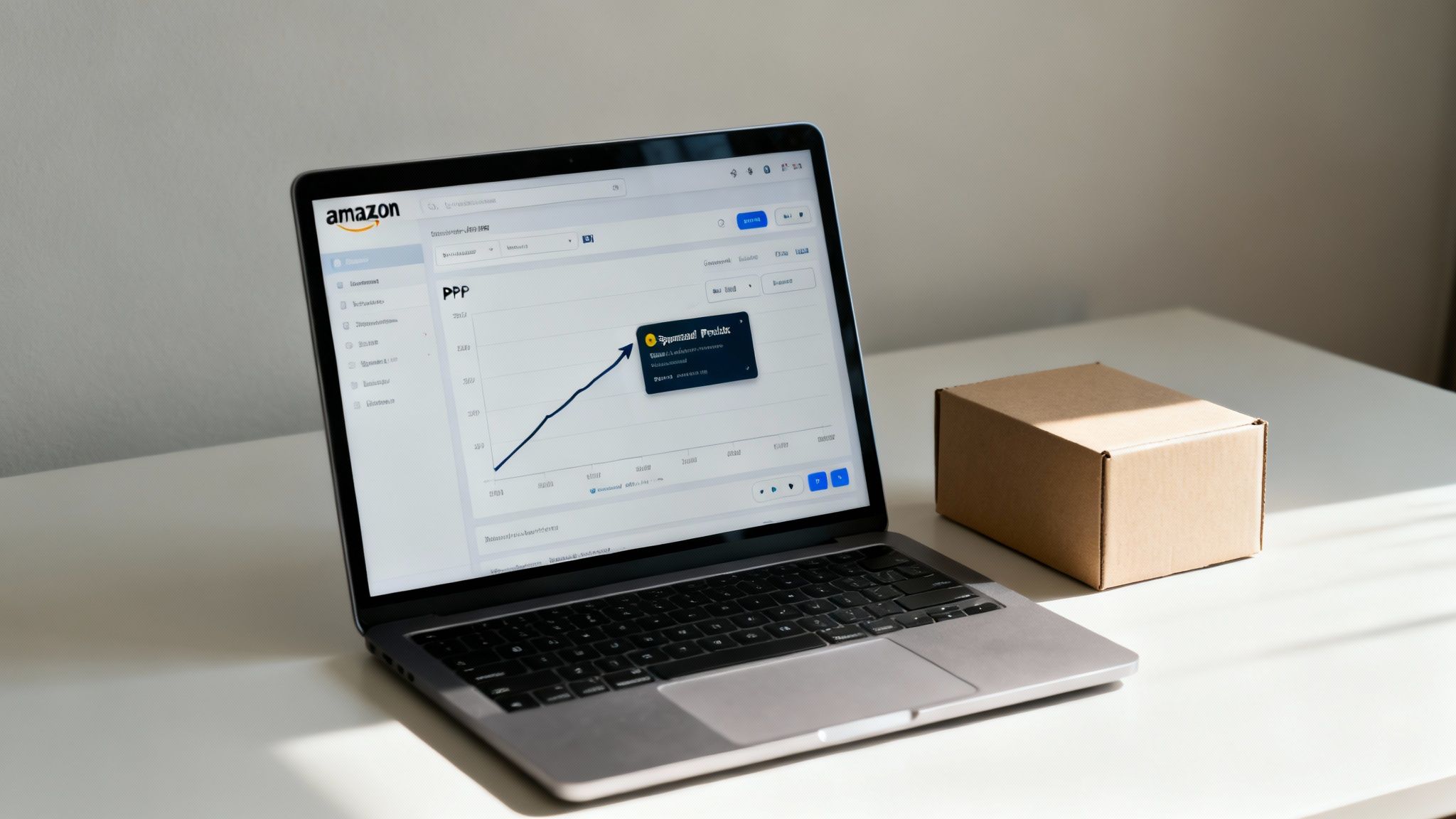
As you can see, these ads blend right in with organic search results, making them a natural and incredibly effective way to grab a premium spot on the page.
Building Your Campaign Structure
One of the biggest mistakes I see sellers make is dumping all their keywords and products into one giant campaign. That approach makes it impossible to control your budget, manage bids, or figure out what’s actually working. A structured campaign is non-negotiable.
Start by creating separate campaigns for each of your main products. From there, create distinct ad groups inside each campaign based on keyword themes.
For example, if you're selling a "stainless steel water bottle," your ad groups might look like this:
- Broad Match Keywords: "water bottle"
- Phrase Match Keywords: "insulated water bottle"
- Exact Match Keywords: "32 oz stainless steel water bottle"
This structure gives you pinpoint control. If you notice your broad match terms are just burning cash without converting, you can dial back the bids for that ad group without touching your high-performing exact match keywords. For a deeper look at the fundamentals, our guide on https://npoint.digital/what-is-ppc-amazon/ is a great place to start.
Your first goal with PPC isn't always instant profit. It's data. Run an automatic campaign with a small daily budget for a week or two. Let Amazon find relevant customer search terms for you. Then, harvest the best-converting terms from that campaign's search report and move them into a manual campaign where you can bid more aggressively.
Mastering Bids and Negative Keywords
Once your campaigns are up and running, the real work begins. Bid management is a constant game of adjusting what you're willing to pay for a click on each keyword.
If a keyword has a killer conversion rate but your ad is buried on page two, you probably need to bump up your bid. On the flip side, if a keyword is getting tons of clicks but zero sales, it's time to slash that bid or pause it completely.
This leads us to one of the most powerful—and underused—tools in your PPC toolkit: negative keywords. These tell Amazon which search terms you don't want your ad to show for.
Imagine you sell premium leather boots. Without negative keywords, your ad might show up for "cheap vegan leather boots." Every click from that search is wasted money. By adding "cheap" and "vegan" as negative keywords, you instantly stop showing up for those irrelevant searches.
This is how you stop the budget leaks and turn your ad spend into a streamlined, profitable sales machine. For more actionable strategies to boost your campaigns, check out these 8 essential Amazon PPC tips for e-commerce success.
Building Trust with A+ Content and Brand Story
Getting a shopper to click on your listing is a good start, but it's only half the battle. You now have just a few seconds to convince them your product is the right choice. This is where you have to move beyond simple bullet points and into visual storytelling with A+ Content.
Available to all Brand Registered sellers, A+ Content is your chance to turn a standard, boring product page into an immersive brand experience. Instead of just rattling off features, you can show the benefits, answer common questions with images, and tell your brand’s story. It’s one of the most powerful tools you have to build the trust and credibility that drive conversions.
Think of it as your digital sales assistant, working around the clock to close the deal.
Going Beyond the Bullets with A+ Modules
The real power of A+ Content comes from its modular design. You can mix and match different blocks of text and images to create a custom layout that makes your product shine, breaking free from the constraints of the standard text description.
Some of the most effective modules I’ve seen work time and again include:
- Comparison Charts: These are absolute gold if you sell multiple versions of a product. A simple chart can clearly lay out the differences between Model A and Model B, guiding customers to the right choice and killing that "purchase paralysis" we all get.
- Lifestyle Imagery: Show your product in the real world. Selling a rugged backpack? Get some shots of it on a muddy hiking trail. This helps customers visualize themselves actually using your product, creating an emotional connection that a block of text never could.
- Technical Specification Modules: For electronics or anything complex, a clean, organized module detailing the specs is way more effective than a dense paragraph. It shows savvy buyers you know your stuff and builds instant credibility.
When you use these modules strategically, you're answering a customer's questions before they even have to ask. That makes their path to purchase as smooth as possible, which is fundamental to improving your sales on Amazon.
Creating Your Amazon Brand Store
While A+ Content upgrades your individual product pages, an Amazon Brand Store creates a central hub for your entire brand. This is your own multi-page website hosted right on Amazon, and the best part? It's completely free of competitor ads and other distractions.
Your Brand Store is the perfect place to send traffic from your Sponsored Brands campaigns. You can showcase your full product catalog, share your brand’s origin story, and even embed videos. It pulls everything together into a cohesive shopping experience, encouraging customers to stick around and explore more of what you offer.
A well-designed Brand Store does more than just display products; it builds brand loyalty. It gives you a dedicated space to control the narrative, build a relationship with customers, and turn one-time buyers into repeat fans. This is how you go from just selling items to building a real brand on the platform.
For instance, a skincare brand can use its store to organize products by concern—like "Anti-Aging" or "Hydration"—and dedicate a page to its commitment to clean ingredients. This kind of thoughtful curation provides huge value to the shopper and establishes the brand as a trusted authority. It’s an advanced move that separates the casual sellers from the professional brands who are serious about long-term growth.
Optimizing Pricing, Promotions, and Fulfillment
Getting your pricing and logistics right is the backbone of your profitability. A perfectly optimized listing and a killer ad campaign might bring shoppers to your page, but it's your pricing and fulfillment that seals the deal—or sends them running to a competitor. This is the operational side of the business where small tweaks can lead to huge gains in both sales and ranking.
Smart pricing isn't about a race to the bottom. It's about finding that sweet spot that juices your sales velocity without wrecking your margins. In the same way, your fulfillment method impacts everything from shipping speed and costs to whether you earn that coveted Prime badge.
Deploying Strategic Pricing and Promotions
A "set it and forget it" pricing strategy is a surefire way to get left behind on Amazon. The marketplace just moves too fast. You need a dynamic approach that reacts to competitors, inventory levels, and your own sales goals. Dropping your price too low can signal poor quality, while pricing too high will absolutely murder your conversion rate.
Promotions are another powerful tool, and they're not just for clearing out last season's stock. Think of them as strategic levers for boosting sales velocity. When Amazon's algorithm sees a sudden spike in your sales, it often rewards you with a bump in organic search ranking, creating a flywheel effect that keeps the momentum going.
Consider these promotional tools:
- Coupons: Those bright orange badges are magnets for eyeballs in search results. They scream "deal" and can seriously boost your click-through rate. A simple 5% or 10% off coupon can be all it takes to make your listing pop.
- Deals: Lightning Deals and 7-Day Deals create a powerful sense of urgency. Getting featured on Amazon's popular Deals page exposes your product to a massive audience of bargain-hunters who are ready to buy now.
The impact of well-timed campaigns is massive. In Q4 2023, for instance, Amazon’s sales jumped 18.8% from the previous quarter, a surge driven largely by holiday promotions. It just goes to show how seasonal campaigns can amplify revenue. You can find more insights on Amazon's impressive sales growth at Capital One Shopping.
Choosing Your Fulfillment Method: FBA vs. FBM
How you get your products into your customers' hands is one of the most critical decisions you'll make. Your two main options are Fulfillment by Amazon (FBA) and Fulfillment by Merchant (FBM). Each has its pros and cons, and the right call really depends on your business model, products, and how much you want to handle yourself.
| Fulfillment Method | Best For | Key Considerations |
|---|---|---|
| Fulfillment by Amazon (FBA) | Sellers who want to offer Prime shipping, outsource all the logistics headaches, and scale up quickly. | Higher fees (storage, fulfillment), less control over packaging, and Amazon has some strict prep requirements. |
| Fulfillment by Merchant (FBM) | Sellers with unique or oversized items, established logistics, or those who want total control over the customer experience. | You're on the hook for all storage, packing, shipping, and customer service. It can be tougher to win the Buy Box without Seller Fulfilled Prime. |
For most sellers looking to grow aggressively, FBA is a no-brainer. Using FBA automatically makes your products Prime-eligible, giving you instant access to Amazon's most loyal and active shoppers. That Prime badge is a massive conversion driver. You can learn more about what Amazon FBA means for sellers in our detailed guide.
The FBA vs. FBM choice isn't just about logistics; it's a strategic decision about your brand's promise. FBA aligns your brand with Amazon's reputation for fast, reliable delivery—a powerful trust signal for customers who are on the fence.
Avoiding the Dreaded Stockout
All your hard work on listings, keywords, and ads means absolutely nothing if a customer lands on your page only to see "Currently unavailable." Stockouts are absolute sales killers. You don't just lose the immediate sale; you hand momentum directly to your competitors. To make matters worse, Amazon's algorithm penalizes listings that stock out, causing your hard-won search ranking to tank.
Effective inventory forecasting isn't optional. You have to analyze your sales data, account for seasonality, and plan for upcoming promos. Keep a close eye on your Inventory Performance Index (IPI) in Seller Central. This score reflects how well you're managing inventory, and a low score can lead to storage limits, which only increases your risk of stocking out.
Always aim to keep at least 30-60 days of stock on hand. This creates a buffer for unexpected sales spikes or supply chain hiccups.
Leveraging Social Proof and Customer Reviews
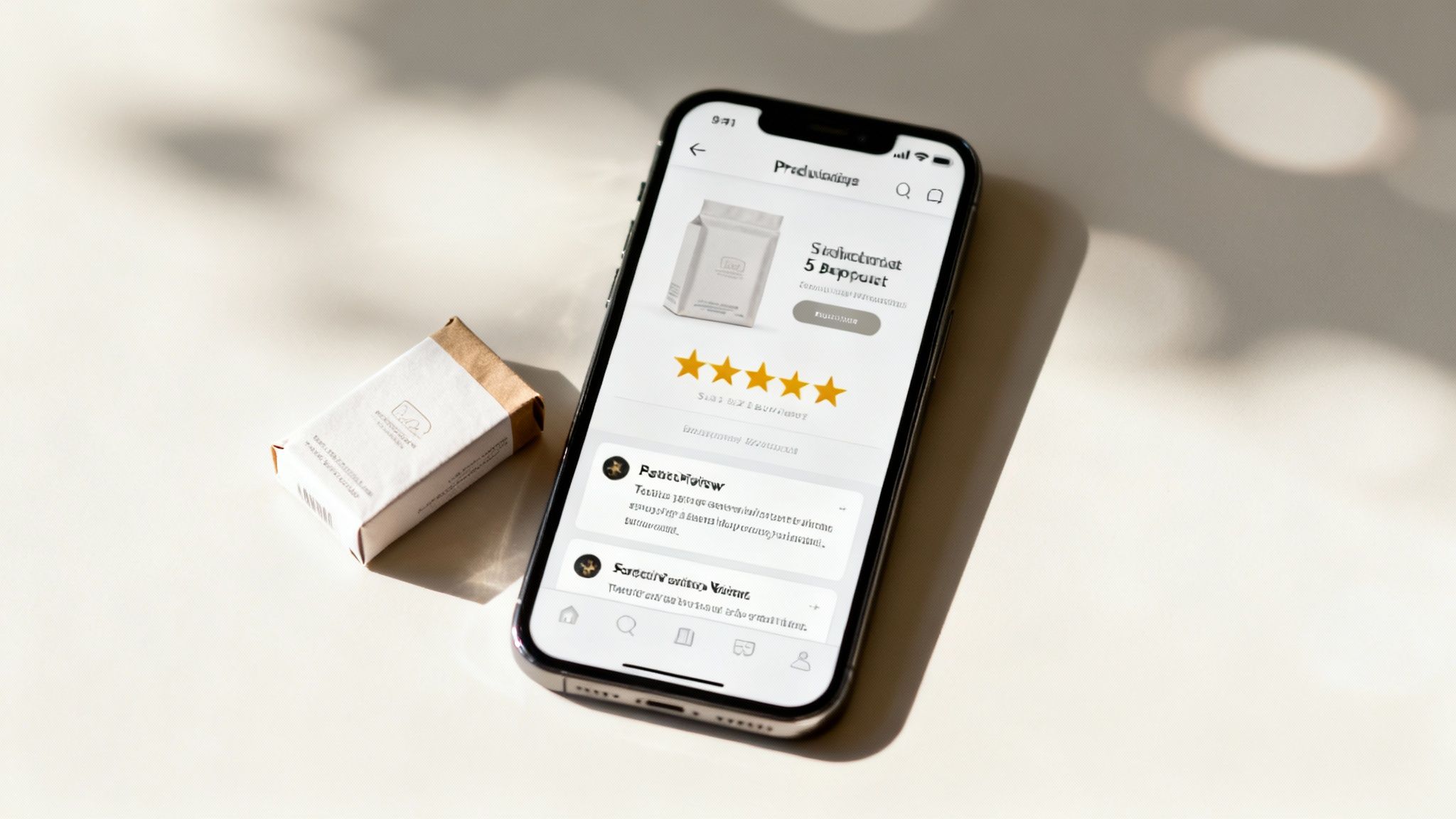
On Amazon, social proof isn’t just some marketing buzzword; it’s the currency of trust. When a shopper can’t physically hold your product, they turn to the collective experience of others to make their decision. A strong foundation of positive reviews is one of the most direct ways to improve sales on Amazon.
Great reviews do more than just convince shoppers—they directly impact your visibility. Amazon’s A10 algorithm favors products with higher ratings and a steady stream of new feedback, seeing it as a clear signal of customer satisfaction. This kicks off a powerful cycle: more reviews lead to better rankings, which drives more sales and, you guessed it, even more reviews.
Proactive Strategies for Generating Reviews
Passively waiting for feedback is not a strategy. You need a compliant system in place to encourage buyers to share their experiences. Amazon actually gives you specific, approved tools for this, and using them correctly is the key to building social proof without risking your account’s health.
The most straightforward method is the "Request a Review" button right inside the order details page in Seller Central. This sends a standardized, Amazon-branded email asking the customer for both a product review and seller feedback. It's manual, but it's 100% compliant and it works.
For sellers looking to scale, various third-party automation tools can trigger these requests systematically, saving you a ton of time.
Don't ever incentivize reviews with discounts, free products, or gift cards. This is a direct violation of Amazon's terms of service and a fast track to account suspension. Stick to the approved channels to protect your business.
Turning Negative Feedback into an Opportunity
No seller is immune to negative reviews. It’s going to happen. How you handle them, however, can turn a potential disaster into a public display of excellent customer service. Ignoring a one-star review tells every future customer that you don’t care about them or the quality of your products.
Always respond publicly and professionally to negative feedback. Acknowledge the customer's issue, apologize for their poor experience, and offer a real solution. This shows prospective buyers that if something goes wrong, you’ll be there to make it right—and that alone can be a powerful tie-breaker in their decision.
Building this kind of trust is fundamental. For a deeper dive on this, check out our conversion rate optimization tips to see how trust impacts the entire sales funnel.
This intense focus on the customer experience is what separates the top sellers from everyone else. In 2024, over 55,000 independent U.S. sellers each averaged more than $290,000 in annual sales. That’s proof that a solid strategy leads to serious revenue. You can find more insights on the success of independent Amazon sellers from Notta.ai.
Common Questions About Growing Amazon Sales
Selling on Amazon can feel like trying to hit a moving target, especially when something goes wrong out of the blue. Most sellers run into the same handful of frustrating problems as they try to scale, and getting straight answers is the only way to build a strategy that actually works.
One of the biggest panic moments for any seller is a sudden, unexplained drop in sales. It’s alarming, but it’s almost never random. More often than not, the culprit is a competitor launching a new promotion, a recent change to your listing that tanked its ranking, or even just losing the Buy Box. A quick, methodical check of your pricing, keywords, and what your competitors are up to will usually point you right to the problem.
Another question I hear all the time is about setting a realistic advertising budget. There’s no magic number here.
A good starting point is to allocate 10% of your total revenue to your advertising budget. Once you have some performance data, you can dial this up or down based on your Advertising Cost of Sale (ACoS) and profit goals. Think of it as an investment, not just an expense.
Understanding Algorithm Changes
Sellers get really hung up on Amazon's A10 algorithm, worrying about every little update. While Amazon keeps the specifics under wraps, its main goal never changes: the algorithm will always, always favor products that give customers a great experience.
Your best defense isn't chasing algorithm rumors. It's nailing the fundamentals.
- High conversion rates: Your listing does a great job of turning clicks into actual sales.
- Positive review velocity: You’re consistently getting fresh, positive feedback.
- Strong sales history: Your product has a proven track record.
- Relevant keywords: You’re optimized for the exact phrases customers are searching for.
Forget the noise. If you focus on delighting your customers, you’re aligning your goals with Amazon's. That makes your business far more resilient to whatever changes they roll out next.
Ready to stop guessing and start growing? Next Point Digital provides the expertise and data-driven strategies you need to scale profitably. We turn clicks into loyal customers. Let's build your growth plan together.