

For brands with a smart game plan, the answer is a resounding yes—selling on Amazon is absolutely worth it. The marketplace is filtering out casual players, creating a prime opportunity for serious, data-driven sellers to thrive. This isn't just about reaching a massive audience; it's about capitalizing on a more professional and profitable landscape.
Why Amazon Is More Lucrative Than Ever
Wondering if selling on Amazon is still a good move? Absolutely. The platform has matured in a way that’s created what I call a "competition paradox." Fewer new sellers are jumping in compared to the gold rush years, but the sales and traffic available to dedicated brands are soaring.
Think of it like a professional sports league. All the amateur teams have been sent home, leaving a clearer field for the skilled competitors to really dominate. This shift means treating Amazon as a side hustle just doesn't cut it anymore. Success now demands a professional approach that’s grounded in data, optimization, and a real understanding of how the game is played.
The New Rules of the Amazon Game
The data tells a pretty compelling story. In the third quarter of 2025, third-party sellers accounted for a massive 62% of all paid units sold—a huge jump from just 45% back in 2015. This trend shows that independent businesses are the real engine behind Amazon's growth, powering over $575 billion in global gross merchandise volume.
Even though the total number of active sellers dropped from a peak of 2.4 million in 2021 to 1.65 million today, the opportunity for each remaining seller has exploded.
- More Eyeballs on Your Products: Traffic per active seller has jumped by 31% since 2021.
- Higher Earning Potential: Over 100,000 sellers now pull in $1 million or more in annual revenue, which has doubled since 2021.
- Faster Path to Profit: A solid 58% of sellers hit profitability within their first year by focusing on the right metrics from day one.
What does this mean for e-commerce brands? It signals that the marketplace is rewarding sophistication and strategy. The casual gold rush is over. It’s been replaced by a meritocracy where well-prepared brands can build substantial, scalable businesses.
To put it all in perspective, here's a quick look at the key numbers that show why Amazon is still a massive opportunity for strategic brands.
Amazon Selling At a Glance: Key Metrics for Brands
| Metric | Data Point | What This Means for You |
|---|---|---|
| 3rd-Party Seller Share | 62% of all units sold | You're not a small fish in Amazon's pond; you're the main event. Amazon's success depends on sellers like you. |
| Seller Revenue | 100,000+ sellers making $1M+ annually | The ceiling for growth is incredibly high for brands that get their strategy right. |
| Traffic Per Seller | Up 31% since 2021 | With fewer casual sellers, there's more customer traffic to go around for serious brands. |
| Prime Membership | Over 200 million members in the U.S. | You get instant access to a massive, loyal customer base that's primed to buy and expects fast shipping. |
| Profitability Timeline | 58% of sellers profitable within 12 months | With a solid plan, you can see a return on your investment relatively quickly. |
These figures aren't just vanity metrics; they represent a real, tangible opportunity for brands that are ready to treat Amazon like a core part of their business. The landscape is more competitive, but it's also more rewarding for those who know how to navigate it.
Capitalizing on the Prime Advantage
One of the biggest reasons selling on Amazon is still worth it is the direct line to its incredibly loyal customer base. With over 200 million Prime members in the U.S. alone, you’re tapping into an audience that expects—and pays for—fast, reliable shipping.
It’s no surprise that 82% of sellers use Fulfillment by Amazon (FBA) to get that coveted Prime badge on their listings. That little blue checkmark does more than just promise two-day shipping; it builds trust, boosts your visibility in search results, and directly drives up conversion rates. Our guide on Amazon sales data dives even deeper into how these trends impact sellers.
Breaking Down the True Cost of Selling on Amazon
So, you're looking at Amazon and seeing dollar signs. It's easy to get excited about the massive revenue potential, but hold on a second. Profitability isn’t about what you make; it’s about what you keep.
Think of it like buying a house. The list price is just the start. It's the property taxes, insurance, and surprise maintenance costs that really determine if you can afford it. Selling on Amazon is the exact same game. Your product cost is the big number, but it's the web of fees that catches new sellers off guard and decides whether you'll build a real business or just spin your wheels.
Getting these numbers right from day one is the single biggest difference between a thriving brand and one that’s left wondering where all the money went.
The Core Fees Every Seller Pays
First up, let's talk about the non-negotiables. No matter who you are or what you sell, you’re going to run into these baseline costs.
It all starts with your Seller Plan. You've got two choices:
- Individual Plan: This one costs $0.99 for every single item you sell. It’s a good fit if you're just testing the waters or know you’ll be moving fewer than 40 units a month.
- Professional Plan: This is a flat $39.99 a month, no matter how many items you move. If you're serious about selling more than 40 products, this is a no-brainer. It’s cheaper and unlocks crucial tools like advertising and advanced reports.
Next, Amazon takes its cut, which they call the Referral Fee. This is their commission for giving you access to their millions of customers. It’s a percentage of the total sale price (yep, including shipping) and usually lands somewhere between 8% and 15%, though it can be higher for certain categories like apparel.
This infographic paints a picture of why getting a handle on these numbers is so critical right now.
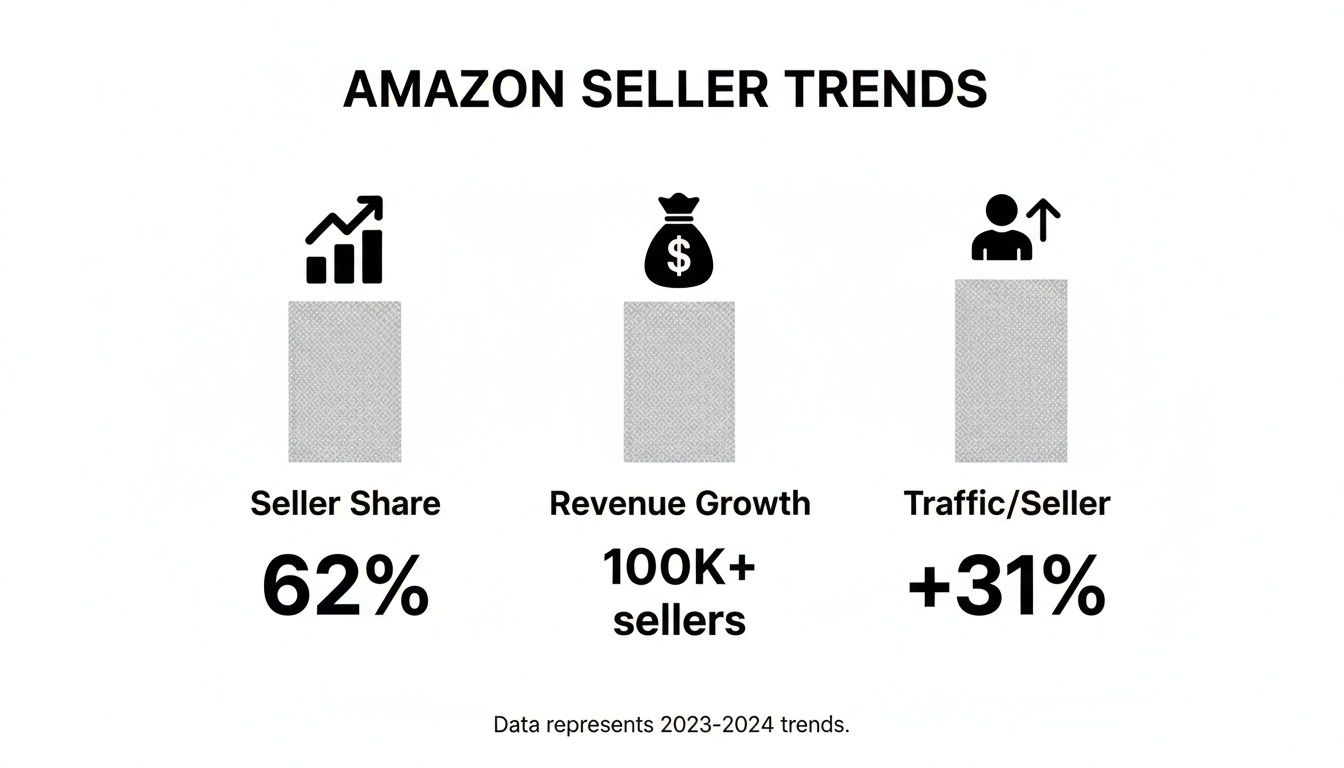
With third-party sellers dominating the platform and more eyeballs on every listing, mastering your finances is the only way to grab your piece of the pie.
Unpacking Fulfillment by Amazon (FBA) Costs
Now let's get into Fulfillment by Amazon, or FBA. A whopping 82% of sellers use FBA, and for good reason—it takes the headache of logistics off your plate. But that convenience comes at a price, and you need to build these fees directly into your pricing strategy.
FBA fees aren't just one charge. They're broken down into two main parts:
- Fulfillment Fees: This is a per-unit fee that covers Amazon picking, packing, and shipping your product. It’s all based on your item’s size and weight. Bigger and heavier means a higher fee. Simple as that.
- Monthly Inventory Storage Fees: You're basically renting shelf space in Amazon's warehouses. This is charged per cubic foot, and it gets more expensive during the busy holiday season from October to December.
To give you a real-world look at how all these costs stack up, here’s a sample breakdown for a common $35 product.
Example Profit Margin Breakdown for a $35 Product
| Line Item | Amount ($) | Description |
|---|---|---|
| Retail Price | $35.00 | The price the customer pays on Amazon. |
| Referral Fee (15%) | -$5.25 | Amazon's commission for the sale. |
| FBA Fulfillment Fee | -$4.75 | Cost to pick, pack, and ship the item (standard size). |
| Monthly Storage Fee | -$0.25 | Estimated cost for one unit stored for one month. |
| Total Amazon Fees | -$10.25 | The sum of all direct fees from Amazon. |
| Net Payout from Amazon | $24.75 | The amount Amazon deposits into your account. |
| Cost of Goods Sold (COGS) | -$8.00 | Your cost to manufacture or source the product. |
| Advertising Cost (10% ACoS) | -$3.50 | Estimated ad spend to generate the sale. |
| Total Costs | -$21.75 | All fees, product costs, and ad spend combined. |
| Net Profit | $3.25 | The final profit you actually keep. |
| Net Margin | 9.3% | Your profit as a percentage of the retail price. |
As you can see, that $35 sale quickly turns into just over $3 in your pocket. This is why knowing your numbers is non-negotiable.
The "Hidden" Costs That Can Sink Your Margins
Okay, we’ve covered the obvious fees. But the real profit killers are the ones that sneak up on you—the costs that new sellers almost always forget to budget for.
- Advertising Spend: Let's be clear: Amazon PPC is not optional anymore. To get seen, you have to pay to play. A healthy budget for Sponsored Products is essential just to get your first sales and build some momentum.
- Return Processing Fees: Customers send things back. When they do, Amazon might charge you a fee to handle it, especially in categories like clothing.
- Long-Term Storage Fees: This is a big one. If your inventory sits in a warehouse for over a year, Amazon will hit you with massive penalties. If your products don't sell, you're paying Amazon to store them.
- Removal Order Fees: Got a product that just won't sell? To get it back from Amazon's warehouse, you have to pay them a per-item fee to ship it back to you. It's a final, painful cost on a failed product.
How to Win in a Less Crowded but More Skilled Marketplace
The Amazon gold rush is over. Gone are the days when you could just throw up a listing and watch the sales roll in. Today’s marketplace is a completely different beast.
Think of it less like a chaotic flea market and more like a professional sports league. There might be fewer teams on the field, but every single one is skilled, well-funded, and playing to win.
This shift has created what we call the "competition paradox." While fewer new sellers are jumping in, the ones who are already there—and the ones who are succeeding—are far more sophisticated. These aren't side-hustlers anymore. They're serious brands treating Amazon as a primary sales channel, armed with data, big budgets, and sharp strategies. This is exactly why having a clear plan isn't just a "nice-to-have." It's the only way to compete.
Understanding the Modern Amazon Competitor
Today's top sellers are masters of the game. They live and breathe marketplace SEO, run incredibly complex ad campaigns, and use every tool they can get their hands on to find an edge. In this arena, your biggest threat isn't a flood of cheap knock-offs from overseas; it's a savvy competitor who has perfected their supply chain, nailed their branding, and dialed in their customer acquisition.
The numbers tell the story perfectly. Amazon's seller landscape saw only 165,000 new registrations in 2025, the lowest figure since 2015. At the same time, third-party sales exploded to $575 billion worldwide.
All that money is being concentrated among fewer, more skilled players. In fact, over 100,000 sellers now pull in more than $1 million a year, a huge jump from just 60,000 back in 2021. This means that while the barrier to entry might seem low, the barrier to success is higher than it's ever been. To win, you have to operate like a pro from day one.
Differentiating Your Brand in a Sea of Experts
When you're surrounded by skilled opponents, generic products and boring listings are invisible. Your most powerful weapon is differentiation. It's not enough to have a good product; you need to build a brand that customers actually recognize, trust, and choose over the other guys.
So, how do you stand out?
- Do a Deep Competitive Dive: Before you even think about listing, you need to know who you're really up against. Dig into their pricing, what their reviews are saying, the quality of their listings, and how they're running their ads. Find their weak spots. Is their branding all over the place? Are customers complaining about the same missing feature? That's your opening.
- Build a Real Brand Presence: Amazon gives you the tools to build a brand, not just sell products. Use them. Create a visually sharp Amazon Storefront that tells your story and lets you show off your entire product line.
- Go All-In on A+ Content: Don't just settle for a few bullet points. Use A+ Content (also known as Enhanced Brand Content) to add rich text, comparison charts, and killer images right on your product detail page. This is your chance to answer questions before they're even asked and create an experience that feels premium. For a deeper look, we have a detailed guide on how to optimize Amazon product listings to turn more shoppers into buyers.
The goal is to make your product listing more than just a place to click "buy." It needs to be a destination that screams value, quality, and trust, convincing a customer to pick you over a dozen other options that look almost identical.
To really seal the deal and turn browsers into buyers, investing in top-notch images is non-negotiable. Your photos are the first—and often only—chance to make an impression. Seriously consider using services that specialize in professional Amazon product photography to make sure your visuals are crisp, compelling, and built to convert. Turning that competitive pressure into your strategic advantage is how you thrive on the modern Amazon.
Choosing Your Fulfillment Strategy: FBA vs. FBM
Figuring out how to get your products to customers is one of the most critical calls you'll make on Amazon. This isn't just about shipping; it's a decision that fundamentally shapes your operations, profitability, and your ability to scale. The two main paths are Fulfillment by Amazon (FBA) and Fulfillment by Merchant (FBM).
Think of it like deciding whether to lease a professional kitchen for your restaurant (FBA) or build one from scratch (FBM). One gives you immediate access to world-class equipment and staff, while the other offers total control at the cost of managing every single detail yourself. Which one is right depends entirely on your business model, budget, and goals.
The Power of Fulfillment by Amazon (FBA)
With FBA, you ship your products in bulk to Amazon’s massive fulfillment centers. Once they have your inventory, they take over completely. They store your products, pick and pack orders, ship them to customers, and even handle returns and customer service.
The single biggest draw of FBA is unlocking the Amazon Prime badge. For millions of shoppers, that little blue checkmark is a non-negotiable symbol of trust and, more importantly, fast and free shipping. Data shows again and again that having the Prime badge dramatically increases conversion rates and gives you a massive edge in winning the all-important Buy Box. For many brands, this benefit alone makes FBA a no-brainer.
By tapping into FBA, you are essentially plugging your business directly into one of the most advanced logistics networks on the planet. This allows even a one-person startup to offer the same delivery speeds as a global retail giant.
Using FBA also streamlines your operations, freeing you up to focus on sourcing, marketing, and actually growing your business instead of packing boxes all day. If you want to dive deeper, our detailed guide on what Amazon FBA means for your business breaks down the whole process. Just remember, this convenience comes with fulfillment and storage fees that you have to bake into your margins.
When Fulfillment by Merchant (FBM) Makes Sense
Fulfillment by Merchant is the classic do-it-yourself approach. You're responsible for everything: storing your own inventory, packing each order as it comes in, and shipping it directly to the customer. You also have to manage all customer service inquiries and returns yourself.
This path gives you ultimate control over your operations and inventory. For certain business models, FBM isn't just an option—it's the smarter and more profitable choice.
Consider these scenarios where FBM often comes out on top:
- Oversized or Heavy Items: FBA fees are calculated based on size and weight, which can make them ridiculously expensive for large products like furniture or heavy equipment.
- Products with Low Margins: If your profit margins are already paper-thin, avoiding FBA fees can be the only way to make the numbers work.
- Multi-Channel Sales: If you already have a solid fulfillment operation for your own website or other marketplaces, managing everything from one warehouse is far more efficient.
- Exclusive or Handmade Goods: For sellers with small inventories of unique items, self-fulfillment gives you much greater control over the packaging and overall customer experience.
When you're weighing FBA vs FBM, it helps to understand the broader landscape of e-commerce fulfillment strategies and how they can integrate with your Amazon business. FBM definitely requires more hands-on work, but the cost savings and control can be a game-changer for the right kind of product.
Making the Right Choice for Your Brand
The good news is the FBA vs. FBM decision isn’t permanent. In fact, many successful sellers use a hybrid approach. You might use FBA for your fast-moving, standard-sized bestsellers to leverage the Prime badge, while fulfilling larger or slower-moving items yourself via FBM to save on fees.
Here’s a simple framework to help you decide:
- Analyze Your Product: Is it small, light, and a fast seller? FBA is a strong contender. Is it large, heavy, or slow-moving? FBM is probably more cost-effective.
- Calculate Your Margins: Run the numbers for both scenarios. Can your profit margin comfortably absorb FBA fees and still leave you with a healthy return?
- Assess Your Operational Capacity: Be honest with yourself. Do you really have the space, staff, and time to manage daily packing and shipping?
Ultimately, choosing your fulfillment strategy is a core part of figuring out if selling on Amazon is truly worth it for you. It directly impacts your workload, your costs, and your ability to compete effectively in a crowded marketplace.
Why Advertising Is Non-Negotiable for Growth
The old Amazon mantra of "if you list it, they will come" is officially dead. These days, launching a product without a dedicated advertising budget is like opening a store in the middle of a desert and hoping for foot traffic. Visibility isn't just handed to you anymore; it's something you have to earn through strategic investment.
In a marketplace with millions of other sellers, relying on organic ranking alone is a slow, painful grind. Proactive advertising, mostly through Amazon's Pay-Per-Click (PPC) platform, is the engine that gets you those critical first sales and reviews. It’s what signals to Amazon's algorithm that your product actually matters. Without it, even the best products get buried on page 20, where shoppers never see them.
This investment isn't just another expense—it's a core part of figuring out if selling on Amazon is even worth it for your brand. A sharp ad strategy can be the single biggest difference between a profitable launch and a failed experiment.
Understanding the Amazon PPC Ecosystem
Think of Amazon’s search results page as prime real estate. The top spots and sidebars are the premium locations, and you have to pay to get your product placed there. Amazon PPC lets you bid on specific keywords, and you only pay when a shopper actually clicks on your ad. Simple enough, right?
The system is built around three main ad types, and each one serves a different purpose:
- Sponsored Products: These are the ads you see most often, popping up right in the search results and on product detail pages. They're perfect for driving immediate sales for specific items.
- Sponsored Brands: These ads sit at the very top of the search results, showing off your brand logo, a custom headline, and a few of your products. They’re fantastic for building brand awareness and defending your turf from competitors.
- Sponsored Display: These ads can follow shoppers on and off Amazon, targeting them based on their browsing history. This is a powerful way to retarget customers who looked at your products but didn't buy.
For a deeper dive into the mechanics, our guide on what Amazon PPC is breaks down exactly how to get started. Success here isn’t about who has the deepest pockets; it's about being smarter with your bids and targeting.
Key Metrics That Define Advertising Success
To manage your ad spend without burning through cash, you need to speak the language of Amazon advertising. Two of the most important metrics you'll hear about are ACoS and TACOS.
ACoS (Advertising Cost of Sale) is all about the direct efficiency of your ad campaigns. You calculate it by dividing your ad spend by your ad revenue. So, a 25% ACoS means you spent $0.25 on ads for every $1.00 in sales you made from those ads. While a lower ACoS sounds better on the surface, a number that's too low might mean you're not bidding aggressively enough and are leaving sales on the table.
TACOS (Total Advertising Cost of Sale) gives you a much bigger picture of your business's health. It’s calculated by dividing your ad spend by your total revenue (from both ads and organic sales). This metric shows you how your advertising is actually lifting your overall sales.
A declining TACOS over time is a fantastic sign. It means your ad spend is successfully boosting your organic rank. Your ads are creating a "flywheel effect"—paid sales are leading to more organic visibility, which in turn means you can rely less on ads.
A healthy, shrinking TACOS proves your ad spend is an investment in long-term growth, not just a short-term cost.
The Strategic Role of Advertising
A well-run PPC strategy does a lot more than just generate clicks; it's a tool for scaling your entire business. A modern approach involves using advanced tools, often powered by AI, to handle predictive bidding and real-time keyword optimization, but the core strategy remains the same.
Here’s how smart advertising fuels real growth:
- Launching New Products: Ads are non-negotiable for getting those first sales and reviews. This builds the social proof you need to start climbing the organic rankings.
- Defending Your Brand: Your competitors will bid on your brand name to poach your customers. Running defensive Sponsored Brands campaigns protects your space and keeps your audience focused on you.
- Scaling Profitably: By watching your ACoS and TACOS, you can quickly see which keywords and campaigns are making you money. This lets you double down on what works and cut what doesn't.
Ultimately, advertising is what gives your brand control over its own destiny on Amazon. It turns you from a passive seller hoping for the best into an active driver of your own success.
Your Go or No-Go Checklist for Selling on Amazon

We've walked through the costs, competition, fulfillment models, and the hard realities of advertising. Now it’s time to put all that theory into action.
This final checklist pulls everything together into a series of direct questions. Think of it as your final pre-flight check before committing. Answering these honestly will give you the clarity you need to decide if selling on Amazon is truly worth it for your brand.
Product and Market Viability
First things first: let's get real about your product and where it fits in the market. A great product isn't enough on its own; it needs a real edge to cut through all the noise on Amazon. Ask yourself:
- Is my product genuinely different? Can you clearly explain what makes it better or more valuable than the top five competitors? If you're launching a "me-too" product, you're going to get lost in the crowd.
- Is there real, searchable demand? Have you done your keyword research to confirm that people are actively searching for a product like yours? Hope is not a strategy.
- Can I build a brand around this? Does your product have the legs to grow into a full product line, or is it just a one-hit wonder? Long-term success on Amazon is about building a brand, not just selling an item.
A "yes" to these questions means you've got a solid foundation to build on. Without a distinct product and proven demand, even the slickest operational plan will fall flat.
Financial and Operational Readiness
Next, it's time for a candid look at your numbers and your capabilities. The financial realities of Amazon can be brutal if you aren't ready for them from day one.
- Are my profit margins strong enough? After you subtract your cost of goods, referral fees, FBA costs, and a 10-15% budget for ads, will you still have a healthy net margin of at least 15%? Anything less is a major red flag.
- Do I have the operational chops? Whether you go with FBA or FBM, can you handle the inventory, shipping, and customer service demands without letting quality slip?
- Am I prepared to pay to play? You have to accept that advertising is a non-negotiable cost of doing business here. Do you have the cash set aside to fund a sustained PPC launch campaign for at least 90 days?
Your Next Steps
How you answered this checklist should give you a pretty clear path forward. If you confidently answered "yes" to most of these questions, you’re probably in a strong position to launch a successful Amazon business. Your next move is to start building out your listings and planning your launch strategy.
But if you answered "no" to the big ones—especially around profit margins or product differentiation—that's a signal to hit the pause button. It doesn't mean Amazon isn't for you. It just means your business plan needs some work before you sink time and money into it. Maybe it's time to tweak your product or go back to your suppliers to improve those margins.
For brands that want an expert guide through this whole process, partnering with a marketplace growth agency like Next Point Digital can give you the strategic roadmap and hands-on execution needed to launch with confidence and scale profitably.
Got Questions About Selling on Amazon? We Have Answers
Even with the best game plan, it’s normal to have a few lingering questions before you dive into the Amazon marketplace. Let's tackle some of the most common concerns head-on so you can move forward with confidence.
How Long Does It Realistically Take to Become Profitable on Amazon?
While every brand's journey is different, the data is pretty encouraging. Most sellers—somewhere between 58% and 64%—hit profitability within their first year. But getting there isn't about luck; it's about being prepared from day one.
A few things will seriously speed up your timeline:
- Healthy Product Margins: You absolutely must have enough room in your price to soak up all of Amazon's fees and ad costs without wiping out your profit.
- An Effective Launch Strategy: A well-funded ad campaign is non-negotiable. It's what drives those critical first sales and gets the review flywheel spinning.
- Optimized Listings: Your product pages need to be retail-ready from the moment you go live. That means compelling copy, great images, and the right keywords.
Brands that treat their launch like a strategic investment almost always see returns faster than those who just dip their toes in the water.
Can I Sell on Amazon if I Already Have a Successful D2C Website?
Absolutely. In fact, you should. Thinking of Amazon and your own D2C site as competitors is a huge mistake. The smartest brands use them together—it’s an "and" strategy, not an "either/or" choice. Amazon is a massive customer acquisition engine, putting your brand in front of its 200+ million Prime members.
Many of the top D2C brands use Amazon to drive volume and reach new shoppers who would have never found them otherwise. They then use their own website to build loyalty, capture customer data, and secure higher-margin sales. The trick is to keep your branding and pricing consistent across both channels.
What Are the Biggest Mistakes New Amazon Sellers Make?
The most expensive and frustrating mistakes almost always boil down to a lack of planning. New sellers tend to trip up in a few key areas that can sink their efforts before they even get started.
The number one error is underestimating the total costs. This single mistake crushes profit margins before a business ever has a chance to get off the ground. You need a full business plan, not just a cool product idea.
Other major pitfalls include:
- Choosing a Hyper-Competitive Product: Jumping into a saturated market without a unique angle is a fast track to getting buried on page 20.
- Failing to Invest in Advertising: You can have the best product in the world, but if you don't have a dedicated PPC budget, it will remain invisible.
- Poor Inventory Management: This is a two-sided nightmare. Stocking out kills your sales momentum and search ranking, while overstocking racks up long-term storage fees that chew through your profits.
Do I Need an Agency to Succeed on Amazon?
While you can definitely go it alone, the marketplace has gotten so complex that an experienced agency can seriously accelerate your growth. A good partner helps you sidestep the costly beginner mistakes in tricky areas like advertising, listing optimization, and inventory planning.
For brands that are serious about scaling efficiently, an agency brings the specialized expertise needed to maximize your ROI and navigate Amazon's constantly shifting rules and algorithms.
Ready to turn clicks into sales and scale your brand with confidence? Next Point Digital provides the strategic roadmap and expert execution you need to thrive on Amazon and beyond. Explore our services and start your growth journey today.