

So, is selling on Amazon actually worth it?
Let’s cut to the chase: for most businesses with a solid product and a clear strategy, the answer is a resounding yes. But it’s not a simple plug-and-play solution. Getting on Amazon means tapping into a colossal, ready-to-buy audience, but it comes with a major trade-off: you gain millions of customers in exchange for navigating intense competition and Amazon's notoriously strict ecosystem.
This guide is your roadmap to understanding that trade-off. We’ll skip the hype and get straight to the real numbers—the costs, the different business models you can run, and the fulfillment strategies that separate the brands that thrive from the ones that barely survive. This isn't another get-rich-quick fantasy; it's about building a sustainable, profitable sales channel.
The core appeal is undeniable: instant access to a global marketplace. From a pure market-access perspective, that scale alone makes Amazon an obvious choice. The platform has over 300 million active customer accounts worldwide, and that audience is more comfortable than ever buying from independent brands like yours. In fact, third-party sellers now account for over 60% of all sales in Amazon’s store—a number that just keeps climbing.
The Real Answer Is Selling on Amazon Worth It
To figure out if selling on Amazon is the right move for you, you need a clear-eyed view of both the good and the bad. It’s not just about the potential for massive sales volume; it’s about whether the operational headaches and fees actually align with your business goals and, more importantly, your profit margins.
A quick look at the pros and cons makes the decision-making process a little clearer.
Selling on Amazon At a Glance Pros vs Cons
| Key Advantages (Pros) | Key Disadvantages (Cons) |
|---|---|
| Massive Customer Base: Immediate access to one of the world's largest pools of active, high-intent buyers. | Fierce Competition: You're competing with thousands of sellers, often on price, making it tough to stand out. |
| Built-in Trust: Shoppers trust Amazon's fulfillment and customer service, which can significantly lift your conversion rates. | Complex Fee Structure: Referral fees, FBA costs, and storage fees can quickly eat into your margins if not managed meticulously. |
| Powerful Infrastructure: Leveraging Fulfillment by Amazon (FBA) offloads the complexities of logistics, storage, and shipping. | Lack of Control: Amazon ultimately owns the customer relationship and can change its rules with little notice, impacting your business overnight. |
As you can see, the opportunity is massive, but so are the challenges. It's a classic risk-reward scenario that requires careful planning.
The question isn't just about sales potential, but profitability. A successful Amazon strategy requires a deep understanding of your unit economics after all platform fees are accounted for.
Getting a grip on your potential profit margins is the critical first step. For a deeper dive into profit calculation, check out our guide on analyzing Amazon sales data.
And for a more comprehensive perspective, this detailed discussion offers a data-driven answer to whether selling on Amazon is worth it. It provides the framework you need to make the right call for your brand.
Understanding the True Cost of Selling on Amazon
So, is selling on Amazon actually worth it? To get to the real answer, you have to look past the flashy revenue numbers and get honest about the costs. Amazon’s fee structure can feel like a maze at first, but figuring it out is the first step to building a business that actually makes money.
Think of it less as a single price tag and more like a series of small tolls you pay on the road to a sale.
Every seller pays these tolls, and they hit your bottom line directly. They aren't hidden, but there are a lot of them. Failing to account for every single one is a classic rookie mistake that keeps new sellers from turning a profit. Let's break down the main expenses you should expect.
The infographic below gives you a sense of just how massive the Amazon marketplace is. We're talking about a colossal customer base, the sheer dominance of third-party sellers, and mind-boggling revenue.
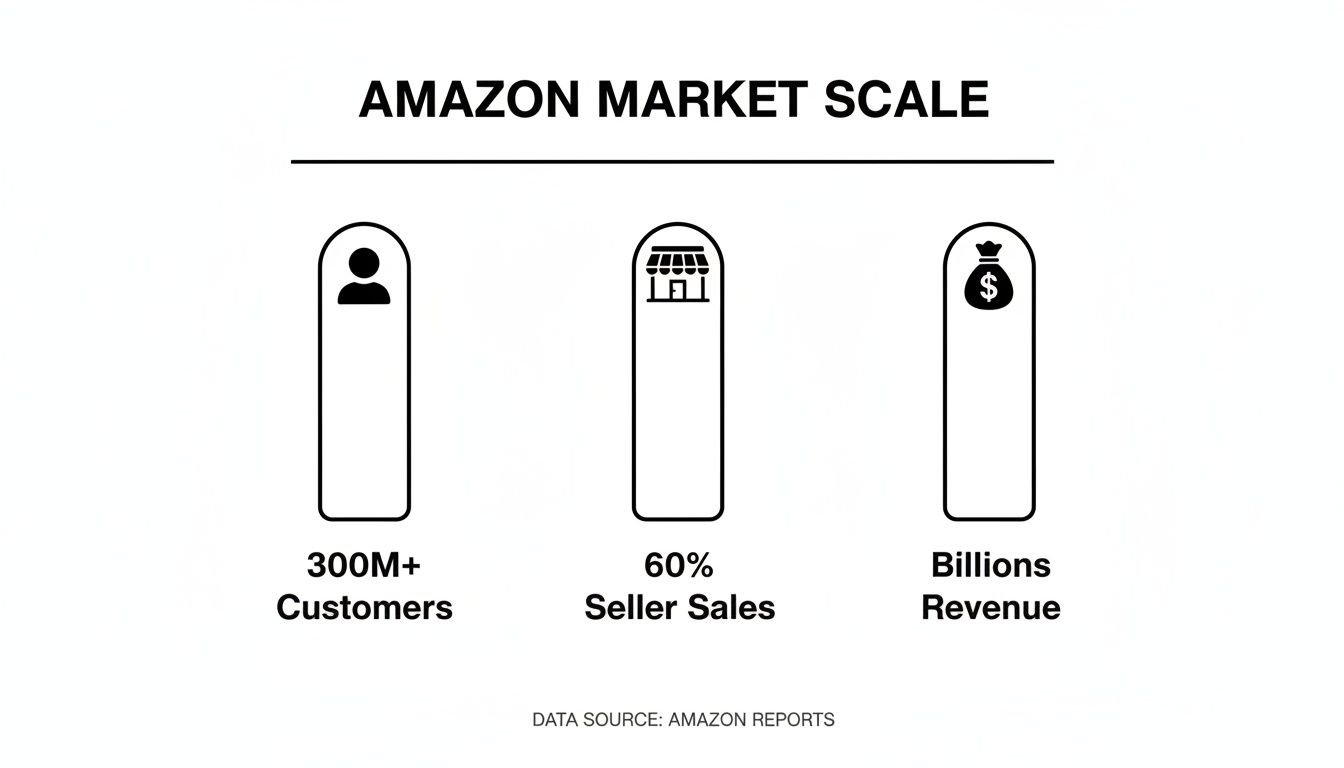
This data proves the opportunity is immense—you get access to 300M+ customers on a platform where independent sellers like you drive over 60% of sales. But that access definitely comes at a price.
Your Core Seller Fees
Your journey starts with the foundational costs that every single seller has to plan for. Think of these as the non-negotiable entry fees to the biggest marketplace on Earth.
-
Selling Plan Fees: You have two options here. The Individual Plan has no monthly fee but dings you $0.99 for every item you sell. This works if you’re just testing the waters or selling fewer than 40 items a month. For anyone serious about volume, the Professional Plan is the way to go. It’s $39.99 per month but gets rid of that per-item fee.
-
Referral Fees: This is Amazon's commission, plain and simple. For every sale you make, they take a percentage of the total price (including shipping). It usually falls somewhere between 8% and 15%, but it can creep higher for specific categories like jewelry or Amazon device accessories.
These are just the entry-level fees. The next layer of costs really depends on one big decision: how you get your products to your customers.
FBA Fees and Other Variable Costs
This is where the math can get a little scary, especially if you decide to use Fulfillment by Amazon (FBA). FBA is an incredible service—it gives you access to Prime shipping and handles all the logistics—but it has its own menu of charges.
The true cost isn't just the percentage Amazon takes; it's the sum of all fees subtracted from your sale price. A product with a seemingly healthy markup can become unprofitable once FBA storage, fulfillment, and advertising costs are factored in.
Let’s look at the most significant expenses that change from product to product:
- Fulfillment Fees (FBA): This fee covers the whole process: picking your item off a shelf, packing it in a box, shipping it, and handling any customer service. The cost is all about your product's size and weight. A small, light item might only cost a few bucks to fulfill, but a big, heavy product will cost a whole lot more.
- Storage Fees (FBA): You’re essentially renting shelf space in Amazon’s warehouses, and you pay for it monthly. These fees jump up during the busy holiday season (October–December) and can get painfully high if your products just sit there for too long.
- Other Costs: Don't forget to budget for advertising (Amazon PPC), fees for processing returns, and potential long-term storage penalties for any inventory that doesn't sell within a year.
A Real-World Example
Let's make this tangible. Imagine you're selling a kitchen gadget for $50. A realistic cost breakdown might look something like this:
- Sale Price: $50.00
- Referral Fee (15%): -$7.50
- FBA Fulfillment Fee: -$5.50
- Monthly Storage Fee (per unit): -$0.25
- Advertising Spend (estimated): -$5.00
- Your Payout (before product cost): $31.75
After Amazon takes its cut, your $50 sale turns into a $31.75 payout. Now, let's say your cost to buy or manufacture the product was $15. Your final profit is $16.75, which is a 33.5% margin. It’s a perfect illustration of how quickly that top-line revenue shrinks.
This is why setting the right price from the very beginning is absolutely critical to absorbing these costs. If you need a hand with that, our guide on how to determine the price of a product walks you through a strategic framework to ensure you're profitable from day one.
Choosing Your Amazon Business Model
Deciding if selling on Amazon is worth it really boils down to one big choice first: how are you going to source and sell your products? There's no magic formula here. The best path depends on your budget, how much risk you're comfortable with, and what you want to achieve long-term.
It’s like picking a vehicle for a road trip. A scooter is perfect for a quick spin around the city, but you’ll want a reliable van for a cross-country haul.

Each model comes with its own trade-offs between upfront cash, profit potential, and how much control you have. Getting these differences is the key to building a real business instead of just a temporary side hustle. Let's break down the four main ways sellers operate on Amazon.
Retail Arbitrage: The Treasure Hunt Model
Retail arbitrage is basically product flipping. You hunt for deals and clearance items at big-box stores like Target or Walmart and then resell them on Amazon for a profit. Simple as that.
- Startup Investment: Extremely low. You can get started with as little as $100-$500 to buy your first round of inventory.
- Profit Margins: Usually pretty thin, hovering in the 10-20% range after all of Amazon's fees.
- Scalability: Very limited. Your growth is capped by how many discounted products you can physically find.
This is a fantastic, low-risk way to learn the Amazon ropes. But because your inventory source is so unpredictable, it’s tough to scale into a large, sustainable business.
Wholesale: The Bulk Buying Model
With the wholesale model, you buy products in bulk directly from established brands or their distributors. You then sell these items on existing Amazon listings, often competing with other sellers for the Buy Box.
Think of yourself as an official retailer for brands that people are already searching for. You're not creating demand from scratch; you're tapping into it.
Wholesaling is the happy medium between the easy entry of arbitrage and the heavy lift of private label. Success here isn't about brand building—it's about locking in good supplier relationships and mastering your inventory.
You'll need more cash upfront than arbitrage since you're buying in case packs or pallets. The payoff is a much more stable and scalable inventory source, which is why it's a go-to for many serious sellers.
Private Label: The Brand Builder Model
This is where you create your own brand from the ground up. You spot an opportunity, find a manufacturer to create a unique product for you, and then sell it under your own brand name on Amazon.
It's the most demanding path but also the one with the biggest potential reward.
- Startup Investment: Significant. Be prepared to invest $5,000-$15,000 or even more for product development, manufacturing, and initial marketing.
- Profit Margins: The highest of all models, often 25-40% or more, since you control the entire process.
- Scalability: Sky-high. A successful private label brand is a real asset that you can grow or even sell for a life-changing exit.
With private label, you own everything—the product, the pricing, and the brand. You’re building something for the long haul.
D2C Brand Expansion: The New Channel Model
This strategy is for established direct-to-consumer (D2C) brands that are already selling successfully on their own websites. They’re not starting from scratch; they’re just adding Amazon as a massive new sales channel.
For these brands, it’s not just about making a quick profit. It’s about grabbing market share and acquiring new customers where they’re already shopping. And the data backs this up. Third‑party sellers now account for about 62% of all sales on Amazon, a huge leap from past years. It proves that while the competition is fierce, Amazon relies heavily on independent brands that master the platform.
Feeling stuck on which path is right for you? Our marketplace evaluation test offers a structured way to see which model best aligns with your resources and goals.
The table below breaks down the key differences at a glance.
Comparison of Amazon Seller Business Models
This table lays out the four main Amazon business models, comparing them across critical factors like startup costs, typical profit margins, and growth potential to help you find the right fit.
| Business Model | Typical Startup Cost | Average Profit Margin | Scalability | Best For |
|---|---|---|---|---|
| Retail Arbitrage | $100 – $500 | 10% – 20% | Low | Beginners learning the platform with minimal risk. |
| Wholesale | $2,000 – $5,000+ | 15% – 25% | Medium | Sellers who want a stable business without building a brand from scratch. |
| Private Label | $5,000 – $15,000+ | 25% – 40%+ | High | Entrepreneurs aiming to build a valuable, long-term brand asset. |
| D2C Brand Expansion | Varies | Varies | High | Established brands seeking to add a high-volume sales channel. |
Ultimately, choosing the right model is the most important first step in deciding if selling on Amazon is worth it for you.
Fulfillment by Amazon (FBA) vs. Fulfillment by Merchant (FBM)
How you get your products into your customers' hands is one of the biggest decisions you'll make as a seller. This choice directly hits your workload, your profit margins, and even how visible you are on the platform.
Think of it like choosing an engine for your business. One is a high-performance, automated system you pay to use, while the other is a manual setup you build and run yourself. Your two main options are Fulfillment by Amazon (FBA) and Fulfillment by Merchant (FBM), and knowing the real-world trade-offs is key to figuring out if selling on Amazon is truly worth it for you.

Fulfillment by Amazon: The Hands-Off Approach
With FBA, you're essentially handing over your entire logistics operation to Amazon. You ship your products in bulk to their massive fulfillment centers, and they take over from there. When an order comes in, Amazon’s team picks it, packs it, ships it out, and even handles all the customer service and returns.
The single biggest reason sellers choose FBA is simple: it gets your products the Amazon Prime badge. That little badge is a massive conversion driver. Shoppers trust it, filter for it, and it gives you a huge advantage in winning the coveted Buy Box.
Of course, that convenience isn't free. You'll pay fulfillment fees on every single order and monthly storage fees for the space your inventory takes up. If you have slow-moving or oversized products, those costs can eat into your profits fast. To get a deeper dive, our guide on what Amazon FBA means breaks it all down.
Key Takeaway: FBA is the fast track to Prime eligibility and hands-off logistics. It's built for sellers with small, fast-moving products who want to scale and are willing to pay for access to Amazon’s world-class fulfillment network.
Fulfillment by Merchant: The Do-It-Yourself Approach
Fulfillment by Merchant is exactly what it sounds like—you, the merchant, handle everything after the sale is made. You store your own inventory, pack every order, arrange the shipping, and manage all customer service and returns yourself.
The main upside here is control. You control your branding and packaging, you sidestep Amazon's strict inventory prep rules, and you avoid FBA’s sometimes confusing fee structure. This model can be way more profitable for items that are large, heavy, or just don’t sell very quickly, since you won't get hit with punishing storage fees.
The trade-off is the sheer operational weight on your shoulders. You have to meet Amazon's strict shipping timelines and performance metrics without fail. One slip-up can damage your account health and get your listings suppressed. You're also competing against the convenience of Prime, which makes winning sales against FBA sellers a real challenge.
Making the Right Choice for Your Business
Choosing between FBA and FBM isn't a forever decision, and plenty of successful sellers use a mix of both. The best route really depends on your products, your margins, and how much you can realistically handle.
A quick side-by-side look makes the decision clearer.
| Factor | Fulfillment by Amazon (FBA) | Fulfillment by Merchant (FBM) |
|---|---|---|
| Prime Eligibility | Automatic. Your products get the Prime badge, boosting visibility and trust. | No, unless you qualify for the strict Seller-Fulfilled Prime program. |
| Logistics | Hands-off. Amazon handles storage, packing, shipping, and returns. | Hands-on. You are responsible for the entire fulfillment process. |
| Fees | Higher. You pay fulfillment and storage fees that can impact margins. | Lower. You avoid FBA fees but have your own shipping and storage costs. |
| Control | Low. Amazon controls the customer experience from packaging to service. | High. You control your branding, packaging, and customer interactions. |
| Best For | Small, lightweight, and fast-selling products where speed is critical. | Oversized, heavy, or slow-moving items where margin control is key. |
At the end of the day, FBA is built for speed and scale. FBM is built for control and protecting your margins. Take a hard look at your products and your resources to decide which engine will power your Amazon business forward.
Playing Offense and Defense on Amazon
Thriving on Amazon means playing both offense and defense. The sales potential is massive, but the platform is also full of unique challenges that can sideline an unprepared seller. Understanding these risks is the first step, but capitalizing on growth opportunities is what makes selling on Amazon worth it.
Think of it like being the general manager of a sports team. You need a solid defense to protect your home field, but you also need a powerful offense to score points and win the championship. A winning season requires mastering both.
Protecting Your Business From Common Threats
The Amazon marketplace is always in motion. Rules change, new competitors show up, and challenges can pop up overnight. Staying proactive is the only way to protect the ground you've gained. Sellers have to be vigilant against a few key risks that can hit their operations and their bottom line.
These threats can be anything from minor headaches to business-ending disasters if you're not ready for them.
- Sudden Account Suspensions: Amazon holds sellers to an incredibly high standard. Let your performance metrics slip, violate a policy you didn't know existed, or get hit with a few unverified customer complaints, and you could face an account suspension. That means your sales and your funds get frozen instantly.
- Listing Hijackers and Counterfeiters: This is a classic Amazon problem. Bad actors can latch onto your successful listings, sell cheap knockoffs of your product, and steal the Buy Box. It doesn't just cost you sales—it can wreck your brand's reputation with negative reviews meant for the fake junk.
- Negative Review Attacks: It's an ugly side of the competition. Unethical rivals sometimes flood your listings with fake one-star reviews to tank your rating and scare off real buyers.
- Unexpected Policy Changes: Amazon is famous for updating its terms of service, fulfillment fees, and category requirements with little warning. If you miss a key change, you could end up with stranded inventory or non-compliant listings, creating a logistical nightmare.
The best defense is a strong offense. If you proactively manage your account health and use Amazon's brand protection programs, you can build a moat around your business. It makes it a lot harder for these risks to sink you.
Strategies for Growth and Expansion
Once your defenses are solid, it's time to go on offense. Amazon gives you a powerful set of tools designed to help ambitious sellers scale their brands far beyond what they could ever do on their own. These are the opportunities that can turn a simple side hustle into a global business.
One of the most powerful ways to speed up growth is Amazon Advertising. This is the platform's pay-per-click (PPC) system that lets you put your products right in front of customers who are actively searching for what you sell. Getting good at PPC is non-negotiable for driving visibility and sales velocity, which in turn helps your organic search ranking. To see how it all fits together, you can learn more about how Amazon PPC works in our detailed guide.
Beyond ads, a few other key strategies can unlock some serious growth:
- International Expansion with Amazon Global Selling: This program takes a lot of the headache out of listing and selling your products in Amazon's international marketplaces, like Europe, Japan, and Australia. You get access to hundreds of millions of new customers without having to set up a physical shop in those countries.
- Building a Brand with A+ Content and Stores: If you're enrolled in Brand Registry, Amazon gives you some killer content features. A+ Content lets you add rich text, comparison charts, and lifestyle photos right on your product detail page, which can boost conversion rates by up to 10%. Amazon Stores let you build out a multi-page, branded storefront, giving customers a much more curated shopping experience.
- Leveraging Brand Registry Protection: This is both a defensive and an offensive tool. On the defensive side, Brand Registry gives you powerful features to find and report counterfeiters and hijackers. Offensively, it unlocks all the advanced advertising and content options we just talked about, giving your brand a more professional, trustworthy look that helps drive sales.
Building Your Go-Forward Amazon Strategy
So, is selling on Amazon actually worth it? After digging into the costs, models, and headaches, you’ve probably realized the answer isn't a simple yes or no.
It’s a strategic "yes, if…" If you have a solid plan. If your expectations are realistic. The opportunity is massive, no question. But profit never happens by accident.
It all starts with deep product research and a serious look at your competition. This is the unglamorous work that decides whether you succeed long before you ever list your first product. It’s the difference between launching to a hungry market and just shouting into the void.
Your Decision-Making Checklist
To move forward with confidence, run through this checklist. An honest look here will save you a ton of cash and frustration down the road.
- Is My Profit Margin Viable? After you subtract every referral fee, FBA cost, and ad dollar, is there anything left? For most private label sellers, a 30% or higher margin is a healthy target to shoot for.
- Which Business Model Fits My Resources? Do you have the capital to go all-in on a private label launch? Or does the low-risk entry of retail arbitrage make more sense right now? Your strategy has to match your budget and experience.
- Can I Handle the Operational Demands? Are you ready to manage inventory, handle customer service, and keep an eye on performance metrics yourself (FBM)? Or is it worth paying Amazon to offload all that logistical work (FBA)?
Answering these questions brings clarity. It forces you to build a business on data, not just excitement.
The most critical question is not whether Amazon works, but whether your specific product and strategy can work on Amazon. Success is found in the details—your pricing, your sourcing, and your fulfillment method.
Ultimately, you have a choice: commit to the steep learning curve of a DIY approach or find an expert partner to get you to profitability faster. The right move depends entirely on your timeline, budget, and how hands-on you want to be.
To make sure your Amazon venture is truly worth it in the long run, you have to keep looking ahead. That means constantly exploring and implementing proven ecommerce growth strategies to scale your business. This forward-thinking mindset is what separates the stagnant sellers from the thriving brands, turning your launch into a real, scalable asset.
Have Lingering Questions About Selling on Amazon?
Even with a solid plan, it's normal to have a few nagging questions before you dive in. Let's tackle the big ones I hear all the time to help you figure out if this is the right move for you.
How Much Money Do I Need to Start Selling on Amazon?
This is the million-dollar question, but the answer really hinges on the business model you choose. Your startup costs can range from a few hundred dollars to the price of a new car.
For a retail arbitrage hustler, you can get your feet wet with as little as $100 to $500. That’s enough to hit the clearance aisles and start flipping products.
If you're going the wholesale route, you'll need a bit more skin in the game. Plan on investing $2,000 to $5,000 for your first bulk inventory purchase. For private label sellers launching their own brand, the bar is much higher—think $5,000 to $15,000+ to cover everything from product development and manufacturing to branding and your initial ad spend.
Remember, your first inventory order is just the entry fee. A successful launch always needs a separate budget for marketing to get the flywheel spinning.
How Do I Find a Profitable Product to Sell?
Finding a winner is less about a "eureka!" moment and more about smart, data-driven detective work. It's a blend of art and science, and it starts with research, not just picking something you'd buy yourself.
- Become an Amazon Bestseller Detective: Spend time on Amazon’s bestseller lists. Don't just look at what's selling; look for the cracks. Are the photos terrible? Are reviews complaining about the same fixable flaw? That's your opening.
- Lean on Research Tools: Don't guess, get data. Tools like Jungle Scout or Helium 10 are non-negotiable. They show you search volume, competition, and sales estimates, turning your hunches into validated opportunities.
- Think Niche, Not Broad: Instead of a generic "yoga mat," what about an "extra-thick cork yoga mat for travel"? Niches are where it's at. They usually have less competition and attract a loyal, passionate customer base that's easier to connect with.
Is the Amazon Marketplace Too Saturated for New Sellers?
I get it, Amazon feels crowded. But "saturated" is the wrong word. "Competitive" is more like it. The platform is always expanding, with new shoppers and new problems to solve popping up every single day.
Gone are the days of just throwing up a listing and watching the sales roll in. Today, success is all about being different. You can absolutely still carve out a profitable slice of the pie by:
- Building a Real Brand: Don't just be a product, be a brand. Private label sellers who invest in great branding, compelling content, and top-notch customer service are the ones who win.
- Being the Solution: Find a pain point in an existing product and create a better version. Listen to customer reviews—they're a goldmine of ideas.
- Outsmarting with Ads: A well-run Amazon PPC campaign can put your brand-new product right in front of people ready to buy, right from day one.
The opportunity is massive for anyone willing to treat this like a real business, not a get-rich-quick scheme.
Ready to build a profitable Amazon strategy without the guesswork? The team at Next Point Digital specializes in turning clicks into customers. We manage everything from marketplace SEO and AI-driven advertising to complete sales funnel optimization, ensuring your brand scales effectively. Start your growth journey with us today.