

Building a killer keyword list boils down to a pretty straightforward process. You start by brainstorming some foundational ideas—what I call seed keywords—based on your products. Then, you get a little sneaky and analyze your competitors to see what terms they're ranking for.
From there, you refine that raw list by digging into the metrics that actually matter, like search volume and buyer intent. Once you have a solid list, you'll group related terms together and map them to specific product listings or pages on your site. This isn't just about making a list; it's about creating a strategic roadmap to get in front of shoppers who are ready to buy.
Your Blueprint for Ecommerce Growth Starts Here
A well-crafted keyword list is so much more than a spreadsheet you fill out and forget. It’s the foundational blueprint for your entire ecommerce growth strategy. Think of it as the bridge connecting what a customer wants with the products you sell.
When you nail down the exact phrases people are typing into Google, Amazon, or Walmart, you gain the power to put your products directly in their path—right at the moment they’re looking to make a purchase. This goes way beyond generic SEO advice. In ecommerce, every single keyword represents a potential sale, and a meticulously built list has a direct, measurable impact on your most important business metrics.
The Tangible Business Impact
Building a strategic keyword list delivers real, dollars-and-cents results that directly affect your bottom line. It’s not just about getting more eyes on your products; it’s about profitable growth. The benefits are clear and feed into each other:
- Higher Product Rankings: Targeting the right keywords helps your product listings climb the search results, putting you in front of more active shoppers.
- Better Conversion Rates: When your listings match specific, high-intent search queries, the traffic you attract is far more qualified and way more likely to buy.
- Lower Acquisition Costs: Smart keyword targeting in your ad campaigns means you spend less to attract customers, which directly improves your return on ad spend (ROAS).
This simple flow shows how a solid keyword foundation leads straight to better business outcomes.
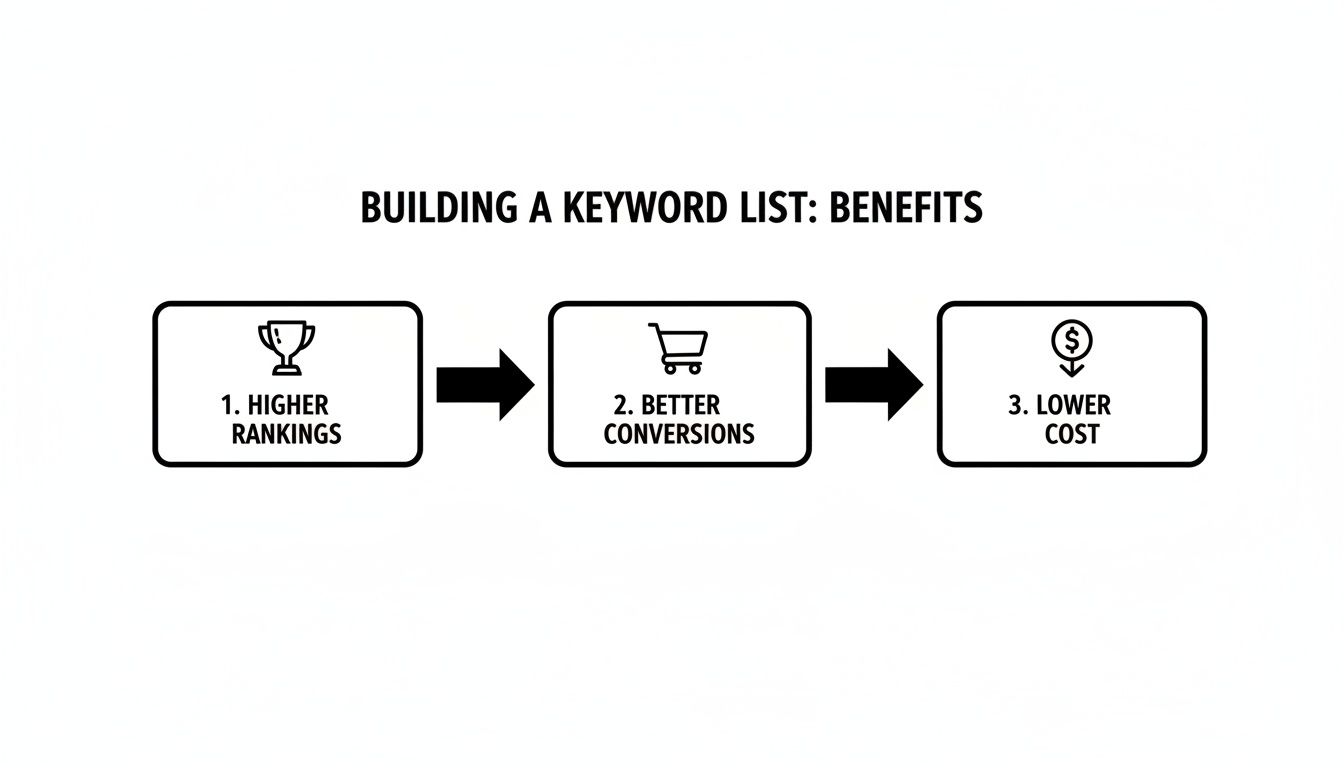
As you can see, each step builds on the last. Better rankings bring in higher-quality traffic, which boosts your conversion rates and makes your marketing dollars work harder for you. It’s a powerful cycle.
A Framework for Action
Throughout this guide, I'm going to give you a clear, actionable framework that takes the mystery out of keyword research. You'll learn not just what to do, but why you're doing it, from the initial discovery phase all the way to implementation and testing.
The goal here is to turn keyword research from a chore you dread into a repeatable system that consistently drives sales and builds your brand’s authority. It’s all about making smarter, data-driven decisions that translate into real, measurable growth.
Building Your Keyword Discovery Toolkit
The first step in building a keyword list that actually drives sales isn't about fancy software—it’s about a simple shift in how you think. You need to get inside your ideal customer's head. This early discovery phase is all about brainstorming a massive, unfiltered list of potential search terms before you even think about metrics.
Start with what you know best: your own products. Forget the technical specs for a minute and focus on the problems you solve.
- Product Features: List the tangible stuff. For a coffee maker, this could be "12-cup capacity," "programmable timer," or "auto shut-off."
- Customer Benefits: Now, translate those features into what the customer gets. "Programmable timer" becomes "wake up to fresh coffee." "Auto shut-off" becomes "peace of mind."
- Problems Solved: Think about the pain points your product fixes. A shopper might be looking for a "coffee maker that doesn't burn coffee" or a "quick brew coffee machine for busy mornings."
This simple exercise gets you out of your own head and into the real-world language your customers are using to find solutions.
Ethically Steal From Your Competitors
Once you’ve got a solid list of your own terms, it's time to see what the competition is up to. Your top competitors have already spent a ton of time and money figuring out what works. By analyzing their strategies on marketplaces like Amazon, you can find some incredible shortcuts and uncover terms you never would have thought of.
One of the most valuable sources of keyword gold is hiding in plain sight: customer reviews. Go dig through the 3, 4, and 5-star reviews on top-selling competitor products. Look for the specific language people use to describe what they love, what they wish the product did, and how they actually use it. You’ll find gems like "perfect lightweight stroller for air travel" or "best blender for making smoothies with frozen fruit"—these are the high-intent, long-tail keywords you want.
Your customers are telling you exactly what they want and the language they use to describe it. Mining customer reviews is the closest you can get to reading their minds, providing a direct line to the most relevant and convertible keywords.
Tearing apart competitor product titles is another must-do. Successful Amazon listings are often jam-packed with keywords. Look for patterns and modifiers they’re using. For instance, a yoga mat listing might include terms like "extra thick," "non-slip," "eco-friendly," and "for hot yoga." Each one is a potential seed keyword for your own list. To make your product stand out, it is essential to have a solid understanding of how to optimize Amazon product listings for maximum visibility and conversion.
Bring in the Tools for Deeper Insights
While manual brainstorming and competitor snooping are the foundation, the right tools can seriously speed things up and uncover hidden opportunities. A good mix of free and paid tools will give you the most complete picture.
- Marketplace Autosuggest: Just start typing your seed keywords into the search bars on Amazon, eBay, and Walmart. The autocomplete suggestions that pop up are the most popular queries real shoppers are using right now.
- Google Trends: This is a fantastic tool for spotting seasonal demand and rising trends. You can compare the popularity of different terms over time to figure out which keywords to push at different times of the year.
For those ready to get more advanced, you can explore the 12 Best AI SEO Tools to Dominate Search in 2025. These platforms can analyze competitor data at scale, spit out hundreds of keyword variations, and help you find gaps in the market with incredible speed.
Right now, the goal is quantity over quality. You want to build a massive, messy list of every possible term. We'll start refining it and digging into the data in the next section.
Refining Raw Data into a Strategic Goldmine
An unfiltered, sprawling list of keywords is just potential. It’s a collection of raw data waiting for someone to give it a purpose. The real magic happens when you start analyzing that data through the lens of what actually drives sales.
This is where you transform a noisy spreadsheet into a strategic asset, moving from simply collecting terms to understanding the customer behind each search.

The trick is to evaluate every potential keyword against four essential ecommerce metrics. These filters help you prioritize terms that aren't just popular but are genuinely profitable.
The Four Pillars of Keyword Analysis
To build a keyword list that actually converts, every term has to be measured against a clear framework. Think of these four metrics as the pillars that support a profitable SEO strategy. They make sure you’re focusing your energy where it will have the biggest impact.
- Search Volume: This is the most straightforward metric—how many times a keyword gets searched each month. But be careful. While high volume looks great on paper, it's often a vanity metric in ecommerce.
- Buyer Intent: This reveals why someone is searching in the first place. It’s the single most critical factor for prioritizing keywords that lead directly to sales.
- Relevance: This measures how perfectly a keyword matches your specific product. High relevance means the searcher's needs align perfectly with what you’re selling.
- Competition: Also known as keyword difficulty, this metric estimates how hard it will be to rank on the first page for a given term.
If you ignore any one of these pillars, you’re just wasting time. A high-volume, low-competition keyword is useless if it’s totally irrelevant to your product. Likewise, a hyper-relevant term is worthless if absolutely no one is searching for it.
Decoding Customer Intent: Your Ecommerce Superpower
Out of all the metrics, understanding buyer intent is your superpower. It’s the difference between attracting casual browsers and attracting shoppers who already have their credit cards out.
Search intent is broken down into a few main categories, and knowing the difference helps you focus your efforts where they'll count.
Research shows that Google search queries are heavily weighted toward information gathering. Specifically, informational searches make up 52.65% of all queries, while transactional searches—the ones with clear purchase intent—account for a tiny 0.69%.
This is why you have to be so deliberate about identifying and targeting those rare, high-value transactional terms.
A high-volume keyword like 'running shoes' (informational) attracts a broad audience, with most people just starting their research. A lower-volume phrase like 'buy women's stability running shoes for overpronation' (transactional) attracts a shopper who knows exactly what they need and is ready to buy now.
Knowing the different types of intent is fundamental to building a keyword list that works.
Keyword Intent Analysis for Ecommerce
Understanding the "why" behind a search query is everything. This table breaks down the four main intent types so you can see exactly where they fit into your ecommerce strategy.
| Intent Type | Description & Example Queries | Value to Ecommerce Brand | Where to Use |
|---|---|---|---|
| Informational | User is looking for answers or learning about a topic. "how to clean suede shoes," "what are the benefits of organic coffee" | Low immediate value for sales, but great for building top-of-funnel awareness and authority. | Blog posts, guides, FAQs, video tutorials. |
| Commercial | User is comparing products and brands before buying. "best running shoes for flat feet," "Garmin vs. Apple watch for running" | High value. These users are close to making a decision and are actively evaluating their options. | Category pages, comparison articles, product review pages. |
| Transactional | User is ready to make a purchase. "buy nike pegasus 40," "black leggings with pockets sale," "garmin forerunner 265 discount" | Highest possible value. These keywords are pure gold and should be your top priority for core pages. | Product pages, category pages, paid search ad campaigns. |
| Navigational | User is trying to find a specific website or brand. "amazon," "nike official store," "zappos" | High value if they're searching for your brand name; otherwise, it has very little value. | Homepage, "About Us" page. |
While every intent type has a place, your main goal is to find and prioritize keywords with strong commercial and transactional intent. These are the queries that directly feed your sales funnel and are essential for any successful set of data-driven marketing strategies.
The Relevance and Competition Balancing Act
Once you’ve identified high-intent keywords, the final step is to balance relevance and competition.
Perfect relevance means the keyword describes your product precisely. If you sell "organic dark roast coffee beans," the keyword "buy organic dark roast coffee" is a perfect match. On the other hand, a term like "coffee beans" is way too broad and much less relevant.
Finally, take a look at the competition. Tools like Ahrefs or Semrush give you a keyword difficulty score. For a new store, targeting keywords with a difficulty score under 30 is a smart way to gain some early traction. You can go after the more competitive terms later as your site's authority grows.
The sweet spot is finding keywords with high intent, perfect relevance, and manageable competition. This is where you’ll find your quickest wins and build a solid foundation for long-term growth.
Why a Long-Tail Keyword Strategy is Your Ticket to More Sales
It’s always tempting to chase those big, flashy "head" terms like "running shoes," but trust me, the real money in ecommerce is almost always hiding in the margins. This is where getting laser-focused on long-tail keywords becomes your most powerful tool.
These longer, more specific phrases are the secret to attracting shoppers who are way further down the buying path.
Think of it this way: someone searching for "shoes" is just window shopping. But someone typing in "waterproof trail running shoes for wide feet"? That person knows exactly what they want and is probably ready to pull out their credit card.
By targeting these super-specific queries, you neatly sidestep the brutal competition for broad terms and put your products right in front of customers who are ready to buy. This is a fundamental shift that makes all the difference.

Why Long-Tail Keywords Just Plain Convert Better
The data doesn't lie. Long-tail keywords, which are queries with three or more words, aren't some tiny niche part of search; they are the search. These longer phrases make up a staggering 91.8% of all search queries.
What's more, about 56% of customers use queries of three or more words when they're shopping online. And here's the kicker: these specific terms deliver conversion rates around 2.5 times higher than their short-tail cousins.
Long-tail keywords aren't about getting a flood of traffic. They're about getting the right traffic. They match user intent so perfectly that when someone lands on your page, they're far more likely to find exactly what they were looking for—and buy it.
How to Systematically Dig for Long-Tail Gold
Finding these valuable long-tail phrases isn't something you can just guess at. It takes a systematic approach that goes way beyond plugging a few words into a basic keyword tool. You have to get inside your customer's head and figure out the exact language they use when they're deep in research mode.
Here are a few proven ways to start mining for these high-intent terms:
- Mine Customer Questions: Fire up a tool like AnswerThePublic or just look at the "People Also Ask" box on Google. Any query starting with "what," "how," "best," or "for" is often a direct signal of a specific need. For example, "stroller" might lead you to "best lightweight stroller for air travel."
- Analyze Your Own Reviews and Feedback: Seriously, your customers are telling you what they want. Comb through your reviews, support tickets, and emails. Look for the exact phrases they use, like "programmable coffee maker with auto shut-off."
- Use Keyword Tool Modifiers: In your go-to keyword tool, don't just stop at the seed term. Add modifiers related to features, benefits, or your target audience to uncover hidden gems.
- Explore Forums and Online Communities: Sites like Reddit and niche forums are goldmines of natural language. You can see how real people talk about the problems your product solves and what features they actually care about.
Weaving Long-Tail Keywords into Your Strategy
Once you've got a solid list of long-tail keywords, the next move is to map them strategically across your site. Unlike broad terms that fit best on category pages, these hyper-specific phrases are perfect for your product pages, blog posts, and FAQ sections. For a deeper dive, check out our guide on applying ecommerce SEO best practices.
To truly unlock more sales, you need to get systematic about targeting these high-intent, low-competition phrases. Doing so builds a foundation that not only drives sales right away but also cements your brand as an authority in specific niches, giving you a sustainable edge.
Turning Your Keyword List Into an Actionable Strategy
A well-researched keyword list is an incredible asset. But let's be honest, on its own, it’s just a spreadsheet full of potential. The real magic happens when you turn that raw data into a clear-cut execution plan.
This is where you bridge the gap between discovery and actual marketing. It’s how you transform that list into a strategic roadmap for your entire ecommerce presence, ensuring every move you make is deliberate and effective.
The process boils down to two key phases: grouping related keywords into tight, thematic clusters and then mapping those clusters to specific pages or listings. This prevents you from cannibalizing your own efforts by targeting the same term across multiple pages, which confuses both search engines and customers.
Grouping Keywords Into Thematic Clusters
Before you can start assigning keywords to pages, you have to get organized. The best way to do this is by grouping them into thematic clusters based on user intent and the topic they're searching for. Think of a cluster as a "parent" keyword with several closely related "child" keywords branching off it.
Let's say you sell hiking gear. A messy, random list of terms won't get you far. Instead, you'd create specific clusters like these:
-
Cluster 1: Hiking Boots
- Parent Term: men's waterproof hiking boots
- Child Terms: lightweight hiking boots for men, best hiking boots for rocky trails, wide-width waterproof hiking boots
-
Cluster 2: Daypacks
- Parent Term: 20L hiking daypack
- Child Terms: small hiking backpack with water bottle holder, lightweight daypack for hiking, best daypacks for short hikes
Clustering your list this way brings immediate order to the chaos and makes the next step—mapping—so much easier.
Grouping keywords thematically is the foundation of an organized SEO strategy. It turns a chaotic list into a structured plan, ensuring your content is focused, efficient, and perfectly aligned with how real customers actually search.
Mapping Keywords to Your Ecommerce Assets
With your keywords neatly clustered, it's time for the most critical step: mapping them to specific pages and content. This is how you tell search engines exactly what each page on your site is about. As a rule, every page should have one primary keyword and a handful of secondary, related keywords.
Think of it like giving each page on your site a specific job to do. Your goal is to match the keyword's intent with the right type of page. This alignment is not only great for user experience, but it’s also a cornerstone of learning how to increase ecommerce sales effectively.
Here’s a practical breakdown of how this mapping usually works:
-
Broad "Head" Terms for Category Pages: General, high-volume keywords like "women's running shoes" or "drip coffee makers" are perfect for your main category pages. These pages act as hubs, guiding users toward more specific subcategories and products.
-
Specific "Body" Keywords for Sub-Category Pages: More detailed terms like "women's trail running shoes" or "12-cup programmable coffee makers" belong on your sub-category pages. These pages target shoppers who have already narrowed their search but are still browsing their options.
-
Hyper-Specific Long-Tail Keywords for Product Pages: Your most valuable, high-intent keywords are reserved for individual product pages. Phrases like "buy brooks adrenaline gts 23 women's size 8" or "breville precision brewer thermal coffee maker sale" signal a clear intent to buy and should lead directly to the product.
-
Informational Keywords for Blog Posts and Guides: Question-based keywords like "how to choose a coffee maker" or "best running shoes for flat feet" are ideal for blog content. This content attracts shoppers at the top of the funnel, builds your brand's authority, and lets you internally link back to your category and product pages.
To give you a clearer picture, here's a sample framework showing how this all comes together.
Sample Keyword Mapping Framework
| Keyword Group | Example Keywords | Primary Intent | Mapped Asset (Page/Listing) | Content/Campaign Angle |
|---|---|---|---|---|
| Broad Category | men's athletic shoes, sneakers for men | Navigational | Category Page: /mens-shoes | Showcase the full range of men's athletic footwear. Highlight top brands and new arrivals. |
| Sub-Category | men's trail running shoes, waterproof trail sneakers | Commercial | Sub-Category Page: /mens-shoes/trail-running | Focus on features like grip, waterproofing, and durability. Compare top models for different terrains. |
| Product-Specific | salomon speedcross 6 gore-tex review, buy salomon speedcross 6 size 11 | Transactional | Product Page: /salomon-speedcross-6 | Detail product specs, show customer reviews, highlight "buy now" calls-to-action. |
| Informational | best shoes for hiking rocky trails, how to clean trail running shoes | Informational | Blog Post/Guide | Provide expert advice and tips. Link out to relevant product and category pages. |
This methodical mapping process ensures every keyword has a home and every page has a distinct purpose. The end result is a powerful and cohesive site structure that both users and search engines will love.
Answering Your Toughest Keyword List Questions

Even with the best plan in the world, the moment you get deep into the weeds of spreadsheets and search data, questions pop up. It’s easy to get stuck on the small details and lose momentum.
This section is built to tackle those common hurdles head-on. Think of it as your go-to reference for troubleshooting your process, with direct answers to the questions we hear the most.
How Often Should I Update My Keyword List?
Your keyword list isn’t a one-and-done project—it’s a living document. Market trends, what your customers are searching for, and what your competitors are doing are always in flux. Your list needs to keep up.
At a minimum, plan for a comprehensive audit and refresh at least twice a year. On a more frequent basis, you should be checking in monthly to monitor performance, spot new search trends, and track any seasonal shifts that impact your products.
For example, if you're in the outdoor gear space, you need to be reviewing terms like "winter hiking gear" in the fall, not waiting until spring. If you launch a new product, building its dedicated keyword cluster is a day-one job, not an afterthought.
Think of keyword maintenance as continuously tuning your strategy. Regular updates ensure you're always aligned with what your customers are searching for right now, not what they were searching for six months ago.
What Are the Best Free Tools for Building a Keyword List?
You can actually build a powerful, foundational keyword list without spending a dime. Some of the most valuable data comes straight from the source—the search engines and marketplaces your customers use every single day.
- Marketplace Autosuggest: Just start typing your seed keywords into the search bars on Google, Amazon, and eBay. The autocomplete suggestions are a direct line into what real people are actively searching for. It's simple, but it's gold.
- Google Trends: This tool is incredible for spotting rising interest in a niche, comparing the popularity of different terms, and pinpointing those crucial seasonal demand curves for your products.
- AnswerThePublic: If you want to find question-based keywords, this is one of the best out there. It visualizes all the questions people are asking around your topic, giving you a treasure trove of informational and long-tail ideas.
- Manual Research: Never, ever underestimate the power of manually mining customer reviews and Q&A sections on your competitors' product pages. The language customers use here is often the source of your highest-converting long-tail keywords.
Should I Include Misspellings or Plural Variations?
In almost every case, the answer is a hard no. Modern search algorithms on Google and major ecommerce platforms like Amazon are incredibly sophisticated. They have no problem understanding plurals, synonyms, and the vast majority of common misspellings.
Wasting valuable character space in your product title, bullets, or backend fields on variations like "shoe" vs. "shoes" is an outdated practice. It’s far more effective to focus your energy on including unique keyword concepts that broaden your reach.
The only rare exception is if your analytics show a very common, specific misspelling is consistently driving significant traffic that the algorithm is somehow missing. Even then, it should be a low-priority addition. These situations are few and far between, and your time is almost always better spent elsewhere.
How Do I Prioritize Keywords When My List Has Thousands of Terms?
Prioritization is everything. A massive, unorganized list is completely unusable. The key is to shift your mindset from simply collecting keywords to strategically selecting the terms that will drive the most impact with the least resistance.
A simple scoring system in your spreadsheet can bring order to the chaos. For every single keyword, rate it from 1 to 5 across three critical factors:
- Relevance: How perfectly does this keyword describe your specific product? (5 = a perfect match)
- Commercial Intent: How close is the searcher to pulling out their wallet? (5 = ready to buy now)
- Achievable Rank: Can you realistically compete for a top spot? (5 = low competition)
The keywords with the highest total scores shoot to the top of your priority list. For the quickest wins, zone in on the terms that score high in relevance and intent but have low-to-medium competition. This same logic is fundamental to paid advertising, where understanding what is PPC on Amazon and how it relies on precise keyword targeting is the difference between profit and loss.
At Next Point Digital, we specialize in transforming complex keyword data into actionable growth strategies for ecommerce brands. If you're ready to build a keyword list that drives real, measurable sales, let's talk.