

Data-driven marketing isn't about chasing buzzwords; it's about using real customer data to make smarter decisions. It moves your strategy beyond guesswork and gut feelings, allowing you to create personalized campaigns that actually connect with people. Think of it as trading a simple compass for a modern ship's GPS, complete with weather radar and sonar.
What Is Data Driven Marketing and Why It Matters Now
One approach relies on general direction and intuition, while the other uses precise, real-time information to chart the safest, most efficient course. That's the core difference between old-school marketing and a data-driven strategy. It turns marketing from a creative art into more of a predictive science.
This infographic breaks down how data acts as your navigation system, guiding your efforts toward predictable success instead of leaving things to chance.
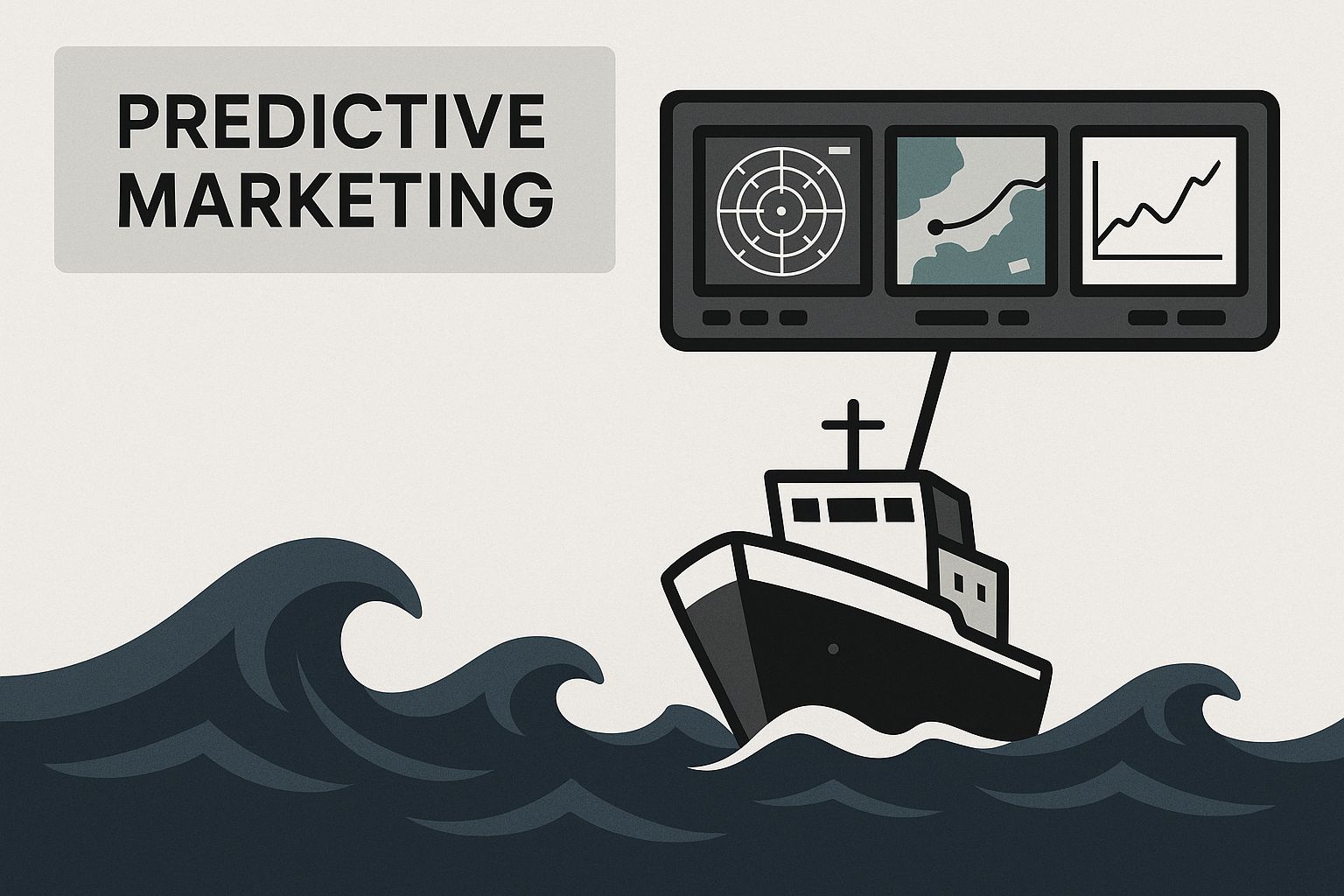
The main takeaway? With the right data, marketing becomes less about reacting and more about anticipating what your customers need, sometimes even before they know they need it.
The Shift from Guesswork to Precision
In the past, marketers launched campaigns based on broad assumptions and just hoped for the best. Today, every click, purchase, and interaction generates a valuable breadcrumb of data. A data-driven approach scoops up this information to understand individual behaviors, preferences, and pain points.
This shift allows for a level of personalization that was unthinkable a decade ago. Instead of a one-size-fits-all message blasted out to the masses, you can now deliver the right offer to the right person at the exact right moment. It’s the difference between shouting into a crowd and having a meaningful one-on-one conversation.
Data is the voice of the customer. A data-driven approach is about listening to that voice and responding with marketing that is helpful, relevant, and welcome.
Why First-Party Data Is Your Most Valuable Asset
Recent privacy changes have completely shaken up how marketers get and use customer information. The old reliance on third-party data is fading fast, making first-party data—information you collect directly from your audience—more critical than ever.
In fact, one report found that 64% of marketing executives agree that data-driven marketing is crucial today precisely because first-party data allows for compliant, effective personalization.
This direct relationship builds trust and gives you much higher-quality insights. Businesses that prioritize collecting and analyzing their own data are gaining a massive competitive edge. To get a better look at how this fits into the bigger picture, check out our guide on online marketing.
To really see how powerful this is in action, it helps to look at specific examples. For instance, these 7 Data Driven Marketing Insights to Boost SaaS Growth offer some fantastic context. At the end of the day, using data isn't just a trend; it's the new standard for building real, profitable customer relationships.
Understanding the Pillars of a Data-Driven Strategy
A solid data-driven marketing strategy isn't just one tactic; it's a complete system. Think of it like building a high-performance engine. You need four essential components working together to generate real power. If one piece is missing, the whole machine stalls. These are the four pillars that turn raw data into measurable revenue.
This structure makes sure you're not just collecting data for the sake of it. Instead, you're systematically turning numbers into intelligent action. Each pillar builds on the last, creating a repeatable process for growth and optimization.

Pillar 1: Data Collection
Everything starts here. Data collection is the process of gathering the raw fuel for your marketing engine from every possible source. The quality of the data you collect at this stage directly dictates the quality of the decisions you'll make later.
The most valuable fuel you can get is first-party data. This is the information you gather directly from your audience through your website, app, CRM, or social media channels. It's incredibly accurate because it comes straight from the source.
To give you a clearer picture, let's break down the different types of data you'll encounter. Understanding where your information comes from is crucial for knowing how to use it effectively.
Comparing Key Data Sources for Marketing
| Data Type | Primary Source | Key Benefit | Main Limitation |
|---|---|---|---|
| First-Party | Your own CRM, website analytics, email lists, and app usage. | The most accurate, reliable, and privacy-compliant data available. | Can be limited in scale; you only have data on your existing audience. |
| Second-Party | Another company's first-party data, acquired via a direct partnership. | Access to a new, relevant audience that you couldn't reach on your own. | Requires finding a trustworthy partner and can be costly or complex to set up. |
| Third-Party | Data aggregated from many sources and sold by data providers. | Offers massive scale and broad reach for targeting large demographics. | Often less accurate, less transparent, and faces growing privacy restrictions. |
While all data types have their place, focusing on building your own first-party data is the smartest long-term play. It gives you a direct, unshakeable line to understanding your customers' actual behaviors.
Pillar 2: Data Analysis
Once you have your fuel, the next step is to refine it. Data analysis is all about processing and organizing that raw information to spot trends, patterns, and outliers. This is where chaotic numbers start to tell a story.
Think of it as a translator converting a foreign language into plain, understandable English. You might use tools like Google Analytics, CRM dashboards, or more advanced business intelligence platforms to sift through it all. The goal is to move from asking "what happened?" to understanding "why it happened."
For example, just seeing a drop in sales on a specific product page isn’t enough. Analysis helps you dig deeper to find out if the cause was a broken link, a clunky mobile experience, or a competitor’s new promotion.
Pillar 3: Insight Generation
This pillar is where the human element becomes absolutely critical. While analysis shows you the patterns, insight generation is about interpreting what those patterns actually mean for your business and your customers. This is the "aha!" moment where you connect the dots.
An insight is so much more than a simple observation. It’s an actionable understanding of customer behavior that you can use to drive real change.
Observation: "Our data shows that 30% of customers abandon their cart at the shipping page."
Insight: "Our customers are highly price-sensitive to unexpected shipping costs, which creates friction and erodes trust right before they're about to buy."
This deeper understanding is the bridge between knowing a fact and knowing what to do about it. It requires genuine curiosity and a clear grasp of your business goals. For companies focused on growth, these insights are crucial for refining their strategy, something you can explore further in our guide to optimizing the journey for online sales and e-commerce.
Pillar 4: Actionable Implementation
This is it—the final pillar where your insights become reality. Actionable implementation is the process of taking what you've learned and using it to create, modify, and launch marketing campaigns. This is where your data-driven marketing strategies finally produce a return on investment.
Without this step, all your data collection and analysis is just an academic exercise. Based on the cart abandonment insight from before, your implementation might involve a few different moves:
- A/B Testing: Launching a version of the checkout page with a prominent free shipping banner.
- Personalization: Offering a special shipping discount to first-time buyers through an automated email.
- Retargeting: Running ads for abandoned cart items that specifically call out "free and easy shipping."
This is the cyclical nature of a data-driven approach. The results from these actions generate brand-new data, which flows right back into Pillar 1, starting the optimization process all over again. Each cycle sharpens your understanding and improves performance, building sustainable growth one insight at a time.
If data is the fuel for your marketing engine, then Artificial Intelligence (AI) and machine learning are the turbochargers. They don’t just use data; they learn from it, predict what’s coming next, and automate complex tasks at a scale no human team could ever dream of managing.
Think of AI as a tireless marketing apprentice that gets smarter with every single customer interaction.
This technology is what shifts your data-driven marketing strategies from reactive to predictive. Instead of just analyzing what happened yesterday, you can start forecasting what customers will want tomorrow. This isn't some far-off, futuristic idea—it’s a practical tool that businesses are using right now to get way ahead of the competition.
Moving From Automation to Prediction
The first major leap AI offers is the jump from simple automation to sophisticated prediction. Sure, marketing automation can send a pre-programmed email. But AI can predict which email, sent at what time, with what subject line, is most likely to make an individual customer convert.
That's the power of predictive analytics. By digging through historical data, machine learning models spot subtle patterns that signal future behavior. This has some seriously powerful applications for marketers.
- Predicting Customer Churn: AI can flag customers who are showing early signs of leaving, like lower engagement or fewer purchases. This gives you a chance to launch retention campaigns before they're gone for good.
- Forecasting Demand: By analyzing market trends and past sales data, AI can predict which products are about to be hot, helping you fine-tune your inventory and marketing spend.
- Lead Scoring: AI models can score new leads based on their likelihood to convert, letting your sales team focus their energy where it will count the most.
By anticipating customer needs and actions, AI turns your data into a forward-looking roadmap. You’re no longer just responding to the market; you're actively shaping your outcomes based on what's likely to happen next.
Hyper-Personalization at Scale
True personalization means delivering a unique experience to every single customer. Manually, that’s just impossible. With AI, it becomes standard practice.
AI algorithms can analyze an individual's browsing history, purchase data, and real-time behavior to serve up dynamically tailored content on the fly.
Imagine an e-commerce site where the homepage, product recommendations, and even promotional offers change in real time for every visitor. That’s AI-powered hyper-personalization in action. It ensures every touchpoint feels relevant and valuable, which dramatically boosts engagement and conversion rates.
The Rise of Generative AI in Marketing
Generative AI has added another powerful layer to the marketer's toolkit. These models can create original content—from ad copy to email drafts—based on simple prompts. This ability speeds up content creation and lets you A/B test different messages at a dizzying pace.
The impact is already huge. A recent report found that 63% of marketers have woven generative AI into their workflows for things like content creation and personalizing campaigns. The market for generative AI in marketing is even projected to hit $22 billion by 2032.
The results are showing up on the bottom line, too. Sales teams using AI tools are seeing real growth; 83% experienced notable revenue growth, compared to just 66% of teams not using AI. These numbers draw a clear line between adopting AI and getting better business results. You can dig deeper into how AI is shaping marketing and sales strategies in recent reports.
But with great power comes great responsibility. As you bring AI into your marketing, it's crucial to be transparent with customers about how their data is used. Ethical issues around data privacy and algorithmic bias have to be a priority. At the end of the day, AI should always serve to improve the customer experience, not exploit it.
How to Build Your Data Driven Marketing Roadmap
Making the switch to a data-driven approach is more than just a project—it’s a total shift in how your company thinks and operates. It takes more than new software; it demands a clear, simple plan that everyone on your team can actually get behind and follow.
Think of it like building a house. You wouldn't just start throwing up walls, right? You'd start with a solid foundation (your goals), then build the framework (your data and tech), and finally, bring in a skilled crew (your team) to make it all happen. This five-stage roadmap is your blueprint for turning data from a buzzword into a real, working strategy.

Stage 1: Define Clear Business Objectives
Before you even think about collecting data, you have to ask one simple question: "What problem are we trying to solve?" Without a clear goal, data is just noise. Your objectives need to be specific, measurable, and tied directly to business growth.
Forget vague goals like "increase sales." Get specific. Real targets look like this:
- Reduce customer churn by 15% in the next quarter.
- Increase the average order value (AOV) by $10 within six months.
- Improve the conversion rate on our top landing pages by 5%.
These clear goals become your North Star. They guide every decision you make and ensure your data-driven marketing strategies actually deliver results you can see.
Stage 2: Unify Your Data Sources
Right now, your customer data is probably scattered all over the place—your website analytics, CRM, email platform, and sales software. To get that coveted 360-degree view of your customer, you’ve got to bring it all together. The mission here is to break down those data silos and create one single source of truth.
Start by mapping out where all your customer data lives. This initial audit shows you what you have and, maybe more importantly, what you're missing.
A unified customer view is the bedrock of personalization. You can't speak to your customer's individual needs if you only see fragmented pieces of their journey.
This step is the foundation for creating the kind of customized reporting that uncovers deep insights into customer behavior. It's how you move from just looking at what happened to predicting what will happen next.
Stage 3: Choose the Right Technology Stack
With your goals set and data sources mapped out, it’s time to pick your tools. The key is to choose a tech stack that fits what you need now but can also grow with you. Don't fall for the trap of buying some overly complex, expensive software you won't even use.
A solid, effective stack usually includes:
- A Web Analytics Platform: Something like Google Analytics is non-negotiable for understanding site traffic and user behavior.
- A Customer Relationship Management (CRM) System: This is your command center for managing all customer interactions and data.
- An Email & Marketing Automation Platform: This is what lets you run personalized campaigns based on the data you've gathered.
Down the road, you might add a Customer Data Platform (CDP) to centralize things even further. But for now, remember: the right tools should make your life easier, not more complicated.
Stage 4: Cultivate the Necessary Team Skills
Tech is only half the battle. Your team needs the skills to look at the data and pull out meaningful insights. This doesn't mean everyone needs to become a data scientist overnight.
Instead, focus on building data literacy across the entire marketing department. Train your team to ask the right questions, understand what the dashboards are telling them, and get to the "why" behind the numbers. Invest in analytics training and encourage a culture where testing and learning are second nature. A curious team is your greatest asset.
Stage 5: Start Small and Scale with Pilot Projects
Trying to overhaul your entire marketing department at once is a recipe for disaster. The final stage is all about starting small with a focused pilot project. Pick one of the goals you defined back in Stage 1 and apply your new data-driven process to it.
For example, you could run a pilot to reduce cart abandonment. Use your unified data to find the biggest drop-off points, form a hypothesis, and run a targeted A/B test. This approach lets you prove the value of your new strategy quickly, build momentum, and get buy-in from the higher-ups.
Once you score that first clear win, you can take what you learned and scale your efforts to other parts of the business.
Measuring Marketing Success and Proving Your ROI
Executing a slick data-driven marketing strategy is great, but it’s only half the job. The real value comes when you can prove it actually worked, and that means having a rock-solid way to track performance and show its worth to the people signing the checks.
This is where you graduate from surface-level “vanity metrics” like likes and impressions. Instead, the focus shifts to the numbers that actually matter in the boardroom—the ones that connect your marketing activities directly to revenue and growth. Without them, your budget is just another expense. With them, it’s a strategic investment.
Key Metrics That Prove Your Value
To really show the impact of your work, you need to focus on metrics that tell a clear financial story. These KPIs cut through the noise and give undeniable proof that your marketing is contributing to the bottom line.
- Customer Acquisition Cost (CAC): This is the total sales and marketing cost required to land one new customer. A falling CAC is a clear sign your marketing is getting more efficient.
- Customer Lifetime Value (CLV): CLV is a forecast of the total revenue you can expect from a single customer over the entire time they do business with you. The big goal here? Get your CLV way higher than your CAC.
- Return on Ad Spend (ROAS): This one’s simple: how much gross revenue did you generate for every single dollar you spent on ads? A high ROAS means your campaigns are profitable and pulling their weight.
Tracking these core metrics is non-negotiable. They turn your marketing reports from a list of things you did into a powerful financial argument for your strategies.
From Data Points to Actionable Dashboards
To keep a close eye on these KPIs, you need a central place to see everything at once. Real-time dashboards, built with tools like Google Analytics or a dedicated business intelligence platform, are perfect for this. They let you track progress and spot trends as they happen, so you can make quick adjustments to campaigns instead of waiting weeks for a report.
Effective measurement isn't about collecting data; it's about presenting it in a way that drives smart, timely decisions. Your dashboard should tell a story that anyone in the company can understand at a glance.
Another huge piece of the puzzle is attribution modeling. This is how you figure out which marketing touchpoints—a blog post, a social media ad, an email—are actually doing the heavy lifting to drive conversions. It finally answers the question, "What's really working?"
Without it, you risk giving all the credit to the very last click and completely ignoring the channels that built awareness in the first place. And to truly understand the financial impact, exploring the ROI of adopting AI-powered analytics tools can show you how technology sharpens these calculations.
Ultimately, your goal is to calculate the overall Return on Investment (ROI) for everything you do. A clear ROI calculation gives you the hard numbers needed to justify your budget, ask for more resources, and earn a strategic seat at the table. Often, the first step in aligning your measurement strategy with business outcomes starts by answering the right questions in an SEO discovery questionnaire.
Real-World Examples of Data-Driven Marketing in Action
Theory is great, but seeing data-driven marketing strategies actually work in the wild is what makes it all click. The real power of this approach snaps into focus when you see how businesses solved nagging problems and drove real, measurable growth.
Let’s look at three different businesses—an e-commerce brand, a B2B software company, and a local plumber—to see how they turned data into a serious competitive advantage. Each story is simple: they hit a wall, used data to find a way around it, and saw a big payoff.
The E-commerce Brand Boosting Conversions
An online fashion retailer was bleeding money from abandoned carts. Shoppers would load up, head to checkout, and then just vanish. The marketing team’s gut told them shipping costs were the culprit, but a gut feeling doesn't pay the bills. They needed proof.
So, they ran a classic A/B test powered by their analytics.
- The Challenge: Slash a cart abandonment rate that was stuck at a painful 70%, costing them a huge chunk of potential revenue every day.
- The Data-Driven Solution: First, they dug into their website analytics and confirmed the drop-off was happening right on the shipping calculation page. Then, they set up a split test. Group A got the usual checkout process, while Group B saw a big, bold banner offering free shipping on all orders over $75.
- The Measurable Result: The free shipping offer was a game-changer. That version saw a 28% decrease in cart abandonment. Even better, the Average Order Value (AOV) shot up by 15% as people added more to their carts to hit the free shipping minimum. This simple, data-backed tweak led directly to a major revenue lift.
The B2B SaaS Company Improving Customer Retention
A growing B2B software company had a different kind of leak: customer churn. They were great at signing up new users, but too many were canceling their subscriptions within a few months. They had to figure out why people were leaving and step in before it was too late.
The answer was in their own product data, which they used to build a predictive model.
- The Challenge: Get their monthly customer churn rate down from an unsustainable 4.5%.
- The Data-Driven Solution: The company’s data team analyzed what users were doing—or not doing—inside the platform. They found a few key actions that were tightly linked to cancellations, like not using a core feature within the first 14 days. They used this insight to create a "health score" for every account, automatically flagging customers who were at risk of churning.
- The Measurable Result: Armed with these alerts, the customer success team could proactively reach out to struggling users with targeted training, tips, and support. Within six months, they dropped their monthly churn rate to 2.8%. This move dramatically increased customer lifetime value and stabilized their revenue. This is a perfect example of what smart data-driven advertising solutions can do.
The Local Service Business Increasing Bookings
A local plumbing company was pouring money into digital ads but had no idea which ones were actually leading to booked jobs. They saw clicks coming in, but they couldn't tell if their budget was bringing in profitable customers or just being flushed down the drain.
The fix was connecting their ad platform data to their CRM.
By closing the loop between marketing touchpoints and final sales data, the business could finally see the full customer journey—from the initial ad click to the final paid invoice.
- The Challenge: Figure out the true ROI of their digital ad campaigns and make them more effective.
- The Data-Driven Solution: They set up call tracking and integrated their ad platforms with their CRM. Suddenly, they could trace every phone call and contact form submission back to the exact ad and keyword that produced it.
- The Measurable Result: The data told a clear story: ads targeting "emergency plumbing services" had a much higher conversion rate and brought in bigger jobs than their general plumbing ads. They shifted 80% of their budget to these high-performers. The result? A 40% jump in qualified leads and a 25% drop in their customer acquisition cost in just one quarter.
Common Questions About Data-Driven Marketing
Diving into data-driven marketing naturally brings up a few questions. Let's tackle some of the most common ones to help you get started with confidence.
Where Should a Small Business Start?
If you're a small business, the best place to start is with the data you already have. Forget the fancy tools for a moment and focus on your first-party data. Install free tools like Google Analytics to see how people behave on your site, and connect your sales data to a simple CRM.
Instead of trying to do everything at once, pick one clear, manageable goal. For instance, you could aim to improve email engagement by segmenting your customer list based on what they've bought before. The key is to use the information right in front of you and sidestep the trap of overly complex or expensive software.
The smartest data-driven strategies often begin with a simple question tied to a real business goal. Complexity can come later; getting quick, small wins is what builds momentum.
This focused approach helps you prove the value of your efforts early on and learn the ropes before you decide to scale up.
How Do You Ensure Customer Privacy While Using Data?
Protecting customer privacy isn't just a legal requirement—it's the foundation of trust. The most important principle here is transparency. Always maintain a clear, easy-to-read privacy policy and make sure you have explicit consent before collecting any data.
Stick to first-party data whenever you can, since you have a direct relationship with the customer. It's also a great practice to anonymize and aggregate data for analysis, which protects individual identities while still giving you valuable insights. Staying on top of regulations like GDPR is non-negotiable for keeping both your business compliant and your customers confident.
What Are the Most Important Tools for a Marketing Stack?
A lean but powerful marketing tech stack really comes down to three pillars. These core tools give you a solid foundation for all your data-driven activities.
- A Web Analytics Platform: Something like Google Analytics is essential. It tells you who's visiting your site, where they're coming from, and what they're doing once they get there.
- A Customer Relationship Management (CRM) System: A CRM, like HubSpot or Salesforce, is your command center for all customer interactions, sales data, and contact info.
- An Email Marketing Platform: Services like Mailchimp let you act on your insights by sending personalized campaigns at scale.
As you grow, you might add more advanced systems like a Customer Data Platform (CDP) to pull all your data sources into one unified view.
Ready to turn your data into your most powerful growth driver? Next Point Digital specializes in building and executing data-driven marketing strategies that convert clicks into loyal customers. Let's build your success story together.