

To get your Average Order Value (AOV), you just need one simple calculation: divide your total revenue by the total number of orders for a specific period. It’s a straightforward formula that instantly tells you the average amount each customer spends when they check out.
Understanding Average Order Value and Why It Matters
Before we jump into the spreadsheets and strategies, let's get one thing straight: AOV isn't just another vanity metric to track. It’s a powerful signal of your customers' buying behavior, how well your marketing is working, and your overall profitability. Think of it as a quick health check for your business. When you know how to calculate Average Order Value, you unlock insights that lead to much smarter decisions.
This single number helps you answer some pretty critical questions that will shape how you grow:
- Is our pricing strategy working? A low AOV might be a red flag that your products are underpriced or that customers just aren't finding your higher-value items.
- How much can we really afford to spend on ads? A higher AOV often means you can justify a higher customer acquisition cost (CAC), making your ad campaigns much more profitable.
- Where should we set our free shipping threshold? This is a classic. Setting the threshold just a bit above your current AOV is a proven way to nudge customers into adding one more item to their cart.
The Strategic Importance of AOV
For any ecommerce business, AOV is a key performance metric for figuring out where you stand in the market and how efficiently you're operating. Before we get into the nitty-gritty of the math, it’s a good idea to delve into the core meaning of AOV to make sure we're on the same page.
AOV serves as a direct link between customer behavior and your bottom line. An increasing AOV often signals healthy customer engagement and successful marketing, while a stagnant or declining AOV can be an early warning sign of pricing issues or missed cross-selling opportunities.
Tracking AOV is also directly tied to other crucial KPIs, especially Customer Lifetime Value (CLV). It's no surprise that customers who consistently place higher-value orders are usually your most loyal and profitable ones over the long haul.
By focusing on lifting your AOV, you're not just making more money today—you're nurturing the relationships that boost long-term revenue. This mindset is a cornerstone of many successful data-driven marketing strategies.
Benchmarking Your AOV
Knowing how your store stacks up is crucial. As of late 2024, the global average order value hit $144.52, which is an 8.7% jump from the previous year. But that number can be misleading because it varies wildly depending on your industry and where your customers are.
For example, in the United States, the AOV for online stores is closer to $88.31, with the top-performing stores reaching $102.93 per transaction. This kind of context helps you set realistic goals and measure your progress against the right standards.
Getting Your Hands on Your Foundational AOV
Alright, let's roll up our sleeves and get into the numbers. The formula for your basic Average Order Value (AOV) is refreshingly simple, but don't let that fool you. This is the cornerstone metric you'll build every other analysis on, so getting it right from the start is non-negotiable.
AOV = Total Revenue ÷ Number of Orders
This tells you, on average, how much a customer forks over in a single transaction. To make this tangible, let's walk through a quick scenario with a fictional DTC brand, "Artisan Coffee Collective."
A Worked Example
Imagine Artisan Coffee Collective wants to figure out its AOV for October. They pull their sales data and find two key numbers:
- Total Revenue for October: $45,000
- Total Number of Orders in October: 1,500
Plugging these into the formula is a piece of cake:
$45,000 (Total Revenue) ÷ 1,500 (Number of Orders) = $30 (AOV)
What does this mean? It means the average customer at Artisan Coffee Collective spent $30 per order last month. This single number is your baseline—your ground zero for every strategic decision you'll make, from ad budgets to checkout optimizations.
Common Sticking Points in the Calculation
The formula itself is easy, but a few common questions always pop up. If you don't handle them correctly, you'll end up with skewed results that can lead you down the wrong path.
Should I include taxes and shipping fees in my revenue?
This is a big one. Best practice is to exclude taxes and shipping costs. Why? Because those fees aren't money spent on your products. They're pass-through costs. Including them inflates your AOV and gives you a false sense of what customers are actually willing to spend on your stuff.
Key Takeaway: For a clean and accurate AOV, stick to the subtotal—the amount a customer spends on products before any extra fees get tacked on. This gives you a true read on their purchasing power and interest in your catalog.
What about discounts and refunds?
Discounts absolutely need to be factored in. Your total revenue figure should be the amount you collected after any promo codes or automatic discounts were applied. It needs to reflect the real cash in the bank.
Refunds, on the other hand, are usually best handled separately. Most analysts calculate AOV on gross sales for a given period and track returns as its own metric (like return rate). Trying to subtract refunds from your initial AOV calculation just muddies the waters.
Ensuring Data Accuracy
One last pro tip: filter out the noise before you run the numbers. A clean dataset is a reliable one.
Before you calculate, make sure to:
- Exclude test orders: Any orders you or your team placed for testing purposes need to go.
- Filter out fraudulent orders: If you've flagged and canceled any fraudulent transactions, make sure they aren't counted in your totals.
Taking these small steps builds a rock-solid foundation. Accurate AOV data is crucial, especially when you start comparing it against past performance or industry benchmarks. For those on bigger platforms, knowing your numbers inside and out is even more critical; you can get a deeper dive into this by reviewing guides on how to properly analyze Amazon sales data.
Using Segmented AOV for Deeper Insights
A single, site-wide Average Order Value is a great starting point, but it only shows you the big picture. The real, actionable insights start to pop when you slice that data into smaller, more meaningful segments. This is where you go from just knowing your numbers to understanding the behaviors that drive them.
Calculating a segmented AOV lets you see how different groups of customers or traffic sources actually perform. Think of it like a detective with a magnifying glass—instead of looking at the whole crime scene, you're zooming in on individual clues to piece together the full story. It's this detailed view that lets you make smarter marketing and business decisions.
The basic formula is always the same, whether you're looking at your whole store or just one tiny segment.
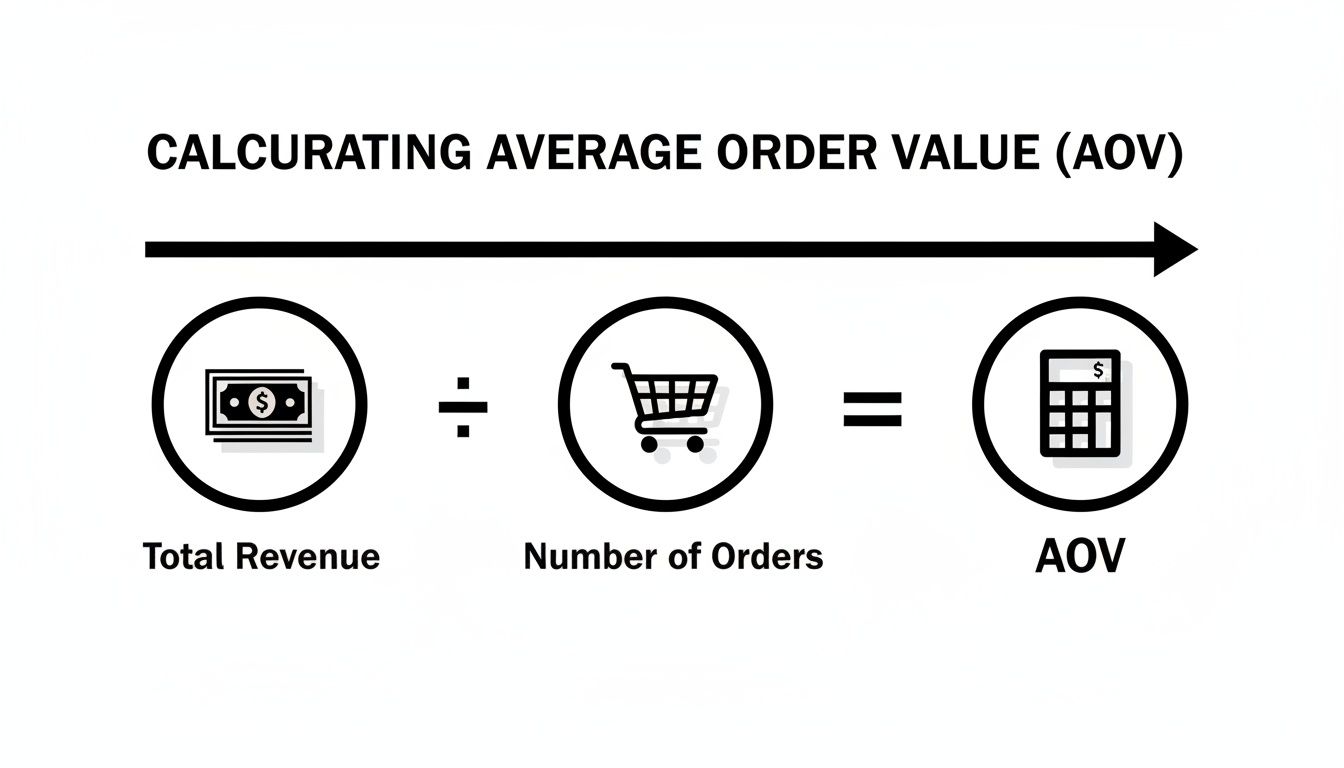
This process is straightforward: total revenue divided by the number of orders. Now, let’s apply this exact same logic to find those deeper insights.
Analyzing AOV by Marketing Channel
One of the most powerful ways to segment your AOV is by the marketing channel that brought the customer to your store. Not all traffic is created equal, and your AOV data will prove it. You might find that customers from your email list spend way more than those who click through from a social media ad.
Let's look at a quick example. Imagine you run a store selling high-quality leather goods and want to compare AOV from three of your main traffic sources for the last quarter.
AOV by Marketing Channel Example
| Marketing Channel | Total Revenue | Number of Orders | Calculated AOV |
|---|---|---|---|
| Google Ads | $15,000 | 300 | $50 |
| Organic Search | $24,000 | 400 | $60 |
| Email Newsletter | $22,500 | 250 | $90 |
This simple breakdown reveals a goldmine. Your email subscribers are your big spenders, with an AOV of $90—nearly double that of your paid ad traffic. This tells you to maybe invest more in growing your email list or to create exclusive, higher-priced offers just for that audience.
Breaking Down AOV by Customer Type
Another crucial segmentation is splitting new customers from returning ones. This comparison helps you get a real sense of customer loyalty and the effectiveness of your retention strategies. Almost always, returning customers trust your brand more and are willing to spend more per transaction.
Pro Tip: If your returning customer AOV isn't significantly higher than your new customer AOV, that’s a red flag. It might be a sign you're missing opportunities to upsell or cross-sell to your loyal base. They already like you—now is the time to show them more of what you offer.
Let's run the numbers for a skincare brand over a six-month period:
- New Customers: Generated $50,000 from 1,250 orders.
- Calculation: $50,000 / 1,250 = $40 AOV
- Returning Customers: Generated $80,000 from 1,000 orders.
- Calculation: $80,000 / 1,000 = $80 AOV
The data is crystal clear: returning customers spend twice as much per order. This insight justifies spending more on loyalty programs, retargeting campaigns, and post-purchase email flows designed to bring shoppers back. It also highlights the value of using the right ecommerce personalization software to create tailored experiences that encourage that repeat business.
Segmenting by Device Type
In today’s market, you have to understand how customers shop across different devices. Calculating AOV by device can reveal major friction in your user experience. A significantly lower AOV on mobile, for instance, is a classic indicator of a clunky mobile checkout or poor product discovery on smaller screens.
Mobile commerce introduces new layers to your AOV. For example, recent benchmarks show desktop devices can pull in an AOV of $204, while tablets and mobile phones lag behind at $144 and $137, respectively.
This gap screams that a one-size-fits-all approach doesn't work. By digging into these segments, you turn a simple metric into a strategic tool. You stop guessing what works and start making data-backed decisions that directly boost your bottom line.
Proven Strategies to Increase Your Average Order Value
Knowing your AOV is one thing, but making it grow is where the real magic happens. Once you have a clear baseline, you can start putting proven tactics to work that encourage customers to spend a little more with each purchase. These strategies aren't about tricking shoppers—they're about enhancing their experience and delivering more value.

Many of the top direct-to-consumer stores have mastered a few key techniques to lift their AOV. From smart product suggestions to loyalty perks, each method is designed to improve the shopping journey while boosting your revenue per transaction.
Let's dig into some of the most effective approaches you can start using today.
Master the Art of Upselling and Cross-Selling
Upselling and cross-selling are classics for a reason—they just work. An upsell nudges a customer toward a more expensive version of an item, while a cross-sell suggests related or complementary products. Think of Amazon’s famous "Frequently bought together" section.
- Upselling in Action: A customer is looking at a 12-ounce bag of coffee. You could show them a 24-ounce bag that offers a better price per ounce, encouraging a slightly larger purchase.
- Cross-selling in Action: Someone adds a new camera to their cart. It’s the perfect moment to suggest a memory card, a camera bag, or a tripod, either on the product page or at checkout.
The key is to be helpful, not pushy. The suggestions should feel like a natural part of the shopping journey that makes the customer's life easier. For more in-depth guidance, this expert guide covers additional proven tactics to increase average order value.
Create Smart Product Bundles
Bundling is another powerhouse strategy for increasing the perceived value of an order. When you group several related items together and offer them at a slight discount compared to buying them individually, you make it easy for customers to say "yes."
This works especially well when you’re creating an all-in-one solution. A skincare brand might bundle a cleanser, serum, and moisturizer into a "Complete Morning Routine" kit. The customer gets everything they need in one click, and you sell three products instead of one. It's a win-win that simplifies their decision-making and directly boosts your AOV.
Expert Insight: Don't just bundle random products. Dig into your sales data to see which items are most frequently purchased together. These data-backed bundles are far more likely to convert because they tap into genuine customer behavior.
Implement a Strategic Free Shipping Threshold
Shipping costs are one of the biggest reasons people abandon their carts. But you can flip this into an opportunity by offering free shipping on orders over a certain amount. The trick is setting the threshold just right.
A solid rule of thumb is to set your free shipping minimum about 30% higher than your current AOV. So, if your AOV is $50, a $65 free shipping threshold might be the perfect nudge to get customers to add one more small item to their cart. This simple tactic can significantly lift your numbers and is a core part of many strategies designed to increase ecommerce sales.
Develop a Customer Loyalty Program
Rewarding repeat customers is one of the most sustainable ways to grow your business. A well-designed loyalty program not only builds retention but also has a direct impact on AOV. When customers earn points for every dollar spent, they're often motivated to consolidate their purchases to hit the next reward tier faster.
Consider a tiered system where the perks get better as customers spend more over time. For example:
- Bronze Tier: Earn 1 point per dollar spent.
- Silver Tier: Reach $250 in lifetime spending and earn 1.25 points per dollar.
- Gold Tier: Reach $500 and get exclusive early access to sales and free gifts.
This structure creates a clear incentive for customers to increase their spending with your brand, turning one-time buyers into loyal, high-value shoppers. Recent data actually shows a shift in consumer behavior, with shoppers responding more to brands that reward them instead of just offering deep discounts.
Common AOV Calculation Mistakes to Avoid
Calculating your Average Order Value (AOV) seems simple on the surface, but a few common slip-ups can easily turn this powerful metric into misleading noise. Bad data leads to bad decisions, skewing your understanding of customer behavior and undermining the very growth strategies you’re trying to build.
Getting the calculation right is just as important as the strategies you build around it. To make sure your AOV is a reliable tool, you need to sidestep the pitfalls that trip up even seasoned pros. Let's walk through the most frequent errors and, more importantly, how to fix them.
Including Taxes and Shipping Costs
This is, without a doubt, the most common mistake we see. It’s tempting to just grab the final checkout number—the "grand total"—because it's right there and easy to find. But including taxes and shipping fees will artificially inflate your AOV, giving you a false sense of security.
Why does this matter? Those costs don't reflect what a customer is actually willing to spend on your products. A customer who buys a $40 product and pays $10 for shipping is not the same as a customer who buys a $50 product. Your AOV should measure the value of the goods sold, not the cost of getting them to the customer's door.
How to fix it: Always use the subtotal—the total value of the products in the cart before any taxes, shipping, or other fees are tacked on. This gives you a clean, accurate picture of your customers' real purchasing power.
Ignoring Fraudulent or Test Orders
Your sales data is never perfect. It’s almost always got some noise in it, like test orders from your dev team or fraudulent transactions that were later canceled or charged back. If you don't clean these out, they can throw off your numbers in a big way.
Think about it: a $1 test order or a $1,000 fraudulent purchase are outliers that don't represent a real customer. Leaving them in your dataset will skew your AOV, leading you to draw the wrong conclusions about your average shopper.
How to fix it: Before you calculate anything, scrub your data. Set up a clear process to filter out all internal test orders and any transactions flagged as fraudulent. A clean dataset is the foundation of any analysis worth doing.
Analyzing AOV in a Vacuum
A rising AOV looks fantastic on a chart, but it can be a dangerous vanity metric if you don't look at it in context. An increase in AOV is only a true win if it’s helping your overall business health, not hurting it. For example, an aggressive upselling strategy might boost your AOV but tank your conversion rate.
Key Takeaway: AOV isn't a standalone metric. It has to be analyzed alongside other critical KPIs like conversion rate, customer acquisition cost (CAC), and profit margins. A winning strategy improves AOV without sacrificing profitability or scaring away potential customers.
Imagine you introduce expensive product bundles that drive up your AOV by 20%. Sounds great, right? But what if your total number of orders drops by 30% because shoppers are put off by the higher prices? Your total revenue would actually go down. This is exactly why context is everything.
How to fix it: Always pair your AOV analysis with other core business metrics. Build a dashboard where you can see how AOV, conversion rate, and profitability trend together. This holistic view helps you make balanced decisions that drive sustainable growth, not just bigger-looking numbers.
A Few Final Questions About Average Order Value
As you start weaving Average Order Value into your business reporting, a few questions are bound to pop up. This is where we’ll tackle the most common ones we hear from store owners. Think of it as a final check to make sure you’re not just calculating AOV, but actually using it to make smarter decisions that grow your brand.
We’ll clear up the practical concerns and strategic gray areas so you can move forward with confidence.
What Is a Good AOV for Ecommerce?
This is the million-dollar question, and the honest answer is: it depends entirely on your industry and business model. What’s considered a “good” AOV for a store selling luxury watches is worlds apart from one selling artisanal coffee beans.
Instead of chasing some universal number, focus on these two things:
- Your Industry Benchmarks: How does your AOV stack up against direct competitors in your niche? A jewelry store should be looking at other jewelry stores, not the entire retail sector. This gives you a realistic baseline for performance.
- Your Own Trends: The most important benchmark is your own historical data. Is your AOV trending upward month-over-month or quarter-over-quarter? Consistent growth is the clearest sign of a healthy strategy.
AOV is also tied directly to how you price your products. For a deeper look into this, our guide on how to determine the price of a product offers some valuable context.
How Often Should I Calculate AOV?
The right cadence really depends on how you plan to use the data. There’s no single correct answer, but here’s a practical framework most brands follow:
- Weekly: This is great for tracking the immediate impact of short-term promotions, like a flash sale or a new product launch. It gives you a quick pulse check on how a specific campaign is performing.
- Monthly: This is the most common and practical frequency for strategic analysis. It smooths out any weird daily spikes or dips and gives you a much clearer view of performance trends over time.
- Quarterly: Perfect for high-level business reviews and planning. Quarterly AOV helps you gauge the success of bigger strategic shifts, like focusing on a new marketing channel or making a significant pricing change.
Unless you're running specific A/B tests, don't get bogged down in daily calculations. A monthly review strikes the right balance between timely data and strategic perspective for most businesses.
Can AOV Ever Be a Misleading Metric?
Absolutely. AOV is a powerful metric, but it can be deceptive if you look at it in a vacuum. Relying on it as your single source of truth is a classic mistake that can lead to some really poor decisions.
For example, an aggressive upselling campaign might jack up your AOV but tank your conversion rate. The result? Fewer overall sales and less total revenue.
Crucial Takeaway: AOV has to be analyzed alongside other key performance indicators (KPIs). Always view it in the context of your conversion rate, customer acquisition cost (CAC), and—most importantly—your profit margins to get the full story on your business's health.
How Does Marketing Performance Tie into AOV?
Your marketing efforts have a direct impact on AOV, and tracking this connection is critical for optimizing your ad spend and channel focus. Segmenting your AOV by channel, for instance, can quickly show you which sources are bringing in your highest-value customers.
The impact here can be huge. One study on email marketing found that as brands got better at their strategies, the average revenue per email jumped by 17%. This lift was tied to a 51% improvement in email click-to-conversion rates, proving that more effective marketing doesn't just drive clicks—it drives higher-value orders. You can discover more about these ecommerce findings on prnewswire.com to see how channel performance and transaction values are linked.
This is exactly why you should always segment your AOV by traffic source. It tells you where your most profitable customers are coming from, helping you put your marketing budget where it will get the best return.
At Next Point Digital, we specialize in turning data like AOV into actionable growth strategies for ecommerce brands. If you're ready to move beyond just tracking metrics and start making them work for you, we can help.