

So, what exactly is the ROI of content marketing?
Think of it as a simple question: for every dollar you spend creating and promoting content, how much revenue are you getting back? It’s the metric that tells you whether your blog posts, videos, and guides are just a creative expense or a genuine growth engine for your business.
Why Your Content's Value Is More Than Just Clicks

Too many ecommerce brands get stuck chasing vanity metrics like likes, shares, and page views. While those numbers might feel good, they don't pay the bills. Real content marketing ROI goes deeper, tracking how your content actually influences the goals that matter to your business.
Think of your content as a digital salesperson that works for you 24/7. It builds your brand’s authority, pulls in high-intent leads through SEO, and guides potential customers through their buying journey—all without needing a coffee break. Each article is a long-term asset that keeps working for you, attracting new prospects long after you hit "publish."
Content as a Profit-Driving Investment
When you start viewing content as an investment, it completely changes how you measure success. The goal is no longer just to create content for the sake of it; it's to create content that drives profitable actions. Every single piece needs a job to do.
This mindset is non-negotiable for any D2C or marketplace brand that wants to scale. It shifts the conversation from, "How many people saw our post?" to, "How much revenue did that post influence?" The focus moves to tangible outcomes that directly impact your bottom line. To see how this works in practice, check out our guide on data-driven marketing strategies.
The core idea is simple: a clear measurement framework transforms content from an ambiguous marketing activity into a predictable and powerful source of growth. It provides the clarity needed to invest confidently and make smarter strategic decisions.
The Clear Advantage of Content
Beyond just building a brand, content marketing has a serious financial edge. Research shows it costs 62% less than traditional marketing while generating about three times as many leads. That kind of efficiency is why content marketing, especially website and blog SEO, has become a top ROI-generating channel for modern businesses.
Of course, to really nail this, you need to understand the nuts and bolts. For a deep dive into the practical side of things, this guide on Measuring Content Marketing ROI is a great place to start. A winning strategy always comes down to tracking how your content impacts the right metrics, including:
- Improved lead quality: Attracting customers who are already looking for what you sell.
- Lower customer acquisition costs (CAC): Relying on organic traffic instead of pouring money into ads.
- Higher customer lifetime value (LTV): Building loyalty by giving customers valuable, helpful content.
The Essential Formula for Calculating Content ROI
To really get a grip on what your content is worth, you need to ditch the guesswork and start doing some real math. At its core, the ROI of content marketing comes down to a simple formula that tells you whether your efforts are a money pit or a gold mine.
Here it is: ((Return – Investment) / Investment) x 100%
The calculation itself is easy. The tricky part is figuring out what “Return” and “Investment” actually mean for your ecommerce business. These aren't just vague ideas; they're real dollars you need to track with a sharp eye.
Deconstructing Your Content Investment
Your "Investment" is the total cost of bringing your content strategy to life. And trust me, it’s a lot more than just your monthly software subscriptions. To get an honest number, you have to add up every single expense that goes into the process.
Think of it like building a physical product. You wouldn’t just count the cost of the raw materials, right? You’d factor in labor, machinery, and all the overhead. It’s the same with content.
Your investment includes:
- Creation Costs: This is usually the biggest piece of the pie. It covers salaries for your in-house team, payments to freelance writers or designers, and any agency fees.
- Promotional Budgets: This is any money you spend on ads to get your content in front of more people, like paid social campaigns, search ads, or sponsored posts.
- Technology and Tools: Don't forget subscriptions for your SEO tools, analytics platforms, content management system (CMS), or any other software that makes your content machine run.
Add all of that up, and you’ve got the "I" in your ROI formula. Without a complete picture of your costs, you’ll never get a true read on your returns.
Identifying Your Content Return
Now for the fun part: the "Return." This is where you see the direct financial payoff from all your hard work. It's the total value your content creates, and it’s often more than just a single, direct sale. For an ecommerce brand, your return is a mix of a few key results.
A classic mistake is to only count revenue from the very last click before someone buys. That ignores all the heavy lifting your content did to introduce your brand and warm up that customer long before they ever thought about pulling out their credit card. You need the whole picture.
To measure your total return, you need to be tracking these critical areas:
- Direct Revenue: Use your analytics tools to track sales that come straight from a piece of content, like when a customer clicks a "Buy Now" link in a blog post.
- Value of Qualified Leads: Put a dollar value on the new leads your content brings in. You can figure this out based on your historical lead-to-customer conversion rate and the average lifetime value of a customer.
- Organic Traffic Value: Calculate what it would have cost you to buy that same organic traffic through paid ads. This shows you the money your content is saving you.
If you want a truly comprehensive view of your content's financial impact, check out this ultimate guide to multi-channel ROI reporting.
By carefully tracking both your investments and all these different types of returns, you can finally plug real numbers into the ROI formula. This shifts your view of content from just another marketing task to a measurable business driver, setting you up for smarter strategies and better attribution down the road. In the grand scheme of things, understanding your ROI is a fundamental part of the best ecommerce marketing strategies you can use to grow your brand.
Connecting Content to Conversions with Attribution Models
Knowing your total return is a great start, but how do you prove which specific blog post or video actually pushed a customer to buy? This is where attribution modeling comes in. It’s the process of giving credit to the different marketing touchpoints that guide a customer toward a sale, and it's how you connect the dots between your content and your revenue.
Think of the customer journey like a soccer match. A sale is the final goal, but multiple players were involved in getting the ball down the field. Attribution models are just the different ways a coach might decide to credit the players for that goal.
Here's the basic formula that underpins all of this.
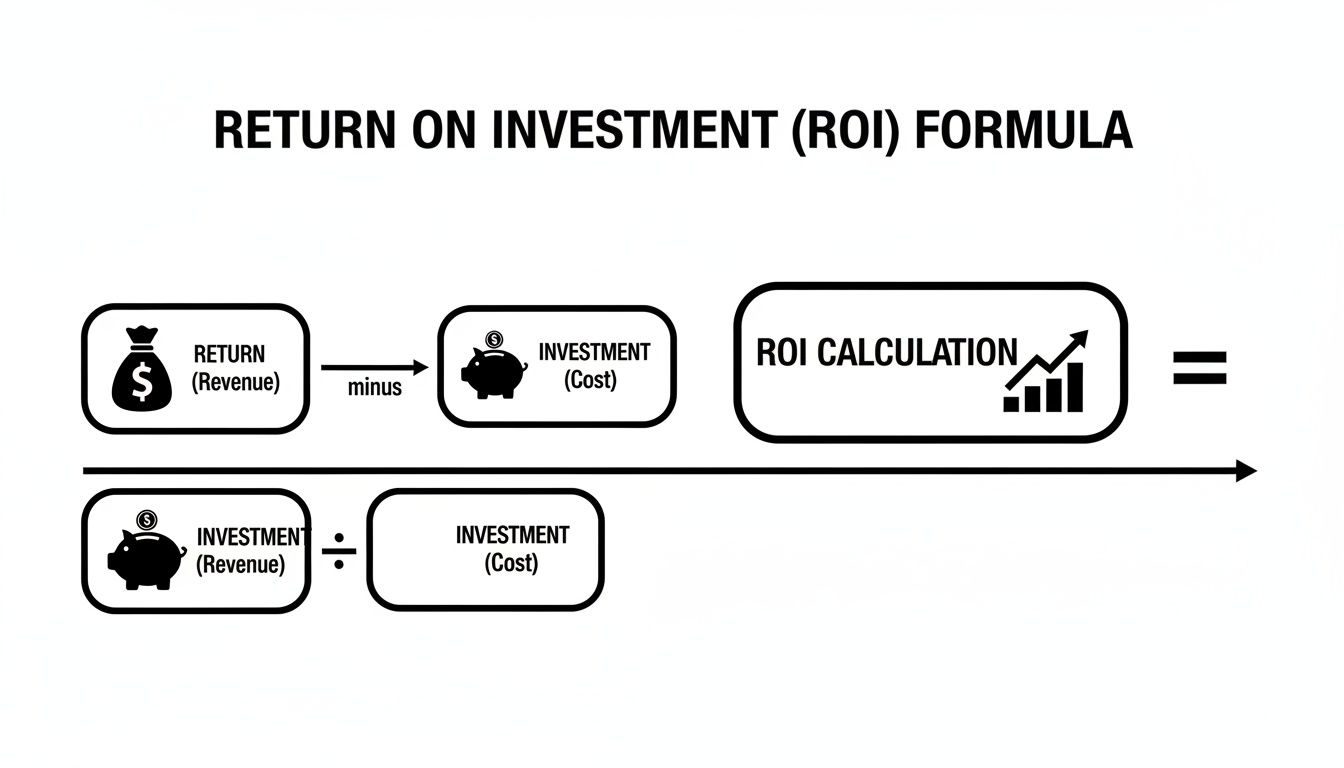
This simple calculation is the foundation for proving your content's financial impact.
First-Touch Attribution: The Playmaker
In a First-Touch attribution model, all the credit for the sale goes to the very first piece of content a customer engaged with. In our soccer analogy, this is like giving all the glory to the defender who first won the ball and kicked off the attack.
This model is fantastic for understanding which content is best at introducing new people to your brand. It answers the question, "What is bringing new prospects into our world?"
The problem? It has a massive blind spot. It completely ignores every other piece of content the customer saw on their way to making a purchase, giving you a seriously incomplete picture of what truly convinced them to buy.
Last-Touch Attribution: The Goal Scorer
The most common and simplest model is Last-Touch attribution. Here, 100% of the credit goes to the final touchpoint right before the sale. It’s like only crediting the striker who physically kicked the ball into the net.
Many analytics platforms default to this model because it’s so easy to track. If a customer clicks a link in your latest product guide and immediately buys, that guide gets all the credit. It’s clean and straightforward.
But this is where so many brands miscalculate the ROI of content marketing. Top-of-funnel content, like that blog post that first made a customer aware of a problem, gets zero credit. It looks worthless in your report, even though it was a crucial first step in the journey.
Multi-Touch Attribution: The Whole Team
This is where things get interesting. Multi-Touch attribution recognizes that multiple touchpoints contribute to a sale and splits the credit among them. It’s like acknowledging the defender who started the play, the midfielders who passed the ball, and the striker who scored. Everyone gets credit for their role.
This approach gives you a much more accurate and holistic view of how your content ecosystem works together. There are a few ways to slice it:
- Linear Model: Credit is split evenly among all touchpoints. If a customer read a blog post, downloaded a guide, and then clicked an ad, each gets 33.3% of the credit. It’s fair, but it assumes every touchpoint was equally influential.
- Time-Decay Model: This model gives more credit to the touchpoints closest to the sale. The final click gets the most credit, while the first interaction gets the least. It works on the assumption that the content consumed just before buying had the biggest impact.
For D2C brands, platforms like Google Analytics let you easily compare these different models in the "Attribution" section. By switching between Last-Touch and a multi-touch model like Linear, you'll often see blog posts and guides suddenly get the credit they deserve for assisting sales.
Marketplace sellers can apply these principles, too. While Amazon’s analytics are more limited, you can track how external marketing campaigns (like a social media post linking to your product) drive traffic and sales. Understanding that the initial click on that post played a role, even if the final purchase came from a later search on Amazon, helps you value your off-platform content correctly. For more on this, explore these proven conversion rate optimization strategies.
Choosing the Right Attribution Model for Your Business
Picking the right attribution model depends entirely on your business goals and customer journey. A brand with a short, simple sales cycle might be fine with Last-Touch, while a business with a longer, more complex funnel needs a multi-touch view to see the full picture.
This table breaks down the most common models to help you decide which one fits your needs.
| Attribution Model | How It Works | Best For | Potential Blind Spot |
|---|---|---|---|
| First-Touch | 100% of the credit goes to the first marketing touchpoint a customer interacts with. | Understanding which channels are best at generating initial brand awareness. | Ignores all subsequent interactions that nurture the lead and close the sale. |
| Last-Touch | 100% of the credit goes to the final touchpoint before a conversion. | Simplicity and tracking bottom-of-funnel content that directly drives sales. | Undervalues top- and middle-of-funnel content that builds trust over time. |
| Linear | Credit is divided equally among all touchpoints in the customer journey. | Getting a balanced, holistic view of every piece of content involved. | Fails to recognize that some touchpoints are more influential than others. |
| Time-Decay | More credit is given to touchpoints closer in time to the conversion. | Businesses with longer sales cycles where recent interactions matter more. | Can undervalue initial awareness-building content that starts the journey. |
Ultimately, no single model is perfect. The key is to understand what each one tells you—and what it doesn't.
By moving beyond a simple Last-Touch view, you can build a far more accurate case for your content’s true financial contribution and make smarter decisions about where to invest your time and budget.
Ecommerce KPIs That Reveal Content's True Impact

While a single ROI percentage is a nice headline number, the real story of your content's success is told through your ecommerce KPIs. These are the metrics that show you how and where your content is actually creating value, long after the initial click or sale. For any D2C or marketplace seller, these indicators are what really prove the ROI of content marketing.
Think of your content less like a one-off ad campaign and more like an investment in your company's future. A great blog post isn't just about a single transaction; it's an asset that lowers your marketing costs over time and convinces customers to stick around.
Let's dig into the KPIs that show you exactly how that works.
Lowering Customer Acquisition Cost
Customer Acquisition Cost (CAC) is what you spend, on average, to get a brand new customer. High-quality, SEO-driven content is one of the best tools you have to bring this number down, systematically.
Every time a customer finds you through an organic search, you’ve won them over without paying for an ad click. That’s a direct saving. As your content library grows and your search rankings climb, you’re building a reliable source of "free" traffic that makes you less dependent on pricey paid channels.
A well-optimized guide that lands on page one of Google can bring in hundreds of qualified leads every month for years. It effectively lowers your blended CAC every single day it stays there. This is how content stops being an expense and becomes a cost-saving machine.
Increasing Customer Lifetime Value
Customer Lifetime Value (LTV) tells you the total revenue you can expect from a single customer over their entire relationship with you. Content marketing is a powerhouse for driving up LTV because it builds the trust and loyalty that turns one-time buyers into repeat customers.
So, how does that actually happen?
- Educational Content: Tutorials, how-to guides, and detailed use cases help customers get more out of their purchase. When they feel successful, they're far more likely to come back for more.
- Community Building: Engaging content on social media or in a newsletter creates a sense of belonging. You're not just a store; you're a brand they want to be a part of.
- Post-Purchase Support: Content that answers common questions or solves problems after the sale reduces frustration and reinforces their decision to trust you, making future purchases a no-brainer.
By nurturing that relationship long after the credit card is put away, you directly increase LTV—a massive piece of your content's long-term return.
Boosting Conversion and Order Value
Beyond attracting new customers and keeping them loyal, content has a direct impact on what they do during a shopping session. The two KPIs to watch here are Conversion Rate by channel and Average Order Value (AOV).
By comparing the conversion rate of traffic from your blog to traffic from other channels, you can see how good your content is at turning readers into buyers. A high conversion rate from organic search is a clear sign you’re attracting the right people with the right message. You can get even more granular by digging into your Amazon sales data to see how your off-site content is driving on-platform purchases.
On top of that, smart content can actually get people to spend more. A well-placed article comparing product tiers or a guide on "products that work great together" can upsell or cross-sell without feeling pushy. This directly increases the revenue you get from every single person who came from your content.
When you track this dashboard of KPIs—CAC, LTV, Conversion Rate, and AOV—you get the complete picture. You can finally prove that your content doesn't just generate a sale; it creates better, more valuable customers who stick around longer and spend more.
How to Amplify Your Content ROI with AI
Once you have a clear system for tracking content performance, the next logical step is figuring out how to improve it. Today, the smartest strategies for boosting your ROI of content marketing are centered around artificial intelligence. AI isn't some far-off concept anymore; it's a practical tool that helps you make better decisions and get more from your budget.
Think of AI as a super-powered assistant. It can sift through mountains of data to spot patterns you’d otherwise miss, sharpening your entire content workflow from research to optimization. The goal? Making every dollar you invest work that much harder.
AI-Driven Content Creation and Optimization
The most immediate place to see AI in action is in the content creation process itself. AI tools can analyze search engine results pages (SERPs) to pinpoint untapped keyword opportunities and even predict which topics will hit home with your audience. This data-first approach takes a lot of the guesswork out of building your content calendar.
For instance, AI can generate personalized product descriptions at scale, tweaking the copy for different customer segments to nudge conversion rates higher. It's also great for dynamically testing A+ Content variations on marketplaces, automatically figuring out which layouts and messages actually drive sales.
The impact here is huge. Marketers using AI tools for their campaigns report an average 68% increase in ROI. Even more impressive, 70% of marketers using AI for advanced personalization have earned 200% ROI or more. The trend is clear, and you can dig deeper into these numbers with additional content marketing statistics.
Smarter Budgeting and Performance Management
Beyond just writing content, AI is a total game-changer for managing your promotional budget. AI-powered advertising platforms can manage bids in real time, automatically shifting more spend toward ads that are successfully driving traffic to your best content.
This means your money is always flowing to the channels and content that deliver the highest return. Instead of tweaking campaigns based on last week's data, the system optimizes on the fly.
The real power of AI is its ability to directly connect your investment to results. It gives you the hard data needed to justify spending on high-quality, SEO-optimized content, proving that this approach delivers far better returns than a cheap, high-volume strategy.
This technology-first mindset is what unlocks scalable growth. By automating the routine analysis and optimization, your team is freed up to think about the bigger picture. For ecommerce brands, that could mean exploring sophisticated tactics like those found in guides on ecommerce personalization software.
Ultimately, leaning into AI allows you to move faster, make more accurate decisions, and build a content engine that doesn't just perform—it continuously improves. This is quickly becoming the new standard for achieving a strong and ever-growing content marketing ROI.
Building a Clear and Convincing ROI Report
After you've tracked your investments and calculated the returns, the final step is turning all that data into a story that actually resonates with executives and stakeholders. A powerful content marketing ROI report does more than just list numbers; it paints a picture of how content is actively driving business growth. It’s your chance to translate hard work into the language of profit and loss, making your team's value undeniable.
Think of this report as the bridge between your marketing efforts and the company's bottom line. It's how you move beyond metrics that only marketers get excited about and showcase results the entire leadership team cares about. A well-structured report brings clarity, justifies your budget, and builds serious confidence in your strategy.
To make your report hit home, it needs to be clear, concise, and visually engaging. Don't just dump a spreadsheet on them. Instead, guide them through a narrative that highlights key wins and connects the dots directly back to business goals.
Structuring Your ROI Report for Maximum Clarity
A great report has a logical flow. It starts with the big picture and then drills down into the details. This approach lets busy executives grab the main takeaways in seconds, while still giving the deeper data to anyone who wants to dig in. Here’s a blueprint you can adapt for your own brand.
- Executive Summary: Kick things off with a brief, powerful overview. State the overall ROI of content marketing for the period (e.g., "220% ROI for Q3") and call out two or three major wins, like a big drop in customer acquisition costs or a jump in organic sales.
- Investment Breakdown: Clearly lay out your costs. Transparency here is crucial for building trust. A simple table showing where the budget went is all you need.
- Return Analysis: This is the heart of your report. Detail the revenue generated, including direct sales from content, the value of new leads you brought in, and even the cost savings from organic traffic.
- Key Performance Highlights: Use charts and graphs to make your progress impossible to ignore. Show the growth in organic traffic, better conversion rates from your blog, or a side-by-side comparison of different campaigns.
A Practical D2C Brand Example
Let’s imagine a D2C company that sells sustainable home goods. Their Q3 report might have a table that breaks down their content performance and how they got to their final ROI number.
The most convincing reports don't just show what happened; they explain why it happened. Connect your data to specific strategic initiatives—for example, "Our new video tutorial series directly contributed to a 15% increase in average order value by showcasing product bundles."
Here's how they could present their data in a simple format that gets right to the point.
Quarterly Content Marketing ROI Calculation Example
The table below provides a sample calculation for an ecommerce brand's content marketing efforts over one quarter. It breaks down the total investment, quantifies the returns from different sources, and presents a clear, final ROI percentage.
| Metric | Calculation/Source | Value |
|---|---|---|
| Total Investment | Content Team Salaries + Freelancers + Ad Spend | $12,500 |
| Attributed Revenue | Sales from blog CTAs (Google Analytics) | $25,000 |
| Value of New Leads | 500 leads x $30/lead (CRM data) | $15,000 |
| Total Return | Attributed Revenue + Lead Value | $40,000 |
| Net Profit | Total Return – Total Investment | $27,500 |
| Content Marketing ROI | (Net Profit / Investment) x 100 | 220% |
This kind of straightforward, evidence-based reporting is what transforms your content team from a "cost center" into a proven profit driver. It's how you secure the buy-in and the budget you need to keep growing.
Common Questions About Content Marketing ROI
Even with a solid plan, measuring the ROI of content marketing can feel like trying to nail Jell-O to a wall. It’s normal to hit a few bumps or have questions pop up. We get it.
Below, we’ll walk through some of the most common hurdles ecommerce leaders run into. Think of this as your guide to navigating the gray areas so you can move from uncertainty to clarity, making every piece of content count.
How Long Does It Take to See a Positive ROI?
This is the big one, and the honest answer is: it takes patience. While a viral video might give you a quick win, real content marketing ROI is a long game. It’s less like a slot machine and more like planting a tree—it takes time to grow, but the payoff is worth it.
Most businesses start seeing a real, measurable return within 6 to 9 months. This gives your content enough time to climb the search rankings, build authority, and pull in a steady stream of organic traffic. The best part? That blog post you publish today can keep generating leads and sales for years to come, compounding its value over time.
What Is the Biggest Mistake in Measuring Content ROI?
The single biggest mistake we see brands make is focusing only on last-touch attribution. It’s like giving all the credit for a Super Bowl win to the player who scored the final touchdown, completely ignoring the quarterback, the blockers, and the coaches who made it happen.
When you only look at the last click, you miss all the other content that guided the customer along the way. You don't see the blog post that first introduced them to your brand or the comparison guide that convinced them your product was the right choice.
To get the full picture, you need a multi-touch attribution model. This approach gives credit where it's due, showing you the true value of all the content that helped nurture a lead from stranger to customer.
How Do I Measure the ROI of Non-Sales Content?
So what about the content that doesn’t have a "Buy Now" button attached, like a fun social media video or an educational infographic? You can’t always draw a straight line from a view to a sale, but you can absolutely measure its impact by tracking proxy metrics.
Think of these as clues that show you’re moving in the right direction. Instead of direct revenue, you’ll want to measure things like:
- Engagement Rate: Are people liking, sharing, and commenting? High engagement means you’re building a real connection with your audience.
- New Email Subscribers: Did your content’s call-to-action get people to sign up? Every new subscriber is a warm lead for the future.
- Branded Search Volume: Are more people searching for your brand name after a campaign? This shows your content is building brand awareness and recall.
- Assisted Conversions: Jump into your analytics and see how many times this content showed up in the customer’s journey, even if it wasn’t the final click.
These metrics prove that your top-of-funnel content is doing its job: building an audience and filling your pipeline for future sales. That’s a return you can take to the bank.
Ready to stop guessing and start seeing measurable growth from your content? The experts at Next Point Digital specialize in building data-driven ecommerce strategies that connect content directly to sales. We help brands on Amazon, Walmart, and D2C platforms turn clicks into loyal customers. Let's build your growth roadmap together.