

An Amazon FBA freight forwarder is the logistics partner who handles the complicated journey of getting your inventory from the factory floor all the way to Amazon's fulfillment centers. They're not just shipping agents. A great forwarder is more like a strategic partner, helping you get through customs, find cost savings, and sidestep expensive delays. For sellers today, that relationship is essential for survival.
Why Your Freight Forwarder Is Your Most Critical Partner
Let’s be real: Amazon's logistics network is a beast. For most sellers, keeping up with its constantly shifting rules feels like a full-time job. Just getting boxes from Point A to B isn’t enough anymore. Who you choose as your freight forwarder has gone from a simple operational choice to a decision that can make or break your profitability.
This became painfully obvious as the market completely flipped. While sellers were celebrating ocean freight rates from Asia to the U.S. dropping by 55-60% year-over-year, a whole new set of financial pressures started coming from Amazon itself. The introduction of aggressive Low-Inventory and Placement fees began to quietly eat away at profits. At the same time, stricter receiving rules meant simple prep mistakes were suddenly causing entire shipments to be rejected.
It's this dual pressure—plunging shipping costs on one side and soaring Amazon fees on the other—that makes a savvy forwarder so indispensable. They are your first line of defense against shrinking margins.
Beyond Shipping: A Strategic Partnership
A top-tier forwarder does a lot more than just book space on a container ship. They actively solve problems before they can ever hit your bottom line.
- Cost Optimization: They can recommend consolidating shipments or strategically splitting inventory across different fulfillment centers to minimize Amazon's new placement fees.
- Compliance Mastery: An experienced partner knows Amazon’s packaging and labeling requirements inside and out. This alone prevents rejections that lead to painful storage fees and stockouts.
- Logistical Agility: When ports get jammed or customs flags a shipment for a random inspection, they have backup plans ready to go, potentially saving you weeks of delays.
Think of your forwarder as your logistics strategist. Their expertise directly protects your profit margins by helping you sidestep hidden fees and operational penalties within Amazon’s ecosystem.
This partnership is the foundation for building a supply chain that can actually withstand a few bumps in the road. As your business grows, their role only gets more important. They help you plan for seasonal demand spikes, manage inventory across different marketplaces, and adapt to whatever global disruption is happening this week. Their insights are a huge piece of learning how to scale an ecommerce business without letting logistics become a bottleneck.
Ultimately, the right Amazon FBA freight forwarder stops being a service provider and becomes a true competitive advantage. They handle the immense complexity of getting your products where they need to go, so you can focus on building your brand.
Getting the FBA Freight Forwarding Essentials Right
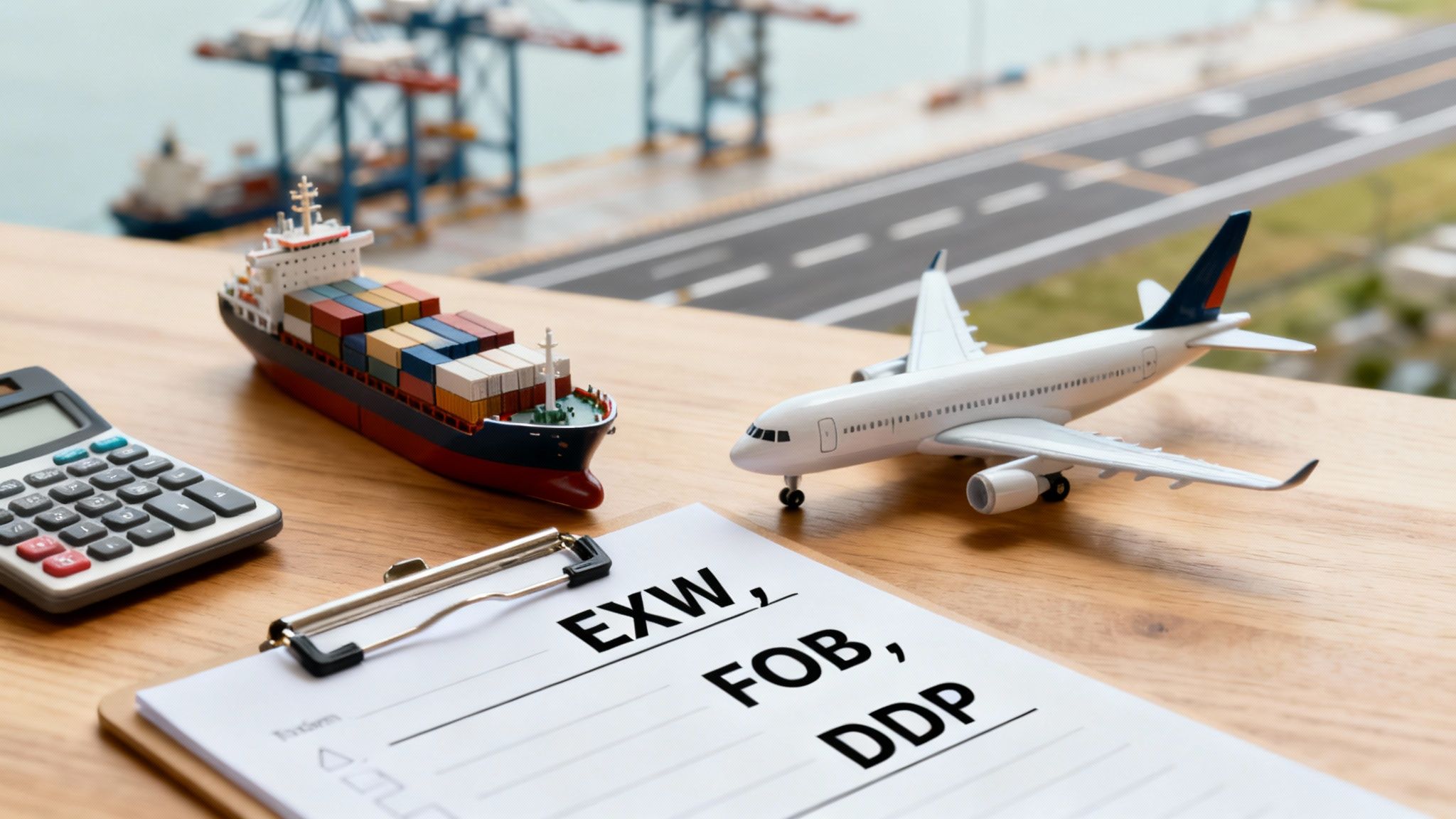
Before you even think about requesting quotes, you need to get a handle on the fundamentals of international shipping. Trust me, getting these basics right from the start will save you from some seriously expensive headaches later on. This isn't just about learning industry jargon; it’s about understanding how every single decision you make impacts your budget, your timeline, and your sanity.
Your first big decision is always going to be the mode of transport: sea or air.
Sea freight is the workhorse of global trade. It’s your cheapest option for larger, heavier shipments, but you have to be patient. We're talking transit times of 30 to 45 days from Asia to the U.S. On the flip side, air freight is your express lane, cutting that journey down to just a handful of days—but you’ll pay a premium for that speed.
This choice has a direct impact on your cash flow and inventory planning. If you're organized enough to plan months ahead, sea freight is a no-brainer for keeping your per-unit costs down. But if you’re about to stock out and need inventory fast, that painful air freight bill might just be a necessary evil.
Decoding the Language of Shipping: Incoterms
Incoterms are the rules of the road for international trade. They’re standardized terms that spell out exactly who is responsible for what, and at what point that responsibility shifts from your supplier to your freight forwarder. Getting this wrong is a classic rookie mistake that leads to unexpected bills and logistical chaos.
For Amazon sellers, it usually boils down to three common terms: EXW, FOB, and DDP.
Here’s a quick rundown of what each one means for you and your forwarder.
Common Incoterms for FBA Sellers at a Glance
| Incoterm | Seller's Responsibility | Forwarder's Responsibility | Best For |
|---|---|---|---|
| EXW (Ex Works) | Only the cost of goods. Inventory is available for pickup at the factory. | Everything else: local trucking, export customs, ocean/air freight, import customs, and final delivery. | Sellers who want maximum control and have a trusted forwarder to manage the entire process from the factory door. |
| FOB (Free On Board) | Getting goods to the origin port and loaded onto the vessel. Covers local trucking and export fees. | Everything from the origin port onward: ocean/air freight, insurance, import customs, and final delivery. | A balanced approach. It’s popular because it splits responsibility and is often easier for suppliers to manage on their end. |
| DDP (Delivered Duty Paid) | Minimal. The seller only pays the supplier for the goods. | The entire journey, door-to-door. This includes all shipping, customs, duties, and taxes. | Sellers who want a completely hands-off, all-in-one price. Simple, but often more expensive. |
As you can see, these terms are non-negotiable. The price difference between an EXW and an FOB quote can be thousands of dollars, because under FOB, your supplier is covering all the local transport and export fees. Always, always confirm the Incoterm when comparing quotes.
Another crucial piece of the puzzle is the critical role of the Importer of Record (IOR). The IOR is the person or entity legally responsible for ensuring the goods comply with all customs regulations. Knowing who is acting as the IOR is a fundamental part of your shipping agreement and is key to avoiding customs delays.
Why You Need a Forwarder with FBA-Specific Experience
Let’s be clear: not all freight forwarders are the same. A general forwarder can get a container from Point A to Point B, but an Amazon FBA freight forwarder is a specialist. They live and breathe Amazon’s strict, and often frustrating, ecosystem.
They are experts in navigating the "middle mile"—that critical journey from the port of arrival to Amazon’s fulfillment center doors.
This specialization is everything, because Amazon isn’t your average warehouse. They have rigid rules for:
- Labeling: FNSKU and carton labels have to be perfectly formatted and placed. No exceptions.
- Palletizing: Pallets must meet specific dimensions, height limits, and weight restrictions.
- Appointments: You can't just show up. Deliveries must be scheduled through Amazon's Carrier Central portal.
A forwarder who doesn’t know these rules will get your shipment rejected. That means storage fees at a third-party warehouse, re-delivery costs, and the ultimate sin for an Amazon seller: a stockout.
With 78% of top Amazon sellers now using FBA, having a logistics partner who gets this right is non-negotiable. They act as your last line of defense, a final quality control check to make sure your inventory arrives at Amazon ready to be scanned and sold. A deep understanding of what Amazon FBA is is what separates a decent forwarder from a great one who actively protects your sales velocity and IPI score.
How to Vet and Select Your FBA Forwarder
Choosing the right logistics partner is one of the most impactful decisions you'll make for your FBA business. Forget the generic advice—this is a real framework for finding a freight forwarder you can actually trust to protect your inventory and your profits. It all starts with asking the right questions, and spoiler alert: "How much does it cost?" isn't the first one.
A low price on paper means nothing if the forwarder buckles under the pressure of Amazon’s notoriously strict system. Think of your vetting process as an interview. You’re not just hiring a shipping company; you’re evaluating a potential partner on their expertise, communication, and ability to handle chaos.
This isn't just about moving boxes. It's about building a relationship that can make or break your supply chain.
Asking the Right Questions
Most sellers start by asking, "What's your rate?" That's a mistake. Instead, you need to dig deep into their operational chops and their specific experience with Amazon's ecosystem. Their answers will quickly tell you whether they're a true specialist or just a generalist trying to cash in on the FBA boom.
Here are the questions that will separate the pros from the pretenders:
- Amazon-Specific Expertise: "Give me your step-by-step process for handling an Amazon warehouse rejection or a lost shipment." A real FBA forwarder will have a documented procedure, not just a vague promise to "figure it out."
- Customs and Compliance: "Do you have your own in-house customs brokerage, or do you farm it out?" In-house teams almost always mean faster, more seamless clearance. Follow that up with, "How do you handle unexpected customs holds or inspections?"
- Problem-Solving Scenarios: "Walk me through a time you dealt with a major port delay. How did you communicate with your client, and what solutions did you bring to the table?" This question tests their proactivity and transparency when things inevitably go wrong.
- Technology and Tracking: "Can I see a demo of your client portal? What level of tracking visibility can I expect?" If they can't offer real-time, detailed tracking, they're already behind the curve. Vague updates are a huge red flag.
A forwarder's true value isn't revealed when things go smoothly—it's shown when things go wrong. Their ability to manage chaos, communicate clearly under pressure, and solve problems proactively is what separates the great partners from the merely adequate.
Assessing Their FBA Competency
Beyond what they say, you need to verify they actually know FBA. A forwarder who truly gets it can talk fluently about pallet dimensions, the difference between FNSKU and shipping labels, and the quirks of booking delivery appointments through Amazon's Carrier Central portal.
They should be a source of guidance, not just a mover of freight. If they aren’t proactively advising you on how to pack your goods to meet Amazon's strict standards, they’re putting your shipment—and your money—at risk.
For example, a skilled forwarder will double-check that your pallets don’t exceed 72 inches in height and that no single carton is over 50 lbs (unless it contains one oversized item). This granular attention to detail is non-negotiable. It's the kind of knowledge that directly impacts your bottom line, much like how analyzing your Amazon sales data helps you fine-tune your marketing spend.
Comparing Quotes Like a Pro
Okay, now that you have a shortlist of competent forwarders, it’s time to talk numbers. But be warned: comparing freight quotes is rarely an apples-to-apples game. The cheapest base rate is often a trap, hiding a minefield of surprise fees that will magically appear on your final invoice.
To compare quotes effectively, demand an itemized breakdown. Insist that every single quote includes these specific line items:
- Ocean or Air Freight (the base transportation cost)
- Origin Charges (local trucking, export docs)
- Destination Charges (port fees, handling)
- Customs Clearance Fees
- Duties and Taxes (even an estimate is better than nothing)
- Final Mile Delivery (the cost to get it from the port to the Amazon FC)
A transparent forwarder won't hesitate to provide this. If a company sends you a single "all-in" price with no breakdown, run. They’re either padding the numbers or, worse, leaving out potential costs you’ll be stuck paying later.
Platforms like Freightos are great for getting a feel for benchmark pricing and seeing what the market rates are.
A dashboard like this gives you a quick snapshot of market rates and transit times, helping you spot a quote that’s way out of line.
Evaluating Communication and Technology
In logistics, information is just as valuable as the physical movement of your goods. A forwarder with terrible communication or outdated tech will leave you completely in the dark, causing massive stress and making inventory planning a nightmare.
During your vetting process, pay close attention to their responsiveness. How quickly do they reply to your emails? Are their answers clear and direct, or are they giving you the runaround? This initial experience is almost always a preview of the service you’ll get once you're a paying client.
A modern freight forwarder must have a robust online tracking portal. You should be able to see real-time updates on your shipment's status 24/7 without having to send an email and wait for a reply. A partner who invests in technology is a partner who values transparency and efficiency—exactly what you need to succeed in the fast-paced world of FBA.
Your FBA Shipment: From Factory Floor to Fulfillment Center
You've picked your freight forwarder. Great. Now the real work begins. Getting your products from the factory floor to an Amazon fulfillment center is a gauntlet of details, and one wrong move can create a logistical nightmare.
The process kicks off the moment you book your shipment. This isn't just a casual "hey, I have stuff to move." You need to provide hyper-accurate data, especially the weight and dimensions of your master cartons. Get this wrong, even by a little, and you're looking at re-quotes, customs headaches, and delays before you've even started.
Once your forwarder has that info, they'll book space on a container ship or cargo plane, setting off a chain reaction of paperwork and coordination.
Mastering the Paperwork Trail
International shipping is built on a mountain of paperwork. As an Amazon seller, the two documents you absolutely need to get right are the Commercial Invoice and the Bill of Lading (B/L) or Air Waybill (AWB).
Think of the commercial invoice as the official receipt for your goods. It tells customs officials who the buyer and seller are, what the products are, and how much they're worth. They use this to figure out duties and taxes, so accuracy is everything.
The Bill of Lading (for sea freight) or Air Waybill (for air freight) is more than just a receipt—it's the title of ownership for your inventory while it's in transit. Your freight forwarder handles creating these documents, but the information comes from you. It's on you to make sure it's all correct.
If you're shipping certain types of products, like anything with batteries or chemicals, compliance gets even stricter. It's worth your time understanding dangerous goods classification to avoid having your entire shipment seized.
Amazon Prep and Labeling: Your Last Line of Defense
This is where so many new FBA sellers trip up. Amazon's rules for prepping and labeling products are notoriously strict. If your shipment arrives non-compliant, it gets rejected on the spot. Then you're stuck paying extra to have it all sent to a third-party prep center for expensive rework.
A good Amazon FBA freight forwarder will double-check your shipment, but you still need to know the rules yourself.
- FNSKU Labels: Every single unit needs its own FNSKU barcode. This is what links the product to your seller account. It has to be placed over any old UPC barcodes.
- "Sold as Set" Labels: Bundling items? You need a label that clearly says "Sold as Set" or "This is a Set, Do Not Separate." If you don't, warehouse workers will break your bundles apart.
- Shipping Labels: Each master carton needs an FBA shipping label, which you generate inside Seller Central. This label tells Amazon's system exactly what's in the box.
Think of Amazon's fulfillment centers as massive, fast-moving machines. Your labels are the instructions that tell that machine what to do with your inventory. Wrong instructions? The machine stops and spits your shipment back out.
This is exactly why vetting your forwarder properly is so important. A partner who gets these details right is worth their weight in gold.
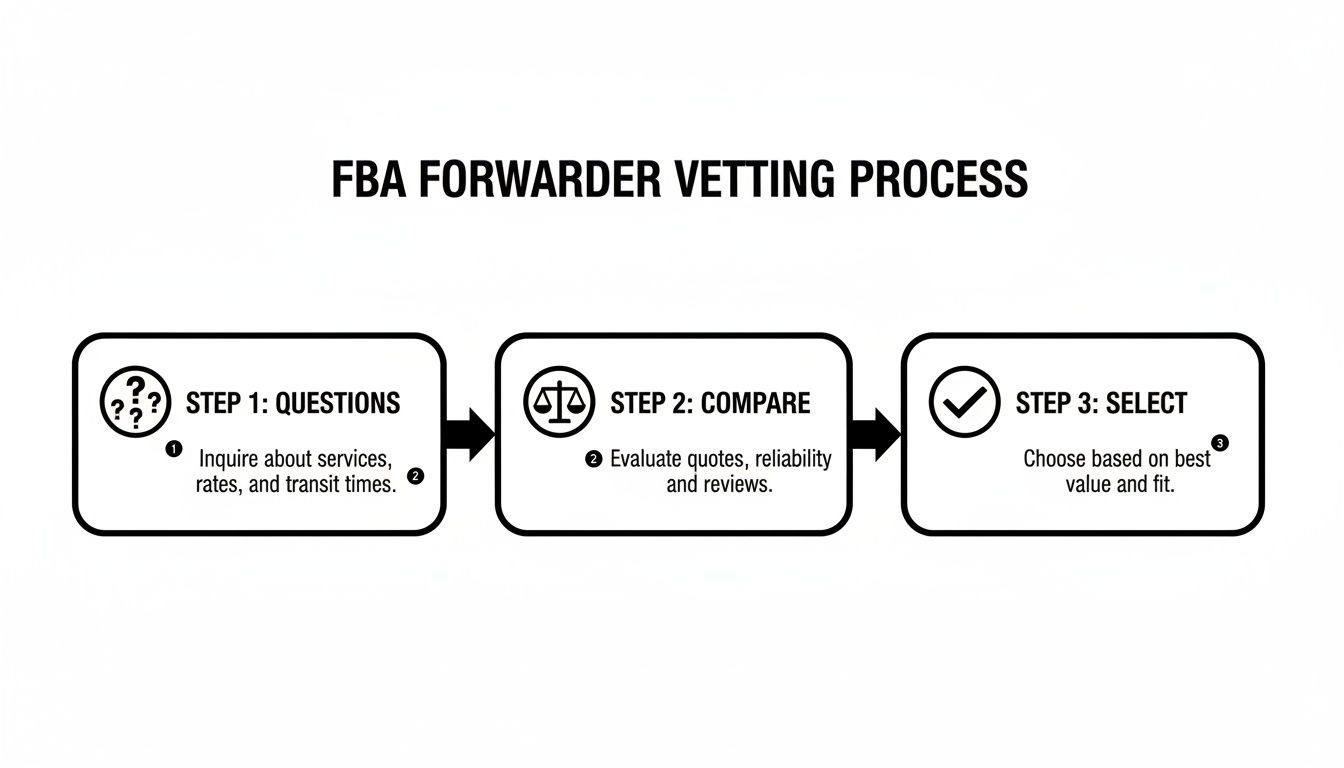
The process is simple: ask the right questions, compare your options side-by-side, and then make a choice. Taking the time to do this upfront prevents costly labeling mistakes down the road.
Clearing Customs and the Final Mile
Once your shipment hits the destination country, it has to clear customs. Your forwarder (or their customs broker) submits all the paperwork. Most of the time, shipments clear electronically in a day or two. But if you get flagged for a random physical inspection, it can add a week or more to your timeline.
After it's cleared, your inventory moves into the final phase: the last-mile delivery. This is where a truck hauls your goods from the port or airport to the Amazon FBA warehouse you were assigned.
Here, your forwarder’s real expertise is tested. They have to schedule a delivery appointment through Amazon's Carrier Central portal, a system that's famous for being inflexible. With Amazon Logistics running a fleet of over 40,000 semi-trucks and 110 aircraft, a small forwarder has to integrate perfectly into this massive, unforgiving network.
A missed delivery appointment can push you to the back of the line, forcing you to wait days—or even weeks—for a new slot. All the while, your inventory is sitting on a truck instead of being available for sale, and your listings are stocked out.
This last step is often the most stressful part of the whole process. But with a competent forwarder managing it, it becomes just one more box to check on the way to getting your products live. This kind of logistical precision is a huge part of learning how to grow sales on Amazon, because you can't sell what you don't have in stock.
Common FBA Shipping Mistakes to Avoid
Learning from someone else’s screw-ups is a lot cheaper than making them yourself. I can’t tell you how many times I’ve seen a single oversight in FBA logistics snowball into a nightmare of fees, delays, and lost sales that can completely derail a product launch.
It’s not just rookies who get tripped up, either. Even seasoned sellers can miss a detail.
By knowing where the landmines are, you can build a much more resilient supply chain. These aren't just hypotheticals—they happen every single day and can turn a profitable shipment into a money pit. A top-tier amazon fba freight forwarder is your best line of defense, but you still need to know what to watch out for.
Under-Insuring Your Cargo
One of the most dangerous assumptions you can make is that your goods are automatically covered if something goes wrong. They’re not.
Standard carrier liability is next to nothing. It often pays out pennies on the dollar based on the shipment's weight, not its actual value.
Think about it: a pallet of high-value electronics worth $15,000 gets crushed in transit. Without the right insurance, you might only get a few hundred bucks back. Always, always opt for all-risk cargo insurance through your forwarder. It’s a small price to pay for not having to worry about losing your entire investment.
Miscalculating Duties and Tariffs
Customs duties are not a "maybe." And pleading ignorance won't get you out of trouble. A surprisingly common mistake is misclassifying a product with the wrong HS code, which leads to an incorrect duty calculation. This can bite you in two ways, and neither is good.
If you underpay, you could be facing hefty fines and audits from customs authorities months down the road. If you overpay, you’re just throwing away profit. This is exactly why it’s crucial to work with a forwarder who has a strong, in-house customs brokerage. They get it right from the start.
Warning: If a forwarder gives you a vague "duties and taxes are extra" line on a quote, that's a massive red flag. A real pro should be able to provide a detailed and accurate estimate of all government charges before your shipment even leaves the port.
Providing Inaccurate Shipment Details
The quote you get from your freight forwarder is only as good as the information you give them. The dimensions and weight of your master cartons are the foundation of all logistics planning. A tiny error can have huge ripple effects.
Here’s a real-world example: A seller guessed their pallet height at 68 inches. When it got to the port, it was measured at 74 inches—too tall for standard container loading. That small mistake led to the shipment being re-palletized, which caused a one-week delay and tacked on an extra $450 in unexpected labor and storage fees.
Always double-check every single detail with your supplier before you book anything. Get final confirmation on carton dimensions, weight, and the exact pallet configuration.
Partnering with a Non-Specialist Forwarder
This is the cardinal sin of FBA shipping. A general forwarder might dangle a tempting rate in front of you, but they simply don't understand the complex, unforgiving world of Amazon's fulfillment centers.
They have no idea about Amazon's specific pallet requirements, the strict labeling rules, or the nuances of scheduling a delivery appointment through Carrier Central.
Choosing a forwarder without proven FBA experience is like hiring a plumber to do your electrical wiring. Sure, they might get it done, but the risk of a catastrophic failure is sky-high. These logistical details are everything, and getting them right is a key part of learning how to improve Amazon sales by making sure your products are always in stock.
To help you stay ahead of these issues, I've put together a quick checklist. Think of it as a pre-flight check for your shipment to proactively address common problems before they become expensive headaches.
FBA Shipment Risk Mitigation Checklist
| Risk Area | Preventative Action | Verification Method |
|---|---|---|
| Cargo Insurance | Always opt for "all-risk" cargo insurance. | Confirm insurance certificate lists full commercial value, not just carrier liability. |
| Customs & Duties | Verify the HS code for your product with your forwarder's customs broker. | Get a detailed duty & tax estimate included in your quote before booking. |
| Shipment Specs | Obtain a final packing list and photos from your supplier before shipment. | Triple-check master carton dimensions, weight, and pallet height against the booking info. |
| FBA Compliance | Only work with forwarders who specialize in Amazon FBA shipments. | Ask for case studies or references from other Amazon sellers they have worked with. |
| Labeling | Send clear, visual instructions for FNSKU and carton label placement to your supplier. | Request photos of a fully labeled carton and pallet before the container is loaded. |
Running through this list before every shipment can save you a world of hurt. It forces you to pause and confirm the small details that, if missed, can cause the biggest problems and eat away at your margins. A few minutes of prevention is worth weeks of trying to fix a mistake later.
Frequently Asked Questions About FBA Forwarding
Navigating FBA logistics always brings up a lot of questions. Think of this as your quick-reference guide for the details that often trip sellers up. Getting these right is the key to a smooth, predictable supply chain.
What Is the Difference Between DDP and DDU Shipping?
This is a big one, and it directly hits your wallet.
DDP (Delivered Duty Paid) means the price your forwarder quotes is all-inclusive. It covers everything needed to get your inventory to its final destination—the shipping itself, customs clearance, duties, and all taxes. You get one price, and you're done.
DDU (Delivered Duty Unpaid), on the other hand, means you are on the hook for paying the import duties and taxes when the goods arrive. The initial quote might look cheaper, but you’ll get a separate, unpredictable bill from customs later.
While DDP can sometimes feel a bit more expensive because forwarders build a small buffer into the cost, it offers peace of mind. For most FBA sellers, especially those just starting out, DDP is the safer bet to avoid surprise bills and customs headaches.
How Much Does an Amazon FBA Freight Forwarder Cost?
There’s no flat-rate answer here—the cost swings wildly based on a few key factors:
- Origin and Destination: A shipment from Shanghai to the US West Coast will cost less than the same shipment going all the way to the East Coast.
- Weight and Volume: You’re paying for space and weight. Bigger, heavier shipments cost more. It's that simple.
- Shipping Mode: Air freight is always a lot more expensive than sea freight, but it slashes transit time from weeks down to just a few days.
- Included Services: A basic port-to-port service won’t cost as much as a full door-to-door DDP service that includes prep and inspection.
As a very rough benchmark, a standard pallet shipped via sea from Asia can range anywhere from $1,500 to $5,000+. To protect yourself from surprise fees, always demand an itemized quote that breaks down every single charge, from port fees to final delivery.
A professional amazon fba freight forwarder will never just throw a single, unexplained number at you. They'll provide a detailed cost breakdown so you know exactly what you’re paying for. If they don’t, consider it a major red flag.
Can I Use My Own Carrier to Ship to Amazon FBA?
Technically, yes, you can. But this is where an FBA-savvy forwarder earns their keep. Amazon has an incredibly rigid system for receiving inventory, and any carrier you choose must play by their rules, perfectly.
This includes booking a delivery appointment through Amazon's Carrier Central portal, which is notoriously difficult to navigate for the uninitiated. Your carrier also has to nail specific pallet dimensions, carton weight limits, and precise labeling rules. One mistake, and you're in trouble.
If you fail to meet any of these requirements, your shipment will likely be rejected at the fulfillment center door. That rejection triggers a cascade of costly problems: delays, storage fees at a third-party warehouse, and the cost of re-delivering the shipment correctly.
While you can use a generic carrier, the risk of a costly mistake is just too high. Using a forwarder who lives and breathes Amazon's system is the smarter, safer choice every time.
Figuring out the complexities of FBA logistics is just one piece of the puzzle. At Next Point Digital, we help brands optimize their entire ecommerce operation, from supply chain strategy to conversion-focused marketing. If you’re ready to scale your sales on Amazon and beyond, let’s talk about building a growth roadmap that delivers real results. Learn more about our services.