

If you're looking for a single trick to boost your Amazon sales, you're looking in the wrong place. Real, sustainable growth comes from a system, not a secret. It’s about making four core pillars work together seamlessly: getting found, closing the sale, driving targeted traffic, and delivering an experience that brings customers back.
A Blueprint For Lasting Amazon Growth
Getting your products live on Amazon is just the starting line. The real marathon is building consistent, month-over-month growth in a marketplace that gets more crowded by the day. Too many sellers chase quick fixes, but the brands that stick around build a solid system where every part supports the others.
This guide is your roadmap. We’ll walk through the foundational strategies and then drill down into the specific, actionable tactics you can use today. The goal is to build a well-oiled sales engine that turns casual shoppers into loyal customers.
Let's break down the core pillars you need to focus on to make that happen.
Core Pillars for Amazon Sales Growth
Before we dive deep into specific tactics, it's helpful to see how everything fits together. Your entire strategy rests on four essential foundations.
| Pillar | Primary Goal | Key Actions |
|---|---|---|
| Visibility | Get your products seen by the right shoppers. | Optimize keywords, titles, and backend search terms (Amazon SEO). |
| Conversion | Convince shoppers to click "Add to Cart." | Use high-quality images, compelling copy, and A+ Content. |
| Traffic | Drive high-intent buyers to your listings. | Run strategic PPC campaigns and leverage external traffic sources. |
| Fulfillment & Reviews | Build trust and encourage repeat business. | Ensure fast, reliable shipping and actively manage customer reviews. |
Mastering each of these areas—and making them work in harmony—is the key to scaling your brand on the platform.
This simple flow chart shows exactly how these pieces connect to create a powerful sales cycle.
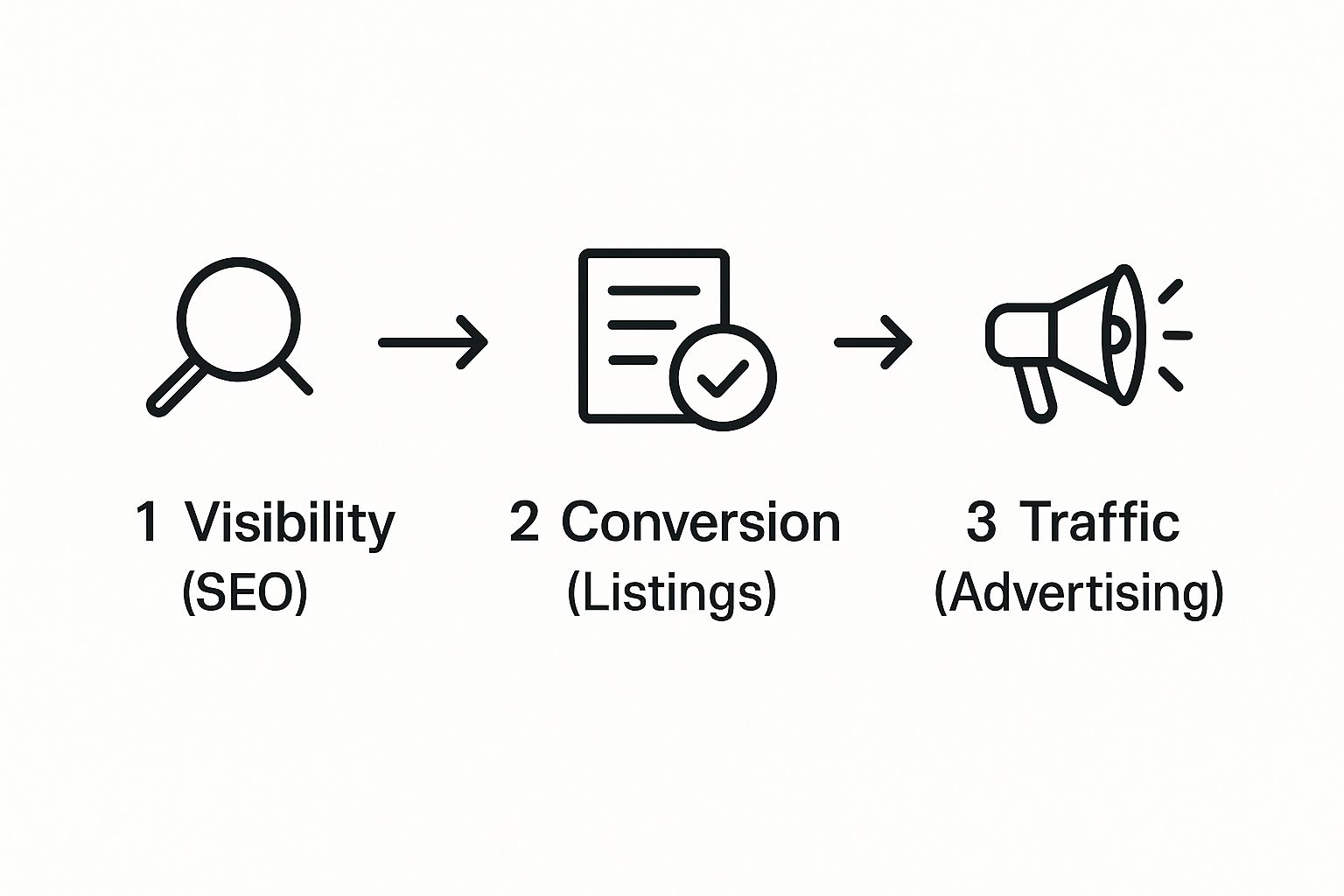
As you can see, it all starts with visibility. You can't sell what can't be found. Once you get eyeballs on your listing, your content needs to do the heavy lifting to convert that traffic into a sale. Smart advertising then acts as a powerful amplifier for the entire process.
The opportunity here is massive. In 2024, Amazon captured a staggering 40.4% of all U.S. ecommerce sales, proving its dominance and the incredible potential it holds for sellers who get their strategy right.
To learn more about the specific tactics that seven-figure sellers use, check out this in-depth guide on how to improve Amazon sales and dominate the marketplace. These principles are fundamental to success not just on Amazon, but across all major digital marketplaces.
Mastering Amazon SEO to Dominate Search Results
If shoppers can’t find your product, they can’t buy it. It’s that simple. On Amazon, everything starts with the search bar, making visibility the absolute cornerstone of your sales strategy. Your Seller Central dashboard is command central, but it's understanding the customer's journey from search to purchase that really drives results.
Forget trying to "trick" Amazon's A9 algorithm. The key is to understand its core purpose: connecting shoppers with the products they're most likely to buy. Your job is to prove to the algorithm that your product is the best possible match for a customer's search.
Identifying High-Intent Keywords
The foundation of great Amazon SEO is rigorous, customer-focused keyword research. We need to get past the obvious, high-competition terms and dig into the specific phrases real people use when they’re actually ready to pull out their wallets. These are your high-intent keywords.
Put yourself in the customer's shoes. If you're selling a "yoga mat," what else might a buyer search for? They could be looking for a "non-slip yoga mat for hot yoga," an "extra thick TPE yoga mat," or an "eco-friendly cork yoga mat." Each of these long-tail keywords reveals a specific need and a much stronger intent to buy.
While tools can definitely speed things up, don't underestimate the power of rolling up your sleeves and doing some manual research:
- Spy on your competitors: Scrutinize the titles, bullet points, and even the Q&A sections on top-ranking product pages. What language are they using? What terms keep popping up?
- Mine customer reviews: Your competitors' reviews (and your own) are a goldmine of keyword ideas. Customers describe products in their own words, revealing exactly how they think and what they value most.
- Use Amazon's search bar: Start typing a main keyword into Amazon's search bar and pay close attention to the auto-suggestions. These are based on popular, real-time searches from actual shoppers.
Key Takeaway: The goal isn't just to find keywords, but to understand the customer's intent behind them. A search for "yoga mat" is browsing; a search for "purple 6mm travel yoga mat" is buying.
Weaving Keywords into Your Listing
Once you have a solid list of keywords, it's time to integrate them strategically throughout your product listing. Keyword stuffing is an old, outdated tactic that makes your listing hard to read and can even get it suppressed by Amazon. The focus should always be on natural placement in the highest-impact areas.
The A9 algorithm pays special attention to several key zones on your listing:
- Product Title: This is your most valuable real estate, hands down. Place your top 1-3 most critical keywords here, with the most important one right at the beginning. A strong title is both keyword-rich for the algorithm and instantly informative for a human shopper.
- Bullet Points (Key Product Features): Use each bullet point to highlight a key benefit, seamlessly working in your secondary and long-tail keywords. This is where you connect your product's features to the customer's problems.
- Backend Search Terms: This is a hidden field in Seller Central where you can add keywords that didn't fit naturally into your visible copy. This is the perfect spot for synonyms, related terms, and common misspellings. Just don't repeat keywords that are already in your title or bullet points.
Performing this kind of deep-dive analysis helps you map out exactly where your keyword opportunities are. If you're looking for some guidance on this initial stage, our SEO discovery questionnaire can help structure your thoughts and identify any critical gaps in your information.
Optimizing Titles for Clicks and Conversions
Your product title has two jobs: get you ranked in search results and convince a real person to click. A poorly written title fails at both. Let's look at a quick example for a hypothetical brand selling a stainless steel water bottle.
A bad, lazy title might be: "Water Bottle – Steel Bottle"
It's short, uninformative, and misses dozens of crucial search terms.
Now, here’s an optimized title that works much harder: "HydroFlow 24oz Insulated Water Bottle – Leakproof Stainless Steel with Sport Cap, Keeps Drinks Cold for 24 Hrs, BPA-Free for Gym & Outdoor"
This title is effective because it:
- Starts with the brand and core product for immediate recognition.
- Includes key attributes that are also common search terms, like "24oz Insulated," "Leakproof Stainless Steel," and "Sport Cap."
- Highlights a major benefit ("Keeps Drinks Cold for 24 Hrs") that directly addresses a customer pain point.
- Adds trust signals like "BPA-Free" and use cases like "Gym & Outdoor" to attract a wider, more targeted audience.
This structure feeds the A9 algorithm the keywords it needs while giving the shopper all the critical info they need to make a confident click. Getting this dual optimization right is fundamental to moving the needle on your Amazon sales.
Crafting Product Listings That Convert Visitors into Customers

Getting a shopper to click on your product from a search results page is only half the battle. Once they land on your listing, you have just a few seconds to prove your product is the solution they’ve been looking for. This is where conversion rate optimization (CRO) comes in, turning casual browsers into actual buyers.
A high-converting listing is a smart mix of persuasive copy, problem-solving visuals, and trust-building content. It anticipates what a customer wants to know and answers their questions before they even think to ask. Nail this, and you’re on the fast track to boosting your Amazon sales.
Writing Copy That Sells a Solution
So many sellers fall into the trap of listing features instead of selling benefits. Let’s be real: a customer doesn’t care about a "lithium-ion battery." What they want is a portable speaker that "lasts all day at the beach." Your copy has to bridge that gap and connect your product’s specs to what the buyer actually wants to do with it.
Think about the one big problem your product solves. Does it save time? Reduce stress? Make life more fun? Lead with that.
For instance, if you’re selling a high-end blender, don't just say it has a "1500-watt motor." Frame it as the solution: "Effortlessly crushes ice and frozen fruit for perfectly smooth smoothies in under 30 seconds." That paints a picture of the benefit and makes the feature feel tangible.
The Undeniable Power of High-Quality Visuals
On Amazon, your product images are your product. Shoppers can’t pick it up or feel it, so your visuals have to do all the heavy lifting. The data doesn't lie—nearly a third of US shoppers will bounce if your images are blurry, unprofessional, or just plain missing.
Your image stack isn’t just a gallery; it’s a strategic sales pitch. Here’s how to build one that works:
- Hero Image: This is your main event. The product needs to be crystal clear on a pure white background, looking its absolute best and following all of Amazon's rules.
- Lifestyle Images: Show your product in action. If you sell a yoga mat, get some shots of someone using it in a peaceful, aspirational setting. Help customers see it in their own lives.
- Infographics: These are perfect for calling out key features, dimensions, or unique selling points in a way that’s easy to scan. A good infographic communicates value way faster than a block of text ever could.
- Product Video: A short demo video is your virtual sales associate. It can show how the product works, highlight its best features, or tell your brand story. It’s one of the most powerful tools for boosting conversions.
Pro Tip: Your images should tell a story. Start with the hero shot to show what it is, move to lifestyle shots to show how it's used, and finish with infographics to show why it's better than everything else.
Elevating the Experience with A+ Content
For brand-registered sellers, A+ Content (what used to be called Enhanced Brand Content) is a total game-changer. It lets you swap out that boring, plain-text description for a slick, visually rich layout with custom images, text, and comparison charts. This is your chance to create a premium brand experience right on the product page.
Use A+ Content to:
- Tell Your Brand Story: Share your mission and values. It’s a great way to build a real connection with shoppers.
- Showcase Unique Features: Use the extra space and high-quality modules to go deep on product benefits you couldn’t fit in the main images.
- Overcome Objections: Address common questions or concerns head-on with detailed visuals and clear explanations.
A sharp A+ Content layout can justify a higher price, build serious brand trust, and give your conversion rate a major lift. When you combine it with the other optimizations, it becomes a core part of a winning strategy. To see how these pieces fit together in the real world, check out our case studies on achieving product optimization for maximum impact.
At the end of the day, a compelling, informative, and visually stunning listing is your best salesperson—and it works 24/7 to turn clicks into customers.
Driving Targeted Traffic with Amazon Advertising
If you've polished your listing to perfection, that's your foundation. But if you want to accelerate growth, paid advertising is the fuel. Relying on organic traffic alone is like setting up a shop and hoping people wander in. A smart ad plan puts your product right in front of shoppers the moment they're ready to buy.
Amazon Advertising, or Amazon PPC, isn't just about spending money to get sales. It's a powerful engine for market research, boosting sales velocity, and building your brand. When you get it right, it creates a flywheel effect: paid sales improve your organic rank, which in turn drives even more sales.
Understanding the Core Amazon Ad Types
Amazon gives you a whole suite of ad products, but three main types are the backbone of almost every winning strategy. Knowing which tool to use for which job is what separates the pros from the rookies.
Think of it like this:
- Sponsored Products: These are the ads you see everywhere—right in the search results and on product detail pages. They are keyword- and product-targeted, making them perfect for snagging high-intent shoppers who are actively looking for something you sell.
- Sponsored Brands: Popping up at the very top of search results, these ads showcase your logo, a custom headline, and a few of your products. They’re fantastic for building brand awareness and funneling traffic to your Amazon Storefront or a specific product line.
- Sponsored Display: This is your retargeting powerhouse. It lets you follow shoppers who’ve viewed your products (or similar ones) around Amazon and even off-site. It's how you stay top-of-mind and gently nudge interested browsers back to seal the deal.
Each ad type plays a specific role. Sponsored Products capture existing demand, Sponsored Brands create it, and Sponsored Display brings people back. A well-rounded strategy almost always uses a mix of all three.
Structuring Campaigns for Profitability
Jumping into an ad campaign without a solid structure is the fastest way to light your budget on fire. Profitable advertising is a methodical process. It starts with research, moves to refinement, and never stops optimizing.
My go-to method involves casting a wide net first, then systematically tightening it.
Expert Insight: Don't be afraid to run automatic campaigns at a slight loss initially. The customer search term data you'll gather is invaluable and will form the foundation of your highly profitable manual campaigns later on.
Kick things off with an automatic campaign for your new product. Let Amazon’s algorithm do the heavy lifting, showing your ad for keywords and products it thinks are relevant. Give it a week or two to collect data, then dive straight into the search term report. This is where you'll find the golden nuggets—the exact phrases real customers are using to find and buy what you're selling.
Now, take that intel and build out your manual campaigns. I like to create separate ad groups for each match type to maintain control:
- Broad Match: This keeps the discovery process going, helping you find new, relevant keywords you might have missed.
- Phrase Match: This gives you more control by targeting specific phrases and their close cousins.
- Exact Match: This is for your proven winners—the high-converting keywords where you can bid more aggressively with confidence.
This tiered structure gives you surgical precision over your ad spend. For a closer look at how we put this into practice, see our approach to data-driven advertising solutions where we turn insights like these into profitable action.
Leveraging Promotions for an Extra Boost
Beyond your everyday PPC campaigns, Amazon’s promotional tools are perfect for creating urgency and driving a quick burst of sales. They’re especially useful for new product launches or during big shopping events to give your sales rank a serious push.
Here are a couple of my favorites for creating a sales spike:
- Coupons: That little orange badge is an eye-catcher. It makes your listing pop in crowded search results and can dramatically increase your click-through rate.
- Lightning Deals: These are short-term, high-visibility promos featured on Amazon's popular "Today's Deals" page. Landing a spot can get your product in front of a massive audience, but you’ll need to meet Amazon’s eligibility criteria first.
And of course, you can't ignore major sales events. Amazon Prime Day has become a global shopping holiday. In 2024, U.S. sales during the event soared to $14.2 billion, an 11.8% increase from the year before, proving just how big the opportunity is for sellers who come prepared.
When it comes to your video ads, you have seconds to make an impact. To stop the scroll and turn viewers into buyers, you have to create video hooks that grab attention. Mastering this skill is non-negotiable for getting results with Sponsored Brands Video and other visual ad formats.
Get Your Fulfillment and Customer Experience Right
The moment a customer hits “buy” isn’t the end of the road. It’s actually the beginning of your next sale. A smooth, reliable post-purchase experience is what earns you positive reviews and repeat business, which are two of the biggest factors that drive your sales rank up.
How that product actually gets into your customer's hands is a huge piece of this puzzle. Nailing your fulfillment is one of the most important decisions you'll make, impacting everything from your costs and time commitment to how shoppers perceive your brand.
Choosing Your Fulfillment Strategy
On Amazon, you really have two main paths: Fulfillment by Amazon (FBA) and Fulfillment by Merchant (FBM). Each one comes with its own set of pros and cons, and the right choice depends entirely on your business model, products, and goals.
Most sellers lean toward Fulfillment by Amazon (FBA), and for good reason. You ship your products in bulk to Amazon’s warehouses, and they take it from there—storage, picking, packing, shipping, and even handling customer service for those orders.
The biggest win here? FBA products automatically get the Prime badge. That little blue checkmark is a massive conversion booster, since millions of shoppers won’t even consider products that don’t come with fast, free shipping.
Key Insight: Never underestimate the power of the Prime badge. For a huge portion of Amazon shoppers, it's a non-negotiable symbol of trust and convenience. Tapping into FBA is the fastest way to get in front of Amazon's most loyal customers.
Then there’s Fulfillment by Merchant (FBM). This is the DIY route where you handle everything yourself. You store your own inventory, pack every order, and manage all the shipping and customer communication.
FBM gives you way more control and can be cheaper for oversized, heavy, or slow-moving items that would rack up hefty storage fees in an Amazon warehouse. But be warned: you're on the hook for meeting Amazon's incredibly strict shipping performance metrics. Miss those targets, and your account health will suffer.
Proactive Inventory Management is a Must
Nothing kills sales momentum faster than running out of stock. A stockout doesn’t just mean lost sales today; it signals to Amazon’s algorithm that you can't meet demand, causing your Best Seller Rank (BSR) to tank. It can take weeks, even months, to claw your way back up after you restock.
You have to get ahead of this. Don't wait until you're running low.
- Track Your Sales Velocity: Know exactly how many units you sell per day, on average.
- Know Your Lead Times: How long does it take for your supplier to produce your goods? And how long does it take to ship them to an Amazon fulfillment center? Factor all of that in.
- Set Reorder Points: Calculate the minimum stock level that should automatically trigger a new purchase order. Don't leave it to guesswork.
Getting these steps right creates a smooth supply chain that keeps your products in stock and your sales flowing. This is a fundamental building block for scaling your online sales and e-commerce operations.
Master Customer Service and Reviews
The final piece is managing your customer interactions and feedback. Great service can turn a potential disaster into a 5-star review, while a steady stream of authentic reviews provides the social proof that convinces new shoppers to click "add to cart."
Amazon's third-party seller ecosystem accounts for roughly 60% of all paid units sold, and FBA is a huge driver of that success. By using FBA, sellers tap into Amazon’s world-class logistics to offer fast, reliable delivery that builds customer trust. You can dive deeper into these marketplace dynamics in the full analysis of Amazon's net sales.
Whether you choose FBA or FBM, responding to customer questions quickly and helpfully is non-negotiable. Solve problems fast before they have a chance to turn into negative feedback.
To encourage reviews, you can use Amazon’s own "Request a Review" button found on each order. The key is to never offer incentives for reviews—that’s a fast track to getting your account suspended. Simply ask satisfied customers if they’d be willing to share their experience.
A consistent flow of positive reviews tells both shoppers and the A9 algorithm that your product is a winner, fueling the flywheel and driving sustainable sales growth.
Got Questions About Increasing Your Amazon Sales? We’ve Got Answers.
When you’re deep in the trenches of growing your Amazon business, questions are going to pop up. It’s natural to wonder which levers to pull, what to expect from your changes, and how to get the best results without wasting time or money.
We get these questions all the time. Here are some straightforward answers to the most common ones sellers ask when they’re trying to scale. Think of it as a quick-reference guide to making smarter decisions for your brand.
How Quickly Will My Sales Improve After I Optimize My Listings?
This is the big one, and the honest answer is: it depends on what you changed. Different optimizations work on different timelines.
If you’re making SEO-focused tweaks—like sharpening your title or dialing in your backend keywords—you’ll likely see a shift in your rankings and traffic within a few days to two weeks. That’s about how long it takes for Amazon's A9 algorithm to crawl your listing again and re-index the new terms.
On the other hand, conversion-focused updates can show results almost immediately. Adding crisp, high-quality images, a compelling product video, or a sharp-looking A+ Content layout can bump up your conversion rate right away. You can watch this metric in your Seller Central Business Reports to see the impact in near real-time.
Key Takeaway: While you can get quick wins from small tweaks, real, sustainable growth is a marathon, not a sprint. It’s the result of consistent, coordinated efforts across your listings, ads, and customer experience over several months.
Should I Just Lower My Price to Get More Sales?
Slashing your price is a tempting quick fix, but it's a dangerous game to play long-term. Sure, a price drop might help you snag the Buy Box or get some early traction for a new product, but it often spirals into a race to the bottom that kills your profit margins and cheapens your brand.
Instead of competing on price, focus on boosting your product’s perceived value. A solid brand built with great A+ Content and a compelling Brand Story, backed by stellar customer reviews and professional photos, gives you the power to command a higher price.
If you really need a short-term sales bump, use promotions like coupons or lightning deals. These create a sense of urgency without permanently torpedoing your pricing strategy. The goal is to find that sweet spot where you’re competitive but still profitable.
Is Using FBA Really Necessary to Boost Sales?
While it’s not technically a requirement, using Fulfillment by Amazon (FBA) is probably the single most powerful move you can make to increase sales. The biggest reason? The Prime badge.
That little Prime logo is a massive driver for conversions. Millions of Amazon's most loyal customers filter their searches for Prime-eligible products, which means if you’re fulfilling orders yourself (FBM), they won’t even see your listing. The badge is a universal symbol for trust, speed, and convenience.
Plus, FBA takes the logistical nightmare of storage, packing, shipping, and customer service off your plate. This frees you up to focus on things that actually grow the business—like marketing, product development, and strategy. While FBM has its place for certain business models, FBA gives you a serious competitive edge.
How Much Should I Be Spending on Amazon PPC Ads?
There's no magic number here. Your PPC budget depends entirely on your product’s price, profit margin, and what you’re trying to accomplish right now. The best way to manage it is by setting a target ACoS (Advertising Cost of Sale).
-
For a brand-new product launch: You might be willing to accept a higher ACoS, maybe even breaking even or taking a small loss. The goal isn’t immediate profit; it’s about getting those first sales, gathering performance data, and kickstarting reviews.
-
For an established, profitable product: Your target ACoS should be set well below your profit margin to make sure your ad campaigns are actually making you money.
A good starting point for a new campaign is a modest daily budget of $20 to $50. Once you see which keywords and targeting methods are profitable, you can scale up your ad spend with confidence.
At Next Point Digital, we help brands turn these questions into a clear, data-driven action plan. We build the strategies and execute the campaigns that drive profitable growth on Amazon and beyond.
Ready to see how we can simplify your path to success? Visit us at npoint.digital to learn more.