

The primary benefits of data driven marketing are pretty straightforward: a dramatically improved return on investment (ROI), hyper-accurate audience targeting, and the ability to create deeply personalized customer experiences. It’s a shift from guesswork to a predictable, measurable growth strategy, simply by using real customer data to inform every decision.
What Is Data Driven Marketing and Why Does It Matter?
Think of data-driven marketing not as some complex science, but as a modern navigation system for your business. An old-world explorer used stars and a compass, making educated guesses about the best path forward. A modern marketer, on the other hand, uses data like a GPS, pinpointing the exact location of their target audience and the most efficient route to reach them.

This strategic shift—making decisions based on real customer behavior and performance metrics instead of intuition—transforms marketing from an unpredictable expense into a reliable growth engine. Every click, purchase, and website visit tells a story. When you listen to those stories, you can deliver campaigns that actually resonate.
Moving Beyond Assumptions
Traditional marketing often relied on broad assumptions, like billboards or one-size-fits-all email blasts. Sure, you generate reach, but it’s nearly impossible to know what actually worked or why. Data-driven marketing flips this entire approach by replacing hunches with hard facts. Instead of casting a wide, expensive net, you can focus your resources with laser precision.
Data-driven marketing is the practice of using customer data to guide your strategy—not guesswork. Businesses that adopt this approach often drive five to eight times more ROI than those who don't.
For any modern ecommerce brand, whether you’re a small D2C store or a major marketplace seller on Amazon or Walmart, this method is non-negotiable. It’s what empowers you to build authentic customer connections that lead to real, sustainable growth.
The Core Advantages
By collecting and analyzing information, you can achieve specific, measurable outcomes that were previously out of reach. The core benefits of data driven marketing create a powerful feedback loop that fuels continuous improvement.
Let's break down the main advantages you can expect when you put data at the center of your marketing efforts.
Core Benefits of a Data Driven Marketing Strategy
Here's a high-level summary of the primary advantages businesses gain when they shift to a data-first marketing mindset.
| Benefit | Business Impact | Key Metric to Track |
|---|---|---|
| Superior ROI | Stops wasteful spending by allocating budget to channels and tactics proven to convert. | Return on Ad Spend (ROAS), Customer Acquisition Cost (CAC) |
| Enhanced Personalization | Creates tailored messages and offers based on individual user behavior, making customers feel understood. | Conversion Rate, Average Order Value (AOV) |
| Clearer Audience Insights | Provides a deep understanding of customer preferences, pain points, and motivations. | Customer Lifetime Value (CLV), Segmentation Data |
| Improved Customer Retention | Builds stronger relationships by delivering relevant, timely experiences that foster loyalty. | Churn Rate, Repeat Purchase Rate |
Ultimately, these benefits work together to create a more efficient, effective, and customer-centric business. Key advantages include:
- Superior ROI: Allocate your budget to channels and tactics proven to convert, eliminating wasteful spending.
- Enhanced Personalization: Tailor messaging and offers based on individual user behavior, making customers feel understood.
- Clearer Audience Insights: Gain a deep understanding of customer preferences, pain points, and motivations.
- Improved Customer Retention: Build stronger relationships by delivering relevant, timely experiences that foster loyalty.
Achieve Explosive ROI with Precision Targeting
One of the best things about data-driven marketing is the direct impact it has on your bottom line. It stops you from throwing money at the wall and hoping something sticks, turning your marketing budget into a calculated investment that actually delivers a serious Return on Investment (ROI). It’s all about shifting away from broad, wasteful campaigns and putting every dollar into the channels and customer groups you know will convert.

Think about an ecommerce store digging into its sales data. They might discover their most valuable customers are people who keep coming back to buy a specific high-margin product. Instead of running generic ads for everyone, the store can now build a hyper-focused campaign targeting a lookalike audience of those exact buyers. The result? More conversions and a much lower Customer Acquisition Cost (CAC).
This is where the real money is made. It’s not a small difference, either. Businesses that lean into data-driven strategies consistently pull in 5 to 8 times more ROI than those just going with their gut. That huge multiplier comes from the simple fact that real customer data makes every campaign decision sharper, leading to smarter spending and better outcomes.
Identifying Your Most Profitable Channels
Data attribution models are your secret weapon for finding this efficiency. Think of them as a financial audit for your marketing, showing you exactly which touchpoints—that one Instagram ad, a particular blog post, or a specific email—are actually bringing in the sales. This kind of clarity is a total game-changer, whether you're a D2C brand or selling on Amazon.
By figuring out which channels deliver the highest quality leads and sales, you can reallocate your budget with confidence. That means you can double down on what works and cut the dead weight without a second thought.
This process directly pumps up your Return on Ad Spend (ROAS). For example, if you see your Google Shopping ads are converting way better than your Facebook ads, you can move your budget over. To really get the most out of this, you can put proven strategies like these 7 data-driven marketing insights to work.
Slashing Waste and Boosting Profitability
When you get right down to it, this data-first approach leads to more profitable, sustainable growth. By zeroing in on high-potential customers and the channels they actually use, you naturally stop wasting ad spend. And it’s a continuous cycle—with every campaign, you collect more data, sharpen your strategy, and get even better results.
This loop of analysis and action doesn't just boost sales today; it strengthens your entire marketing foundation for the long haul. If you're looking to turn more of those clicks into actual customers, you might find some real value in these conversion rate optimization tips. Using data to guide your decisions creates a marketing engine that's not only powerful but incredibly efficient, driving explosive ROI and giving you a solid edge over the competition.
Build Deeper Customer Relationships Through Personalization
Let's be honest, just dropping a customer's first name into an email isn't real personalization anymore. That’s just the bare minimum. True personalization is about creating genuinely helpful experiences that make customers feel seen and understood, which is what builds real, lasting loyalty.
This is where data-driven marketing truly shines. It lets you stop blasting generic ads and start having meaningful conversations with your audience.

How? By using behavioral data—like which products a user clicked on, what they left in their cart, or what they’ve bought before—to anticipate what they actually need. Think about an online store that automatically suggests the perfect accessories for the laptop a customer just bought. Or a subscription service that sends a friendly reminder to re-up just before they run out of their favorite coffee.
These aren't complex magic tricks; they're just smart, data-informed interactions. The proof is in the numbers. Research shows consumers are 80% more likely to purchase when a campaign feels like it was made just for them. Even small data points matter—shoppers who linger on a product page for over three minutes are 40% more prone to buy. It's all about knowing how to operationalize these insights.
From Transaction to Relationship
Generic marketing talks at everyone the same way, which feels impersonal and cold. Data flips that script, letting you shift from a one-off transaction mindset to building a genuine relationship with each customer based on their unique journey with your brand.
For instance, a brand-new customer should get a totally different message than someone who’s been buying from you for years.
- For a new buyer: You might send a welcome email series with tips on getting the most out of their new product.
- For a repeat customer: Why not offer early access to a new collection or an exclusive reward based on their purchase history?
This kind of tailored communication shows you’re paying attention. It makes customers feel valued, not just like another order number. This is a huge reason why solid ecommerce personalization software is becoming so critical for D2C brands and marketplace sellers trying to grow.
By personalizing the entire customer journey, you’re not just increasing the odds of a single conversion. You are actively investing in a long-term relationship that significantly boosts Customer Lifetime Value (LTV).
Practical Personalization in Action
Let’s walk through a common scenario for an Amazon or D2C seller. A potential customer adds a high-end camera to their cart but then gets distracted and leaves. Instead of sending a generic "You left something behind!" email, a data-driven approach gives you a much smarter way to follow up.
You can set up an automated email that does more than just remind them about the camera. It could also include:
- Helpful Content: A link to a blog post or video comparing that exact camera to similar models, helping them make a confident choice.
- Social Proof: A few five-star reviews or user-generated photos taken with that camera to show them what's possible.
- Relevant Accessories: A curated list of compatible lenses, memory cards, and camera bags that other customers frequently bought with it.
This simple shift turns a basic reminder into a valuable, consultative experience. It answers their unasked questions, builds their confidence, and shows that your brand is a helpful resource, not just a storefront. This is how data turns window shoppers into loyal advocates.
Optimize Every Campaign with Real-Time Performance Insights
The best marketers don't just launch campaigns and hope for the best. One of the biggest perks of a data-driven approach is the agility it gives you, turning every campaign into a live learning opportunity. Instead of waiting weeks for a post-mortem report, you can watch performance as it happens and make smart adjustments on the fly.
This constant feedback loop is built on a simple but powerful idea: test, measure, and optimize. Modern analytics dashboards let you see exactly what’s working and what isn’t, moment by moment. It’s an iterative process that makes sure you stretch your budget and get better results from every single campaign you run.
The Power of A/B Testing
At the heart of real-time optimization is A/B testing, also known as split testing. This is where the data-driven mindset gets put into practice. It’s all about creating two slightly different versions of a marketing asset—like an email subject line, an ad headline, or a product image—to see which one performs better.
- Version A: Your original "control" version.
- Version B: A variation with one key difference.
By showing each version to a segment of your audience, you can definitively measure which one drives more clicks, conversions, or engagement. Over time, these small, incremental wins stack up, leading to massive improvements in campaign effectiveness. Your marketing literally gets smarter with each test.
Data isn't just about looking back; it's about looking forward. The ability to continuously test and refine your approach is what separates good marketers from great ones. It transforms marketing from a static activity into a dynamic, results-focused process.
Real-World Optimization for Ecommerce Sellers
Think about an Amazon seller running a Sponsored Products campaign. At first, their ACOS (Advertising Cost of Sale) is way too high, making the campaign unprofitable. Instead of just giving up, they dive into their daily performance data. To see how to effectively break down this information, you can check out our detailed guide on using Amazon sales data to make informed decisions.
They notice one specific keyword is getting tons of clicks but almost no sales. Armed with that insight, they immediately lower the bid on that underperforming keyword and shift that budget to another one with a much higher conversion rate. Within a few days, their ACOS drops, and the campaign becomes profitable.
This kind of agility is a game-changer. Research backs this up, showing that businesses using data-driven attribution see a 29% growth in paid ROI and 27% higher conversion rates through this kind of experimentation. While a typical Google Ads campaign might see a 200% ROI, a data-first approach pushes that even higher by pinpointing the best-performing channels and tactics for optimization. This continuous cycle of learning and improving ensures you’re not just spending your budget—you’re investing it for the highest possible returns.
Putting Your Data to Work: A Simple Framework
Feeling buried in data? You're not alone. But getting started with data-driven marketing doesn't mean you need a team of analysts or a complicated tech stack. You can start making smarter, more profitable decisions today with a simple, practical framework.
The first step is to stop chasing vanity metrics like "likes" or "impressions" and connect your marketing directly to business goals. What does success actually look like for you? Are you trying to bump up your Average Order Value (AOV) by 10%? Or maybe slash your cart abandonment rate?
Once you have a clear, specific goal, you can pinpoint the Key Performance Indicators (KPIs) that truly measure your progress. This laser focus keeps you from getting lost in the numbers and makes sure you're only tracking what matters to your bottom line.
Your Core Data Toolkit
Good news—you probably already have the tools you need. Your data stack doesn't need to be expensive; it just needs to be connected. For most ecommerce sellers, this boils down to three core sources: your website analytics, your email platform, and your ecommerce dashboard.
This is a pretty standard view inside Google Analytics, where you can see how people find your site and what they do once they get there.
By keeping an eye on metrics like traffic sources and conversion rates, you can quickly figure out which channels are bringing in customers who actually buy something.
A great way to get all this information in one place is by leveraging a Customer Data Platform (CDP). A CDP pulls everything together from different sources to give you a single, unified view of each customer, making your insights that much more powerful.
From Insight to Action
With your goals set and your data sources hooked up, the process becomes a simple, repeatable loop. The whole point is to turn raw numbers into profitable marketing decisions. For a deeper look at what this looks like in practice, you can explore these effective data-driven marketing strategies.
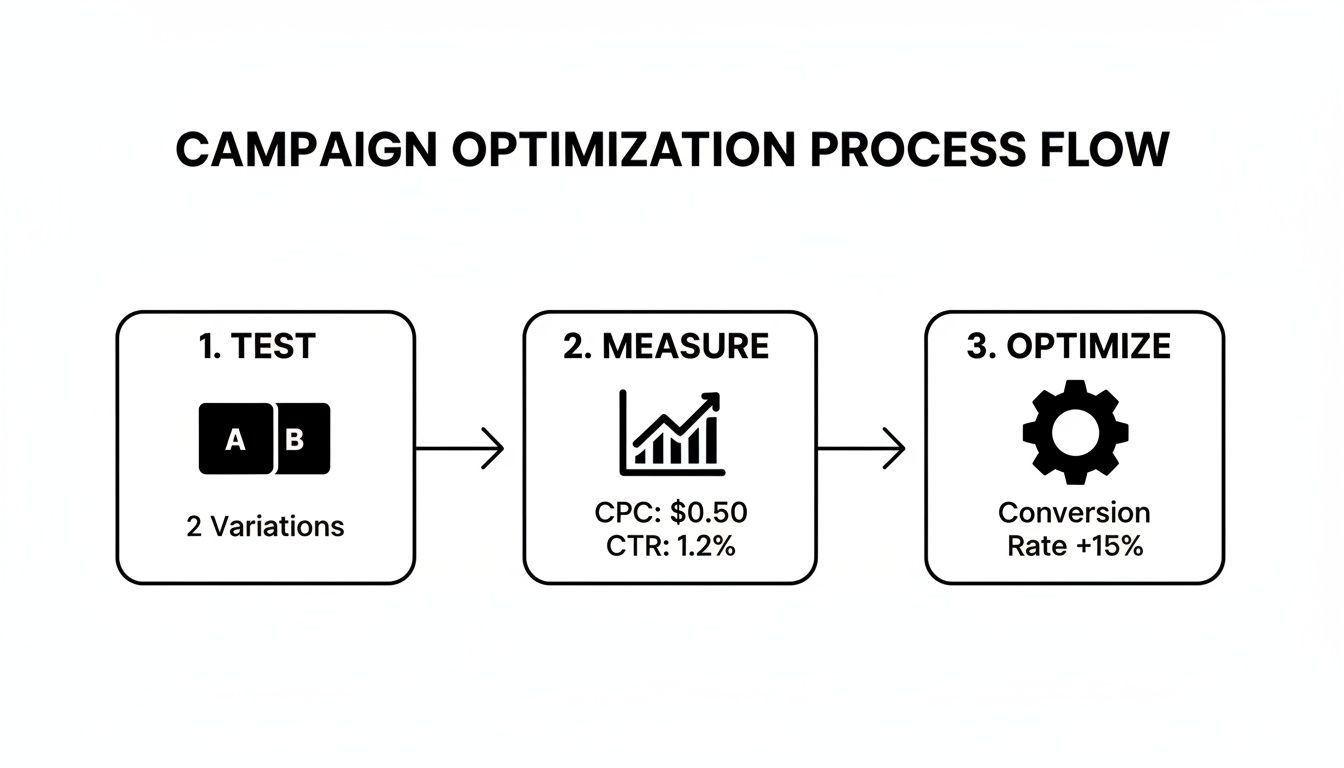
This flow chart nails the basic concept of optimizing your campaigns with data.
It really is that straightforward: test different approaches, measure what happens, and then adjust your strategy based on what you learn.
The entire framework boils down to this: Collect clean data from your core tools, analyze it for actionable insights related to your business goals, and then confidently apply those findings to improve your marketing campaigns.
By sticking to this clear roadmap, you can start reaping the rewards of data-driven marketing without getting bogged down in the complexity.
Real-World Examples of Data-Driven Success
Theory is one thing, but seeing a strategy actually make money is what really counts. The true power of data-driven marketing isn’t in the buzzwords; it’s in the real-world results. Let's walk through a few scenarios showing how ecommerce sellers, just like you, are turning raw numbers into serious growth.
These aren't just abstract ideas. Think of them as practical blueprints you can borrow, whether you’re selling on a huge marketplace or running your own D2C store.
How an Amazon Seller Won Page One
Picture an Amazon FBA seller trying to break into the crowded kitchen gadget market. Instead of just guessing what might sell, they dug into competitor sales data and found an underserved niche: a specific type of ergonomic garlic press for people with arthritis. The data showed tons of searches but low satisfaction with what was already out there, a fact they confirmed by analyzing negative reviews.
Armed with that knowledge, they sourced a better product and built a killer listing. They used keyword data to write a title and bullet points that spoke directly to the pain points people were complaining about in competitor reviews.
- Tactic: Analyzed competitor sales velocity and customer review sentiment.
- Action: Launched a product targeting a specific, unmet need.
- Result: This focused approach got them to page one in a few weeks, driving a 300% increase in initial sales velocity compared to what they would have seen with a non-data-driven launch.
This is a perfect example of how data turns product selection from a gamble into a calculated business move.
The most successful sellers don't just sell products; they sell solutions to problems they've identified through data. This customer-centric approach is a direct result of listening to what the market is telling you.
Boosting LTV for a D2C Brand
Now, let’s switch gears to a D2C skincare brand on Shopify. They had a decent flow of new customers but noticed their repeat purchase rate was pretty low. So, they dove into their purchase cycle data and found a golden nugget: most customers ran out of their main serum in about 60 days.
They took that single data point and built a simple but powerful automated email campaign. An email would automatically go out 50 days after a purchase, offering a small discount to reorder and reminding the customer about the benefits of using the serum consistently. For brands looking to scale these kinds of campaigns, exploring data-driven advertising solutions can unlock even greater potential.
This tiny, data-informed automation made a huge difference. It dramatically improved their customer retention and lifetime value, effectively turning one-time buyers into loyal subscribers.
Frequently Asked Questions About Data-Driven Marketing
Diving into data-driven marketing usually brings up a few questions. Let’s tackle some of the most common ones that brands ask when they start shifting from gut feelings to real insights.
What’s the Most Important Data for a Beginner to Focus On?
Start with your own first-party data. This is the information you collect directly from your audience—and it's by far your most valuable asset. To get the quickest wins, focus on three core areas:
- Website Analytics: Tools like Google Analytics show you where your traffic comes from, which pages are converting, and how people behave once they get to your site.
- Customer Purchase Data: Your own ecommerce platform (think Shopify or WooCommerce) is a goldmine. It reveals your average order value, most popular products, and how often customers come back to buy again.
- Email Engagement: Look at the data from your email service provider. Open rates and click-through rates tell you exactly what content and offers grab your subscribers' attention.
This information is free, incredibly relevant, and gives you a direct path to making improvements without needing any complex or expensive tools.
Do I Need Expensive Software to Get Started?
Absolutely not. You can build a powerful data-driven strategy with free or low-cost tools you’re probably already using. Mastering the insights from Google Analytics, your ecommerce dashboard, and your email platform is more than enough to build a solid foundation.
The goal isn't to buy fancy software; it's to prove the value of data-driven marketing with the resources you already have. Once you see the ROI from optimizing campaigns with this core data, then you can justify investing in more advanced platforms.
How Can I Use Data While Respecting Customer Privacy?
This is non-negotiable—privacy and trust are everything. You have to be transparent about what data you’re collecting. Make sure your privacy policy is clear and easy to find, and always comply with regulations like GDPR by getting proper consent before you track anything.
Remember, the whole point of collecting data is to improve the customer experience with better offers and more relevant content, not to be intrusive. Anonymizing data whenever possible and keeping your customer database secure are fundamental. It’s how you build the trust that turns one-time buyers into loyal brand advocates.
Ready to turn your data into a predictable growth engine? At Next Point Digital, we build data-driven strategies for ecommerce brands that convert clicks into sales. Let's make your data work for you.