

A content development strategy is more than just a plan; it’s the blueprint connecting what you create to why you create it. This is the framework that ensures every product listing, blog post, and email campaign actually has a purpose. Without it, you’re just creating content at random and hoping something sticks. A solid strategy, on the other hand, builds a predictable engine for growth.
Your Blueprint for an Ecommerce Content Engine
Let's ditch the generic advice and build a content engine that actually drives sales. For ecommerce brands selling on Amazon, eBay, or their own DTC sites, content isn’t marketing fluff—it's the primary driver of traffic, conversions, and customer loyalty. Without a clear strategy, you're just throwing spaghetti at the wall, wasting time and budget on efforts that never connect with your audience or your bottom line.
A successful content development strategy is built on a simple premise: create valuable, relevant, and consistent content to attract and keep a clearly defined audience. To really lay a solid foundation, you first need to understand what a comprehensive content marketing strategy even looks like. This is your roadmap to stop guessing and start building a system where every single piece of content works together.
The diagram below breaks down this process, showing how raw customer insights get transformed into measurable revenue.
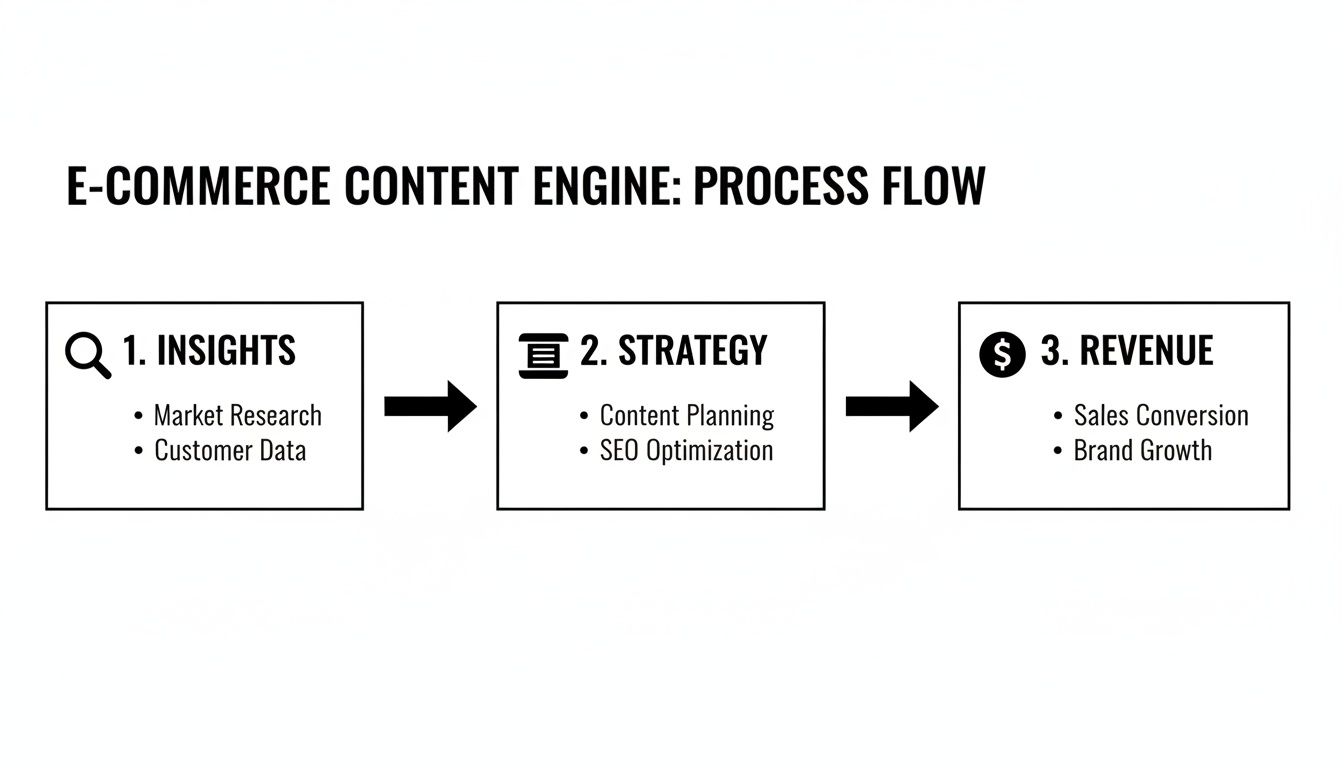
This flow makes one thing clear: revenue isn't the starting point. It’s the final outcome of a well-executed strategy that’s rooted in a deep understanding of your customer.
Core Pillars of a Modern Strategy
Your blueprint needs to stand on a few core pillars that tie everything together, from initial research all the way to performance analysis. We’re not just talking about writing blog posts here; this is a framework where every asset has a specific job to do.
These pillars include:
- Deep Audience Insights: Go beyond basic demographics. You need to understand the real pain points, questions, and shopping behaviors of your ideal customers on each specific platform.
- Competitive Analysis: Figure out what your top competitors are doing right, where their content sucks, and how you can swoop in to fill those gaps and grab market share.
- Clear KPIs: Set measurable goals that tie your content’s performance directly to revenue. Think conversion rates, average order value, and customer lifetime value.
A great strategy ensures every product listing, email, and social media post works in harmony. It's about building a system where the whole is greater than the sum of its parts, creating a consistent and persuasive brand experience across all touchpoints.
This guide will unpack the strategies that top ecommerce brands use to turn content into a predictable growth machine. As you start implementing these ideas, remember that a strong content engine is just one part of a much larger growth plan. To see how it fits into the bigger picture, check out our detailed guide on how to scale an ecommerce business, which covers both operational and marketing expansion. We'll show you how to build a framework where every effort is measurable and genuinely impactful.
Understanding Your Audience and Keywords
Great content is never created in a vacuum. A successful content strategy starts with two non-negotiables: knowing exactly who you’re talking to and understanding the words they use to find what you sell.
For an ecommerce brand, this isn't just a marketing exercise—it's the absolute foundation of every single sale.

Without this clarity, you're just guessing. You'll end up with product listings that never get seen and blog posts that attract window shoppers with no intention of buying. It’s time to move beyond guesswork and build an approach that’s driven by data, not assumptions.
Crafting Actionable Customer Personas
Forget basic demographics like age and location. That’s just scratching the surface. To create content that actually connects with people, you need to build detailed customer personas that dig into their real motivations, frustrations, and shopping habits. These aren't just fictional characters; they're composites of your very best customers.
A solid persona for an ecommerce brand should answer a few key questions:
- What's their end goal? What is the customer really trying to accomplish by buying this product? For instance, they're not just buying boots; they’re trying to "Find durable, waterproof hiking boots for a big trip they’ve been planning for months."
- What are their biggest pain points? What frustrations are they dealing with? Maybe, "Boots from other brands fell apart after one season, and they're worried about getting blisters on the trail."
- How do they shop? Where do they do their research? Are they a price-conscious Amazon shopper who reads every review, or a brand-loyal DTC buyer who trusts influencer recommendations?
- What convinces them to buy? Do they rely on user-generated photos, technical specs, or a good story to make a decision?
Answering these questions helps you tailor your content's tone and focus. A persona worried about durability doesn't care about flashy marketing fluff—they need to see content that highlights high-quality materials, construction details, and testimonials from customers who put the product to the test.
Finding High-Intent Ecommerce Keywords
Keyword research for ecommerce is a completely different ballgame than it is for a standard blog. You have to get inside your customer's head and distinguish between the terms they use when they’re ready to buy versus when they're just gathering information. Getting this wrong is one of the most common—and costly—mistakes I see brands make.
It really boils down to two main categories:
| Keyword Type | Primary Goal | Best Used For | Example |
|---|---|---|---|
| Transactional Keywords | To make a purchase | Amazon/eBay/Walmart Listings, Product Pages, Google Shopping Ads | "buy men's waterproof hiking boots size 11" |
| Informational Keywords | To learn or solve a problem | DTC Blogs, How-To Guides, YouTube Videos, Email Content | "how to break in new hiking boots" |
When you're optimizing listings on a marketplace like Amazon, your energy should be focused on long-tail, transactional keywords. These are hyper-specific phrases like "lightweight gore-tex boots for rocky trails" that signal a buyer is deep in the purchasing cycle. A massive search volume isn’t the goal here; relevance and purchase intent are what actually drive sales.
Your goal isn’t just to be found, but to be found by the right person at the right moment. Aligning keyword intent with content type is the secret to converting searchers into customers.
This is a critical piece of building a powerful online presence. For a deeper look at this, you can learn more about how to master the search landscape with our guide on ecommerce SEO best practices.
Analyzing Competitor Content for Gaps
Your competitors are a goldmine of strategic intel, but only if you know what to look for. A real competitive analysis goes way beyond just seeing what keywords they rank for. You need to dissect their content to find their weaknesses and carve out your unique angle.
Start by digging into your top three competitors and asking these questions:
- What questions are they failing to answer? Go read their product page Q&As and customer reviews. Are there recurring issues or questions that pop up over and over again? That’s your opening to create more helpful, comprehensive content.
- Where is their content thin? Do their blog posts just offer surface-level advice? You can win by creating the definitive, go-to resource on that topic.
- What content formats are they ignoring? If your competitors are stuck with just text and basic images, you can immediately stand out by creating high-quality product demo videos, detailed infographics, or side-by-side comparison charts.
When you combine a deep understanding of your audience, precise keyword targeting, and a sharp competitive analysis, you're building a rock-solid foundation. From this point forward, every piece of content you create will have a clear purpose, a defined audience, and a direct path to driving more sales.
Crafting High-Conversion Content for Each Channel
Getting a shopper to your digital doorstep with a high-intent keyword is only half the battle. The content they find there is what actually closes the sale. In ecommerce, every single word, image, and video has one job: guide the customer from discovery to checkout. Simply copying and pasting the same product description across Amazon, eBay, and your own website is a surefire recipe for mediocrity.
Each channel has its own audience, its own algorithm, and its own set of expectations. A truly effective content development strategy gets this. What works on your beautifully branded website will fall completely flat in the fast-paced, cutthroat world of an online marketplace.
Mastering the Marketplace Product Listing
On platforms like Amazon, eBay, and Walmart, your product listing is your digital salesperson. It needs to be persuasive, informative, and optimized for both real shoppers and the platform’s search algorithm. Forget poetic language; clarity and benefits are what make you money here.
A winning marketplace listing isn't just one thing; it's several key components working together perfectly.
- The Title: This is your most valuable piece of SEO real estate, period. Lead with your main keyword and cram in all the critical info: brand, model, key feature, quantity, and color. Don’t write "Durable Hiking Boots." Instead, write "Brand X Men’s Waterproof Gore-Tex Hiking Boots, Size 11, Brown."
- The Bullet Points: This is where you sell, not just describe. Start each bullet with a capitalized benefit, then explain the feature behind it. Frame it around solving a real customer problem. For example: "STAY DRY ON ANY TRAIL: Made with a 100% waterproof Gore-Tex membrane that keeps your feet comfortable in rain, mud, and stream crossings."
- The Product Description: Here’s your chance to go deeper. Elaborate on the benefits, tell a quick story about how the product is used, and proactively answer the questions you know customers will have. Use simple HTML to bold key phrases and add line breaks so people can actually scan it.
Think of your listing as a complete sales pitch, squeezed into a few hundred words. Every piece has to build confidence and create urgency. For a deeper dive, our guide on conversion rate optimization tips has more tactics for turning those browsers into buyers.
Elevating Your Brand with A+ and EBC
Enhanced Brand Content (EBC), known as A+ Content on Amazon, is a total game-changer. This is where you stop just selling a product and start telling a brand story. You move beyond plain text and use rich media to visually showcase features and build a premium feel. It's not just for looks, either—data shows A+ Content can boost sales by 5-10% by creating a far more engaging experience.
Here’s how to make the most of this space:
- High-Quality Lifestyle Images: Show your product in action. Help customers see exactly how it will fit into their lives.
- Comparison Charts: Make the decision easy for shoppers. Pit your product against competitors or other models in your own lineup.
- Detailed Feature Callouts: Use annotated images to point out specific design elements and spell out why they matter.
A+ Content is your chance to forge an emotional connection. It separates you from the dozens of other sellers just competing on price and turns your product page into a genuine brand experience.
This kind of visual storytelling isn't a "nice-to-have" anymore. It's a critical part of a modern content strategy.
The Rise of Video in Ecommerce
Speaking of visuals, video is absolutely exploding. It has quickly become the highest-ROI format in most content strategies today. Short-form video is leading the charge, with 49% of marketers calling it a top performer. This trend is completely reshaping how brands connect with customers everywhere. Integrating video into product listings—think quick, dynamic demos showing a product in use—is now essential for driving clicks and conversions. If you want to see just how dominant this format has become, check out HubSpot's latest marketing report.
Content for Your Direct-to-Consumer Site
While marketplaces demand sharp, conversion-focused content, your DTC site is where your brand’s personality can truly come alive. This is your home turf, and you have complete control over the story you tell.
Your content strategy here should be much more diverse:
- Blog Content: Write genuinely helpful articles that answer your audience's bigger questions. If you sell hiking boots, you should be writing about "The Top 10 Hiking Trails for Beginners" or "How to Choose the Right Hiking Socks." This is how you attract organic traffic and position your brand as an authority.
- Email Campaigns: Use email to build real relationships. Send welcome sequences to new subscribers, give loyal customers exclusive discounts, and share user-generated content to foster a sense of community.
- Ad Copy: Your ads need to speak directly to your audience's pain points. A/B test different hooks, visuals, and calls-to-action to find what clicks. Focus every ad on one, single compelling benefit.
Your DTC site is your brand’s home base. It's where you build long-term relationships that aren't at the mercy of some third-party platform’s algorithm. By crafting unique content for each channel, you create a powerful, multi-pronged approach that meets customers exactly where they are.
Content Format vs Channel Effectiveness
Deciding what content to create is one thing; knowing where it will perform best is another. Different formats are built for different platforms. This table breaks down which content types deliver the most impact on specific channels, helping you prioritize your efforts for maximum return.
| Content Format | Primary Channel | Key Objective | Example Tactic |
|---|---|---|---|
| Product Listings | Marketplaces (Amazon, eBay) | Drive Immediate Conversion & Rank in Search | Keyword-rich title, benefit-led bullets, clear product images. |
| A+/EBC Modules | Marketplaces (Amazon, Walmart) | Increase Conversion Rate & Build Brand Trust | Use comparison charts, lifestyle images, and detailed feature callouts. |
| Short-Form Video | Social Media Ads, Product Pages | Capture Attention & Demonstrate Use | Create a 15-second "how-to" video showing the product solving a problem. |
| Long-Form Blog Posts | DTC Website / Blog | Attract Organic Traffic & Establish Authority | Write a 1,500-word guide on a topic your target audience cares about. |
| Email Campaigns | Email Marketing Platform | Nurture Leads & Drive Repeat Purchases | Send a weekly newsletter with tips, promotions, and user-generated content. |
| Paid Ad Copy | Google Ads, Social Media Platforms | Generate Clicks & Drive Targeted Traffic | A/B test ad headlines that focus on different customer pain points. |
Ultimately, the goal isn't just to create content, but to create the right content for the right context. By aligning your format with the channel, you ensure your message not only reaches your audience but resonates with them in a way that drives action.
Building a Scalable Content Production Workflow
A brilliant content strategy is just a document until you build a system to actually get things done. Without a clear workflow, even the best ideas get lost in a mess of missed deadlines, confusing feedback, and inconsistent quality. This is where we stop planning and start doing.
Let's build the operational backbone that turns your strategy into a well-oiled, repeatable content machine.

The goal is simple: create a process that’s clear, scalable, and keeps everyone on the same page, whether you're a solo founder juggling everything or managing a team of freelancers.
Designing Your Master Content Calendar
A content calendar is way more than a list of publish dates. Think of it as your single source of truth for the entire production pipeline. It’s what prevents chaos and ensures every blog post, product listing, and email serves a purpose. A simple spreadsheet can get you started, but tools like Asana or Trello offer more muscle.
To keep everything organized, your calendar should track the essentials:
- Topic & Target Keywords: What are we creating, and what search terms are we trying to own?
- Content Format: Is this a blog post, a product listing update, an A+ Content module, or an email campaign?
- Target Channel: Where is this going live? (e.g., Amazon, DTC blog, Instagram).
- Assigned Owner: Who’s on the hook for writing, designing, or producing this?
- Status: Where is this in the workflow? (Briefing, Drafting, In Review, Scheduled).
- Publish Date: The big day.
This level of detail kills the guesswork. Anyone on the team can glance at the calendar and know exactly what’s happening, what’s next, and where they fit in.
A well-structured content calendar is the difference between proactive, strategic execution and reactive, chaotic scrambling. It's the operational core of a successful content development strategy.
Mapping out your content weeks or even months ahead lets you build a consistent publishing rhythm—something both your audience and the search engine algorithms love. It also means you can plan for seasonal campaigns and product launches without the last-minute panic.
Defining Roles and Responsibilities
When people aren't sure what they're supposed to do, things fall through the cracks. It's that simple. Ambiguity is the enemy of efficiency, so defining clear roles is non-negotiable, even if one person is wearing multiple hats.
Think about these core functions in your workflow:
| Role | Primary Responsibilities |
|---|---|
| Strategist | Plans topics, handles keyword research, and sets the goals for content. |
| Creator | Writes the copy, designs the graphics, or shoots the video. |
| Editor/Reviewer | Checks for quality, accuracy, brand voice, and SEO optimization. |
| Publisher | Uploads and schedules the final, approved content on each platform. |
When roles are clearly assigned, accountability follows. The writer knows exactly who to send their draft to for review. The publisher knows when a piece is 100% approved and ready to go. This creates smooth handoffs and keeps bottlenecks from jamming up your whole process.
Creating Effective Content Briefs
Nothing drains time and morale faster than endless revision cycles. Nine times out of ten, the problem starts with a weak or nonexistent brief. A detailed content brief is your best defense against this, ensuring the final piece matches your vision from the very first draft.
A solid brief should always include:
- Working Title: A clear, descriptive title to guide the creator.
- Primary & Secondary Keywords: The main search terms the content needs to hit.
- Target Audience Persona: A quick reminder of who this content is for.
- Key Talking Points: Bullet points outlining the core message, required info, and key takeaways.
- Competitor Examples: A few links to high-ranking articles to use for inspiration (and to beat).
That little bit of upfront effort pays for itself tenfold by slashing back-and-forth emails and making sure everyone is aligned before a single word gets written. It’s the final piece of the puzzle in building a workflow that doesn't just scale, but consistently produces great content.
Using AI in Your Content Development Strategy
Let's be honest, artificial intelligence isn't some futuristic idea anymore. It's a real tool that ecommerce content teams are using right now to get ahead. When you bring AI into your content strategy, you’re not trying to replace your team's creativity. You're giving it a massive boost, making everything more efficient, and uncovering insights you’d otherwise miss.
For anyone selling online, this means you can move faster and work smarter. Instead of getting stuck staring at a blank page, you can let AI handle the most tedious parts of content creation.

This isn’t just a niche trend. A whopping 94% of marketers are already planning to use AI for content creation, which tells you everything you need to know. For sellers on Amazon or Walmart, this looks like using AI for everything from fine-tuning A+ Content to writing product descriptions that actually convert.
A Practical Hybrid Approach to AI
From what I’ve seen work best, a hybrid model is the way to go. Let AI do the heavy lifting—the initial keyword research, the first drafts, the data crunching—while your human experts handle the final polish, inject the brand voice, and add that crucial emotional touch.
Think of AI as your super-fast junior copywriter. It can spit out a dozen product description ideas in seconds, but it's your job to pick the winner and tweak it until it sounds exactly like your brand.
Here are a few high-impact ways to put this hybrid approach to work:
- Brainstorming Product Angles: Give an AI tool your product features and customer profile, then ask for unique selling points. You might be surprised by the creative marketing angles it comes up with.
- Generating First Drafts: Use AI to build a solid first draft of a product listing or a blog post. It's a fantastic way to beat writer's block and get a structured foundation you can build on.
- Optimizing with Keywords: Once your copy is written, have an AI tool review it. It can suggest natural ways to weave in your target keywords so the text doesn’t sound forced or robotic.
The real game-changer with AI in a content development strategy isn't just speed; it's scale. It lets you test more ideas, create more versions, and personalize content in ways that would be flat-out impossible to do by hand.
This goes way beyond just writing text, too. AI is becoming essential for creating dynamic ad creatives and personalized email campaigns that actually feel one-to-one. For a deeper dive into how this works, check out our guide on ecommerce personalization software.
AI-Powered Tactics for Ecommerce Platforms
Okay, let's get practical. For an ecommerce seller, AI offers immediate advantages on the big marketplaces.
- Amazon Listing Optimization: Use a simple AI prompt like, "Write five benefit-focused bullet points for an insulated stainless steel water bottle. Target outdoor lovers who care about durability and keeping drinks cold." The AI will hand you a great starting point that you can then polish with your brand’s personality.
- A/B Testing Ad Copy: Need to test ads? Generate ten different headlines for a Facebook ad promoting your new product. Have AI create variations that hit different pain points—one on price, one on a key feature, one on social proof—and see what your audience responds to.
As search engines get more conversational, your content needs to follow suit. To make sure your product pages and articles show up in these new AI-driven search results, you have to learn how to optimize content for AI search by focusing on clear, direct answers.
Ultimately, when you treat AI as a collaborator instead of a replacement, you build a much stronger and more nimble content machine. It frees you up to focus on the things that really matter: high-level strategy, creative direction, and building a brand that customers actually care about.
How to Measure Content Success and Iterate
Creating content without measuring its impact is like shouting into the void. You’re putting in all the work, but you have no real idea if anyone is listening—or more importantly, if it’s actually growing your business.
A successful content development strategy doesn't end when you hit "publish." That's actually where the real work begins. It kicks off a continuous feedback loop fueled by real-world data.
If you can't measure it, you can't improve it. This means moving beyond feel-good vanity metrics like page views or social media likes. While those numbers are nice to look at, they don’t pay the bills. For any ecommerce brand, success is defined by metrics that tie directly to revenue.
Defining KPIs That Actually Matter
Your Key Performance Indicators (KPIs) are the vital signs of your content’s health. Don't get lost in a sea of data. Instead, focus on a handful of metrics that clearly show whether your content is helping you sell more products.
For ecommerce sellers, these are the KPIs that truly count:
- Conversion Rate: What percentage of people who see your content actually take action? On Amazon, this is your Unit Session Percentage—the number of units purchased per session. On your DTC site, it’s your add-to-cart rate.
- Average Order Value (AOV): Is your content encouraging customers to spend more? Think blog posts about product bundles or guides that upsell accessories. A rising AOV is a clear win.
- Customer Lifetime Value (CLV): Does your email marketing and brand storytelling bring people back for more? Tracking CLV shows the long-term impact of the relationships you're building.
- Lead Generation Rate: For a DTC blog, how many visitors sign up for your email list after reading an article? This is a direct measure of your content's ability to build an audience you own.
The goal is to connect every piece of content to a tangible business outcome. When you can say, "This blog post generated 50 new email subscribers, which led to $1,200 in sales," your strategy becomes undeniably powerful.
Building Simple Performance Dashboards
You don't need complicated, expensive software to track what’s going on. A simple spreadsheet or a basic dashboard in Google Analytics can give you all the clarity you need. The key is to check in on performance consistently so you can spot trends and react quickly.
Your dashboard should give you a clean, at-a-glance view of your most important metrics for each channel.
| Channel | Key Metric to Track | Why It Matters |
|---|---|---|
| Amazon/Marketplace | Unit Session Percentage | Directly measures how well your listing turns traffic into sales. |
| DTC Blog | Email Opt-in Rate | Shows how effectively you're turning casual readers into leads. |
| Product Page | Add-to-Cart Rate | Indicates the persuasive power of your copy, images, and videos. |
| Email Campaign | Click-Through Rate (CTR) | Reveals if your content is compelling enough to drive action. |
Conducting Regular Content Audits
A content audit is just a systematic review of all your content to see what’s working, what isn’t, and where you can improve. I recommend doing a light audit every quarter and a really deep dive once a year.
The process itself is pretty straightforward:
- Inventory Your Assets: Make a list of all your key content—top blog posts, every product listing, all your A+ Content modules.
- Gather Performance Data: Pull the core KPIs for each asset right from your dashboard.
- Identify Underperformers: Find the content that isn't pulling its weight. Is a product listing converting poorly? Is a blog post getting zero traffic?
- Decide on Action: For each lagging piece, choose a path. Update it with fresh information, Optimize it for better SEO, or just Delete it if it's no longer relevant.
This cycle transforms your content strategy from a static plan into a living, breathing system. By consistently measuring and refining, you ensure your efforts are always driving profitable, long-term growth. To dig deeper into this, our guide on data-driven marketing strategies offers a great framework for making smarter decisions.
FAQs About Your Content Development Strategy
How Often Should I Update My Content Strategy?
I usually tell clients to give their core content development strategy a solid review every quarter. This lets you make smart, data-driven tweaks without constantly changing course. A complete overhaul? Save that for once a year, or if something big happens—like a major algorithm shake-up on Amazon or Google. Staying agile is key, but so is consistency.
What Is the Biggest Content Mistake Ecommerce Brands Make?
Hands down, the most common mistake I see is creating content without a clear purpose tied to an actual business goal. Brands just publish stuff randomly, hoping something sticks. This leads to a ton of wasted time and money with zero measurable ROI.
Every single piece of content, whether it's a product listing or a blog post, needs to have a specific job to do within your strategy. If it doesn’t, you’re just making noise.