

Ever wonder how much money your content is actually making? Content marketing ROI is the number that answers that question. It cuts through the noise and tells you exactly how much revenue you’re generating compared to what you spent creating and promoting your content.
Simply put, it’s the proof that your content isn’t just an expense—it’s a money-making machine.
Why Measuring Content ROI Matters
Think of your content as a business asset that grows in value over time, not just another line item on a budget. Paid ads are great, but they stop working the second you turn off the spend. A killer blog post, on the other hand, can pull in organic traffic, build trust, and capture leads for years. That compounding effect is exactly why you need to get a handle on your content marketing ROI.
Measuring ROI is like having a compass for your entire strategy. It tells you which topics are hitting the mark, what formats are actually converting, and where your budget will have the biggest impact. Without it, you're just flying blind, chasing vanity metrics that look good but don’t actually grow the business.

The Foundation of Smart Marketing Decisions
Calculating your content ROI forces you to move past guesswork and start making decisions based on real data. The basic formula looks simple enough:
(Return – Investment) / Investment x 100% = ROI
The math is easy. The real work—and the real opportunity—is figuring out what numbers to plug in. What actually counts as a "return"? And what should you include in your "investment"? Answering those questions is what connects your marketing efforts directly to the bottom line.
Once you start tracking this, you’ll be able to:
- Justify Your Budget: Nothing gets stakeholders on board faster than showing them a clear, positive return. A solid ROI is your best argument for getting more budget for your next big idea.
- Optimize Your Strategy: When you know what works, you can pour fuel on the fire. Double down on the content and channels that are winning, and cut back on what’s not. This is the heart of all smart data-driven marketing strategies.
- Prove Your Team's Value: When you can show exactly how marketing impacts revenue, your team stops looking like a cost center and starts being seen as a growth engine.
At the end of the day, measuring content marketing ROI isn't about getting lost in spreadsheets. It’s about understanding—and proving—the real financial impact your work has on the business. It ensures every piece of content you create has a clear, profitable purpose.
How to Calculate Your Content Marketing ROI
Figuring out your content marketing ROI can feel like trying to nail jelly to a wall. But once you break it down, it gets a lot clearer. At its core, the whole process boils down to two simple things: what you spent (Investment) and what you got back (Return).
The basic formula is as straightforward as it gets:
(Return – Investment) / Investment x 100% = ROI
The math isn’t the hard part. The real challenge is making sure you’ve got the right numbers plugged into the equation. Nailing this is the difference between a vague guess and a metric that actually means something for your business.
Pinpointing Your Total Content Investment
Your investment isn't just the invoice from a freelance writer. To get a true picture, you have to account for every single dollar that goes into creating and pushing your content live. Think of it like baking a cake—you wouldn’t just count the flour. You have to include the eggs, sugar, and even the cost of running the oven.
Your total investment should cover:
- Creation Costs: This includes salaries for your in-house team, fees for freelancers (writers, designers, videographers), and any money spent on stock photos or video assets.
- Software and Tools: Add up the monthly or annual subscriptions for your content management system (CMS), SEO tools like Ahrefs or Semrush, grammar checkers, and project management software.
- Promotional Spend: Did you boost a blog post with paid ads? That cost goes in here, whether it was on social media or search engines.
Tracking these expenses meticulously gives you a solid, credible foundation for your ROI calculation.
Assigning a Dollar Value to Your Return
Now for the fun part: your return. This is where you connect your content efforts directly to the cash register. For ecommerce and marketplace sellers, this is often more direct than for other types of businesses.
Start with the low-hanging fruit: direct sales that came from a piece of content. If a customer clicks a link in your blog post and buys a product, that’s a clear win. Using UTM parameters in your links is a great way to trace these conversions right back to specific articles or videos. Analyzing this kind of information is key to figuring out how to grow your online revenue, a topic we dive into in our guide to https://npoint.digital/amazon-sales-data/.
But not all returns are immediate sales. You also need to put a value on your leads.
A common way to do this is by calculating the value of a lead based on your lead-to-customer conversion rate. If 10% of your blog subscribers eventually buy something, and your average customer lifetime value (CLV) is $500, then every new subscriber is worth $50 ($500 x 0.10).
Example in Action:
Let's say you spent $5,000 last quarter on a series of blog posts (Investment). Your analytics show you generated $15,000 in direct sales and got 100 new leads worth $50 each, for another $5,000 (Return = $15,000 + $5,000 = $20,000).ROI = ($20,000 – $5,000) / $5,000 x 100% = 300%
A 300% ROI means for every dollar you put in, you got four dollars back. Now that's a number worth reporting.
Choosing the Right Attribution Model
Connecting a sale to just one piece of content is rarely simple. A customer might read a blog post, see a social ad a week later, and then click a link in an email before finally buying. So, which piece of content gets the credit?
This is where attribution models come in. An attribution model is just a set of rules that decides how you assign credit for conversions across all those different touchpoints. While this guide is all about content, the principles to measure marketing ROI apply across the board and can sharpen your understanding of your entire strategy.
Deciding how to credit conversions is a big decision, as it shapes how you interpret your data. Here’s a quick rundown of the most common models to help you find the right fit.
Comparing Content Attribution Models
| Attribution Model | How It Works | Best For |
|---|---|---|
| First-Touch | The very first piece of content a customer interacts with gets 100% of the credit for the sale. | Businesses focused on top-of-funnel awareness and generating new leads. |
| Last-Touch | The last piece of content a customer interacts with right before converting gets 100% of the credit. | Companies with short sales cycles where the final touchpoint is the most influential. |
| Multi-Touch (Linear) | Credit is split equally among every single touchpoint in the customer's journey. | Marketers who want a balanced, holistic view of the entire customer journey. |
There's no single "best" option here—the right model really depends on your business goals. Understanding how each one works is the key to telling a more accurate story about what your content is actually accomplishing for your brand.
Choosing The Right Metrics And KPIs
Not all metrics are created equal, especially when you’re trying to measure your content marketing ROI. It's way too easy to get lost in "vanity metrics" like social media likes or impressions. Sure, those numbers look great on a report, but they don't actually tell you if your content is driving real business growth.
Think of it like the dashboard in your car. Your speed is interesting, but it's the fuel gauge and engine temperature that tell you if you'll actually make it to your destination. To get a real picture of your content's performance, you need to focus on actionable Key Performance Indicators (KPIs) that tie directly to your bottom line.
This flowchart breaks down the fundamental process of turning your content efforts into something you can actually measure.
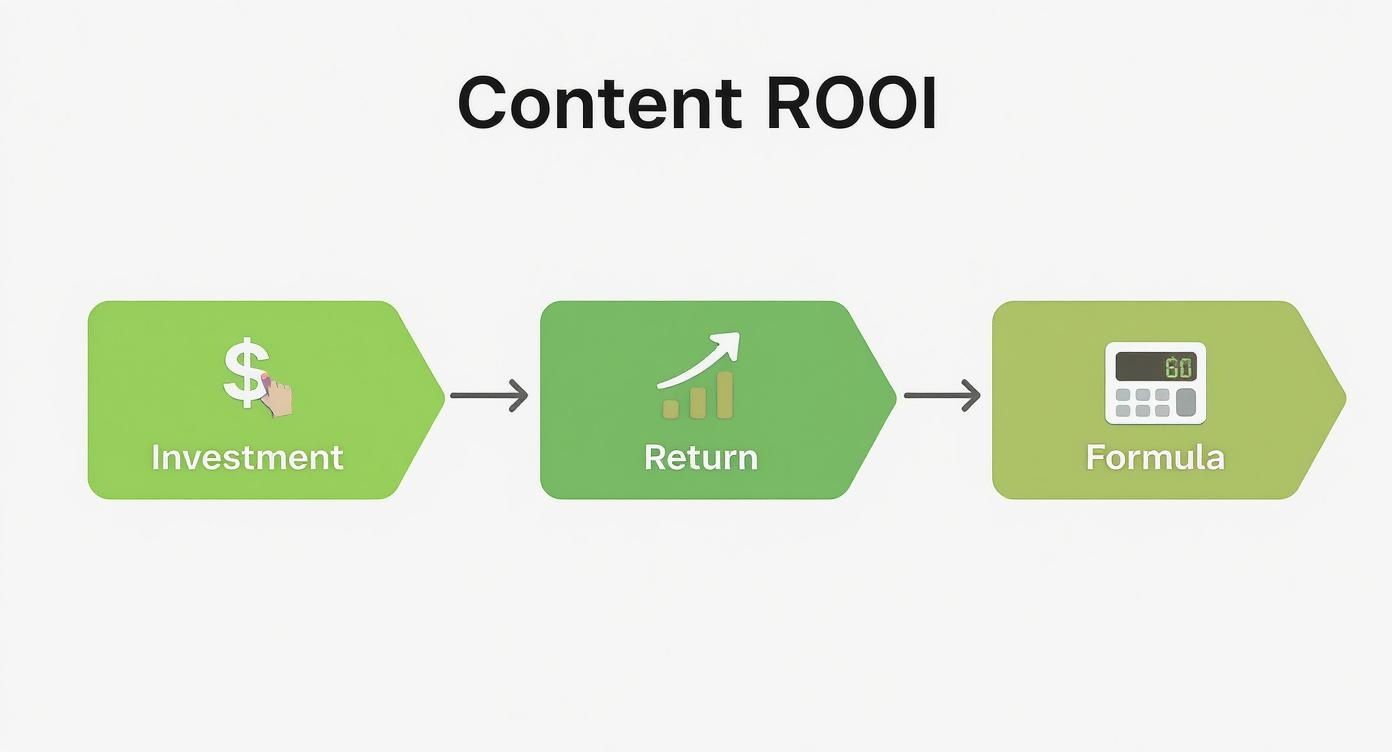
It shows you exactly how your initial investment flows through to a tangible return, which you can then plug into the ROI formula to see how you’re really doing.
To help you get started, here's a look at the essential KPIs you should be tracking, broken down by what they measure and why they matter for your ROI.
Essential KPIs for Measuring Content Marketing Success
| KPI Category | Key Metric | What It Measures |
|---|---|---|
| Consumption | Page Views, Unique Visitors, Time on Page | How many people are seeing your content and if they're actually reading it. |
| Engagement | Backlinks, Social Shares, Comments | Whether your content is interesting enough for people to share or link back to. |
| Lead Generation | Conversion Rate, Downloads, Form Fills | How effectively your content turns anonymous visitors into potential customers. |
| Lead Nurturing | Cost Per Lead (CPL), Email Open/Click Rate | The efficiency of your content in guiding leads closer to a purchase decision. |
| Sales & Revenue | Sales Conversion Rate, Customer Lifetime Value | How well your content directly contributes to closing deals and making money. |
These KPIs give you a comprehensive view of your content's performance, from initial awareness all the way to the final sale. Let's dig a little deeper into each category.
Consumption and Engagement Metrics
The first question you need to answer is simple: is anyone even looking at your stuff? These initial metrics tell you about your content's reach and whether it’s grabbing your audience's attention.
- Page Views: This is the most basic measure of your content’s popularity, showing you the total number of times a page has been viewed.
- Time on Page: This tells you how long visitors are sticking around. Longer times are a good sign that your content is engaging and delivering real value.
- Backlinks: When other reputable websites link to your content, it’s a huge signal to search engines that you’re an authority. For ecommerce sellers, mastering link building is a core part of any solid ecommerce SEO strategy.
- Shares and Comments: Social shares and comments mean your content is resonating enough for people to not only engage with it but also pass it along to their own networks.
These metrics give you a foundational layer of data. They tell you what’s working at the top of the funnel and help you understand which topics and formats your audience actually cares about.
Lead Generation Metrics
Once you have your audience's attention, the next logical step is to turn that interest into actual leads. This is where your content starts showing its direct value in filling your sales pipeline. The key metrics here all focus on actions that signal a visitor is moving from a passive reader to an active prospect.
For example, 79% of B2B marketing specialists report that their content strategy successfully helped them achieve key business goals, including lead generation at 74% and audience nurturing at 62%.
To track this progress, you’ll want to keep a close eye on:
- Conversion Rate: This is the percentage of visitors who take a desired action, like downloading an ebook, signing up for a webinar, or filling out a contact form.
- Cost Per Lead (CPL): This calculates how much you spend to get one new lead from your content. A lower CPL means your strategy is more efficient.
Beyond just getting leads, it's also critical to measure the quality of your newsletter content, since this is a primary channel for nurturing those leads effectively over time.
Sales and Revenue Metrics
At the end of the day, the most important measure of content marketing ROI is its impact on sales. These are the bottom-line metrics that draw a straight line from your content to revenue.
This is where you connect the dots between that blog post a customer read three months ago and the purchase they just made today. Attributing sales correctly is what allows you to prove the full financial impact of your content program.
The essential sales KPIs you need to track are:
- Sales Conversion Rate: This measures the percentage of leads generated by your content who actually become paying customers.
- Customer Lifetime Value (CLV): CLV projects the total revenue you can expect from a single customer. Content that attracts high-CLV customers is pure gold.
- Revenue Attributed to Content: Using attribution models, you can assign a specific dollar amount of revenue that was influenced or directly generated by your content.
A Framework for Improving Content ROI
Calculating your content marketing ROI is like a diagnostic test; improving it is the cure. A positive ROI is great—it proves your strategy is working. But a growing ROI? That proves your strategy is getting smarter. This doesn't happen by accident or with random acts of content creation. It requires a system.
Instead of reinventing the wheel with every campaign, you need a repeatable, cyclical framework that turns your performance data into tangible improvements. This process ensures every new piece of content is informed by what’s already succeeded or failed, stacking the odds of a higher return in your favor.
The framework is built on four key actions: Audit, Amplify, Optimize, and Integrate.
Audit Your Existing Content
First things first, you need to take a detailed inventory of your current content assets. Think of it as a strategic treasure hunt. You’re digging through your archives to find the hidden gems—the high-performing articles quietly driving traffic and leads—and the underperforming pieces that are just taking up space.
Group your content based on the KPIs you’ve already identified. A simple classification system makes this process clear and actionable:
- Winners: These are your all-stars. They rank high for valuable keywords, pull in significant organic traffic, and actually convert visitors into leads or customers.
- Losers: These articles are digital dead weight. They get little to no traffic, have sky-high bounce rates, and generate zero conversions.
- Sleepers: This group has potential. Maybe a blog post is hovering on the second or third page of Google, or it gets some traffic but fails to convert. These are prime candidates for a tune-up.
A thorough content audit replaces guesswork with a clear, data-driven roadmap for what to do next.
Amplify and Optimize Your Assets
Once you’ve separated your winners and sleepers from the losers, it’s time to get to work. This phase is all about doing more of what’s working and fixing what isn’t.
For your winners, the goal is amplification. Don't just let a great piece of content sit there. Squeeze every last drop of value out of it.
- Repurpose it: Turn a killer blog post into an infographic, a video script, or a series of social media snippets. This lets you reach different audiences on different platforms without starting from scratch.
- Promote it: Feature the content on your homepage, push it out in your email newsletters, and put some paid promotion behind it to get it in front of fresh eyes.
For your sleepers, the goal is optimization. These underperforming assets are your comeback kids. You can boost their performance by updating them with fresh information, improving their on-page SEO, adding stronger calls-to-action, or embedding new internal links.
A common mistake is obsessing over new content while ignoring the goldmine you're already sitting on. A 2025 survey of CMOs revealed that 65% of marketers struggle to quantitatively demonstrate their impact, often because they aren't leveraging the data from assets they already own.
Integrate Insights into Future Strategy
This final step is what closes the loop, turning your historical data into a predictive tool for your future content strategy. The insights you gained from your audit and optimization efforts should directly shape your next content calendar.
If you discovered that "how-to" guides generate your most qualified leads, make more of them. If case studies have the highest conversion rate on your site, build more into your plan. This data-driven approach is how your content strategy becomes progressively more effective and your content marketing ROI consistently climbs.
For example, an ecommerce brand might find that blog posts featuring user-generated photos drive three times more engagement than those with slick stock images. That single insight can reshape their entire visual content strategy, leading to a huge boost in ROI without a massive increase in budget. This cyclical process turns measurement into a powerful engine for sustainable growth.
Essential Tools for ROI Reporting
You can't measure what you can't see. In the world of content marketing ROI, trying to track performance without the right tools is like flying blind. To move from educated guesses to data-backed decisions, you need a solid tech stack.
Think of these tools not as expenses, but as instruments in your orchestra—each one plays a distinct role in creating a complete picture of your performance. Your measurement system doesn't have to be complicated, but it does need to cover three core areas: how users find you, what they do on your site, and how they become customers.

Web Analytics Platforms
At the heart of any reporting system is a powerful web analytics tool. This is your source of truth for on-site behavior, tracking everything from where your visitors come from to which pages they view and what actions they take.
- Google Analytics 4 (GA4): This is the industry standard and an absolute must-have. By setting up specific conversion events—like a form submission, a download, or a product purchase—you can directly link user actions back to the content that inspired them. This data is the foundation of your entire content marketing ROI calculation.
SEO and Traffic Analysis Tools
For most businesses, organic search is the gift that keeps on giving, often delivering the biggest long-term return from content. SEO platforms help you put a number on that value and spot opportunities for growth.
- Ahrefs or Semrush: These tools are indispensable for measuring your content's organic performance. They let you track keyword rankings, analyze backlinks, and even estimate a blog post’s "traffic value"—that is, how much you would have to pay in ads for the same amount of traffic. This is a powerful metric for proving ROI, especially for top-of-funnel content that doesn't immediately lead to a sale.
Customer Relationship Management (CRM) Systems
A CRM is the final piece of the puzzle, connecting your marketing efforts directly to sales. It closes the loop between a lead generated by a blog post and the revenue that lead eventually brings in.
By integrating your CRM with your website, you can trace a customer's entire journey. You can see that a new customer first found you through an article on "ecommerce best practices," downloaded an ebook two weeks later, and finally made a purchase after a targeted email. This multi-touch view is critical for accurate ROI attribution.
- HubSpot or Salesforce: These systems track every interaction a lead has with your brand. By connecting content downloads and form fills to customer accounts, you can directly attribute revenue back to specific campaigns and calculate the lifetime value of customers acquired through your content.
Bringing It All Together in a Dashboard
The real magic happens when you pull data from all these different sources into a single, unified view. A visualization tool like Google Looker Studio can transform raw numbers into a clear and compelling story for stakeholders.
A consolidated dashboard lets you showcase your most important ROI metrics at a glance, making complex information digestible for anyone in the company.
For businesses that need a more hands-on approach, exploring options for customized reporting can provide even deeper insights tailored to unique business goals. When you present your content marketing ROI in a clear, visual format, you make it easy for everyone to see the immense value your strategy delivers.
Common Pitfalls in Measuring Content ROI
Even the sharpest marketers can get tripped up trying to prove the value of their work. Calculating a real content marketing ROI means knowing which traps to avoid—the ones that can skew your numbers and sink your credibility before you even get started. Think of this as your field guide to sidestepping the most common measurement mistakes.
One of the biggest blunders is relying solely on last-touch attribution. This model is simple, but it's dangerously misleading. It gives 100% of the credit for a sale to the very last click, completely ignoring the blog post someone read three months ago that first introduced them to your brand. It's like giving all the credit to the cashier and ignoring the entire store that brought the customer in. This tunnel vision fails to capture the messy, non-linear journey customers actually take.
Another classic pitfall? Undercounting your investment. So many marketers only tally up the obvious costs, like a freelancer's invoice, and conveniently forget about everything else that went into creating and promoting the content.
Forgetting Hidden Costs
If you want a true ROI, you have to count every single expense. Forgetting costs just inflates your return, making your content look way more profitable than it really is. It’s a recipe for a bad surprise down the line.
Your full investment includes more than you think:
- Software Subscriptions: Those monthly fees for SEO tools, analytics platforms, and your CMS all add up.
- Internal Team Salaries: You need to account for a portion of the salaries for the writers, editors, designers, and strategists who touched the project.
- Promotional Spend: Any cash you dropped on paid ads to get more eyeballs on your content counts.
Failing to track these "hidden" costs leads to ROI figures that are flimsy and hard to defend. A credible calculation starts with an honest and complete look at your total investment.
A critical mistake is focusing only on short-term sales metrics while ignoring the long-game. Content builds brand authority, customer trust, and organic traffic over months and years. These long-term assets have immense value but won't always show up in a quarterly sales report.
Neglecting Long-Term Value
It’s tempting to chase quick conversions, but great content marketing is a marathon, not a sprint. Some of its biggest returns build up slowly over time, like interest in a savings account. Forgetting this means you'll almost always undervalue your top-of-funnel content.
Look at metrics like organic traffic growth, keyword ranking improvements, and increases in brand search volume. These are powerful signs that your content is building a valuable, long-term asset for your business. For instance, boosting your organic visibility directly helps your bottom line—every click you don't have to pay for is pure profit. A great on-site experience is crucial here, which you can learn more about in these conversion rate optimization best practices.
Finally, don't let your data become just noise. It's easy to collect metrics; the real work is turning them into insights you can actually use. Don’t just report that a blog post got 10,000 views. Dig deeper. Ask why it did so well and figure out how to bottle that lightning again. A solid ROI process isn’t just about reporting numbers—it’s about using them to make smarter decisions next time.
Still Have Questions? Let's Clear Things Up.
Even with a solid framework, it’s normal to have questions about content marketing ROI. It’s one of those topics where the details really matter. Let’s tackle a few of the most common questions marketers ask when they’re trying to prove the value of their work.
How Long Does It Take to See ROI From Content Marketing?
Patience is the name of the game with content marketing. Unlike a paid ad campaign that gives you an instant (but temporary) spike, content is a long-term play. Think of it like planting a tree—you have to put in the work upfront, and it takes time to grow before you can enjoy the shade.
Most experts agree you should expect to wait 6 to 12 months before seeing a significant, measurable return. This gives your content enough time to get indexed, start ranking on search engines, and pull in a steady stream of organic traffic. The first few months are all about laying the foundation; the real, compounding growth comes later.
How Can I Measure ROI for Top-of-Funnel Content?
This one’s tricky. Measuring the ROI of awareness-stage content, like a blog post or an infographic, feels tough because it rarely leads to a direct sale on the spot. But that doesn’t mean it has no value. The key is to use proxy metrics that represent real business impact.
Instead of chasing direct revenue, track metrics like these:
- Organic Traffic Value: Use an SEO tool like Ahrefs or Semrush to figure out how much you’d have to pay in ads for the same amount of organic traffic. This puts a clear dollar value on your SEO efforts.
- Brand Search Lift: Keep an eye on the number of people searching for your brand name directly in Google. If that number is going up, your top-of-funnel content is doing its job and building brand recognition.
What Is a Good Content Marketing ROI?
While there’s no single magic number that fits everyone, industry benchmarks can give you a pretty good idea of what to aim for. Many studies point to an average return of 3:1—meaning for every dollar you put in, you should aim to get three dollars back.
But remember, a "good" ROI is completely specific to your business. Your target will depend on your industry, profit margins, and what you’re trying to achieve. A high-growth startup might be perfectly happy breaking even at first if it means grabbing market share, while an established brand will expect a much higher return from the get-go.
Ready to stop guessing and start growing? At Next Point Digital, we build data-driven content and advertising strategies that deliver measurable results. We turn your content into a predictable revenue engine, helping you scale profitably across marketplaces and your own D2C site.