

Data-Driven Marketing Agencies track every click and demographic detail with the precision of a pastry chef weighing flour and sugar. They mix analytics and AI to cook up campaigns that hit the spot—every time.
Crafting Success With Data Driven Marketing Agency

At a glance, these agencies resemble a test kitchen. They slice audience segments, run A/B experiments, and adjust the recipe until every campaign serves the perfect flavor for each customer group.
When you’re selling on platforms like Amazon or eBay, that means zeroing in on who clicks, who buys, and where your ad dollars stretch the furthest.
Key Capabilities
- Audience Segmentation that speaks directly to each shopper’s needs
- Predictive Bidding which shifts budget in real time to your highest-potential bids
- Conversion Rate Optimization designed to nudge browsers into buyers
- Personalized Funnels guiding customers with offers they actually care about
Underpinning all of this is a suite of analytics tools and live dashboards. Agencies watch metrics like CPA, ROAS, and Customer Lifetime Value to steer each decision.
Every number has a backstory.
As datasets grow worldwide, this approach scales seamlessly. In fact, the global digital marketing agency market generated $598.58 billion in revenue driven by data analytics and AI and is projected to reach $1,443.27 billion by 2034 at a 9.20% CAGR.
Read the full research about these projections on source.com
Check out our guide on data driven marketing strategies for practical frameworks and case examples.
You’re about to move from theory to real ecommerce wins.
Our next chapters dive into marketplace SEO, predictive bidding, CRO, and custom funnels. We’ll share case studies from Amazon sellers and DTC brands.
Stay tuned for hands-on examples and clear takeaways.
Let’s get ready to celebrate actual results.
Understanding Core Capabilities And Benefits
A data-driven marketing agency is like a master detective—piecing together clicks, form fills, and purchase histories to reveal what your customers truly care about. Instead of letting raw numbers sit in a dashboard, these agencies turn data into clear audience groups and actionable insights.
When you know which shoppers matter most, you can steer both your ad spend and creative messages toward the people who will buy again. In one case, a fashion retailer segmented its email list by purchase frequency and enjoyed a 25% lift in repeat orders. That kind of clarity becomes the bedrock for campaigns that actually connect.
Audience Segmentation And Customer Insights
Agencies lean on clustering tools to group shoppers by behavior and demographics. The outcome? Actionable personas that guide product suggestions and ad copy with pinpoint accuracy.
- Clear Audience Clusters drive more relevant ads
- Behavior-Based Segments uncover hidden buying patterns
- Demographic Profiles refine creative direction
Instead of broad strokes, you get targeted messaging tailored to each segment’s preferences and purchase history.
Attribution Tracking And Budget Efficiency
Ever wonder which channel really closed that sale? Multichannel attribution maps every touchpoint—from a Facebook ad to an email click to checkout—so you stop guessing and start investing wisely.
By distributing credit across Google, Facebook and email, smart attribution can cut acquisition costs by 30% while boosting overall ROI. You’ll finally know which channels deserve more of your budget and which ones need rethinking.
Attribution reveals which channels deserve more of your budget.
Testing And Continuous Improvement
Think of A/B tests as a GPS for your campaigns. They point you straight to the best performing headlines, images or landing pages.
- Formulate a hypothesis—say, “Will a shorter headline drive more clicks?”
- Split your audience evenly and run tests at the same time
- Compare metrics like click-through rate and conversions
Within weeks, this disciplined approach can boost CTR by 15%, and those learnings feed directly into personalization engines that adjust content on the fly.
Personalization Engines And Growth
A personalization engine is like a concierge service for each visitor—greeting them with the products, offers and messages they’re most likely to love.
- Dynamic Emails adapt content based on browsing history
- Real-Time Offers adjust according to cart value and loyalty tier
- Customized Web Pages swap images and copy in an instant
These capabilities not only raise lifetime value by 25–40%, but they also support automated workflows that nurture leads at scale.
Learn more about ecommerce marketing strategies in our article Best Ecommerce Marketing Strategies.
Agencies tie each of these capabilities back to core goals—revenue growth, lower CPA and improved customer lifetime value—creating a transparent scorecard for success:
| Capability | Business Goal Impact | Typical Improvement |
|---|---|---|
| Audience Segmentation | Targeted messaging | +20–30% engagement |
| Multichannel Attribution | Efficient budgeting | -15–30% acquisition cost |
| A/B Testing | Optimized creative performance | +10–20% conversion rate |
| Personalization | Enhanced customer experience | +25–40% lifetime value |
This foundation sets you up to evaluate, select and leverage the right services. Next, we’ll dive into the technologies and metrics that power these capabilities—and why clear data is your most valuable asset.
Explaining Key Technologies And Metrics
When you dive into a data-driven marketing agency, you’ll find more than flashy dashboards. Picture predictive analytics as your trusted weather channel—flagging customer trends before they even begin. And real-time bidding? Think of it as a pit crew, racing to grab the best ad slots in milliseconds.
Nobody wants jargon when discussing ROI. That’s why we swap complex formulas for everyday images. ROAS becomes a trusty compass, pointing you to the channels that truly move the needle.
Below is a visual map we often share to show how audience segmentation, attribution, and A/B testing weave together in our process.
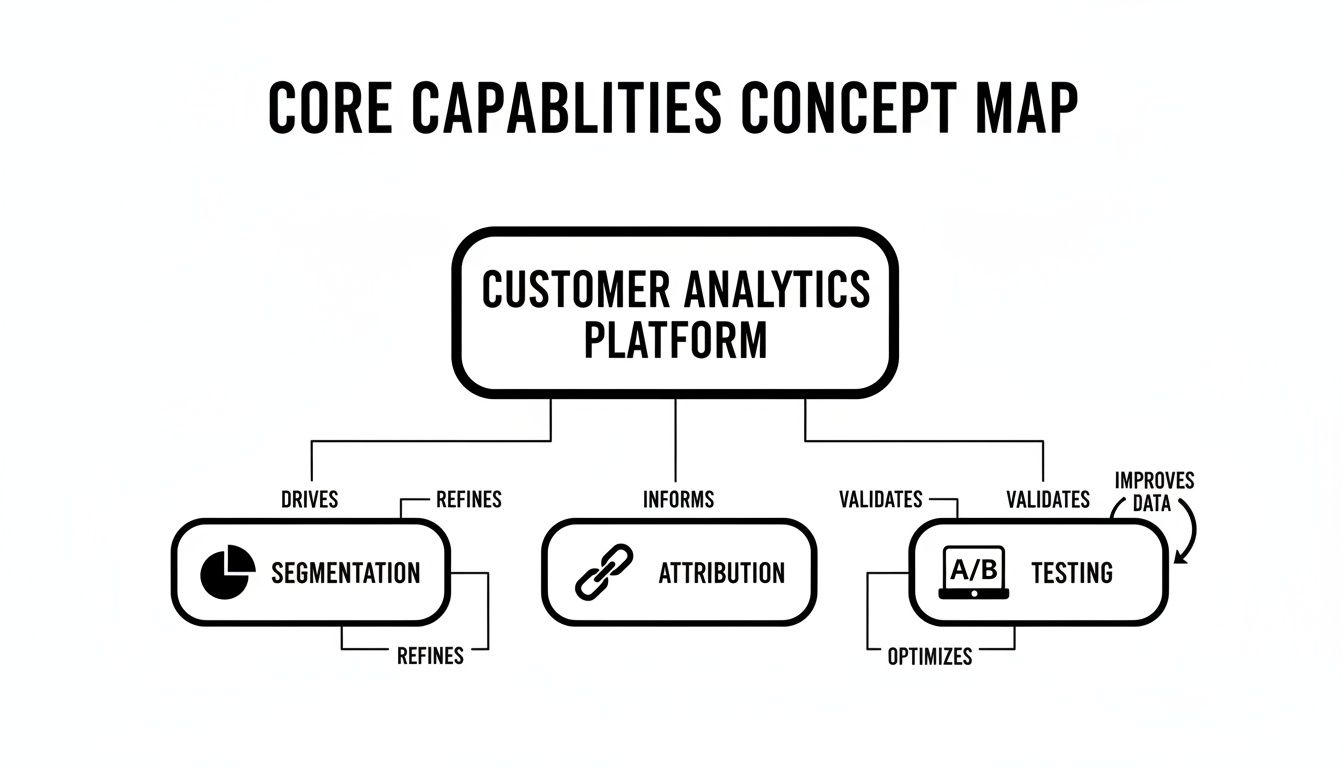
It lays out the workflow—from slicing your audience into segments to validating ideas with performance tests.
Key Metrics In Everyday Terms
Before you chase the next viral campaign, let’s break down four metrics that often trip up sellers:
- Cost Per Acquisition (CPA) feels like buying a ticket to an event; each new customer costs a set price.
- Return On Ad Spend (ROAS) is your navigational tool, guiding you back to the highest-yield channels.
- Customer Lifetime Value (LTV) measures how many “tickets” one fan might buy over their lifetime.
- Attribution Windows set the time frame for giving credit to each ad touchpoint—much like recording every ticket scan at the venue.
With these analogies, a CPA of $20 looks like twenty $1 tickets, while an LTV of $200 suggests a fan coming back for twenty $10 shows.
Comparison Of Marketing Technologies
Next, let’s see how leading platforms stack up. Use this guide to match features with your goals.
| Platform | Key Feature | Best Use Case | Pricing Tier |
|---|---|---|---|
| Adobe Sensei | Automated image and content tagging | Large ecommerce catalogs | Enterprise |
| Google AI | Predictive bidding and forecasting | Real-time ad budget optimization | Subscription |
| IBM Watson | Natural language and sentiment | Customer feedback analysis | Custom |
| HubSpot AI | Email automation and personalization | Lead nurturing workflows | Modular |
Each platform shines under different conditions—you might lean on Adobe Sensei for catalog-heavy inventory, but turn to Google AI when your bidding strategy needs that split-second edge.
Tracking And Reporting KPIs
Spotting trends in real time can save your budget from drifting off course. Interestingly, the AI marketing tool market has grown from $20 billion in 2022 to a projected $40 billion by 2025, boosting conversion rates by 25% and slashing acquisition costs by 37%. For more context, check out the research at Cubeo AI.
If you’re creating dynamic experiences, our tips on ecommerce personalization software can help.
“Tracking the right metrics is like steering a ship with a precise compass—it keeps you on course.”
Integrating Tools And Workflows
A strong tech stack only works when everything talks to each other. Here’s how we build seamless data flows:
- Choose platforms with open APIs to dodge data silos.
- Use connectors like Zapier or Integromat to automate repetitive tasks.
- Stick to consistent naming and tagging conventions.
- Audit your data pipelines regularly to catch glitches early.
These steps keep your dashboards honest and your reports trustworthy.
Fine Tuning Attribution Windows
Depending on campaign speed, you might adjust your windows:
- 1-Day Click Window for flash sales and promotions.
- 7-Day View Window when awareness is key.
- 30-Day Combined Window to capture longer purchase journeys.
Testing different settings helps you credit touchpoints accurately, ensuring you understand every dollar of ROI.
Ecommerce Use Cases With Real Examples

For more success stories, check out our portfolio of data-driven advertising solutions: Explore our portfolio of data-driven advertising solutions
Marketplace SEO Success
Imagine an Amazon seller whose best-selling widget was buried on page three. Every month, they watched sales stall at $10K.
We treated SEO like guiding foot traffic in a busy market stall. First, we dove into deep keyword research and reshaped titles, bullet points, and backend search terms. Then we layered in A+ content to highlight features and customer stories.
By testing variations, we discovered that longer bullets loaded with social proof snagged more clicks.
“After 60 days, organic rank jumped by 30%, delivering a 15% boost in monthly revenue.”
| Metric | Before | After |
|---|---|---|
| Organic Rank | Page 3 | Page 2 |
| Monthly Revenue | $10,000 | $11,500 |
| Click-Through Rate | 3.2% | 4.8% |
These tweaks also drove down negative reviews by 10%, further lifting buyer confidence.
- Added 600+ high-resolution images to improve visual appeal
- Ran weekly competitor audits to map shifting keyword landscapes
- Refreshed descriptions around peak search trends
- Optimized backend search terms every 48 hours with custom scripts
This case shows how technical SEO and compelling content can work together to move the needle.
Predictive Bidding Campaign Wins
An electronics seller felt like they were pouring money into a leaky bucket—40% of their Google Shopping budget was wasted daily.
Think of predictive bidding as an autopilot for your ad spend. We built models that adjust bids in real time based on device, location, and the hour of day. As signals changed, bid modifiers kicked in to protect ROI.
Over a 45-day trial, cost-per-click fell by 18% and wasted spend dropped by 20%.
- Used hour-of-day trends to set precise bid adjustments
- Excluded low-margin SKUs automatically with live profit data
- Layered in CRM signals to zero in on high-LTV audiences
- Deployed negative keywords each hour to block irrelevant clicks
“Predictive bidding is like a thermostat for your ad spend—it keeps performance comfortable while saving energy.”
This dynamic setup unlocked deep bid insights and shielded budget during off-peak hours.
Conversion Rate Lift Example
Traffic was flooding a fashion DTC site, yet only 12% of shoppers completed checkout. It was a classic case of invisible friction.
We traced drop-off points with heatmaps and session replays. Then we introduced micro-interactions: resized “Buy Now” buttons, swapped in urgency timers, and tested different trust badges.
Within three weeks, checkout completion climbed to 27%, a 15-point lift.
| Step | Action | Result |
|---|---|---|
| Drop-off Analysis | Heatmaps and replays | Identified issues |
| A/B Test | Trust badge vs. urgency timer | +9% completion |
| Sitewide Launch | Winning variant applied | +15% total lift |
We bolstered this with exit-intent surveys and one-click checkout experiments.
- Enabled chat-based guidance for complex product selections
- Automated follow-ups within one hour to recapture cart abandoners
- Tested one-click purchase buttons for mobile users
- Added live social proof pop-ups showing recent buys
- Segmented by geolocation to tailor shipping messages
Here, ironing out small bottlenecks unlocked major revenue gains.
Personalized Funnels That Convert
A wellness brand’s generic pop-up converted just 5% of visitors—a far cry from its potential. It was like fishing with the wrong bait.
We split visitors by referral source and on-site behavior, then served each group a tailored hook. First-timers saw a free guide matching their entry page. Returning customers got loyalty discounts and bundle offers.
- First-time visitors received a relevant free guide
- Returning customers unlocked discounts and curated bundles
This simple segmentation doubled sign-ups to 10%, generating $25,000 in extra monthly revenue.
“Tailoring the hook to the audience is like fishing where the fish are biting.”
We continued refining with A/B tests on email send times and subject lines.
- Personalized subject lines lifted open rates by 22%
- Used dynamic discount codes to lower bounce rates
- Mapped journeys with heatmaps for more precise segments
- Triggered SMS reminders that recovered 5% of lost carts
Bulletproof Your Funnel With These Best Practices
- Segment early and refine often using real user data
- Match offers to visitor intent for stronger engagement
- Automate flows with dynamic content for a seamless journey
Use these real-world examples as blueprints when vetting agencies or crafting your next campaign.
These wins underline the sheer impact a data-driven marketing agency can deliver.
Hiring And Evaluation Checklist
Imagine you’re tasting a recipe from a cooking instructor you’ve never met. You wouldn’t just swallow it whole—you’d ask about every spice and method. The same goes for a data-driven marketing agency.
Start by demanding transparency on each “ingredient” in your campaigns. Through pointed questions and hands-on tests, you’ll soon see if their analytics and reporting skills hold up. By the end, you’ll know whether their expertise matches your data maturity and growth ambitions.
Key Questions To Ask
- Data Access and Ownership – How do they collect, store, and secure your first-party data? You should retain full ownership at all times.
- Attribution Model Details – Do they rely on single-touch, multi-touch, or algorithmic attribution? Each method can dramatically reshape your view of ROI.
- Reporting Cadence and Format – Are you looking at weekly snapshots or monthly deep dives? Request sample dashboards so you get visuals, not jargon.
- Proof-of-Concept Results – Ask for case studies from clients on Amazon, eBay, or DTC brands, complete with concrete metrics.
- Budget Alignment – Clarify their fee structure and how they manage ad spend and platform costs. Transparency here prevents nasty surprises.
Each question peels back another layer of their process, helping you decide if they can tackle your unique challenges.
Spotting Red Flags
If they hand you a locked dashboard or insist on cookie-only tracking, raise an eyebrow. Those signs often lead to hidden costs and flawed metrics.
Watch for hesitation around sharing raw data exports or running a trial campaign. A partner that won’t “cook” a small test before the main course might not deliver on the full menu.
- Opaque Dashboards – No access to raw data means you can’t audit performance.
- Cookie-Only Tracking – Outdated approach misses mobile and cross-device journeys.
- No Proof-of-Concept – Skipping the pilot means they’re not invested in your success.
| Red Flag | What It Means |
|---|---|
| Opaque Dashboard | You can’t audit or validate results |
| Cookie-Only Tracking | Broken user journeys and lost insights |
| No Proof-of-Concept | No guarantee they can deliver |
Building Your Evaluation Scorecard
Turn impressions into data with a simple scorecard. Rate each area from 1 to 5, where 5 means best-in-class transparency and results. Then, add up the scores to compare agencies side by side.
- Score Data Access and Ownership
- Score Attribution Model Accuracy
- Rate Reporting Clarity and Frequency
- Assess Proof-of-Concept Outcomes
- Compare Budget Transparency
“Transparency is the cornerstone of trust,” notes Christina Inge at Harvard Professional Development.
Match the highest-scoring agency to your budget range and ROI goals. This checklist ensures you hire someone who truly speaks the language of data and backs it up with results.
Best Practices To Evaluate
Always audit sample dashboards and request raw data exports. Ask about their data governance and compliance standards.
- Run a 30-Day Pilot to see real CPA improvements before signing a long-term contract.
- Verify Privacy Compliance with GDPR and CCPA to protect customer trust.
- Confirm Secure Storage—cloud or on-prem—so your first-party data stays safe.
- Demand a Technical Lead who can translate metrics into clear action items.
- Set SLA Guidelines for report delivery, data refresh rates, and response times.
- Include a crisis response plan for potential data breaches or performance hiccups.
These steps weed out agencies that promise the moon but deliver far less. Test them on small projects first, then scale up with confidence.
Reporting Templates And KPI Benchmarks
Think of your reporting toolkit as a GPS for your marketing efforts. It keeps everyone on the same route, reveals detours early, and celebrates milestones when you hit your targets.
Below, you’ll find ready-made dashboards and KPI frameworks sorted by goal—awareness, acquisition, retention, and revenue growth. Each template includes 5–7 must-track metrics, suggested chart types, and performance thresholds so you know exactly where you stand.
Must Track Metrics By Objective
- Awareness: Impressions, reach, and CTR to measure how far your message travels.
- Acquisition: CPA, new customers, and click-to-conversion rate to gauge spend efficiency.
- Retention: Repeat purchase rate, churn rate, and average order value for loyalty insights.
- Revenue Growth: ROAS, revenue per visitor, and customer lifetime value to track profitability.
Ecommerce KPI Benchmarks
Here’s a quick snapshot of typical KPI ranges for marketplace sellers and DTC brands. Use these figures as a reference point when you compare your own results.
| Channel | CPA Range | ROAS Target | Conversion Rate |
|---|---|---|---|
| Amazon Sellers | $10–$30 | 4:1–6:1 | 8%–12% |
| eBay Stores | $12–$35 | 3:1–5:1 | 6%–10% |
| DTC Brands | $20–$50 | 5:1–8:1 | 10%–15% |
These benchmarks mirror current industry averages and give you context for evaluating your agency’s performance.
Template Usage Guide
- Make a copy of the master dashboard and rename it by objective.
- Enter your spend and conversion data into each metric field.
- Tweak threshold values to match your targets.
- Choose chart types—line, bar, heatmap—to highlight key insights.
- Schedule automated exports for weekly or monthly delivery.
Completing these steps ensures every report follows the same playbook and frees you from repetitive setup.
“Clear benchmarks empower you to demand transparency and accountability from any data driven marketing agency.”
Dive deeper into how your Amazon metrics compare by reading our dedicated Amazon sales data guide from NPoint Digital.
Toolkit Checklist
- Access to raw data exports for full visibility.
- A defined refresh cadence to keep insights fresh.
- Threshold alerts to flag issues early.
- A custom notes section for context around anomalies.
- Agency commentary on each KPI to explain the numbers.
Visualizing Performance Trends
Adding context turns numbers into stories. For example, overlay ad spend and revenue on a dual-axis chart to see how budgets drive income.
- Trendlines that highlight seasonal shifts.
- Funnel diagrams that reveal drop-off points.
- Heatmaps pinpointing high-engagement pages.
- Waterfall charts breaking down channel contributions.
Use conditional formatting to call out metrics that soar above—or fall below—your targets.
Reporting Best Practices
- Hold a monthly review meeting to walk through results and next steps.
- Validate the data before sharing with stakeholders.
- Refresh benchmarks annually to keep pace with market shifts.
- Weave in customer feedback and qualitative insights.
- Apply version control to compare performance over time.
These habits ensure your reporting remains a trusted guide for growth and keeps everyone accountable.
FAQ
This FAQ tackles the questions that come up when you’re vetting a data-driven marketing agency. You’ll learn why swapping guesswork for analytics feels like moving from a weather vane to a satellite, plus exactly when you’ll start seeing real data light up your dashboard. Each response points you toward deeper dives, so you can make faster, more confident decisions.
Common Questions
Why Partner With a Data-Driven Marketing Agency Instead of a Traditional One?
Traditional shops often rely on experience and gut instinct. A data-driven agency, on the other hand, builds every decision around real-time analytics, which means they can:
- Spot performance dips the moment they happen
- Tweak bids, budgets, and creatives on the fly
- Deliver crystal-clear ROI reports instead of educated guesses
How Soon Will I See Measurable Results?
Think of the first 4–6 weeks as your campaign’s warm-up. In that window, you’ll spot early shifts—maybe a bump in click-through rates or a dip in cost-per-acquisition. By month three, after ongoing A/B tests and fine-tuning, you’ll witness more dramatic improvements across your funnels.
Do I Need a Complex Data Infrastructure Before Getting Started?
Not at all. At minimum, you should have basic tracking set up—page views, conversions, traffic sources. If you’re already using a CDP or BI dashboard, great. If not, most agencies will step in to integrate and configure the tools you need, so you’re never left in the dark.
How Do Agencies Ensure Data Privacy and Compliance?
Top-tier teams treat privacy like mission-critical. They adhere to GDPR and CCPA, anonymize personal data, and maintain clear data-processing agreements. That way, your brand stays protected and customer trust remains rock-solid.
Transparent reporting lays the groundwork for genuine trust.
Elevate your ecommerce growth with expert guidance from Next Point Digital: Next Point Digital