

Getting your products from a factory in another country to an Amazon warehouse isn't just shipping. It’s a logistical maze of customs clearance, hyper-specific labeling rules, and strict delivery appointments. A standard shipping company just isn't built for this. You need a specialized freight forwarder for Amazon FBA to act as your logistical quarterback—someone who protects your inventory and, ultimately, your bottom line.
Why a Standard Shipper Just Won’t Cut It for Amazon FBA
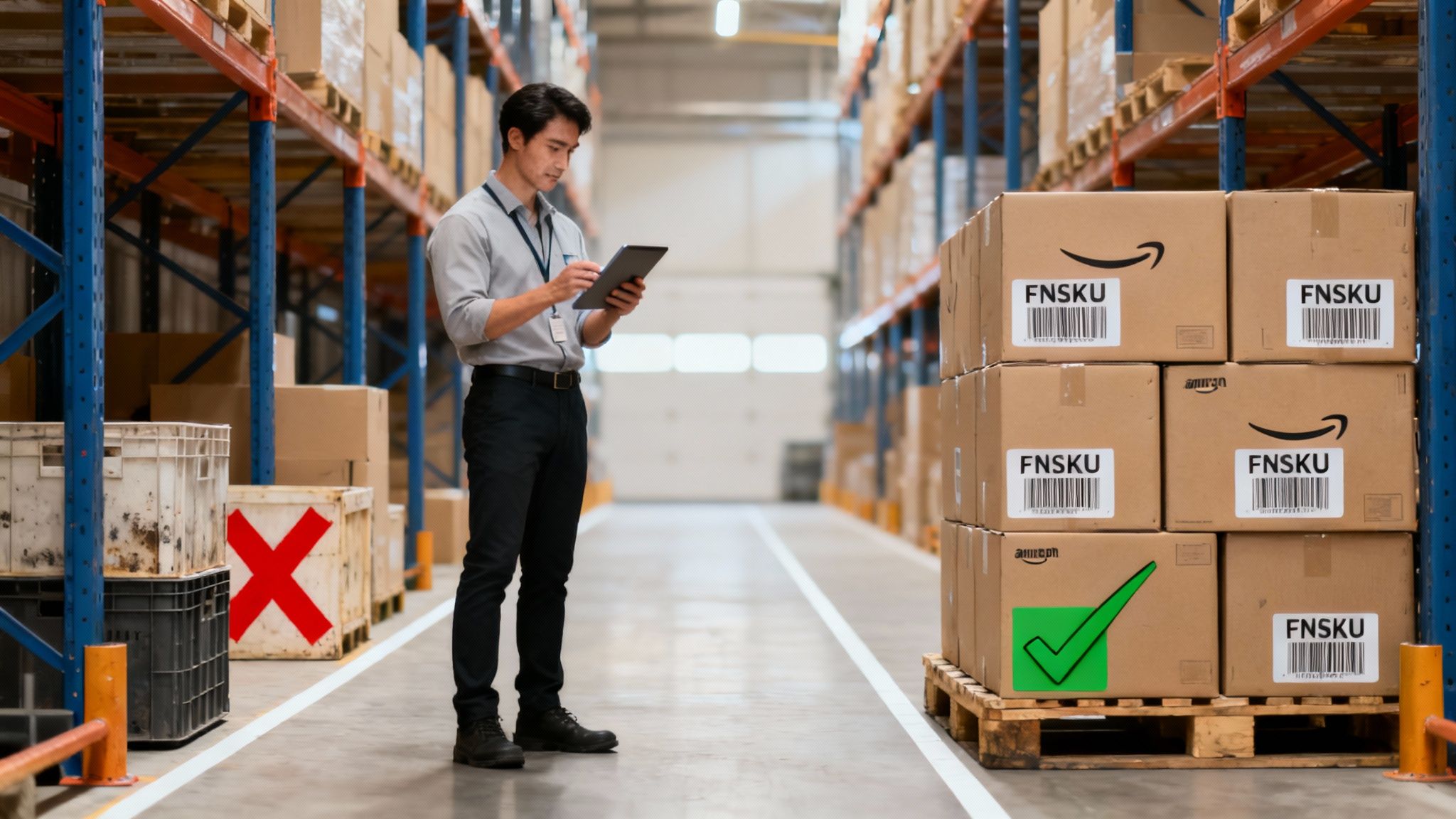
So many new sellers make the mistake of thinking any old shipping company can get their products to Amazon. That assumption can be a disaster, leading to rejected shipments, unexpected fees, and—worst of all—stockouts during peak seasons like Q4.
A generic shipper is great at moving a pallet from Point A to Point B. But the journey to an FBA fulfillment center is loaded with unique hurdles. Amazon runs a tightly controlled inbound system that standard carriers simply aren't equipped to navigate.
The Specialized Role of an FBA Forwarder
Unlike a regular courier, an FBA freight forwarder lives and breathes the Amazon ecosystem. They’re fluent in the language of FNSKUs, pallet requirements, and carton labels. Think of them as a highly specialized type of Third-Party Logistics Provider (3PL), acting as a strategic partner laser-focused on getting your products through Amazon's gates.
Here’s where their expertise really shines:
- Booking Delivery Appointments: You can't just show up at an Amazon warehouse. FBA forwarders know how to navigate the Carrier Central portal to book the precise delivery slots Amazon requires.
- Ensuring Compliance: They double-check that your products and boxes are labeled exactly to Amazon's strict standards, helping you dodge costly re-labeling fees or an outright refusal of your shipment.
- Handling Customs: They manage the entire customs clearance process, ensuring duties and taxes are paid correctly so your inventory doesn't get stuck in limbo at the port.
The real value of an FBA-focused forwarder is risk mitigation. They prevent the small errors that cascade into major supply chain disruptions, protecting your seller ranking and cash flow.
With the intense competition on Amazon, having your logistics dialed in is non-negotiable. The reality is, over 82% of Amazon's active sellers are using FBA to stay competitive, which makes expert forwarding an essential part of the puzzle. Understanding this dynamic is a core part of learning https://npoint.digital/what-is-amazon-fba-mean/ for your business's growth.
Nailing the Essential FBA Shipment Paperwork
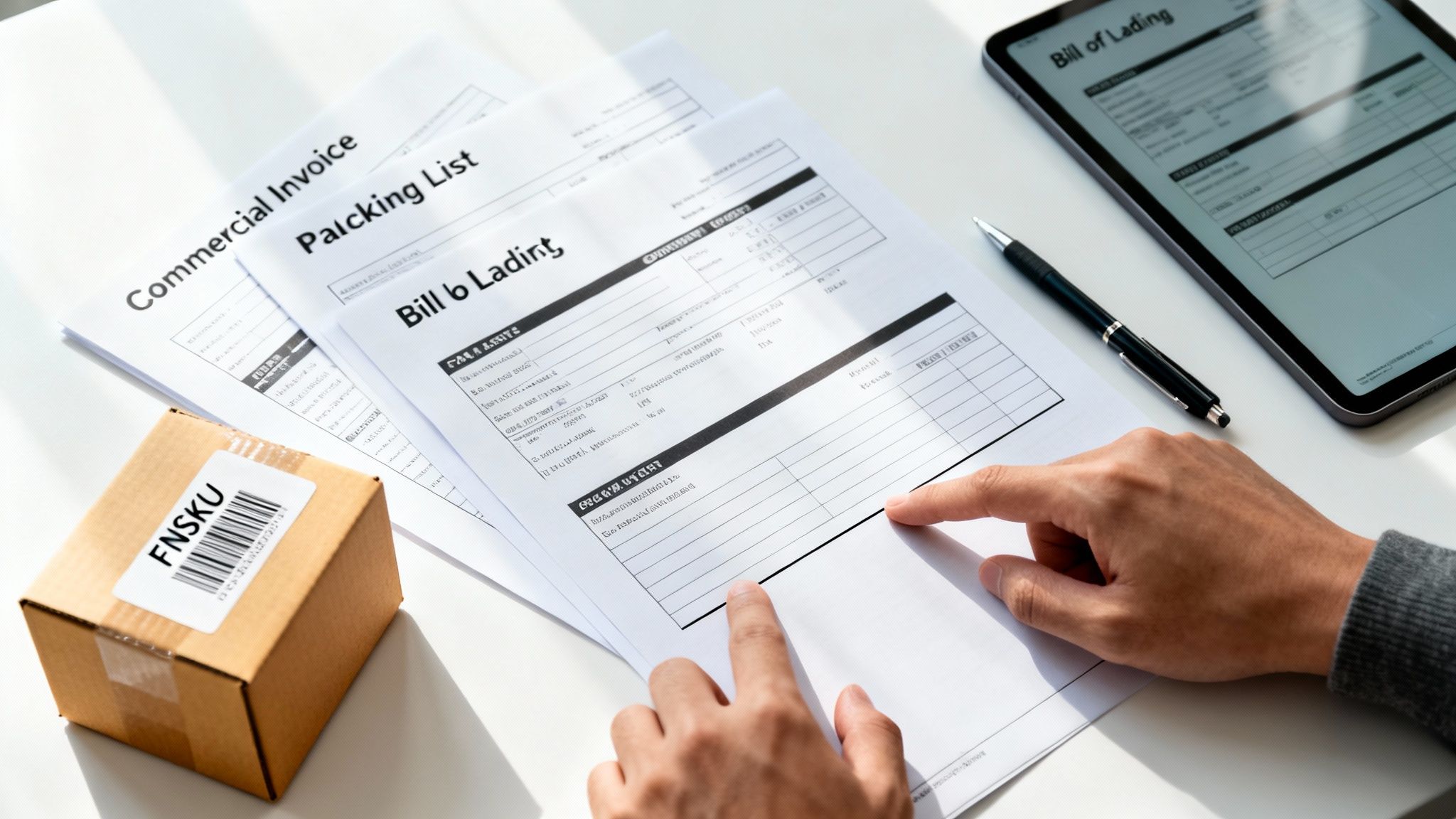
Let’s be honest, international shipping runs on paperwork. Get it right, and your inventory sails through customs. Get it wrong, and you’re looking at weeks of delays, surprise fees, and a launch that’s dead on arrival. One tiny typo can turn a profitable product into a logistical nightmare.
A good freight forwarder for Amazon FBA will be your guide here, but you are the final line of defense. Understanding the core documents yourself lets you spot those costly mistakes before your cargo ever leaves the factory.
Think of your shipping documents as your product’s passport. Without the right stamps and signatures, it’s not going anywhere. The big three you absolutely need to master are the Commercial Invoice, the Packing List, and the Bill of Lading.
The Core Three Shipping Documents
First up is the Commercial Invoice. This is the single most important document for customs. It spells out everything: who’s buying, who’s selling, what the goods are, how much they’re worth, and the HS Code. The Harmonized System (HS) code is a universal product classification number, and getting it wrong is a classic rookie mistake that practically guarantees a customs inspection.
Next, you have the Packing List. This is exactly what it sounds like—a detailed inventory of what's inside every single carton, right down to the weights and dimensions. It’s what allows customs agents and your forwarder to verify the contents without having to rip open every box on the pallet.
Finally, there's the Bill of Lading (BOL). This is your contract with the shipping carrier. It serves as both a receipt confirming they have your goods and a title document proving you own them. Your forwarder will need this to claim your shipment when it arrives at the destination port.
Pro Tip: Never, ever let a shipment leave the factory without getting draft copies of these documents from your supplier. A five-minute review can save you thousands of dollars and weeks of stress. Check everything—the address, the HS code, the product quantities. Trust me, it’s worth it.
Amazon-Specific Labeling Requirements
Getting through customs is only half the battle. Amazon has its own set of strict, non-negotiable labeling rules. If you mess this part up, your shipment will get rejected at the fulfillment center door. Then you’re stuck paying for storage and scrambling to get everything re-labeled. It’s expensive and totally avoidable.
Your freight forwarder can usually handle this prep for you (for a fee, of course), but you need to know exactly what to ask for.
- FNSKU Labels: Every single unit needs its own Amazon-generated FNSKU barcode. This label must completely cover any other barcode on the product, like a UPC. It’s how Amazon tracks your specific inventory inside its massive warehouses. No FNSKU, no check-in.
- FBA Box ID Labels: Every carton in your shipment needs an FBA Box ID label. You generate these from your shipping plan in Seller Central, and they tell the warehouse team exactly what’s in the box and who it belongs to.
Imagine shipping 500 garlic presses from your supplier in China. They accidentally list the wrong HS Code on the Commercial Invoice. That one little error triggers a manual customs inspection, delaying your shipment by two weeks. You miss your launch window, your BSR tanks, and your ranking momentum vanishes.
This isn’t a far-fetched scenario; it happens all the time. It’s a perfect example of why perfect paperwork isn’t just a formality—it’s the bedrock of a smooth-running FBA supply chain.
How Incoterms and Hidden Fees Impact Your Bottom Line
If you think you can just look at a freight quote and know your costs, you might be in for a rough surprise. The real difference between a profitable product and one that bleeds money often comes down to one thing most sellers overlook: Incoterms.
These are the international commercial terms that spell out exactly who is responsible for what during the shipping process. Getting this wrong can bury you in unexpected fees for things like port handling, customs exams, and local trucking. That cheap quote can quickly become your most expensive mistake.
Your freight forwarder for Amazon FBA should be your guide here, but you absolutely need to speak the language to protect your business.
Decoding the Most Common Incoterms
Let's cut through the jargon and look at the three Incoterms you’ll run into most often. Each one shifts the balance of cost, risk, and responsibility.
-
EXW (Ex Works): This one puts almost everything on your shoulders. You're responsible for picking up the goods from the factory door and handling every single step from there. We're talking export customs, trucking to the port, ocean freight, import clearance, and final delivery. It gives you the most control, but it also comes with the most risk and logistical headaches.
-
FOB (Free On Board): This is the go-to for many experienced sellers for a reason. It's a balanced approach. Your supplier handles everything needed to get your products loaded onto the ship at the origin port. The moment the cargo is on that vessel, the risk and cost transfer to you. From there, you're on the hook for the main freight journey, insurance, and everything on the destination side.
-
DDP (Delivered Duty Paid): Think of this as the "all-inclusive" option. The price you're quoted covers the entire journey, including shipping, duties, and taxes, right to the Amazon fulfillment center's doorstep. It’s convenient, no doubt. But that convenience usually comes at a premium, and it can be tough to see where costs might be inflated in that single bundled price.
A classic rookie mistake is choosing EXW just to get a lower per-unit price from a supplier. They get a great deal on the product, only to be blindsided by massive local transport and export fees in China that an FOB agreement would have covered. Always get a full landed cost estimate before you commit.
Calculating Your True Landed Cost
Your landed cost isn't just the freight quote. It’s the total expense to get a single unit from the factory floor into an Amazon warehouse, ready to sell. Nailing this down is fundamental to figuring out how to determine the price of a product for profit and making sure your margins don't evaporate.
Knowing your numbers has never been more critical. In 2025, supply chain chaos has become the new normal. We’ve seen the average shipping delay spike by a staggering 37% compared to pre-pandemic times.
That translates to an average of 23 extra days in transit. For critical Asia-to-North America routes, transit times have ballooned from a manageable 40 days to a painful 67 days. Those delays can lead to unexpected storage fees and costly stockouts.
To help you see the full picture, here's how responsibilities shift between the most common Incoterms.
Incoterms Responsibility Breakdown for FBA Sellers
This table breaks down who pays for what, depending on the term you agree to with your supplier. The checkmarks indicate who is typically responsible for the cost at each stage.
| Stage of Shipment | EXW (Ex Works) | FOB (Free On Board) | DDP (Delivered Duty Paid) |
|---|---|---|---|
| Product Cost | You | You | Included in Price |
| Origin Trucking | You | Supplier | Supplier |
| Export Customs | You | Supplier | Supplier |
| Origin Port Fees | You | Supplier | Supplier |
| Ocean/Air Freight | You | You | Supplier |
| Insurance | You | You | Supplier |
| Destination Port Fees | You | You | Supplier |
| Customs Brokerage | You | You | Supplier |
| Duties & Taxes | You | You | Supplier |
| Final Delivery | You | You | Supplier |
As you can see, DDP looks simple because the supplier handles everything, but you pay for that simplicity. On the other end, EXW gives you control but leaves you managing (and paying for) every single step. For many FBA sellers, FOB strikes the right balance between cost, control, and supplier responsibility.
How to Vet and Choose Your FBA Forwarding Partner
Picking the right freight forwarder for Amazon FBA is one of those make-or-break decisions that directly hits your inventory, cash flow, and ultimately, your brand's reputation. Going with the cheapest quote is a rookie mistake I see sellers make all the time. The real win is finding a partner who genuinely understands Amazon's notoriously complex logistics system.
A cheaper forwarder who doesn’t get FBA prep rules or how to book a Carrier Central appointment can cost you thousands in rejected shipments and lost sales. Your vetting process should feel like a job interview, because that's exactly what it is. You're hiring a critical team member.
Beyond the Price Quote
Start by asking pointed questions that get to the heart of their expertise. Don’t just ask, "Do you ship to Amazon?" That's a lazy question.
Instead, dig deeper: "Can you walk me through your process for handling a rejected FBA shipment?" or "How do you manage split shipments to multiple fulfillment centers?" Their answers will quickly separate the true specialists from the generalists.
Another huge tell is their communication during the quoting process. Are they responsive? Do they answer your questions clearly and completely? If they’re slow and vague before they have your money, just imagine what the service will be like when your shipment is stuck at a port.
A forwarder's responsiveness during the quoting stage is the single best predictor of their customer service quality. If it takes them three days to send a quote, it will take them a week to respond when there's a problem.
Key Criteria for Your Shortlist
As you start comparing potential partners, zoom in on these essential capabilities. The right forwarder should be way more than just a shipper; they should feel like an extension of your own operations team.
- In-House FBA Prep Services: Can they handle FNSKU labeling, polybagging, or creating product bundles for you? A forwarder offering these services is a lifesaver, especially if your supplier's prep work isn't quite up to Amazon's strict standards.
- Integrated Customs Brokerage: A forwarder with an in-house customs broker is a game-changer. They can clear your goods much faster, avoiding the frustrating delays that happen when one company has to hand off critical documents to another.
- A Modern Tracking Portal: You absolutely need real-time visibility. A quality forwarder will give you a clean, easy-to-use online platform where you can track your shipment's entire journey, from the factory floor to the FBA check-in scan.
- Proven FBA Experience: Don't be shy—ask for case studies or references from other Amazon sellers. A forwarder who is genuinely proud of their FBA work will have plenty of success stories to share.
Choosing the right partner is a foundational step as you figure out how to scale an ecommerce business effectively. Ultimately, your choice will come down to massive global firms versus smaller, boutique specialists. The big guys offer vast networks, while boutique forwarders often provide more personalized, hands-on service. Think about which model best aligns with your brand’s size and the level of support you need.
Your Shipment's Journey from Factory to FBA Warehouse
So, you've picked your forwarder and you're ready to ship. What happens next? Getting your products from the factory floor in another country to an Amazon fulfillment center isn't a single step—it's a multi-stage marathon, and your freight forwarder is the race director. A good freight forwarder for Amazon FBA makes this incredibly complex process feel almost seamless.
The whole thing kicks off the second your goods are packed and ready to go. Your forwarder schedules a truck to pick up the inventory right from your supplier. This first leg is called origin handling, and it involves moving the cargo to the port or airport and, crucially, clearing it through export customs. Any mistake here—a typo on a form, a missing document—can bring the entire shipment to a screeching halt before it even leaves the country.
From Port to Port
Once your shipment is cleared for export, it gets loaded onto a massive container ship or a cargo plane. This is usually the longest part of the journey, where your inventory is out on the water or in the air for days or even weeks. Throughout this phase, a solid forwarder will provide you with tracking updates so you're not left guessing where your investment is.
When the ship or plane arrives at the destination port, the real administrative gauntlet begins: customs clearance. This is where your forwarder’s customs brokerage team shines. They'll submit all the essential documents—the commercial invoice, packing list, and Bill of Lading—to the local customs authorities. They also handle paying all the necessary duties and taxes, a step that requires absolute precision to avoid painful delays, inspections, or even seizure of your goods.
This flowchart breaks down the simple but critical stages of vetting a forwarder to make sure they can handle this journey.
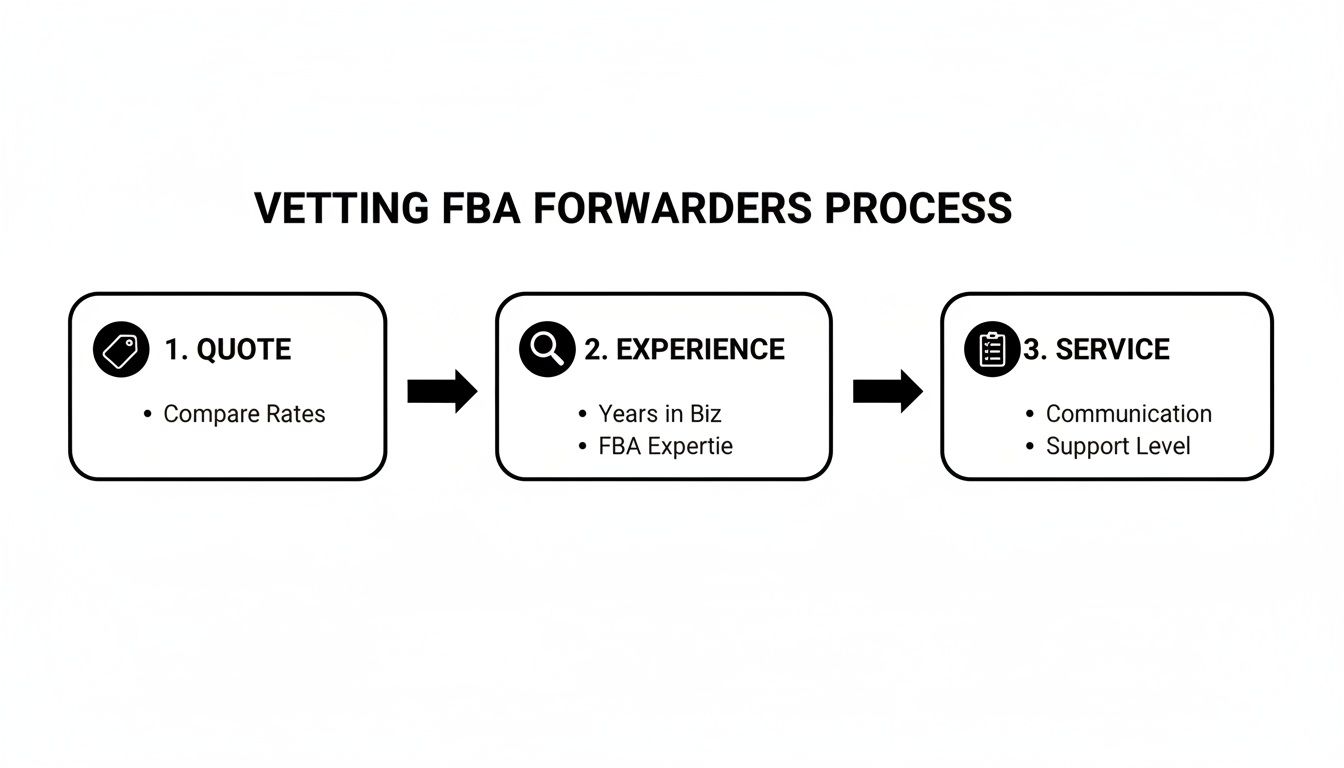
Nailing this vetting process is how you find a partner who can truly manage the complexities of the shipping world. To get a better sense of what your forwarder is navigating, it helps to understand the broader international supply chain management landscape they operate in.
The Final Mile Delivery to Amazon
After clearing customs, your inventory is trucked to a local warehouse. This is often where any last-minute FBA prep happens, like applying FNSKU labels or palletizing the boxes to meet Amazon's strict standards. Then comes the final, and often most stressful, part: the "final mile" delivery to the Amazon fulfillment center.
Your forwarder can't just show up. They have to book a very specific delivery appointment through Amazon's Carrier Central portal. If they miss that appointment window or show up with pallets that don't meet Amazon's requirements, your entire shipment can be rejected. It's a logistical nightmare that can cost you thousands. This is where an FBA-savvy forwarder really proves their value, ensuring your products get there on time and are checked in without a problem. Knowing your Amazon sales data is key here, as it helps you plan inventory levels to avoid these very headaches.
Your freight forwarder is becoming more than just a logistics provider; they're a strategic partner. This is especially true as Amazon aims to manage 96% of FBA inbound volume directly by 2026. With shipping costs skyrocketing by 189% since 2022, having an expert manage this journey is non-negotiable for staying profitable.
Your Top FBA Freight Forwarding Questions, Answered
Jumping into FBA logistics, especially when you're moving inventory across the globe, is bound to bring up some questions. Getting straight answers is the only way to build a supply chain you can actually rely on. Let's tackle some of the most common questions sellers have about working with a freight forwarder for Amazon FBA.
What’s the Difference Between a Freight Forwarder and a Customs Broker?
It's easy to get these two mixed up, but their roles are pretty distinct. Think of your freight forwarder as the general contractor for your shipment. They’re the ones orchestrating the entire journey—from booking space on an ocean liner or cargo plane all the way to arranging the final truck delivery to Amazon. They manage the big-picture logistics.
A customs broker, on the other hand, is a highly specialized, licensed professional. Their job is very specific: to act as your legal agent with a country's customs authority. Their sole focus is to make sure your shipment gets into the country legally by preparing all the right paperwork and handling the duties and taxes.
While a lot of the big freight forwarders have customs brokerage services in-house, they are still two separate functions. For any FBA seller importing products, working with a forwarder that has a solid, integrated customs team is non-negotiable. It’s what keeps your inventory from getting stuck in customs purgatory at the port.
Should I Use Air or Sea Freight for My FBA Shipments?
This is the classic FBA seller dilemma, and it really comes down to a trade-off between speed and cost. Neither one is always the "right" answer; it completely depends on your product, your margins, and where you are in your inventory cycle.
-
Air Freight: This is your express lane. It's fast—you're typically looking at 5-10 days from the factory floor to an Amazon fulfillment center. That speed is perfect when you're launching a new product, sending in a small test run, or rushing an emergency restock to avoid a costly stockout. But all that speed comes at a much higher price.
-
Sea Freight: This is the workhorse of global trade for a reason. It's significantly cheaper than air, especially for anything heavy or bulky, but you pay for it in time. You need to plan for a transit time of 30-60 days, and sometimes even longer depending on the route and port congestion.
A lot of successful sellers use a hybrid approach. They'll airship a small initial batch to get sales rolling and start collecting reviews. At the same time, the main bulk of their inventory is already on a container ship, making its way across the ocean at a much more sustainable cost. This keeps the sales momentum going without completely killing your profit margins.
Choosing your shipping method directly impacts your cash flow and how fast your inventory turns over. A slow sea shipment can tie up your capital for two months straight, while a last-minute air shipment can wipe out your profits. Plan ahead and learn to use both methods strategically.
What if My Supplier Can't Handle FBA Prep?
Don't panic—this is an incredibly common scenario. It's also a perfect example of where a great FBA forwarder really shines. You might find an amazing manufacturer who makes a fantastic product but has absolutely no clue how to handle Amazon's strict prep requirements for FNSKU labeling, poly bagging, or bundling.
If your supplier can't do it, your forwarder can. Most forwarders who specialize in FBA offer prep services at their own warehouses, usually located near major ports. They’ll have your goods shipped directly from the factory, perform all the necessary prep work to make sure it's 100% compliant with Amazon's rules, and then handle the final delivery into the FBA network.
How Should I React if My Shipment Gets Delayed?
First things first: accept that delays are just part of the international shipping game. Port congestion, random customs inspections, and bad weather are going to happen. A good freight forwarder for Amazon FBA can't prevent every storm, but they will be proactive and transparent when a delay pops up.
Your best defense is to build a buffer into your inventory planning right from the start. Never, ever plan for a perfect, best-case-scenario timeline. When a delay does happen, your forwarder should give you a clear reason and an updated ETA. That information is gold because it lets you adjust your ad spend and sales forecasts, which is critical if you want to know how to improve Amazon sales velocity even when your shipment is running late.
At Next Point Digital, we help ecommerce brands turn logistical challenges into growth opportunities. From optimizing your marketplace presence to managing inventory, our data-driven strategies ensure your supply chain supports your sales goals.