

Before you can build a high-converting sales funnel, you need a blueprint. Forget the old, rigid models—think of your funnel less as a business tool and more as a map of your customer’s psychological journey. It’s all about understanding where they are, mentally, and meeting them there.
A great funnel aligns your marketing messages with a person's current level of awareness and intent. This stops you from pitching a sale to someone who just discovered their problem or, just as bad, boring a ready-to-buy customer with beginner-level info.
This journey starts long before they land on a product page. In fact, a critical early decision is simply choosing between platforms like ClickFunnels and WordPress, as each offers a completely different foundation for building out these customer paths.
The Three Core Funnel Stages
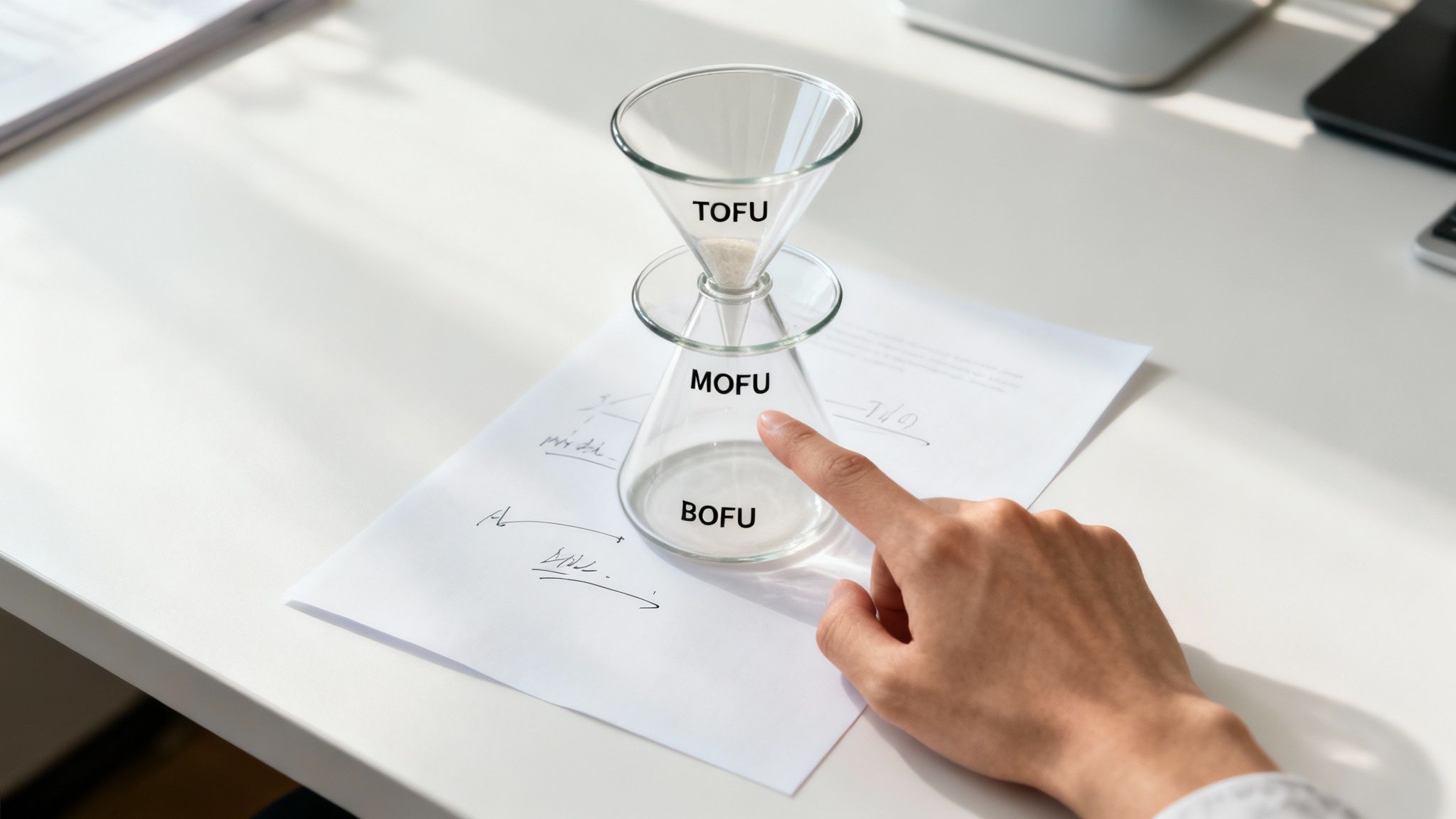
The classic sales funnel is typically broken down into three main sections: Top of the Funnel (TOFU), Middle of the Funnel (MOFU), and Bottom of the Funnel (BOFU).
Each stage represents a different mindset and requires a completely different approach. Get this right, and you'll build a system that naturally nurtures relationships and drives conversions.
-
Top of the Funnel (TOFU): This is the Awareness stage. Your audience has a problem, but they probably don’t know you or your specific solution even exists. Your goal here is to attract and educate. Don't sell. They're looking for answers and expert guidance.
-
Middle of the Funnel (MOFU): Welcome to the Consideration stage. At this point, prospects know who you are and are actively weighing their options. Now, your goal is to build trust and position your product as the obvious best choice.
-
Bottom of the Funnel (BOFU): This is the Decision stage. Your prospect is on the verge of buying but might just need one last nudge. The goal is simple: convert them. You do this with a compelling offer and by making the buying process as smooth as possible.
To help you visualize this, here’s a quick breakdown of how each stage functions.
The Three Core Stages of a Sales Funnel
| Funnel Stage | Primary Goal | Customer Mindset | Key Metrics |
|---|---|---|---|
| Top (TOFU) | Attract & Educate | "I have a problem, and I'm looking for answers." | Traffic, Impressions, Reach, Engagement |
| Middle (MOFU) | Build Trust & Nurture | "I'm comparing solutions to find the best one for me." | Lead Magnet Downloads, Email Open/Click Rates |
| Bottom (BOFU) | Convert & Close | "I'm ready to buy, but I need the right offer." | Conversion Rate, Add-to-Carts, Sales, ROAS |
Seeing it laid out like this makes it clear why each stage demands a unique strategy.
A rookie mistake is pouring all your energy and budget into the bottom of the funnel. A healthy funnel needs a constant flow of new leads from the top, which are then nurtured through the middle. That’s how you get a steady stream of customers at the end.
Mapping your customer journey to these stages lets you create a much more persuasive experience. The whole game is about delivering the right content, to the right person, at exactly the right time. This is the bedrock of any successful data-driven marketing strategies that consistently turn casual browsers into loyal customers.
Mapping Your Ecommerce Funnel Blueprint
Before you write a single line of copy or spend a dollar on ads, you need a plan. Building a high-converting sales funnel isn't about throwing up a landing page and hoping for the best; it’s about architecting the entire customer journey from the ground up. The foundation of that entire plan starts with knowing exactly who you're selling to.
And I don’t mean basic demographics like age and location. You need to dig into the real-world problems your ideal customer is facing. What keeps them up at night? What are they trying to achieve? More importantly, what specific pain point does your product solve for them?
Think about it this way: a brand selling ergonomic office chairs isn't just selling furniture. They're selling relief from nagging back pain, a boost in productivity, and the feeling of a professional home office. Your blueprint has to start from this problem-aware perspective.
Choosing Your Primary Traffic Sources
Once you have a crystal-clear picture of your customer, the next question is simple: where will you find them? Not all traffic is created equal, and your choice of channels should align directly with where your ideal customers already spend their time.
If your product is highly visual and perfect for an impulse buy—like unique apparel or eye-catching home decor—paid social is probably your best bet. A well-targeted Meta ad campaign can put your product right in front of audiences who have already shown interest in your niche. It’s direct, fast, and visual.
On the other hand, if your product solves a specific, research-heavy problem—like specialized skincare for acne or supplements for joint health—then organic search is your lifeline. People are literally typing their problems into Google. Your goal is to be the solution they find waiting for them.
- Paid Social (Meta, TikTok): Best for visual products, building brand awareness, and targeting based on interests and behaviors.
- Search Engine Optimization (SEO): A must for problem-solving products where customers are actively looking for information and answers.
- Paid Search (Google Ads): Excellent for snagging high-intent customers at the very bottom of the funnel who are ready to pull out their wallets right now.
Start with one or two primary channels. Focus your energy, master them, and then expand. Spreading yourself too thin is a classic mistake that just dilutes your impact.
Designing an Irresistible Lead Magnet
Okay, you've got traffic heading to your site. Now what? You need a compelling reason for them to hand over their contact information. This is where your lead magnet comes in. A lead magnet is a freebie you offer in exchange for an email address, officially turning an anonymous visitor into a qualified lead.
The secret to a great lead magnet is providing undeniable, immediate value that directly solves a small part of your customer's bigger problem. A generic "10% off" coupon can work, sure, but it often just attracts one-and-done discount seekers, not loyal fans.
A truly effective lead magnet solves a small piece of the customer's larger problem for free. It builds trust and positions your brand as an expert, making the eventual sale a natural next step instead of a hard pitch.
Think about what your audience really needs. For a brand selling high-performance running shoes, a downloadable PDF guide like "The 5 Best Stretches to Prevent Shin Splints" is infinitely more valuable and targeted than a simple discount.
Here are a few other powerful lead magnet ideas for ecommerce:
- Exclusive Video Tutorials: A short video showing how to style a piece of clothing in three different ways.
- Interactive Quizzes: A quick quiz that helps customers find the perfect skincare product for their unique skin type.
- Checklists or Worksheets: A simple "Kitchen Decluttering Checklist" for a brand that sells home organization products.
Your lead magnet is the handshake that begins the relationship. Make it a firm one.
Assembling Your Essential Tech Stack
Finally, your blueprint needs a solid technological foundation to actually bring it to life. You don’t need a dozen complicated tools, but a few core components are non-negotiable for building and scaling a proper sales funnel. This is the engine that powers the entire journey.
Here’s a quick look at the essential tools you’ll need to get started:
| Tool Category | Purpose | Popular Examples |
|---|---|---|
| Landing Page Builder | To create focused, high-converting pages for your ads and lead magnets. | Leadpages, Instapage, Unbounce |
| Email Marketing Platform | To capture leads and send automated email sequences that nurture them. | Klaviyo, Mailchimp, ActiveCampaign |
| Analytics & Tracking | To measure what's working, find out what's not, and fix the leaks. | Google Analytics, Hotjar, Triple Whale |
The key is choosing tools that play nicely together. Your landing page builder should connect directly to your email platform, so new leads are automatically dropped into your nurture campaigns without any manual work. This cohesive system is the operational backbone of your entire funnel.
Building High-Converting Landing Pages
Think of your landing page as the digital front door to your entire sales funnel. After someone clicks your ad, this is the very first real interaction they have with your offer. This single page has one job and one job only: turn that visitor into a lead. If it falls flat, the rest of your carefully built funnel is useless.
Getting this right isn’t about flashy design or complicated bells and whistles. It’s about clarity, psychology, and an obsessive focus on what the user needs to do next. Every single element, from the headline down to the button color, has to work together to nudge the visitor toward one specific action. This is where your funnel blueprint starts to come to life.
The Anatomy of a Winning Landing Page
A truly great landing page is a masterclass in persuasive communication. It anticipates a visitor's questions and answers them in a natural, logical flow, removing any friction and building momentum straight to your call-to-action.
These are the non-negotiable parts you absolutely have to nail:
- A Magnetic Headline: Your headline is your one shot to grab attention. It has to scream value and connect directly back to the ad they just clicked. If you sell artisanal coffee, a headline like "Tired of Bitter, Burnt Coffee?" hits much harder than a generic "Welcome to Our Coffee Shop."
- Persuasive, Scannable Copy: Let's be honest, nobody reads dense walls of text online. Use short sentences, punchy bullet points, and clear subheadings to lay out the benefits. Always focus on what the customer gets, not just what your product is.
- Compelling Visuals: A high-quality image or a quick video can show your product's value way faster than words ever could. Show it in action. Feature a real customer loving it. Your visuals need to support the story you're telling, not just fill space.
- An Unmistakable Call-to-Action (CTA): Your CTA button needs to be impossible to miss. Use a color that pops and action-focused text like "Get My Free Guide" or "Start My Trial." Anything is better than a passive, boring word like "Submit."
For a deeper dive into the small tweaks that make a huge difference, check out this great resource on how to optimize landing pages for conversion.
The Psychology of Lead Capture Forms
Your lead capture form is the single biggest friction point on the entire page. Ask for too much information, and you'll scare people off. Ask for too little, and you won't have what you need to nurture them properly. The magic is in finding that balance.
This isn’t just a gut feeling; the data backs it up. Turning visitors into customers is the top priority for 69% of marketers, and the signup form plays a huge role. In fact, simply asking for three or fewer pieces of information can boost conversion rates by an average of 10%.
The rule of thumb here is simple: only ask for what you absolutely need to take the next step. If you're offering a lead magnet, an email address is probably enough. You can always gather more info later as you build the relationship.
This diagram breaks down those crucial early stages that bring a potential customer to your landing page in the first place.
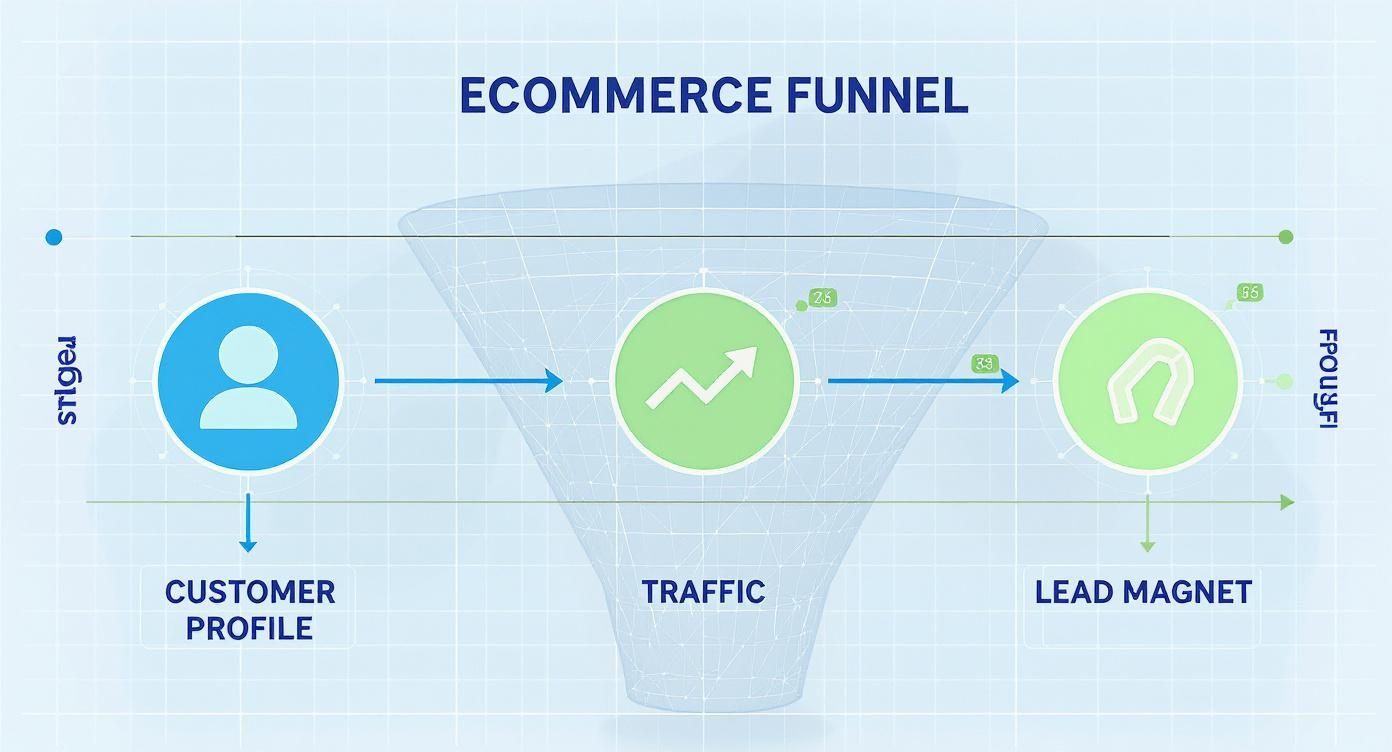
As you can see, it all starts with deeply understanding your customer so you can drive the right traffic to an offer they simply can't refuse.
Bringing It All Together with Personalization
Once you've got the core elements locked in, you can take things to the next level by making the experience feel personal. The data you collect isn't just for stuffing into your CRM—it's your key to creating a more relevant journey for every single user.
Imagine a visitor lands on your page from an ad about "vegan protein powder." Your headline, your copy, and even your images should all reflect that specific interest. This kind of dynamic content makes the visitor feel seen and confirms they've landed in the right place. The right ecommerce personalization software can automate this, making sure every visitor gets an experience tailored to them. That simple act of alignment can dramatically increase the odds of them taking that crucial next step.
Automating Email Sequences to Nurture and Sell
Getting a visitor to hand over their email address is a huge win, but it’s not the finish line. It’s the starting gun. This is where the real work of building a relationship begins, and automated email sequences are your single most powerful tool for turning a curious lead into a paying customer. Without a smart email strategy, your leads will quickly grow cold.
Think of email automation as your best salesperson, working 24/7 to deliver the perfect message at the perfect moment. It allows you to guide each lead on a personalized journey, building trust and demonstrating value long before you ever ask for the sale. This is a core part of building a sales funnel that generates predictable revenue.
Crafting the Perfect Welcome Series
Your welcome series is your first impression, and it sets the tone for the entire relationship. A single, generic "thanks for subscribing" email just won't cut it. A strong welcome sequence should be a series of three to five emails sent over the first week, designed to onboard your new lead and make them feel like they made the right choice.
The goal isn't to sell immediately. It's to deliver on the promise of your lead magnet, introduce your brand's personality, and provide immediate value. A great first email should be simple: deliver the freebie they signed up for and warmly welcome them to your community. Subsequent emails can share your brand's story, highlight your most popular content, or offer a small, exclusive bonus.
The Value-Packed Nurturing Sequence
After the initial welcome, leads enter a nurturing sequence. This is the "middle of the funnel" stage where your primary job is to educate, solve problems, and build authority. You're not pushing products; you're proving that you understand their challenges and have the expertise to help.
This sequence can be triggered by specific actions, like downloading a particular guide or visiting a certain page. The content should be hyper-relevant to that initial interest.
- For a skincare brand: If someone downloaded a guide on "Managing Oily Skin," the nurture sequence could include emails on "Top 5 Ingredients for Oil Control" or "A Morning Routine for Shine-Free Skin."
- For a home goods store: If a lead signed up through a "Kitchen Organization Checklist," you could send them content about meal prep tips or decluttering hacks.
This approach positions your brand as a trusted advisor, making the eventual sales pitch feel like a natural and helpful next step.
Your email content should be 90% value and 10% pitch. When you consistently solve your audience's problems for free, they'll be far more receptive when you finally present a paid solution. This is the foundation of trust-based selling.
Recovering Lost Revenue with Cart Abandonment Flows
One of the most profitable email automations you can build is the cart abandonment sequence. Statistics show that nearly 70% of online shopping carts are abandoned before a purchase is completed. That's a massive amount of potential revenue left on the table.
A timely, well-crafted cart abandonment email can bring a significant portion of those customers back to finish their purchase. Don't just send one email—a sequence of three is often most effective.
- Email 1 (Sent ~1 hour after abandonment): A gentle reminder. "Did you forget something?" This email should be helpful, perhaps mentioning that you've saved their cart for them.
- Email 2 (Sent ~24 hours later): Address common objections. This is a great place to highlight your return policy, customer testimonials, or offer to answer questions via live chat.
- Email 3 (Sent ~48-72 hours later): Create urgency with a small incentive. This is where you can offer a modest discount, like 10% off or free shipping, to provide that final nudge.
These automated flows are just one piece of a larger puzzle. To truly maximize their impact, they must be integrated with your other marketing efforts. To see how these automations fit into a broader plan, explore some of the best ecommerce marketing strategies that successful brands use to drive growth. Smart segmentation and targeted automation are what separate average funnels from high-converting ones.
Driving Traffic and Retargeting Your Audience
You can build the most elegant, persuasive sales funnel in the world, but it's completely useless if nobody ever sees it. Traffic is the lifeblood of your funnel, and getting a consistent stream of qualified visitors is where your growth strategy truly begins. It’s all about actively filling the top of your funnel with people who are likely to be interested in what you sell.
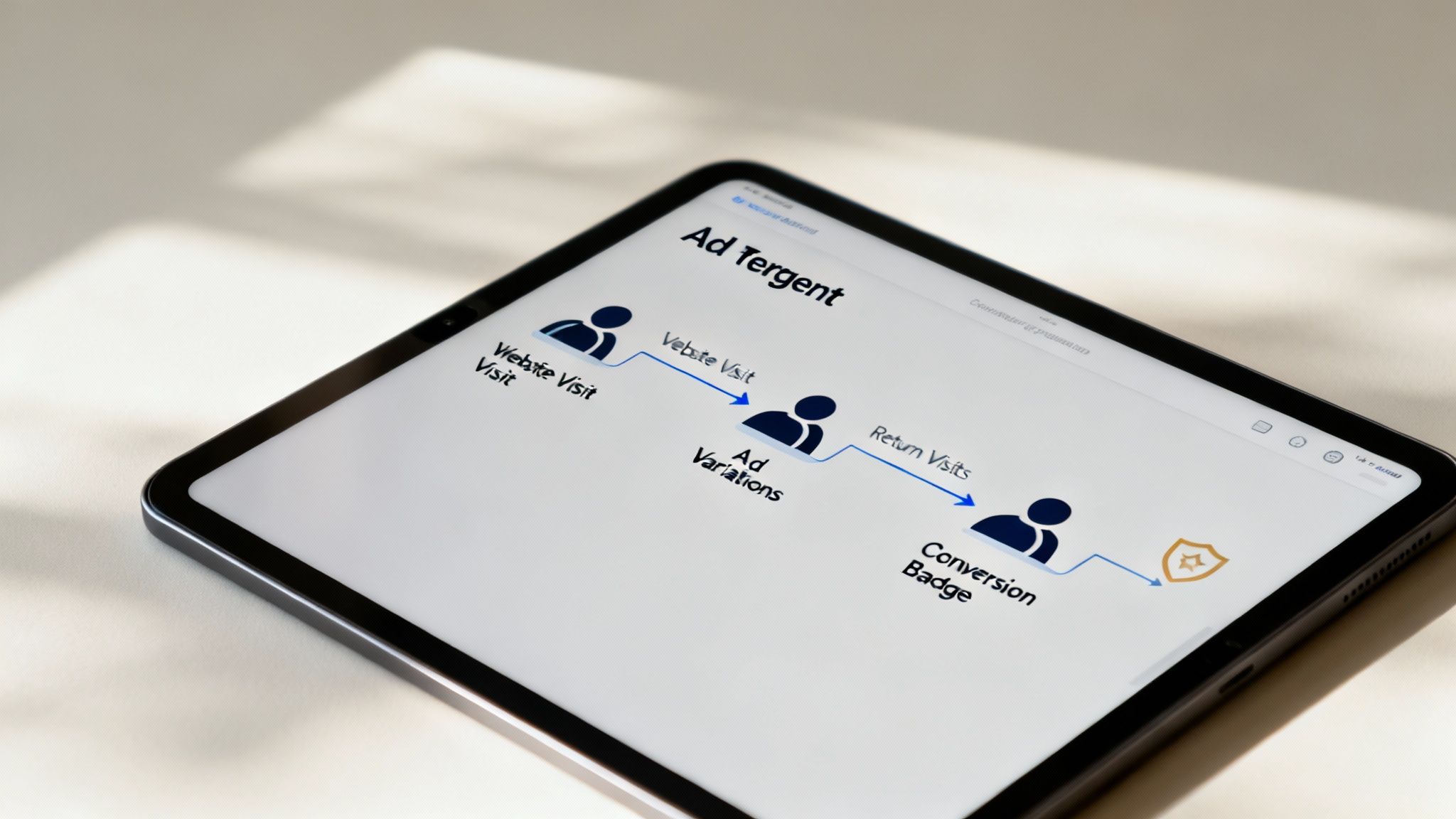
While organic methods are powerful for long-term growth, paid acquisition is the fastest way to get your offer in front of a precisely defined audience. It gives you immediate feedback and lets you test and refine your funnel's performance in real time.
Mastering Paid Acquisition Channels
Not all paid traffic is created equal. The key is to show up on platforms where your ideal customers are already active and in the right mindset. For most ecommerce brands, this boils down to two primary powerhouses: Meta (Facebook & Instagram) and Google Ads.
Meta Ads are brilliant for demand generation. You’re targeting users based on their interests, behaviors, and demographics, putting your product in front of people who didn't even know they needed it yet. This is perfect for visually appealing products or items that tap into specific hobbies and lifestyles.
Google Ads, on the other hand, excels at demand capture. You're targeting users based on the exact keywords they're searching for, which signals incredibly high purchase intent. Someone searching for "best vegan protein powder for runners" is much further down the funnel than someone just scrolling their Instagram feed.
Beyond these giants, don't overlook other platforms that might be a perfect fit for your niche:
- Pinterest Ads: A goldmine for brands in the home decor, fashion, food, and DIY spaces, since users are actively looking for inspiration and products.
- TikTok Ads: Unbeatable for reaching a younger demographic with engaging, short-form video content that feels native to the platform.
- Search Engine Optimization (SEO): While not a paid channel, a solid organic presence is the perfect partner to your paid efforts. Investing in sound ecommerce SEO best practices creates a sustainable source of high-intent traffic that pays dividends for years.
The Art of Strategic Retargeting
Here's a hard truth: the vast majority of your first-time website visitors will not buy anything. In fact, for ecommerce, the average conversion rate hovers around a sobering 2-3%. This is exactly why retargeting becomes your most profitable marketing activity. It’s the simple act of showing targeted ads specifically to people who have already visited your site but left without converting.
These aren't cold leads; they are warm prospects who have already demonstrated interest. Your job is to bring them back.
Retargeting isn't about annoying people with the same ad over and over. It's a second chance to make your case, address their potential hesitations, and remind them why they were interested in the first place. This is often where the highest return on ad spend (ROAS) is found.
Effective retargeting demands segmentation. You shouldn't show the same generic ad to every person who leaves your site. Break your audience down into more specific groups to deliver a message that’s far more relevant and compelling.
Crafting Ads for Different Funnel Stages
Your ad creative and copy absolutely must align with where the user is in their journey. A one-size-fits-all approach will just drain your budget with poor results. You have to tailor your message to match their level of awareness and intent.
| Funnel Stage | Audience | Ad Creative & Copy Goal |
|---|---|---|
| Top (TOFU) | Cold Audience (Interests, Lookalikes) | Educate & Intrigue. Use engaging videos or lifestyle images that grab attention. Focus on the problem you solve, not just the product features. |
| Middle (MOFU) | Warm Audience (Website Visitors, Video Viewers) | Build Trust & Showcase Value. Feature customer testimonials, user-generated content, or highlight a key benefit. The goal is to show social proof and answer "Why you?" |
| Bottom (BOFU) | Hot Audience (Added to Cart, Initiated Checkout) | Convert & Overcome Objections. Be direct. Remind them what's in their cart, create urgency ("Limited Stock!"), and offer a small incentive like free shipping to close the deal. |
By segmenting your traffic strategies and tailoring your messaging this way, you create a cohesive journey that guides users from initial awareness straight through to the final purchase. This turns your advertising from a simple expense into a predictable, revenue-generating system that feeds and powers your entire sales funnel.
How to Measure and Optimize Funnel Performance
Getting your sales funnel live is a huge step, but it’s just the starting line. A funnel isn't something you set and forget; it's a living system that needs constant attention and fine-tuning. The brands that really pull ahead are the ones who treat their funnel like a science experiment—using data to find and fix the leaks, turning small tweaks into massive growth over time.
This whole process kicks off by defining your key performance indicators (KPIs) for each stage. You simply can't improve what you don't measure.
For example, at the top of the funnel, you’ll be watching your ad click-through rates (CTR) and cost per lead (CPL). In the middle, it’s all about email open rates and lead magnet download rates. Once you get to the bottom, the focus shifts to the final conversion rate and average order value (AOV).
Tools like Google Analytics are non-negotiable here. They let you build a visual map of your funnel, showing you exactly where people are dropping off. If you see a massive plunge in numbers between your landing page and your thank you page, you know you’ve got a conversion problem right there. This data-first approach takes the guesswork out of the equation and points you directly to where your effort will make the biggest difference.
Pinpointing Leaks and Forming Hypotheses
Once you’ve spotted a "leaky" stage in your funnel, the real work begins: figuring out why it's leaking. This is where you put on your detective hat. Is the headline on your landing page confusing? Is the call-to-action button buried at the bottom of the page? Are you asking for way too much information during checkout?
This investigation is what helps you form a smart hypothesis for an A/B test. A solid hypothesis isn’t just a random guess. It looks something like this: "Changing the CTA button text from 'Submit' to 'Get My Free Guide' will increase form submissions because it’s more specific and shows the value."
This targeted testing is the heart of Conversion Rate Optimization (CRO), a discipline all about systematically improving your funnel’s performance. Our guide on conversion rate optimization best practices dives much deeper into how to build out a structured testing program.
Don't test random ideas. Every A/B test should be rooted in a data-backed hypothesis. Your analytics tell you what is happening; your job is to figure out why and test a potential solution.
Understanding Your Conversion Rate
Your overall funnel conversion rate is the ultimate health metric. It tells you how well the entire system is working together.
According to recent data, the average conversion rate for sales funnels globally sits somewhere between 2.35% and 7%. For most industries, hitting a rate of 3.1% to 5% is considered a solid benchmark for success.
Calculating this is simple: just divide your total number of conversions by the total number of leads who entered the funnel, then multiply by 100. You can dig into more of these sales funnel statistics here.
Consistent optimization is what drives sustainable growth. By tracking your KPIs, pinpointing leaks, and running disciplined A/B tests, you can transform your sales funnel from a simple marketing tool into a powerful, predictable revenue machine that only gets smarter with every bit of data you collect.
At Next Point Digital, we specialize in engineering and optimizing data-driven sales funnels that turn clicks into customers. If you're ready to scale your ecommerce brand with a strategy built for profitable growth, let's connect. Learn more about our approach at https://npoint.digital.