

If you want to improve your ecommerce sales, it boils down to three things: getting your products seen, convincing people to buy, and keeping them coming back. Forget chasing every new trend. A solid strategy focuses on how customers find you, why they choose you, and what makes them loyal. That’s how you build sustainable growth, not just temporary sales spikes.
Your Framework for Immediate Ecommerce Growth
Struggling to get your sales numbers moving in the right direction? You’re not alone. So many brands get tunnel vision, focusing on a single channel like running ads without ever building a solid foundation underneath. A real plan for improving ecommerce sales is about more than just one tactic; it’s a full-court press that works whether you're on Amazon, Walmart, or your own D2C site.
The goal here is to get past the high-level theories and give you an actionable plan that makes an impact right away. Before we jump into specific playbooks, it’s crucial to understand the "what" and "why" behind a strategy that actually works. These pieces fit together to create a powerful, self-sustaining momentum for your business.
The Three Pillars of Ecommerce Success
At the end of the day, ecommerce growth isn't about some secret hack. It’s about getting three interconnected areas right. If you let one of them slide, the other two will suffer—it’s that simple.
- Visibility: This is the top of your funnel. It’s all about making sure potential customers can actually find your products. This covers everything from mastering marketplace SEO to running sharp, data-driven ad campaigns that get you in front of the right audience.
- Conversion: Once you’ve got their attention, the next job is to turn that click into a sale. This is where you obsess over optimizing product pages, making the checkout process dead simple, and using social proof to build trust and create a little urgency.
- Retention: It costs a whole lot more to get a new customer than to keep one you already have. Retention is all about creating a great post-purchase experience that encourages repeat business, builds loyalty, and drives up that all-important customer lifetime value (CLV).
Think of it like this—visibility, conversion, and retention are the three engines powering your growth.
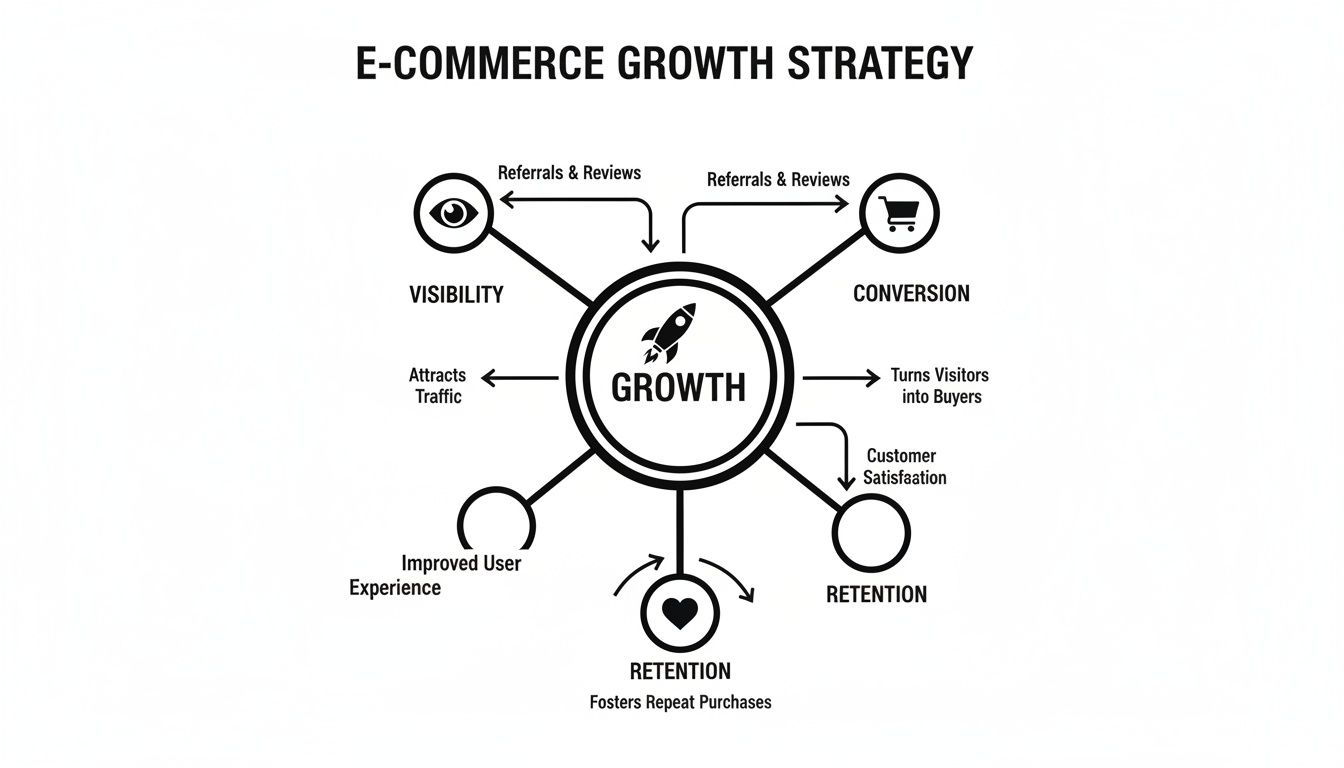
As you can see, each pillar directly feeds that central goal of growth. It’s a balanced system, and you need all three firing on all cylinders for long-term success. The rest of this guide will break down each area with clear playbooks you can put to work immediately. And for those ready for the next level, our guide on how to scale an ecommerce business offers more advanced strategies.
Key Takeaway: Real ecommerce growth isn’t just about driving more traffic. It's about creating a smooth journey that attracts the right customers (Visibility), makes it incredibly easy for them to buy (Conversion), and gives them a compelling reason to return (Retention). Get these three pillars right, and you'll build a resilient and profitable online business.
Core Strategies for Boosting Ecommerce Sales
To give you a quick overview, here’s a breakdown of the key strategies we’ll cover. This table summarizes the core tactics, where they make an impact, and what you should be tracking to measure your success.
| Strategy Area | Key Actions | Primary KPI to Track |
|---|---|---|
| Visibility | SEO, marketplace optimization, PPC ads | Organic traffic, Ad Spend (ROAS) |
| Conversion | A/B testing, CRO, checkout optimization | Conversion Rate (CVR) |
| Retention | Email marketing, loyalty programs, upsells | Customer Lifetime Value (CLV) |
Each of these areas is a critical piece of the puzzle. By focusing on the right actions and tracking the right metrics, you can create a well-rounded strategy that drives consistent, profitable growth.
Mastering Marketplace SEO and Product Listings
Your products can't sell if customers can't find them. That sounds obvious, but it’s a hard truth on crowded marketplaces like Amazon, eBay, and Walmart, where you’re just one seller among millions. To stand out, you can't just list your products—you have to master the art and science of marketplace Search Engine Optimization (SEO).
Think of it like getting prime shelf space at a physical store. Good marketplace SEO gets your products to the top of the search results when a shopper types in what they're looking for. It’s a game of visibility, and winning requires a sharp, data-informed strategy that goes way beyond basic keyword stuffing.
Deconstructing the Perfect Product Title
Your product title is the single most important piece of your listing. It’s the first thing shoppers see, and it’s what the marketplace algorithms weigh most heavily. A weak title gets ignored. A great one acts like a magnet for qualified buyers.
The trick is to balance keyword relevance with human readability. A generic title like "Yoga Mat" is a guaranteed way to get lost.
Instead, try something like: "Eco-Friendly Pro Grip Yoga Mat, 72-Inch, Non-Slip TPE for Hot Yoga & Pilates, Lightweight with Carry Strap."
This title does a few things right away:
- It hits primary keywords like "Yoga Mat" and "Pro Grip."
- It weaves in long-tail keywords like "Non-Slip TPE for Hot Yoga."
- It highlights key features people actually care about: "Eco-Friendly," "72-Inch," and "Lightweight with Carry Strap."
- It answers potential questions before they're even asked, which builds instant trust.
Crafting Bullet Points That Convert
Once someone clicks, your bullet points are your next shot to close the deal. This is where you prove the claims you made in your title by turning dry features into real-world benefits. Too many sellers just list technical specs here, and it's a huge missed opportunity.
Don't just say, "Made from TPE material." Explain what that actually means for the customer: "Enjoy a Superior Grip with Eco-Conscious TPE: Our mats are made from non-toxic, recyclable TPE material that offers better traction than standard PVC mats, ensuring you stay stable during any pose."
Each bullet should solve a problem or speak to a desire, making a strong case for your product before the customer even thinks about scrolling down.
Pro Tip: Start each bullet point with a benefit-driven headline in all caps, then follow it with the details. This format is incredibly easy to scan, letting shoppers quickly grab the main value of your product.
The Hidden Power of Backend Search Terms
Customers never see them, but backend search terms are your secret weapon. They tell the marketplace’s algorithm exactly what your product is all about, giving you a place to put all the keywords that didn’t quite fit in your title or bullets.
This is the spot for common misspellings, synonyms, and even foreign-language equivalents if they're relevant to your audience.
Think about all the ways someone might search for your product. For our yoga mat, backend terms could include "yogamat," "pilatesmat," "ejercicio," "workout mat," and "thick exercise mat." Filling this section out properly is a simple way to show up in more searches. For a deeper dive, check out our complete guide on how to optimize Amazon product listings for maximum visibility.
Visual Merchandising Your Way to More Sales
In ecommerce, your images are your storefront. High-quality visuals are non-negotiable—they build trust, show value, and are often the final nudge a customer needs to make a purchase. But great visual merchandising is more than just a few clear photos.
Your image stack needs to tell a story. Here's what it should include:
- A Hero Image: A crisp, professional shot of the product on a pure white background. No distractions.
- Lifestyle Images: Show the product in action. Help customers imagine it in their own lives.
- Infographics: Use text overlays to call out key features, dimensions, or benefits. Make it easy to understand at a glance.
- Comparison Charts: Visually demonstrate why your product is a better choice than the competition.
The data backs this up. Listings with professional photos can see conversion rates up to 20% higher than those without. On top of that, products with A+ Content (what Amazon calls enhanced brand content) see an average sales lift of 3-10%. Why? Because rich images and detailed descriptions close the gap between browsing and buying, turning curious visitors into confident customers.
Fine-Tuning Your Conversion Funnel for More Sales
Driving traffic to your store is just the first part of the puzzle. The real challenge—and where sustainable growth actually happens—is turning those visitors into paying customers. This whole process is known as Conversion Rate Optimization (CRO), and it’s all about methodically tweaking every touchpoint in your sales funnel to make buying from you as easy and intuitive as possible.
Think about it: even tiny friction points can send a potential customer packing. A slow-loading page, confusing navigation, or a surprise shipping fee at checkout can kill a sale in an instant. Fine-tuning your conversion funnel means hunting down and eliminating these obstacles, creating a smooth path from the product page to that final "thank you for your order" screen.
Optimizing the User Experience
A killer user experience (UX) is the bedrock of high conversion rates. When your site is fast, easy to navigate, and works flawlessly on any device, you’re tearing down the initial barriers that might frustrate a potential buyer.
Start by zeroing in on these core elements:
- Boost Page Load Speed: Every second counts. A site that takes longer than three seconds to load will see a huge chunk of visitors just give up and leave. Use tools to compress images and clean up your code to make sure your pages are lightning-fast.
- Simplify Site Navigation: Shoppers need to find what they're looking for with minimal clicks. A clean menu structure, a big, obvious search bar, and logical product categories are non-negotiable. Don't make them think.
- Ensure Mobile Responsiveness: The majority of online shopping now happens on a phone. Your site must provide a seamless experience on a small screen. Test every single page to make sure buttons are easy to tap and text is readable without pinching and zooming.
These might sound like basic technical fixes, but they have a massive impact on your ability to improve ecommerce sales. A clunky, slow site tells customers you don’t care about their experience, and that erodes trust before they even see a single product.
Building Trust with Social Proof and Clear CTAs
Once the technical foundation is solid, it's time to build credibility and gently guide the user toward making a purchase. This is where the psychology of selling really comes into play.
Social proof is incredibly powerful because it shows that other real people have already bought from you and had a good experience. Plastering customer reviews, star ratings, and testimonials directly on your product pages can dramatically boost a visitor's confidence. Products with a bunch of positive reviews are just flat-out more likely to sell.
Alongside that social proof, your Call-to-Action (CTA) buttons need to be impossible to miss. Use contrasting colors, clear, action-oriented text like "Add to Cart" or "Buy Now," and stick them right where the user’s eye naturally falls.
Key Insight: Don't make customers hunt for the next step. A well-placed, compelling CTA acts as a clear signpost, telling the user exactly what to do next and reducing decision fatigue. It's one of the simplest yet most effective changes you can make.
Streamlining the Checkout Process
The checkout is the final—and most critical—stage of your conversion funnel. It’s also where an astonishing number of businesses lose sales. A truly seamless checkout is make-or-break for ecommerce success, especially when you realize nearly 70% of online shopping carts are abandoned.
Data shows that a complicated checkout is a top reason for this, yet optimizing the checkout design can recover up to $260 billion in lost orders. You can explore more data on checkout optimization from Baymard Institute.
Here are a few high-impact changes to slash that cart abandonment rate:
- Offer a Guest Checkout Option: Forcing users to create an account before they can buy is a notorious conversion killer. Simply allowing a guest checkout can boost conversions overnight.
- Be Transparent with Costs: Unexpected shipping fees, taxes, or other hidden costs are the #1 reason people abandon their carts. Show all costs clearly and upfront. No surprises.
- Provide Multiple Payment Options: Offer a variety of payment methods, including credit cards, PayPal, and "Buy Now, Pay Later" services to cater to every customer's preference.
- Display Trust Seals: Little security badges from well-known providers like Norton or McAfee can seriously boost consumer confidence, reassuring customers that their payment data is safe.
By refining each of these areas—from the first impression to the final click—you create a well-oiled machine designed to turn visitors into loyal customers. For a deeper dive into this process, check out our full guide on conversion rate optimization tips.
Using AI for Smarter Advertising and Personalization
A generic, one-size-fits-all marketing approach is a surefire way to burn through your budget with little to show for it. To really move the needle on sales today, you need to get smarter and more personal. This is where Artificial Intelligence (AI) and machine learning stop being buzzwords and become your most powerful tools for growth.
By leaning on AI, you can shift from guesswork to data-driven precision, supercharging your ads and creating shopping experiences that feel unique to every single visitor. This isn't just about showing the right ad; it's about making each customer feel like your entire store was designed just for them.
Predictive Bid Management for Maximum ROAS
One of the quickest ways AI can boost sales is through predictive bid management on ad platforms like Google or Amazon. Think about it: manually adjusting your bids based on performance is slow, reactive, and often a shot in the dark.
AI algorithms, on the other hand, crunch thousands of data points in real-time—things like time of day, user location, device, and past browsing behavior—to predict the likelihood of a click actually converting. The system then automatically adjusts your bid up or down to capture the most valuable clicks, all while avoiding wasteful spending. It ensures your ad budget is spent with surgical precision.
For example, if the AI detects that shoppers browsing on a desktop on Tuesday mornings are 30% more likely to buy your high-margin products, it will automatically bid more aggressively for that specific audience. A human marketer simply can't replicate that kind of real-time optimization at scale.
Winning with Dynamic Creative Testing
Beyond just managing bids, AI can also figure out which ad creative actually works. Dynamic creative testing lets you feed an AI engine multiple versions of your ad components—different headlines, images, descriptions, and calls-to-action—and let it mix and match them on the fly.
The algorithm serves different combinations to various audiences, measures what resonates, and automatically puts more budget behind the winning variations. This takes the guesswork out of A/B testing and makes sure your ads are always performing at their peak.
This stuff is incredibly effective. Platforms like Amazon and Google Ads report 15-30% ROAS improvements for campaigns using predictive bid management. For sellers on Walmart and eBay, automated keyword optimization can cut waste, with some seeing cost reductions of up to 40%. To really sharpen your edge, harnessing AI-driven marketing insights is no longer optional.
AI-Powered Personalization on Your Website
Getting people to your store with smart ads is half the battle. Personalization is what convinces them to stay and buy. AI lets you move past the basics (like using a customer's first name in an email) and create deeply customized on-site experiences.
Key Takeaway: Personalization is no longer a "nice-to-have"—it's an expectation. Shoppers who engage with AI-powered product recommendations have a 26% higher average order value. That's a direct line from a personalized journey to higher revenue.
AI algorithms analyze a visitor's real-time behavior—the products they click on, categories they browse, items they add to their cart—to dynamically change the content they see. The whole experience feels uniquely relevant and helpful.
Here are a few ways this plays out:
- Personalized Product Recommendations: Instead of showing generic "best-sellers," AI can display products based on an individual's browsing history. Someone looking at running shoes will see recommendations for moisture-wicking socks and GPS watches, not hiking boots.
- Dynamic Homepage Content: The AI can customize the hero banner and featured products on your homepage based on a visitor's past purchases. A returning customer who previously bought coffee beans might see a banner for your new espresso machine.
- Customized Search Results: AI learns from user behavior to reorder search results, pushing the most relevant products to the top for each specific user. This alone can dramatically increase conversion rates.
By putting these AI-driven strategies in place, you’re not just selling products; you’re building a smarter, more responsive business. You're creating a system that learns from every interaction, constantly optimizing itself to drive sales and build real customer loyalty. If you're ready to get started, it's worth exploring different ecommerce personalization software options to find the right fit.
Advanced Tactics for Increasing Average Order Value
Getting more ecommerce sales isn't just about driving more traffic; it’s about making every single transaction count. One of the most efficient ways to grow your revenue—without spending a dollar more on ads—is by boosting your Average Order Value (AOV).
It all comes down to encouraging shoppers to add just a little more to their carts before they check out. When you get this right, it doesn't feel like a hard sell. It feels like you're genuinely helping them, making their experience better while lifting your bottom line.
The Art of Cross-Selling and Upselling
Cross-selling and upselling are the bread and butter of AOV strategy. Cross-selling is all about suggesting complementary items, while upselling is about offering a better, premium version of the product they're already looking at. The magic is in the timing and relevance.
A classic cross-sell happens right on the product page with a "Frequently Bought Together" section. Think about it: if someone's buying a digital camera, suggesting a memory card and a camera bag is just plain helpful. It's a natural fit.
Upsells, on the other hand, are your chance to show off the added value of a higher-priced item. Let's say a customer is viewing a standard blender. You could display a more powerful model right beside it, calling out killer features like "Crushes ice in 3 seconds" or "Includes travel cup." Suddenly, the higher price feels like a smart investment.
Key Insight: Don't underestimate product recommendations. Industry data shows they can drive anywhere from 10-30% of an ecommerce site's revenue. On top of that, effective cross-selling can bump up sales by 20% and profits by an incredible 30%.
Smart Product Bundling for Perceived Value
Bundling is another fantastic way to drive up order value. The idea is to group several related products together and sell them as a single package, usually at a slight discount. Bundles are effective because they simplify the buying decision and make customers feel like they’re getting a great deal.
Why hope a customer adds a phone, a case, and a screen protector to their cart one by one? Instead, you can offer a "Smartphone Starter Kit" with all three included.
Here’s a quick playbook for creating bundles that sell:
- Solve a Complete Problem: Group items that provide a full solution, like a skincare bundle with a cleanser, toner, and moisturizer.
- Show the Savings: Make the value obvious. Display the bundle price next to the cost of buying each item separately. A little note like, "Save $15 when you buy the set!" goes a long way.
- Create Themed Packages: Build bundles around specific needs or events. Think "New Parent Survival Kit" or a "Work-from-Home Essentials" pack.
This strategy not only boosts AOV but can also be a clever way to move some of your slower-selling inventory by pairing it with your bestsellers. To really dial in this approach, check out these Proven Strategies to Increase Average Order Value on Shopify.
Using Free Shipping Thresholds to Your Advantage
Never, ever forget the power of "free shipping." It's a psychological trigger that works time and time again. By setting a free shipping threshold, you can easily nudge customers to add more to their cart just to avoid paying for delivery.
The trick is to set the bar just a little higher than your current AOV. If your average order is around $60, try setting your free shipping minimum at $75. You’d be surprised how many people will hunt for one more small item to qualify. It's one of the simplest and most effective ways to lift your sales.
Analyzing Your Data and Measuring What Matters
You can't improve what you don't measure. Simple as that. All the strategies we've covered—from marketplace optimization to checkout CRO—mean very little if you aren't tracking performance and making decisions based on real data, not guesswork.
This is where everything comes together. Moving from hunches to data-driven choices is what separates stagnant stores from the ones you see scaling month after month. The proof is in the numbers: companies that adopt data-driven marketing are six times more likely to be profitable year-over-year. It's not magic; it's just smart business.

Building Your Ecommerce Dashboard
First things first: you need a command center. A dashboard that tracks the key performance indicators (KPIs) that actually move the needle. It’s incredibly easy to get lost in a sea of metrics, but focusing on the right ones is what leads to action. Your dashboard should give you a clear, at-a-glance view of your store’s health.
Here are the essentials I always tell clients to monitor:
- Conversion Rate (CVR): The percentage of visitors who actually buy something. This is the ultimate report card on how well your site turns traffic into cash.
- Customer Lifetime Value (CLV): The total revenue you can realistically expect from a single customer over time. This metric tells you if you're building a brand with loyal fans or just a leaky bucket of one-time buyers.
- Customer Acquisition Cost (CAC): How much you're spending, on average, to get a new customer in the door. For a healthy business, your CLV needs to be significantly higher than your CAC.
- Cart Abandonment Rate: The percentage of shoppers who add items to their cart but bail before paying. A high number here is a massive red flag, usually pointing to friction in your checkout process.
Tracking these core metrics creates a powerful feedback loop. A dip in your conversion rate might tell you it's time to A/B test a product page. A rising CAC could be a signal to tighten up your ad targeting.
Committing to Continuous Optimization
Data gives you the "what," but A/B testing gives you the "why" and "how to fix it." Consistent, methodical testing is the engine of continuous improvement.
This isn't about massive, risky website redesigns. We're talking small, iterative changes that add up to huge gains over time.
Experiment with different headlines on your product pages. Test a new set of ad creatives. Try changing the color of your call-to-action button. Each test delivers real, tangible results, creating a cycle of optimization that compounds. This data-first approach ensures every decision is validated, turning growth from a guessing game into a predictable process. For more on this, check out our guide on data-driven marketing strategies.
Frequently Asked Questions
Even with the best game plan, questions are going to pop up. It's just part of the process. Here are some of the most common ones we hear from ecommerce leaders as they start putting these strategies to work.
How Long Does It Take to See Results?
This one really depends on which lever you're pulling. Some things create an almost immediate impact, while others are more of a slow burn.
If you’re looking for quick wins, Conversion Rate Optimization (CRO) is your best bet. Tweaks like simplifying your checkout flow or adding a guest checkout option can lift sales right away—sometimes in just a few days. You’re removing friction, and customers reward you for it instantly.
On the other hand, something like marketplace SEO on Amazon is more of a medium-term play. You'll probably see your rankings start to nudge up within a few weeks, but it can take a solid two to three months for the algorithm to fully recognize your listing’s new momentum and deliver stable traffic growth. AI-driven ad campaigns also need a bit of patience; they typically require a 2-4 week learning period to gather enough data before you see a real improvement in your Return on Ad Spend (ROAS).
The bottom line? For a comprehensive growth strategy where all these pieces are working together, you should expect to see significant, measurable results within one fiscal quarter. That gives each tactic enough time to mature and build on each other.
What Is the Most Important Metric to Track?
It’s so tempting to get fixated on daily sales or conversion rates. They’re right there on the dashboard, and they feel important. But if you want to build a business that lasts, you have to look deeper.
The single most important metric for sustainable growth is the ratio between Customer Lifetime Value (CLV) and Customer Acquisition Cost (CAC). This simple number tells you if your business is actually profitable in the long run.
A healthy CLV to CAC ratio is 3:1 or higher. What that means is for every dollar you spend bringing a new customer in the door, you’re getting at least three dollars back over their entire relationship with your brand. It’s the ultimate proof that your marketing is efficient and your products keep people coming back. Focusing on this ratio stops you from chasing unprofitable, one-off sales that look good today but hurt you tomorrow.
Should I Focus on My D2C Site or Marketplaces First?
This is a classic "it depends" situation, and it usually comes down to your brand’s age and resources.
Marketplaces like Amazon and Walmart are discovery engines. They come with a massive, built-in audience actively looking to buy something. That makes them the perfect launchpad for new products and a fantastic way to acquire customers quickly. You’re tapping into a river of traffic that already exists.
Your own Direct-to-Consumer (D2C) site, however, is your home base. It's where you get higher profit margins, control your brand story completely, and—most importantly—own your customer data. That data is gold.
The most powerful approach is a hybrid strategy. Use the marketplaces to get that first sale and introduce customers to your brand. Then, use smart email marketing, social retargeting, and great packaging inserts to pull them over to your D2C site for their next purchase. You get the best of both worlds: acquisition from the giants and long-term loyalty on your own turf.
Ready to stop guessing and start growing? Next Point Digital creates data-driven roadmaps that turn clicks into loyal customers. Let our experts optimize your marketplaces, streamline your conversion funnel, and run smarter ad campaigns. Schedule your free growth audit today and find out how we can improve your ecommerce sales.