

Before you pour a single dollar into ads or get lost in complex growth tactics, you have to nail the absolute foundation of your Amazon business: your product listing.
Think of your listing as your digital storefront and your best salesperson, working 24/7. It's the most critical asset you have for grabbing a shopper's attention and turning their interest into a sale. If your listing is weak, it's like trying to fill a leaky bucket—no matter how much traffic you drive, the sales will just drain away.
Building a killer listing isn't about stuffing keywords into a title and calling it a day. It’s a mix of art and science—part customer psychology, part sharp copywriting, and part strategic SEO. The goal isn't just to show up on the first page; it's to create a listing so compelling that it stops a shopper mid-scroll and convinces them your product is the solution they've been looking for.
This process is a cycle. A better listing leads to more sales, which boosts your rank, which brings in more traffic. It's a powerful loop.
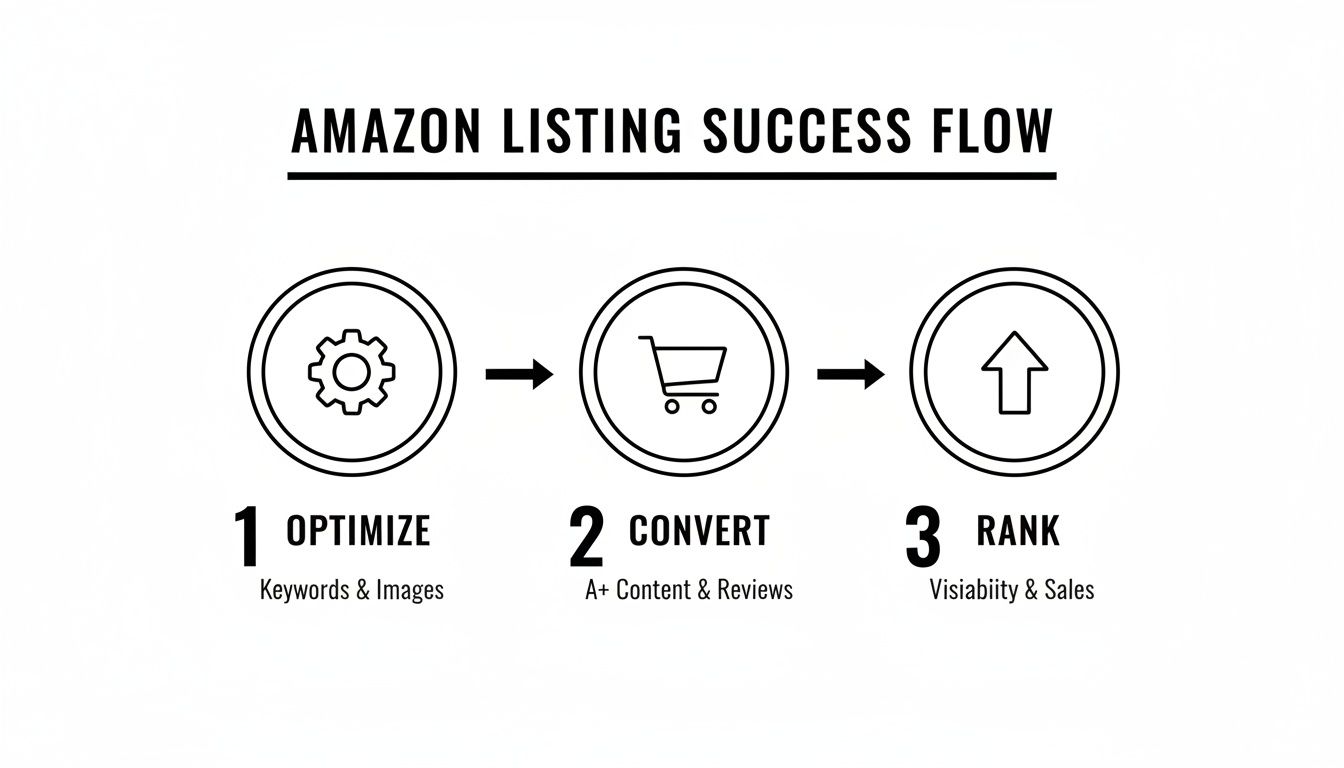
As you can see, optimizing your listing directly fuels conversions. More conversions tell Amazon your product is a winner, improving your ranking and visibility. This creates a self-sustaining growth engine.
Craft a Title That Commands Clicks
Your product title is the first—and often only—thing a customer sees in the search results. It has to work for both Amazon's A9 algorithm and the human eye. A great title blends your most important keywords with benefit-driven language that actually speaks to the shopper.
For example, don't just say "Stainless Steel Water Bottle." That's boring.
Instead, try something like: "HydroFlow 24oz Insulated Stainless Steel Water Bottle – Keeps Drinks Cold for 24 Hrs, Leakproof Lid, BPA-Free for Gym & Travel."
See the difference? This version has the brand, size, material, key benefits, and even specific use cases, casting a much wider net for potential search terms while telling a much better story.
Write Bullet Points That Sell Solutions
Those five bullet points are your prime real estate to sell the outcome, not just the features. This is your chance to connect what your product does with what your customer wants.
I've found a simple structure works best: lead with a capitalized, benefit-focused header, then follow up with a quick explanation.
- ALL-DAY HYDRATION: Our double-wall vacuum insulation keeps your water ice-cold for up to 24 hours or coffee hot for 12, so you're always refreshed.
- 100% LEAKPROOF DESIGN: Toss it in your bag with confidence. The secure twist-on cap with a silicone gasket ensures zero spills during your commute or workout.
- PURE, REFRESHING TASTE: Made from premium 18/8 food-grade stainless steel that never rusts or imparts metallic flavors. Enjoy clean-tasting water every time.
A well-crafted listing is your 24/7 salesperson. It should anticipate customer questions, overcome objections, and clearly articulate the value your product delivers, creating a seamless path from discovery to purchase.
Develop a Compelling Product Description
While many shoppers make their decision from the title and bullets alone, the product description is your closing argument for the more meticulous buyers. This is where you can tell your brand story, get into the nitty-gritty technical specs, and use richer, more persuasive language.
Just remember to keep it readable. Break up the text with short paragraphs and use bold headings. No one wants to read a wall of text.
The impact of these optimizations is massive, but don't just take my word for it. Let's look at the numbers.
Amazon Listing Optimization Impact at a Glance
This table breaks down the typical conversion lift you can expect from various optimizations. It’s a great way to see where your efforts will have the biggest impact.
| Optimization Tactic | Average Conversion Lift | Key Action |
|---|---|---|
| Title Optimization | 5-10% | Front-load main keywords and benefits. |
| Bullet Points | 20-30% | Focus on benefits over features; use clear headers. |
| High-Quality Images | 15-25% | Use a mix of studio shots, lifestyle images, and infographics. |
| A+ Content/EBC | 5-15% | Use rich media to tell your brand story and showcase features. |
| Customer Reviews | 10-20% | Actively solicit and manage reviews to build social proof. |
These aren't just vanity metrics; they translate directly into sales. Focusing on robust Amazon listing optimization strategies is essential if you want to stand out from the crowd. A piecemeal approach just won't cut it anymore.
The competition is fierce. Amazon's online store sales recently jumped 10% year-over-year to nearly $83 billion in a single quarter, fueled largely by sellers like you. That means optimization isn't optional—it's a requirement for survival.
For a deeper look into the nuts and bolts, our guide on how to properly optimize Amazon product listings breaks down every step.
Master Your Amazon Advertising and PPC Strategy
So you’ve got a perfectly optimized listing. That’s a great start, but it’s only half the battle. To really get the sales needle moving on Amazon, you have to actively drive traffic to your products. The single most powerful way to do that? Amazon's own advertising platform, better known as Pay-Per-Click (PPC).
Think of running ads not as an expense, but as a direct investment in your brand’s visibility, sales velocity, and market share. It's how you get your product seen.
When a customer searches for a product like yours, you want to be right there at the top of the results. PPC makes that happen—instantly. It’s an absolutely critical tool for launching new products, defending your turf against competitors, and snagging sales from high-intent shoppers the moment they're ready to buy.
Amazon's ad ecosystem is massive. With ad revenue soaring past $68 billion, it’s pretty clear that sellers who figure this out gain a serious edge. In fact, top performers often attribute 30-50% of their total sales directly to well-managed Sponsored Products campaigns. That’s a serious return.
Understanding the Main Ad Types
Amazon gives you a few different ad options, but most sellers will see the biggest impact by focusing on three core types. Knowing which one to use, and when, is the key to building a profitable strategy.
Sponsored Products: These are the ads you see everywhere—right in the search results and on product detail pages. They’re targeted by keywords and specific products, making them perfect for driving direct sales. This should be the foundation of any PPC strategy.
Sponsored Brands: Think of the banner ads at the very top of the search results. They feature a brand logo, a custom headline, and a few products. These are fantastic for building brand awareness and funneling traffic to your Amazon Storefront.
Sponsored Display: This ad type lets you retarget shoppers who’ve already checked out your product pages, both on and off Amazon. It's a powerful way to re-engage interested customers and stay top-of-mind, giving them that final nudge to make a purchase.
Structuring Your Campaigns for Success
One of the most common mistakes I see is sellers lumping all their keywords into one giant, messy campaign. When you do that, it's impossible to manage bids effectively or figure out what's actually working. A structured approach is non-negotiable if you want control and scalability.
Start with a simple, organized structure. For a single product, you could create separate campaigns for different targeting methods.
- Automatic Campaign: Let Amazon's algorithm do the heavy lifting and find relevant keywords for you. This is a goldmine for discovering new, high-performing search terms you might have overlooked.
- Manual Broad Match Campaign: Once you have some proven keywords from your auto campaign, move them here to test them on a broader scale. This helps you capture long-tail variations and related searches.
- Manual Exact Match Campaign: This is where your champions go—the highest-converting, best-performing keywords. Since you're targeting the exact search term, you can bid more aggressively here, knowing the traffic is highly qualified.
The whole point of a structured campaign is to "graduate" your keywords. You discover them in automatic, test their potential in broad match, and then scale the winners in exact match. This methodical process ensures your ad budget is always working for you, not against you.
The Critical Role of Negative Keywords
Bidding on the right keywords is important, but telling Amazon which keywords not to bid on is just as crucial. This is where negative keywords come in, and mastering them is the number one way to slash wasted ad spend.
Imagine you sell premium leather dog collars. Your automatic campaign might start showing your ad for searches like "cheap dog collar" or "nylon dog collar." Every click from those searches is wasted money because the shopper is looking for something you don't sell.
By adding "cheap" and "nylon" as negative keywords, you stop your ad from appearing for those irrelevant terms. Make it a habit to regularly review your search term reports to find and negate terms that are burning cash without bringing in sales. This simple bit of campaign hygiene can dramatically improve your Advertising Cost of Sale (ACoS).
If you need to brush up on the fundamentals, you might find our detailed breakdown of what Amazon PPC is and how it works helpful. Continuous optimization like this is how you turn a costly campaign into a profitable machine.
Earn Trust with Powerful Visuals and Reviews
Once your ads get shoppers to your product page, the game changes. It’s no longer about getting found; it's about getting chosen. So, what makes a casual browser click "Add to Cart"? It all comes down to trust.
On Amazon, trust is built visually and socially. Your product images, A+ Content, and customer reviews are your most powerful tools for convincing a shopper that your product is the one they need.
Think about it: in a real store, people can touch, feel, and see a product from every angle. Online, your visuals have to do all that heavy lifting. They need to answer unspoken questions, show off the value, and build a connection that closes the gap between the screen and the customer.
Create a Visually Stunning Product Page with A+ Content
A+ Content, or Enhanced Brand Content (EBC), is where you turn a boring product description into a branded, magazine-like experience. It lets you use high-quality images, helpful comparison charts, and clean text modules to tell your story in a way that old-school bullet points never could.
This is your shot to tackle a customer's doubts before they even have them.
Here's how to use A+ Content to your advantage:
- Showcase Lifestyle Images: Help customers see your product in their world. If you sell a yoga mat, don't just show the mat rolled up—show someone happily using it in a bright, peaceful room.
- Highlight Key Features: Use infographics with clear callouts to point out specific details or what makes your product special. It’s way more engaging than burying specs in a wall of text.
- Include Comparison Charts: Pit your product against other models in your own product line (never a competitor's). This helps shoppers easily choose the best fit for them, keeping them on your page.
By mixing and matching the modules Amazon provides, you can build a custom page that walks a customer through a story, showing them exactly why your product is the best solution. Better visuals almost always lead to better conversion rates.
Your product page isn't just a listing; it's a conversation with your customer. A+ Content allows you to control that conversation, providing clear, visually appealing answers to their most pressing questions, which is a core principle of effective conversion rate optimization.
To really make your listing pop, think about adding AI-generated UGC product videos. They use authentic user content to create visual proof that feels genuine and trustworthy.
The Power of Social Proof and Customer Reviews
Even with the best photos in the world, shoppers will still scroll down to see what other people think. Customer reviews are the ultimate form of social proof on Amazon, and getting a steady stream of positive feedback is one of the surest ways to boost sales.
Your job isn't just to hope for reviews; it's to build a system that encourages them. Amazon’s "Request a Review" button is a simple, 100% compliant way to send a standardized request to buyers. Make it a routine part of your post-sale checklist for every single order.
Of course, you’ll eventually get a negative review. It happens. How you react says everything.
- Never Argue: Getting into a public back-and-forth on a review is a bad look. Try to address the customer's problem privately if you can.
- Learn from Feedback: Is the same complaint popping up over and over? That’s not a hater; that's free market research. It might be pointing to a product flaw or something confusing in your listing that you need to fix.
- Bury It with Positives: The best way to deal with a few bad reviews is to drown them in a flood of good ones. Focus your energy on getting new, positive feedback to keep your overall rating high.
When you combine amazing, informative visuals with a smart review strategy, you create a powerful flywheel of trust. The more confident shoppers feel, the higher your conversion rate climbs, which in turn improves your sales velocity and ranking. That's how you win the click, and more importantly, the sale.
Implement Smart Pricing and Inventory Management
Getting your listing optimized and running sharp ad campaigns will definitely move the needle on your Amazon sales. But if you’re chasing real, sustainable profitability, the magic happens behind the scenes. Your long-term success hinges on two operational pillars: intelligent pricing and flawless inventory management.
Get these right, and you’ll build a resilient business that squeezes every last drop of margin from every sale.

Mess up either one, and you’ll silently bleed profits. Price too high, and you lose the Buy Box and your sales velocity tanks. Price too low, and you’re just leaving money on the table. In the same way, stocking out kills your momentum and search ranking, while overstocking leads to brutal storage fees that eat your bottom line alive.
Find Your Pricing Sweet Spot
Your pricing strategy can't be a "set it and forget it" affair. It needs to be dynamic. The goal is to find that perfect balance where you're competitive enough to win sales but priced high enough to protect your margins. This all starts with a little competitive snooping.
Make it a habit to monitor the prices of your top 3-5 direct competitors. Don’t just glance at their list price; watch how often it changes and see if they're running deals. There are plenty of tools that can automate this, giving you a clear picture of the pricing landscape without you having to manually check every day.
This data is your power. If a key competitor launches a lightning deal, you can respond with a coupon to keep pace. If everyone's prices are holding steady, it might be a perfect time to test a slight price increase and see if it sticks.
Use Promotions and Deals Strategically
Promotions are much more than just a way to clear out old inventory. Think of them as tools to create urgency and spike your sales velocity. A sudden jump in sales can seriously boost your product's organic ranking, creating a halo effect that lasts long after the deal ends.
Consider these tools in your promotional arsenal:
- Coupons: That little orange tag is a magnet for clicks. These digital "clip-on" discounts are highly visible in search results and can pull in shoppers who love a good bargain.
- Lightning Deals: These are time-sensitive promotions featured on Amazon's popular "Today's Deals" page. They’re fantastic for driving a massive, short-term sales surge—perfect for a new product launch.
- Prime Exclusive Discounts: Offering a special price just for Prime members is a smart way to appeal to Amazon’s most loyal and active customer base.
The key here is to run promotions with a clear goal. Are you trying to liquidate aging stock, boost your Best Sellers Rank (BSR), or just get a new product off the ground? Your goal dictates your strategy.
Master Your Inventory Health
Effective inventory management is the unsung hero of every successful Amazon business. Your mission is simple: keep just enough stock to meet demand without getting slammed with fees or, even worse, running out. A stockout is poison. It doesn't just cost you sales today; it tells Amazon's algorithm your product isn't reliable, causing your search rank to plummet.
A huge piece of this puzzle is accurate demand forecasting. Dig into your historical sales data, but remember to account for seasonality and any marketing campaigns you have planned. If you sold 200 units last December, you'd better plan to have more than that on hand this year, especially if you’re expecting to grow.
Staying ahead of the curve operationally is crucial for profitability. For instance, sellers using AI-powered dynamic pricing have seen margins jump by 10-20% while also increasing sales volume by 15%. In the same vein, better inventory forecasting helps sellers avoid an average of 15% in losses from overstocking alone.
Choose the Right Fulfillment Method
Your fulfillment strategy directly impacts your costs and, more importantly, the customer experience. For most sellers, it boils down to two choices: Fulfillment by Amazon (FBA) or Fulfillment by Merchant (FBM).
- Fulfillment by Amazon (FBA): You ship your inventory to Amazon's warehouses, and they take care of everything else—storage, picking, packing, shipping, and even customer service. The biggest perk? Your products become Prime-eligible, which is a massive conversion driver.
- Fulfillment by Merchant (FBM): You handle it all yourself. You store, pack, and ship products directly to the customer. This route gives you more control but often means slower shipping times unless you have a serious logistics operation in place.
For most sellers trying to scale, FBA is the clear winner. That little Prime badge builds instant trust and dramatically increases your chances of winning the Buy Box. If you want to dive deeper, check out our guide on what Amazon FBA is and how it can benefit your business.
When you pair smart pricing with a dialed-in inventory and fulfillment plan, you create a powerful operational core that can support serious, scalable growth.
Drive External Traffic to Build a Resilient Brand
Relying only on Amazon's built-in customer base is a risky game. Sure, it's a massive marketplace, but the competition is brutal, and a sudden algorithm change can tank your visibility overnight. True, long-term brand resilience comes from building an audience that's loyal to you, not just to Amazon. That means you need to be actively driving your own qualified traffic.
When you send customers from your social media, blog, or email list to your Amazon listing, it sends a powerful signal to the A9 algorithm. It basically tells Amazon your product has demand beyond the platform, which can give your organic rankings a serious boost. It’s a way to take control of your sales velocity instead of just passively waiting for shoppers to find you.
This approach is what separates a simple Amazon seller from a genuine brand. You're creating multiple touchpoints and building a more stable, predictable business.
Leverage the Amazon Brand Referral Bonus
As if you needed another reason, Amazon actually rewards you for doing this. The Amazon Brand Referral Bonus program gives brand-registered sellers a bonus averaging 10% of a product's sale price when the purchase comes from your own off-Amazon marketing.
This completely changes the math on your external marketing spend. It’s essentially a discount on your referral fees, making those social media ads, influencer collabs, and email campaigns far more profitable.
Here’s a quick look at how it works:
- Generate a Tagged Link: First, you create a special "Amazon Attribution" link for your specific campaign.
- Drive Traffic: Next, you use that link in your social media bio, a blog post, or an email newsletter.
- Customer Buys: A customer clicks your link and makes a purchase on Amazon within the attribution window.
- You Get a Bonus: Amazon tracks that sale back to your link and credits you with the bonus.
This program turns your marketing spend into a direct investment with a much clearer ROI. It’s a no-brainer for any brand serious about scaling on Amazon.
Build Your Brand Hub with an Amazon Storefront
Your Amazon Storefront is your brand's own custom, multi-page mini-website that lives right on Amazon. It's a powerful tool that’s shockingly underused. Instead of sending all that hard-earned external traffic to a single product page, you can direct them to your Storefront, where you control the entire narrative.
A well-designed Storefront lets you:
- Tell Your Brand Story: Use rich media like videos and lifestyle images to connect with customers on a much deeper level.
- Showcase Your Entire Catalog: Organize your products into logical categories, making it easy for shoppers to see everything you offer.
- Cross-Sell and Upsell: Feature complementary products together and highlight your bestsellers to increase the average order value.
Think of your Storefront as your home base on Amazon. It elevates your presence from a random collection of listings to a cohesive, trustworthy brand destination. For more on building a strong presence, check out our guide on implementing data-driven marketing strategies.
By creating a dedicated space for your brand, you capture a shopper's full attention. A well-curated Storefront prevents customers from getting distracted by competitor ads that litter standard product pages, keeping them within your brand’s ecosystem.
Choose Your External Traffic Channels Wisely
Not all external traffic is created equal. The key is to stop chasing every platform and instead focus on where your ideal customers are already spending their time. A shotgun approach is just an expensive way to get nowhere; a targeted one drives high-intent buyers straight to your products.
To help you decide where to focus your efforts, here’s a quick look at some of the most popular channels.
External Traffic Channel Comparison
| Channel | Primary Benefit | Best For… | Key Metric to Track |
|---|---|---|---|
| Social Media Ads (Meta, TikTok) | High-precision audience targeting based on interests and demographics. | Visually appealing products in lifestyle, fashion, beauty, and gadget categories. | Click-Through Rate (CTR) and Cost Per Click (CPC) from the ad platform. |
| Content Marketing (Blog, YouTube) | Building authority and trust by solving customer problems. | Products that require education or demonstration, like tech, fitness, or complex hobbies. | Conversion rate from Amazon Attribution for a specific content piece. |
| Email Marketing | Nurturing repeat purchases from a loyal, owned audience. | Consumable products or brands with a wide catalog for cross-selling. | Clicks on product links and sales from the campaign. |
| Influencer Marketing | Leveraging trusted voices to generate authentic social proof. | Trendy products or items targeting a specific niche community. | Engagement rate on sponsored posts and attributed sales. |
Ultimately, choosing the right mix of channels depends on your product, your audience, and your budget. The goal is to find what works for you and double down on it.
By building these off-Amazon assets, you create a business that is far less dependent on any single channel. You're not just learning how to sell more on Amazon; you're building a resilient brand that can thrive no matter how the marketplace evolves.
Got Questions About Growing on Amazon? We've Got Answers.
Jumping into the Amazon game often feels like opening a Pandora's box of questions. Even when you think you have a solid plan, a new hurdle pops up and can stall your momentum. We hear the same questions over and over from brands trying to scale, so let's clear the air and give you some straight answers.
How Long Does Amazon SEO Actually Take to Work?
Everyone wants to see results yesterday, but Amazon SEO is a marathon, not a sprint. While you might see a few minor bumps in ranking a couple of days after tweaking a title or some backend keywords, you need to give it 30 to 90 days to see real, stable growth.
Here’s why: Amazon’s A9 algorithm is less about just matching keywords and more about seeing results. Your initial optimizations get your product in front of the right eyeballs. But the real magic happens when those shoppers start buying. Those sales and conversions signal to Amazon that your product is the real deal, which kicks off a positive feedback loop of better rankings and even more sales. Patience is the name of the game here.
What’s a “Good” ACoS for My PPC Campaigns?
There’s no magic number here. A “good” Advertising Cost of Sale (ACoS) is completely tied to your product’s profit margin and what you’re trying to accomplish with a specific campaign. The first thing you absolutely have to do is calculate your break-even ACoS—that’s simply your profit margin before you spend a dime on ads. This number is your ceiling; go above it, and you're losing money on each sale.
Once you know your break-even point, your goal determines your target:
- Launching a new product? Don't be afraid to run a higher ACoS, even in the 40-60% range. You're not trying to make a profit right now; you're buying data, gathering those first crucial reviews, and jump-starting your organic rank. Think of it as an investment.
- Running ads for a proven winner? This is where you focus on profitability. A lower ACoS, usually somewhere between 15-30%, is a much more sustainable target. The goal is to make sure every ad dollar is driving profitable growth.
ACoS isn't a fixed rule; it's a flexible lever. Pull it hard to grab market share for new products, then ease it back to squeeze out maximum profit from your established best-sellers.
Should I Use FBA or FBM?
For nearly every seller focused on serious growth, Fulfillment by Amazon (FBA) is the way to go. The biggest reason is simple: FBA instantly makes your products Prime-eligible. That little blue badge is non-negotiable for winning the Buy Box and tapping into Amazon’s most valuable customer base. Let's be real, slow shipping is a conversion killer, and FBA solves that problem overnight.
The trust and sales lift you get from the Prime badge almost always justifies the fees.
Fulfillment by Merchant (FBM) really only makes sense in a few specific scenarios. If you already have a slick, efficient warehouse and logistics operation, or if you sell products that are huge, heavy, or have razor-thin margins, then FBM might be a better fit. Otherwise, FBA is your ticket to growth.
How Many Reviews Do I Need Before Sales Pick Up?
There isn't a universal magic number, but we consistently see a real turning point once a product hits 10 to 15 positive reviews. That's usually enough social proof to get shoppers over the initial hump of trusting a new product, and you'll often see a clear bump in your conversion rate.
But the real goal isn't just hitting a number and stopping. What matters more is maintaining a steady flow of new reviews. Both shoppers and the Amazon algorithm care more about recent feedback. Keep your overall rating at 4.5 stars or higher, and you'll build the kind of shopper confidence that fuels consistent sales.
At Next Point Digital, we turn these tough questions into profitable growth strategies. If you're ready to stop guessing and start executing a data-driven plan to scale your Amazon sales, our team is here to build your roadmap. Let's talk about your brand's future.