

Effective marketplace growth strategies don’t just happen; they're built on a solid foundation, and that foundation starts with smart platform selection. It’s tempting to throw your products on every marketplace out there, but a scattergun approach is a recipe for diluted effort and dismal results.
The real first step toward scalable, profitable growth is a deliberate, analytical choice.
Building Your Foundation for Marketplace Success
Spreading yourself thin across every channel might feel like you're covering all your bases, but it's a rookie mistake. A powerful growth strategy starts with picking the right battleground—surgically placing your products where they have the best chance to win.
This isn’t about a quick glance at which platform is most popular. It’s a deep dive into the nuances of each ecosystem. Think of it like matchmaking: you need to align your product’s personality with a marketplace’s unique culture and customer base.
Aligning Products With Platform Demographics
The shoppers on Amazon, eBay, and Walmart are looking for different things. Amazon customers are often hunting for speed, convenience, and the trust that comes with Prime eligibility. This makes it a perfect fit for mass-appeal products with competitive pricing.
eBay, on the other hand, is a global treasure chest for unique, collectible, or refurbished items. It’s a haven for niche sellers and one-of-a-kind inventory. You won’t sell a generic phone case there as easily as you would a rare vintage one.
Then there’s Walmart. With its massive U.S. footprint and focus on value, it’s the go-to for budget-conscious households. If you’re selling everyday essentials, home goods, or competitively priced electronics, you’ll find a receptive audience.
The key is to ask yourself, "Who is my ideal customer, and where do they already shop?" Answering that question honestly saves you from wasting time and money on platforms where your products just don't fit. For a detailed walkthrough on tapping into this specific market, our guide on how to sell on the Walmart marketplace offers actionable steps: https://npoint.digital/how-to-sell-on-walmart-marketplace/
The most common mistake new sellers make is assuming a one-size-fits-all approach. Your value proposition for a premium gadget on Amazon should highlight features and speed, while on eBay, the same product might be positioned based on its condition or rarity.
This flowchart helps visualize how different types of products are best suited for each of the big three marketplaces.
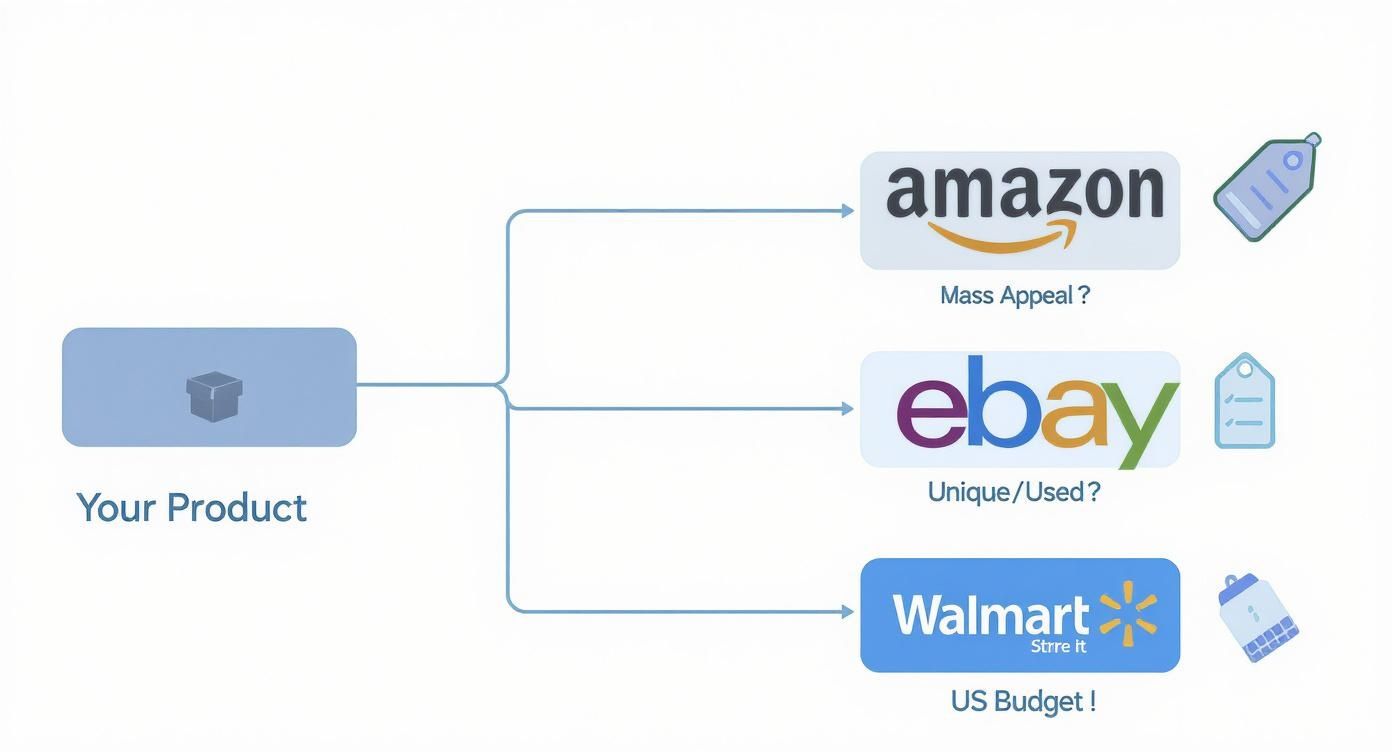
As you can see, the path forward starts with a clear understanding of your product’s core appeal—whether it’s for a mass market, a niche audience, or a value-driven consumer.
Crafting a Platform-Specific Value Proposition
Once you’ve picked your starting marketplace, the work has just begun. Don't just copy and paste your listings. You need to craft a distinct value proposition for each platform that speaks directly to its audience and its algorithm.
This means getting inside the head of each marketplace to understand what it rewards:
- Amazon's A9 Algorithm: This beast prioritizes sales velocity, keyword relevance, and conversion rate. Your listings must be meticulously optimized for search, period.
- eBay's Cassini Search Engine: Here, things like seller ratings, listing completeness, and shipping policies carry more weight. Building trust and providing granular detail is how you win.
- Walmart's Ecosystem: This platform heavily favors competitive pricing and reliable fulfillment. Being the best-priced option with fast shipping can rocket you to the top.
Choosing your platform wisely is more critical than ever. The global Gross Merchandise Value (GMV) of the top 100 online marketplaces is projected to hit an incredible $3.832 trillion by the end of 2024. That’s a doubling in market size in just six years, showing the massive opportunity for sellers who get their strategy right.
To dive deeper into scaling your presence, check out these proven ecommerce growth strategies. By getting this foundation right, you set the stage for explosive and, more importantly, sustainable growth.
Marketplace Selection Matrix Amazon vs eBay vs Walmart
Choosing the right platform is the cornerstone of any successful marketplace strategy. This matrix breaks down the key differences between Amazon, eBay, and Walmart to help you decide where your products—and your brand—will thrive.
| Attribute | Amazon | eBay | Walmart Marketplace |
|---|---|---|---|
| Primary Audience | Prime members, convenience-focused shoppers | Bargain hunters, collectors, international buyers | Value-conscious U.S. households |
| Competition Level | Extremely high, saturated categories | High, but varies by niche and product condition | High and growing, but less saturated than Amazon |
| Fee Structure | Complex (referral, FBA, storage, advertising) | Simpler (insertion, final value, payment processing) | Straightforward referral fees based on category |
| Ideal Product Types | New, mass-market, private label, brand-name goods | Used, refurbished, unique, collectible, niche items | Everyday essentials, home goods, unbranded items |
| Seller Support | Automated, often difficult to reach a human | Generally more responsive and seller-friendly | Improving, but can be slower than competitors |
| Fulfillment Options | FBA (Fulfillment by Amazon) is dominant | Seller-managed or third-party logistics (3PL) | WFS (Walmart Fulfillment Services) or seller-managed |
Ultimately, the best choice depends entirely on your product catalog, target customer, and business model. Amazon offers unparalleled reach but comes with fierce competition. eBay provides access to a unique audience that values niche products, while Walmart offers a growing channel focused on everyday value. Use this table as a starting point to align your strategy with the platform that gives you the highest chance of success.
Mastering Marketplace SEO and Listing Optimization
Once you've picked your marketplace, the next fight is for visibility. On a digital shelf packed with millions of products, having a great item is useless if shoppers can’t find it. This is where mastering marketplace SEO becomes one of the most powerful moves you can make.
Think of each listing as its own digital salesperson. It has just a few seconds to grab attention, answer questions, and build trust. A weak listing gets scrolled past, but a strong one consistently pulls in traffic and sales, creating a positive feedback loop that marketplaces reward with higher search rankings.

The Anatomy of a High-Converting Title
Your product title is the single most important piece of SEO real estate on the page. It's often the first, and sometimes only, thing a shopper reads before deciding whether to click.
A classic mistake is just stuffing it with keywords, which creates a robotic, unreadable mess. The real goal is to blend human psychology with algorithmic precision. Structure your titles logically, leading with the most critical info.
A proven formula that works almost every time is: Brand + Core Product Identity + Key Feature/Benefit + Size/Color/Quantity.
For example, a title like "Water Bottle" is a complete waste of an opportunity. A much stronger version would be: "HydroFlask – Wide Mouth Insulated Water Bottle with Straw Lid – 32 oz, Stainless Steel, Black". This title tells both the customer and the search algorithm exactly what the product is, hitting essential keywords in a natural way.
The best titles answer a customer's unspoken questions before they even click. They don't just describe the product; they confirm it's the right solution for the searcher's needs, dramatically improving click-through rates.
To find the right keywords, use a mix of platform-specific tools (like Amazon Brand Analytics for Amazon sellers) and third-party research software. Zero in on "long-tail" keywords—those longer, more specific phrases that signal a shopper is ready to buy. For a deeper dive into keyword research, check out our guide on ecommerce SEO best practices.
Crafting Bullet Points That Solve Problems
After the title hooks them, a shopper’s eyes jump to your bullet points. This is your chance to sell the benefits, not just list the features. You need to frame each bullet point as a solution to a problem your customer has.
Instead of this:
- Made with BPA-free plastic
Try this:
- Worry-Free Hydration: Enjoy pure-tasting water from our durable, 100% BPA-free materials, keeping your family's health a top priority.
See the difference? The second option connects a feature (BPA-free) to a real, tangible benefit (health and safety). Use every bullet point you’re given and load the most compelling information into the first two. This is especially important for mobile shoppers who might not see the full list without tapping to expand it.
Visuals That Sell and Reduce Returns
Your images and videos have to do the heavy lifting. In ecommerce, customers can't touch or hold your product, so your visuals must fill that sensory gap. High-quality, professional photography isn't a luxury; it's non-negotiable.
Your image stack should tell a complete story:
- The Hero Image: A crystal-clear shot of the product on a pure white background. No exceptions.
- Lifestyle Images: Show the product being used in a real-world setting. Help customers picture it in their own lives.
- Infographics: Call out key features, dimensions, or benefits with clean text overlays. Make it scannable.
- Comparison Shots: Place your product next to a common object (like a phone or a coffee mug) to give an immediate sense of scale.
- Video: A short video can be a conversion powerhouse. Show the product in action, do an unboxing, or walk through the setup. It can dramatically increase sales and cut down on returns by setting clear expectations.
Never underestimate the power of a complete visual package. It builds confidence, clarifies features, and answers questions that text alone never could.
Strategic Pricing and Inventory Management
Profitability on any marketplace comes down to a delicate balance between two powerful levers: pricing and inventory. Get them right, and you build a scalable business. Get them wrong, and you’re either leaving money on the table or getting crushed by slow-moving stock and mounting fees.
A solid marketplace growth strategy isn't about simple, reactive repricing. It's about building a proactive system that fiercely protects your margins. This means you have to abandon the race to the bottom. Competing solely on price is a losing game, especially against massive sellers with deeper pockets. The real goal is to implement intelligent, multi-faceted dynamic pricing rules that react to more than just a competitor's latest price drop.

Implementing Intelligent Dynamic Pricing
Effective dynamic pricing isn't about always being the cheapest. It's about being the smartest. Your rules need to factor in a whole host of data points to set the perfect price at any given moment.
Let’s say you’re selling a popular brand of kitchen blender. A basic repricer would just undercut the lowest competitor by a penny. An intelligent system, however, thinks bigger.
- If a competitor has low stock (e.g., only 2 units left), your repricer should hold firm or even slightly raise your price. Why? Because once they sell out, you'll capture the next sales at a much healthier margin.
- If you have the Buy Box and high sales velocity, the system should test incrementally increasing the price until the conversion rate starts to dip. This helps you find the true ceiling of what customers are willing to pay.
- During peak gift-giving seasons like December, pricing rules can automatically adjust upwards to capture higher demand, then dial back down in January.
This whole approach hinges on setting clear floor and ceiling prices for every single SKU. That's your safety net to ensure you never sell at a loss or price yourself out of the market. To nail down the basics, our guide explains in detail how to determine the price of a product based on your costs, value, and market position.
The Discipline of Inventory Health
Even with perfect pricing, your strategy will fall apart without disciplined inventory management. The two biggest profit killers are stockouts and overstock.
A stockout means lost sales and a direct penalty from marketplace algorithms that hate seeing customers disappointed. On the flip side, overstocking—especially with programs like Amazon FBA—leads to crippling long-term storage fees that chew through your profits.
Accurate demand forecasting is your best defense here. This involves looking beyond just the last 30 days of sales data. You need to analyze:
- Sales Seasonality: Identify the yearly trends for your products. Does your outdoor gear spike in the spring? Do your cozy blankets sell best in the fall?
- Recent Sales Velocity: Track the trends over the last 7, 14, and 30 days. Is demand picking up or slowing down?
- Upcoming Promotions: Factor in any planned ad campaigns or deals that will give sales a temporary boost.
A healthy inventory system isn't just about reordering. It's a predictive engine that aims to have just enough stock arrive at the fulfillment center right when you need it, minimizing storage costs and maximizing sales potential.
This discipline becomes even more critical as you think about global expansion. Cross-border e-commerce is a massive opportunity, with worldwide e-commerce sales projected to hit $6.86 trillion by 2025. But as you expand into new regions, your inventory planning gets more complex, factoring in longer shipping lead times, customs, and local demand patterns.
Leveraging Fulfillment Programs like FBA
Programs like Fulfillment by Amazon (FBA) and Walmart Fulfillment Services (WFS) are more than just logistics solutions; they're a core part of a modern inventory strategy. They don't just handle your shipping—they make your products significantly more attractive to customers.
Think about it. Products eligible for Amazon Prime see a massive jump in conversion rates. Customers trust the fast, reliable shipping, and the marketplace algorithms reward sellers who use their native fulfillment networks.
Using FBA or WFS streamlines your operations, freeing you up to focus on sourcing, marketing, and strategy instead of packing boxes. It creates a resilient system where your pricing and inventory efforts work together, driving both sales velocity and real profitability.
Driving Traffic with Paid Advertising and Promotions
Organic visibility is your foundation, but paid advertising is the accelerator. Relying solely on marketplace SEO is like building a powerful engine and never putting fuel in the tank. A core part of any effective marketplace growth strategy is a smart, targeted advertising plan that turns ad spend into predictable, profitable sales.
Paid ads put you directly in front of high-intent buyers at the exact moment they’re searching for a solution you offer. This isn't just about driving traffic; it's about driving the right traffic. By mastering marketplace pay-per-click (PPC) systems, you can launch new products, defend your market share, and scale your revenue far faster than with organic efforts alone.
Structuring Marketplace PPC Campaigns That Work
A common mistake is to turn on an "auto" campaign and hope for the best. That approach burns cash, fast. A successful advertising strategy is built on a clear, tiered structure that balances broad discovery with precise targeting.
Think of it as a funnel. At the top, you have broad match or automatic campaigns designed for one purpose: keyword and ASIN discovery. These campaigns cast a wide net to see what search terms customers are actually using to find products like yours. Your goal here isn't immediate profit; it's data collection.
Once you have a week or two of data, you start moving successful search terms into more targeted campaigns:
- Manual Broad Match: A mid-funnel campaign where you control the keywords but still allow for some variation.
- Manual Phrase Match: Narrows the targeting further, showing your ad only when the search query includes your specific keyword phrase.
- Manual Exact Match: This is your high-performance, bottom-of-the-funnel campaign. You bid aggressively on the proven, high-converting keywords you discovered in your initial research phase.
This tiered approach lets you control your budget effectively. You can allocate the most spend to the keywords that are proven to convert while continuously feeding the system with new potential terms from your discovery campaigns. For a deeper dive, you can learn more about what Amazon PPC is and how to structure campaigns for maximum return.
The most profitable ad campaigns aren't set-it-and-forget-it. They are living systems that require constant monitoring. Regularly harvest new, profitable keywords from your auto campaigns and add poor-performing ones to your negative keyword lists to stop wasting ad spend.
Choosing the Right Ad Type for the Job
Marketplaces like Amazon and Walmart offer different ad formats, each serving a unique strategic purpose. Knowing when to deploy each is critical for maximizing your return on ad spend (ROAS).
| Ad Type | Best Used For | Strategic Goal |
|---|---|---|
| Sponsored Products | Driving sales for specific items | Appear in search results and on competitor product pages to capture high-intent buyers. This is your primary sales driver. |
| Sponsored Brands | Building brand awareness and loyalty | Showcase your brand logo and a collection of products at the top of search results. Ideal for introducing shoppers to your broader catalog. |
| Sponsored Display | Retargeting and audience building | Reach shoppers both on and off the marketplace who have previously viewed your products or similar ones. Perfect for bringing interested customers back to complete a purchase. |
For a new product launch, a combination of Sponsored Products and Sponsored Brands is powerful. The Sponsored Products ad drives the initial sales velocity needed to start ranking organically, while the Sponsored Brands ad builds crucial brand recognition right from the start.
Using Promotions to Kickstart Momentum
Paid ads aren't the only tool in your traffic-driving arsenal. Strategic promotions, coupons, and deals are essential for creating the kind of sales spikes that marketplace algorithms love.
Promotions serve several key functions within a growth strategy:
- Launch Velocity: Offering a launch discount or a limited-time coupon can generate the initial burst of sales needed to prove to the algorithm that your new product is relevant and desirable.
- Increased Visibility: Many marketplaces have dedicated "Deals" or "Coupons" pages that give your product extra exposure to bargain-hunting shoppers.
- Inventory Management: Need to clear out slow-moving or seasonal inventory? A well-timed promotion can turn potential long-term storage fees into immediate cash flow.
You can amplify your reach even further by integrating these promotions with influencer marketing. To streamline discovery and campaign management, exploring the best influencer marketing tools can connect your products with trusted voices in your niche. By combining a targeted ad campaign with a compelling promotional offer, you create a powerful engine for driving sustainable growth.
Leveraging Analytics and Automation for Scalability
You can't grow what you don't measure. If you're not building your marketplace strategy on a solid foundation of data and smart automation, you're essentially just guessing your way forward.
Relying on gut feelings to manage inventory, pricing, and advertising is a recipe for burnout and shrinking margins. The goal is to move from simply collecting data to pulling out real, actionable insights that guide every move you make. This is how you free up your time for high-level planning instead of getting stuck in the weeds.
Pinpointing the KPIs That Actually Matter
Drowning in data is just as bad as having none at all. The first step is to cut through the noise and zero in on the handful of Key Performance Indicators (KPIs) that directly impact your profitability and growth. A simple, clean dashboard is far more powerful than a complicated report you never read.
Start by tracking these essential metrics:
- Unit Session Percentage (Conversion Rate): This tells you how well your listing turns visitors into buyers. A low rate might point to issues with your price, images, or bullet points.
- Advertising Cost of Sale (ACoS): This is the lifeblood of your ad campaigns, showing the direct link between ad spend and ad revenue. Your target ACoS should be well below your gross profit margin to stay profitable.
- Total Advertising Cost of Sale (TACoS): This gives you the bigger picture by measuring your total ad spend against your total revenue (both organic and paid). A declining TACoS over time is a great sign that your ads are successfully boosting your organic rank.
- Inventory Performance Index (IPI): For Amazon sellers, this score is critical. It measures your inventory health based on sell-through rates and in-stock levels, and it directly impacts your storage limits.
The goal is to use these numbers to tell a story about your business. Our comprehensive guide to data-driven marketing strategies can help you turn these metrics into a clear roadmap for growth.
For instance, this Amazon performance dashboard visualizes key advertising metrics in a clear, digestible format.
This kind of snapshot immediately shows performance trends, allowing a seller to see if their ad spend is actually translating into impressions, clicks, and sales, or if it's time to make some adjustments.
Putting Repetitive Tasks on Autopilot
Once you’re tracking the right data, the next logical step is to automate the actions that data informs. Automation isn't about replacing your strategy; it's about executing that strategy perfectly, 24/7, without you having to lift a finger. This is where you reclaim your time to focus on actually scaling the business.
The real power of automation is that it allows a small team—or even a single person—to manage an operation that would have once required an entire department. It levels the playing field, enabling you to compete on strategy, not just manpower.
Consider the impact of these key automation tools:
- Algorithmic Repricers: These tools go far beyond simply undercutting the competition. You can set rules to raise prices when a competitor goes out of stock, maintain the Buy Box at the highest possible price, and protect your pre-defined profit margins.
- Inventory Sync Software: If you sell on multiple marketplaces like Amazon, eBay, and Walmart, this is non-negotiable. It automatically updates your stock levels across all channels the moment a sale is made, preventing overselling and protecting your seller metrics.
- Automated Feedback and Review Requests: These tools send timely, policy-compliant requests to customers, systemically increasing your volume of seller feedback and product reviews—two crucial elements for building trust and improving your conversion rate.
As you scale, how you integrate different technologies becomes even more important. A key growth strategy for major platforms has been the fusion of mobile and social commerce. The global social commerce market is set to grow from $764.5 billion in 2024 to $872.7 billion in 2025, fueled by shoppers using their phones. You can discover more insights about these online retail trends on invespcro.com.
By combining robust analytics with smart automation, you build a resilient, efficient operation that's ready to capitalize on these shifts.
Frequently Asked Questions
When you're deep in the trenches of marketplace expansion, the same questions tend to pop up. This section cuts through the noise with direct, practical answers to the most common hurdles sellers face when trying to scale.
What's the Most Important First Step in Marketplace Growth?
Your first and most critical move is strategic platform selection. It's tempting to blast your products everywhere at once, but that's a recipe for burnout and mediocre results. You have to rigorously analyze each marketplace first.
Look at their customer base, fee structures, and the competitive landscape. A product that crushes it with Amazon's Prime delivery model might get lost on eBay, where unique finds and auction-style listings often win. A focused, killer launch on the right platform will always beat a weak, scattered presence on ten wrong ones.
How Much Should I Budget for Marketplace Advertising?
There's no magic number here. The smartest way to set a budget is to work backward from a target Advertising Cost of Sale (ACoS). This metric anchors your ad spend to the revenue it actually generates, giving you a clear North Star for profitability.
For a brand-new product, you’ll need to invest more aggressively to get things moving. A higher ACoS, maybe in the 30-40% range, is often necessary to grab that initial traction, collect data, and start ranking. Once a product is established, you should be aiming for a much healthier ACoS that sits comfortably below your gross margin—think 15-25%.
The best approach? Start with a modest daily budget. Watch the data like a hawk to see what’s working, then double down and scale your spend on the campaigns that are proven winners. This turns advertising from a guessing game into a predictable growth lever.
This data-first mindset minimizes risk and ensures you're investing, not just spending.
How Do I Choose the Right Automation Tools?
Start by pinpointing your single biggest operational headache. What's the one repetitive task that drains the most time and energy from your day? Is it manually repricing products, juggling inventory across channels, or begging for reviews one by one?
Whatever it is, focus on automating that one high-pain task first. Take advantage of free trials from a few different software providers to see which one clicks with your workflow.
So many sellers get immense value by starting with a dedicated tool—like a repricer or a feedback manager—before they even think about committing to a pricey, all-in-one suite. It’s about solving a real problem without overcomplicating your tech stack.
Should I Optimize Existing Listings or Launch New Products?
Honestly, you have to do both. A balanced approach is almost always the right answer. Your existing listings are proven assets. They’re already getting traffic and sales, so continuous optimization is a high-leverage activity that delivers the fastest ROI.
But true, long-term growth comes from smart product line expansion. The easiest way to manage this without getting overwhelmed is to apply the 80/20 rule:
- 80% of your time should go toward maximizing sales and profit from your current top performers.
- 20% of your time should be dedicated to researching, sourcing, and launching new products to build a more resilient business.
This dual focus ensures you're squeezing every bit of value from what you have now while building the foundation for what's next.
Ready to turn clicks into customers and scale your brand profitably? At Next Point Digital, we build data-driven marketplace growth strategies that deliver measurable results. Let's create your roadmap to success. Start your growth journey with us.