

Predictive analytics isn't some far-off, futuristic concept anymore. At its core, it's about using the data you already have—historical sales, customer behavior, market trends—to make incredibly smart guesses about the future. It's the difference between looking at last month's sales report and knowing which customers are most likely to buy again next week.
This approach completely flips the script on marketing. Instead of just reacting to what happened, you're proactively shaping what's going to happen. You can spot customers who are about to churn before they leave, identify your future VIPs from their very first visit, and put your ad dollars exactly where they’ll make the biggest impact.
Why Predictive Analytics Is No Longer Optional
Relying on past performance alone is like trying to drive a car by only looking in the rearview mirror. It shows you where you’ve been, sure, but it gives you zero clue about the road ahead. The top ecommerce brands have moved way beyond simple guesswork and retrospective reports. They aren’t just analyzing what customers did yesterday; they’re accurately predicting what they’ll do tomorrow.
This fundamental shift is powered by predictive analytics for marketing, and it's what gives you the foresight to stay ahead of the curve.

Imagine knowing which first-time visitors have the highest potential to become loyal, high-spending customers, all based on their initial browsing patterns. This isn't just a cool idea—it's a practical reality for brands focused on smart growth.
From Reactive to Proactive Marketing
The real magic here is turning your marketing function from a reactive cleanup crew into a proactive growth engine. Think about it. Instead of scrambling to launch a generic win-back campaign after a customer has already gone cold, you can identify churn risks weeks in advance and step in with a personalized offer that keeps them around.
Here’s what that looks like in the real world:
- Anticipatory Personalization: Forget basic "customers also bought" suggestions. We're talking hyper-relevant "you'll love this next" recommendations based on predicted interests.
- Smarter Ad Spend: Stop wasting money on audiences that won't convert. Allocate your budget with surgical precision, focusing only on segments with the highest predicted probability of buying.
- Proactive Retention: Catch the subtle behavioral shifts that signal a customer is losing interest and automatically trigger a retention flow to pull them back in.
This isn't just a niche strategy, either. By 2025, it’s estimated that 75% of top-performing marketing teams will have predictive analytics baked into their workflow. Brands that get this right are already seeing a 15-20% improvement in marketing effectiveness.
The real power isn’t just in the prediction itself, but in your ability to act on it. Knowing a customer has a 90% chance of churning is useless unless you have an automated, effective strategy in place to change that outcome.
Forecasting metrics like customer lifetime value (CLV) and spotting churn risks are just the starting point. These insights reshape your entire approach, setting the stage for more powerful, data-driven marketing strategies. In today's market, adopting these techniques isn't just an improvement—it's becoming essential for survival and growth.
Finding Your Most Profitable Predictive Use Cases

The world of predictive analytics for marketing is massive, but trying to tackle everything at once is a surefire way to get nowhere. Instead of boiling the ocean, the smart money is on picking a few high-impact areas where you can score quick, measurable wins. For ecommerce brands, that means going straight for the core drivers of profitable growth.
Let's get practical. The real goal here isn't just to build cool models; it's to solve specific business problems that directly pad your bottom line. We'll break down the most profitable use cases and how they actually translate into marketing actions you can take today.
To give you a clearer picture, here’s a breakdown of the key marketing use cases, the business questions they answer, and the data you'll need to get started.
Predictive Analytics Use Cases for Ecommerce
| Use Case | Business Question It Answers | Key Data Inputs |
|---|---|---|
| Predictive CLV | Which new customers are most likely to become my future top spenders? | First purchase data (AOV, product), acquisition channel, on-site behavior, email engagement |
| Churn Prediction | Which of my existing customers are about to stop buying from me? | Purchase frequency, time since last purchase, email/SMS engagement, website visits |
| Product Personalization | What specific product is a customer most likely to buy next? | Individual purchase history, browsing behavior, product category affinity, similar customer data |
| Predictive Bidding | Which ad impressions are most likely to convert, and how much should I pay for them? | User browsing behavior, conversion history, device type, time of day, audience segment data |
Focusing on these areas allows you to target the biggest levers for growth—acquiring high-value customers, keeping them longer, increasing their order frequency, and making your ad spend work harder.
Pinpointing Your Future VIP Customers
Every store has its VIPs—that top 5-10% of customers who drive a massive chunk of your revenue. But what if you could spot them after their first purchase, not their tenth? That’s exactly what predictive Customer Lifetime Value (CLV) does.
A predictive CLV model digs into the early signals from new customers, looking at things like:
- The first products they bought or even just viewed.
- The channel that brought them in (e.g., organic search vs. a specific Meta ad).
- Their initial average order value (AOV) compared to your store’s average.
- How long it takes them to make a second purchase.
By mapping these early behaviors to the long-term value of your historical customers, the model generates a future value score for every new shopper. This lets you roll out the red carpet for high-potential customers with exclusive offers or dedicated support, turning promising buyers into loyal brand advocates.
The impact here is very real. Companies using AI-powered predictive analytics often see a 20–30% higher campaign ROI. It all comes down to better segmentation and knowing what your customers will do next.
Proactively Preventing Customer Churn
It’s always cheaper to keep a customer than to find a new one, but most brands only notice churn when it's already happened. A predictive churn model flips the script entirely by flagging at-risk customers before they walk away. It’s like an early warning system for your customer base.
The model constantly scans your data for subtle but critical warning signs—a drop-off in purchase frequency, lower email engagement, or fewer website visits. It then assigns a "churn risk score" to each person. Armed with that knowledge, you can set up automated retention campaigns that trigger when a score hits a certain threshold, sending a perfectly timed discount or a friendly "we miss you" message to pull them back in.
Delivering Hyper-Relevant Personalization
The days of generic "customers also bought" widgets are over. Predictive analytics lets you graduate to true 1:1 personalization by forecasting what a customer is most likely to buy next. By analyzing an individual’s browsing habits, past purchases, and the behavior of similar shoppers, you can build a propensity model for specific products or categories.
This unlocks deeply personal experiences across all your channels. Imagine sending an email that doesn't just show off new arrivals but highlights the one specific product a customer is 85% likely to be interested in. That's the kind of relevance that doesn't just lift conversion rates; it makes your customers feel like you actually get them. To see this in action, check out our guide on the best ecommerce personalization software.
Optimizing Ad Spend with Predictive Bidding
Finally, one of the most direct ways predictive analytics hits your budget is through smarter ad spend. Instead of paying the same for every click, a predictive bidding model estimates the conversion probability for each user in real-time.
This means you can automatically bid higher for users showing strong intent and pull back for those who are just window shopping. This is incredibly powerful on platforms like Google and Meta, where you can feed these predictive scores directly into their ad algorithms. The result? A much more efficient budget allocation that maximizes your return on ad spend (ROAS) by putting your money where it counts.
Building a Solid Data Foundation
Predictive models are incredibly powerful, but they have one critical weakness: they’re only as good as the data you feed them.
Think of it like this: even the world's best chef can't make a gourmet meal with rotten ingredients. In the same way, your predictive analytics efforts will completely fall apart without a clean, organized, and comprehensive data foundation.
Getting this right isn't just a technical prerequisite; it's the most important part of the entire process. A shaky data strategy leads to flawed predictions, which in turn leads to wasted ad spend and missed opportunities. This is your blueprint for getting it right from the start.
Identifying Your Essential Data Streams
To have any hope of predicting what a customer will do next, you first need a detailed picture of their past actions. This means pulling in data from multiple touchpoints across their entire journey. Don't fall into the trap of looking at just one source—the real magic happens when you combine different types of information.
Start by zeroing in on these core categories:
- Transactional History: This is the bedrock of ecommerce data. It includes every order, return, and financial interaction. Metrics like average order value (AOV), purchase frequency, and the specific products bought are non-negotiable.
- Website Behavior: What customers do on your site is often just as revealing as what they buy. You need to track events like page views, clicks, session duration, add-to-cart actions, and cart abandonment. This is the data that screams intent.
- Customer Attributes: This is the demographic info that helps you build richer customer profiles. Capture details like their sign-up source, geographic location, and any other information they give you during registration.
When you start weaving these streams together, you can answer much more sophisticated questions. For instance, do customers who come from organic search have a higher AOV than those from paid social? This kind of holistic view is what fuels accurate predictions. Understanding how these data points connect is crucial, especially when you're dealing with massive datasets like those found in comprehensive Amazon sales data.
Centralizing Data for a Single Customer View
Collecting data is one thing; making it usable is another beast entirely. Raw data sitting in isolated silos—your Shopify store, your Klaviyo account, your Google Ads dashboard—is almost impossible to use for advanced analytics. The information is completely disconnected, making it incredibly difficult to see the full customer journey.
This is where a centralized data repository becomes absolutely essential. You really have two main options here:
- A Data Warehouse: Solutions like Google BigQuery, Amazon Redshift, or Snowflake act as a central hub for all your business data. They’re built to store massive amounts of structured and semi-structured information, getting it ready for complex analysis.
- A Customer Data Platform (CDP): A CDP like Segment or Twilio Engage is purpose-built to unify customer data from dozens of sources into a single, coherent profile for each person. CDPs are great because they often come with built-in tools for identity resolution and audience segmentation.
The ultimate goal here is to create a single customer view. This means that when you look up a customer, you see everything in one place: their first visit, every purchase they've made, every email they've opened, and every ad they've clicked. This unified profile is the raw material for any meaningful predictive analytics.
Ensuring Data Quality and Integrity
Finally, let's talk about instrumentation—the quality of your data collection. Inconsistent, messy, or incomplete data will sabotage your models before they even get a chance to run. "Garbage in, garbage out" isn't just a cliché; it's the unbreakable rule of data science.
To keep your data clean, you absolutely need a clear tracking plan, ideally managed with a tool like Google Tag Manager. This ensures that events are named and tracked consistently across your website and all your marketing channels.
For example, an 'add_to_cart' event should be labeled the exact same way, every single time, no matter where it happens. This kind of rigor prevents errors and ensures your models are learning from accurate, reliable signals. It's the only way to set yourself up for success.
How to Choose Your Predictive Modeling Approach
Once your data is clean and centralized, you're ready to turn all that raw information into actual foresight. This is the fun part—picking the predictive models that will become the engine for your marketing intelligence. The first big decision you’ll face is the classic "build vs. buy" dilemma, a choice that will shape your timeline, resource needs, and overall capabilities.
Build vs. Buy: Which Path Is Right for You?
The "buy" approach is often the fastest way to get started. This involves using platforms that come with powerful, pre-built predictive models right out of the box. Customer Data Platforms (CDPs) are a perfect example, offering ready-to-go models for common ecommerce problems like churn prediction and customer lifetime value (CLV) forecasting. These tools do the heavy data science lifting for you, letting you focus on strategy and putting the insights to work.
On the other hand, the "build" approach gives you ultimate control and customization. This means using your own data science team to create bespoke models from scratch. It’s a bigger lift and requires serious technical expertise, but it lets you tailor the model's logic to your unique business rules and data quirks. This is a powerful route for mature brands with very specific goals that off-the-shelf solutions just can't handle.
Matching the Model to the Marketing Goal
Whether you build or buy, you need to pick the right type of model for the job. You don't need a PhD in statistics to get the gist of it. For marketing, most predictive models fall into two main categories that answer different kinds of questions.
- Regression Models: These predict a continuous number. Think of them as answering "how much?" or "how many?" A CLV model is a classic regression model because it forecasts the total dollar amount a customer will likely spend.
- Classification Models: These predict a specific category or label. They answer "which one?" or "will they or won't they?" A churn model is a perfect classification model because it sorts customers into one of two buckets: "likely to churn" or "not likely to churn."
Knowing the difference helps you align the right tool with your goal. If you want to spot your future VIPs based on how much they might spend, you need a regression model. If you want to flag at-risk customers so you can launch a retention campaign, that's a job for a classification model.
From Prediction to Action: The Final Integration Step
A predictive model is basically useless if its insights just sit in a spreadsheet or a data warehouse. The final, and most critical, step is closing the loop by feeding your model's outputs directly into the marketing tools you use every day. This is what makes your predictions truly actionable.
The goal is to push the model's output—like a "high churn risk" tag or a "predicted CLV > $500" segment—back into the platforms where you actually talk to customers.
This simple workflow shows how to turn raw data into models you can actually use.
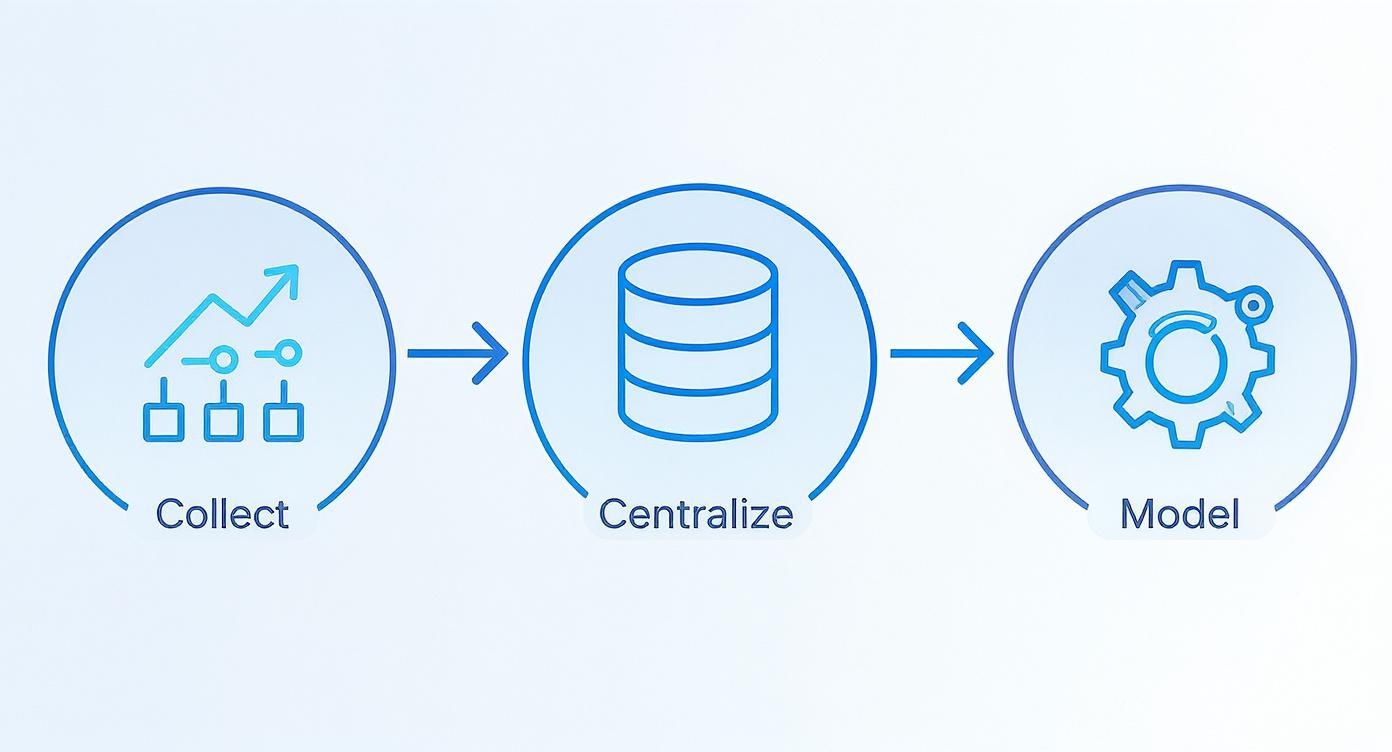
This workflow visualizes the three essential stages: collecting diverse data, centralizing it for a unified view, and then applying models to generate insights.
This kind of integration transforms your campaigns from manual and generic to automated and intelligent. For example, you could set up a workflow where any customer tagged as "high churn risk" is automatically added to a specific retention journey in your email platform, like Klaviyo. That’s a massive leap in both efficiency and effectiveness. For more tips on improving campaign performance, you might be interested in our guide on conversion rate optimization strategies.
This final step is the bridge between data science and marketing execution. It’s where a statistical score becomes a personalized email, a targeted ad, or a timely SMS message that changes customer behavior and boosts your bottom line.
There’s a reason the market for these technologies is exploding. Valued globally between $18 and $22 billion in 2025, the predictive analytics sector is expected to grow by 22% to 28% annually. This rapid expansion shows just how vital these integrations have become for any modern marketing team trying to stay ahead.
Measuring Success and Sidestepping Common Pitfalls
Deploying your first predictive model is a huge milestone, but it's certainly not the finish line. Honestly, the real work starts now: proving its value in a way your finance team will actually understand.
Without a clear way to measure impact, your slick data science project is just an expensive hobby. You have to connect your predictions directly to tangible business outcomes, like revenue growth and customer retention.
The most reliable way to do this is by treating every predictive initiative like a science experiment. This means moving beyond vanity metrics and focusing on controlled testing. You have to prove that the actions you take based on your model's output are definitively better than just doing nothing at all. This is where the simple but powerful concept of A/B testing with a control group becomes completely non-negotiable.
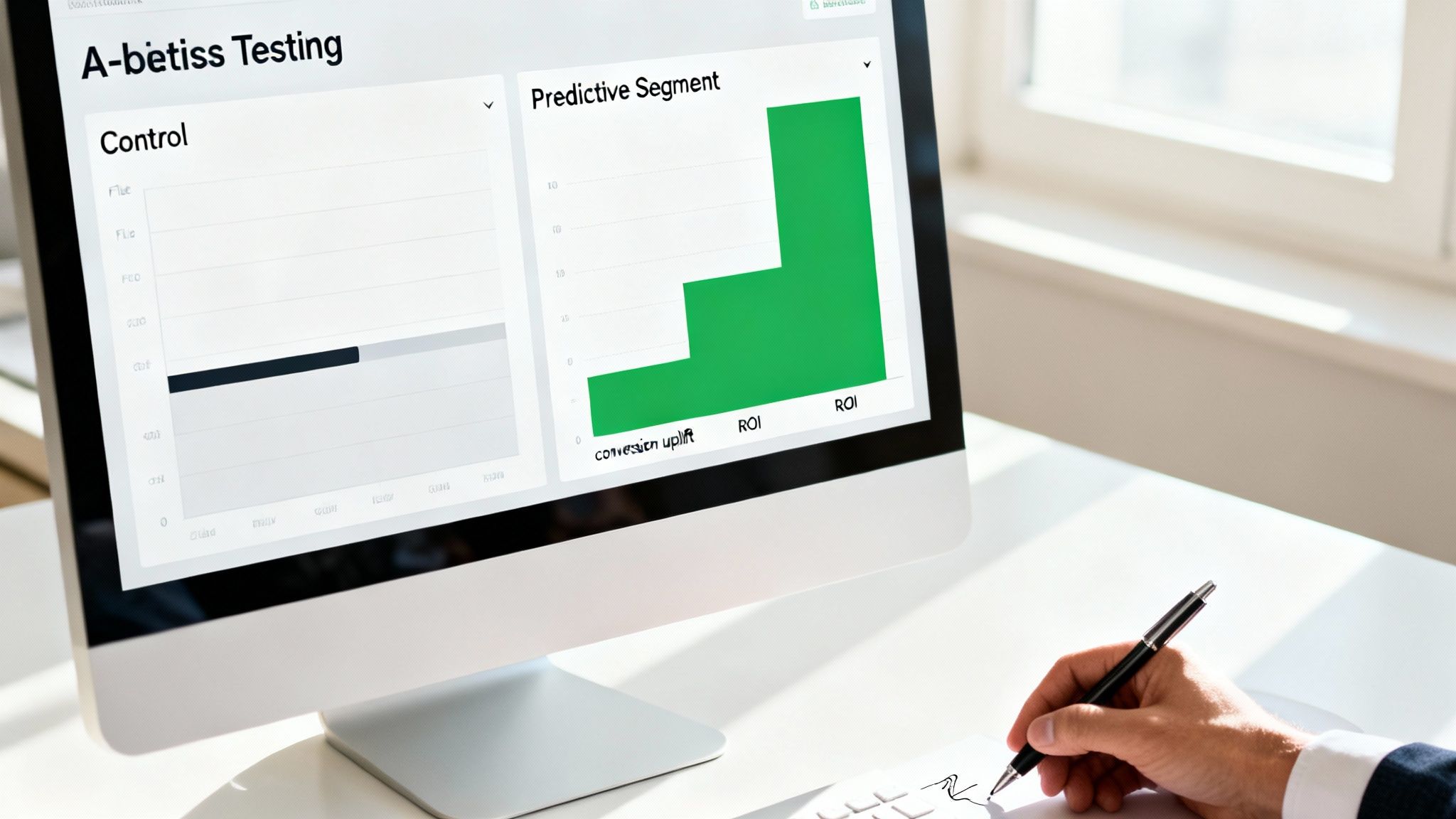
Proving Your Model’s Worth
Let’s make this real. Imagine your churn model flags 1,000 customers who are likely to leave. Instead of blasting all of them with a "please stay" offer, you set up a proper test.
You send the offer to 900 of them (the test group) and intentionally do nothing for the remaining 100 (the control group). After a month, you compare what happened.
If the test group had a 15% lower churn rate than the control group, that 15% is your uplift. That’s the concrete, defensible ROI of your predictive model. You can apply this same logic to any use case:
- For Predictive CLV: Target your predicted high-value segment with an exclusive offer but hold back a control group. Measure the difference in average order value (AOV) and repeat purchase rate.
- For Product Recommendations: Show model-driven recommendations to one group and your old, generic ones to another. The difference in click-through and conversion rates is your proof.
The goal is to isolate the impact of your predictive strategy. Without a control group, you can never be sure if a change in customer behavior was caused by your campaign or by external factors like seasonality.
Navigating Common Predictive Analytics Pitfalls
Getting started with predictive analytics for marketing is exciting, but it's incredibly easy to stumble. To measure success effectively, it's essential to understand the broader challenges that many organizations face. This founder's guide on overcoming AI implementation challenges details many of these hurdles, and they apply directly to predictive modeling.
Here are a few of the most common mistakes I see ecommerce brands make and how to sidestep them.
1. Obsessing Over Model Complexity
It’s tempting to build the most technically advanced, PhD-level model possible. But a slightly less accurate model that's easy to explain and deploy is infinitely more valuable than a "perfect" one that never actually gets used.
Start simple. A straightforward logistic regression model for churn is often more than enough to deliver significant value right out of the gate.
2. Ignoring Data Quality Until It's Too Late
This is the cardinal sin of predictive analytics. If your underlying data is messy, inconsistent, or incomplete, your model's predictions will be completely useless.
"Garbage in, garbage out" is an unbreakable rule. Prioritize a clean, centralized data foundation before you even think about building a model. That means consistent event tracking and a single source of truth for all your customer data.
3. Failing to Close the Activation Loop
A prediction is worthless if you can't act on it. One of the most common failures is building a great model that generates a list of high-risk customers, but then having no automated way to push that list into your marketing platforms.
Make sure you have the integrations needed to send predictive segments to your email provider, ad platforms, and other tools where you engage with customers. Without this final step, your insights will remain trapped in a spreadsheet, gathering digital dust.
Answering Your Top Predictive Analytics Questions
Diving into predictive analytics can feel like stepping into a new world, and it’s natural to have questions. Concerns about team structure, data requirements, and the real-world impact are common. Let’s tackle some of the most frequent questions marketers ask when they're getting started, providing straightforward answers to help you build confidence.
This isn’t about abstract theory; it’s about giving you the practical clarity needed to move forward. Understanding these key points will help you navigate the initial learning curve and set realistic expectations for your strategy.
Do I Need a Data Scientist to Get Started?
Not necessarily. While a dedicated data scientist is invaluable for building complex, custom models from scratch, many modern platforms are built specifically for marketers. The "buy" approach lets you get started much faster.
Tools like Customer Data Platforms (CDPs) and specialized AI marketing solutions offer powerful, "out-of-the-box" predictive models for things like CLV, churn risk, and purchase propensity. These systems handle the complex data science behind the scenes.
This frees you up to focus on the most important part—activating the insights and improving your marketing campaigns. You can always hire a specialist later as your needs become more sophisticated.
How Much Data Do I Really Need?
There isn't a single magic number, but the quality and relevance of your data matter far more than the sheer volume. A solid starting point is having at least one year of clean transactional data (orders, customer IDs, product details) and several months of website behavioral data.
The core principle is simple: you need enough historical information for a model to learn meaningful patterns. For a churn model, this means having enough examples of customers who have already left. For a CLV model, you need sufficient purchase history to distinguish one-time buyers from your loyal repeat customers.
Most modern platforms can provide guidance on data requirements based on the specific model you want to deploy, helping you understand if your current dataset is robust enough.
What Is the Difference Between Predictive Analytics and AI?
The terms are often used together, but they aren't interchangeable. Think of it like this:
- Predictive Analytics is the specific practice of using data, statistical algorithms, and machine learning to identify the likelihood of future outcomes. It answers the question, "What is likely to happen next?"
- Artificial Intelligence (AI) is the broader field focused on creating systems that can perform tasks that typically require human intelligence, like learning, reasoning, and decision-making.
In marketing, AI often powers predictive analytics. For example, a predictive model might score a customer's churn risk. An AI system could then take that score and automatically decide the best channel, message, and offer to send to retain that specific customer, adapting its strategy in real-time.
How Can I Actually Prove the ROI?
The most effective way to prove the return on investment (ROI) from your predictive analytics initiatives is through disciplined, controlled testing. For any campaign powered by a predictive model, you must run an A/B test against a control group.
Imagine your model identifies a segment of customers at 'high risk of churn.' You would target this segment with a special retention offer. However, you must hold back a small portion of that same high-risk segment (the control group) and send them nothing.
The difference in the retention rate and revenue between the two groups demonstrates the direct 'uplift' of your predictive strategy. This methodical testing provides clear, defensible data on the value your initiatives are creating. This approach is a cornerstone of the best ecommerce marketing strategies because it ties actions directly to results.
For readers seeking a broader context on this topic, you can explore a comprehensive overview of predictive analytics in marketing.
At Next Point Digital, we specialize in transforming data into actionable growth strategies for ecommerce brands. If you're ready to move from guessing to knowing, our team can help you implement predictive analytics to drive real results. Learn how we can help you grow.