

Before you even think about sending out that first email to a prospective agency, the most important work needs to happen internally. Getting your own house in order first is what separates a frustrating, expensive agency search from a strategic hunt for the right growth partner.
It’s the difference between asking for "help" and defining a clear mission.
Laying the Groundwork for a Winning Partnership
Jumping on calls with agencies without a solid brief is like trying to drive somewhere new without a map. You’ll get somewhere, sure, but it probably won’t be where you wanted to go. This upfront work ensures you're not just shopping for a service provider; you're recruiting a partner to achieve a specific outcome, like hitting a 3:1 return on ad spend or boosting customer lifetime value by 20%.
Your first move is to translate those big business ambitions into tangible marketing goals. "Grow the business" is a wish, not a target. A real goal sounds like this: "Increase organic traffic from non-branded keywords by 40% within 12 months." That level of clarity is non-negotiable.
Audit Your Current Marketing Efforts
Once you know where you want to go, you need to know where you're starting from. A quick, honest audit of your current marketing helps you understand what's working, what's broken, and where the biggest opportunities are hiding. You don’t need to be a data scientist, but you should have answers to some basic questions.
- Channel Performance: Which channels—SEO, social, email, PPC—are actually driving revenue? Where are you getting tons of engagement but no sales?
- Customer Acquisition Cost (CAC): What does it cost to get a new customer? How does that number change from channel to channel?
- Conversion Rates: What’s your current conversion rate for key actions, like adding to a cart or completing a purchase?
This isn’t just busy work. This audit uncovers the real problems an agency needs to solve. For instance, if your Instagram drives a ton of traffic but your conversion rate is a dismal 0.5%, you don't just need a "social media agency." You need a partner who lives and breathes social commerce and conversion rate optimization.
Establish a Strategic Budget
Your budget shouldn't be a random number you pull out of thin air. Think of it as a strategic investment tied directly to your goals. A well-defined budget tells agencies you’re serious and have realistic expectations about what it takes to grow.
This is a huge factor when choosing a digital marketing agency. Industry benchmarks show marketing budgets often hover around 7.7% of company revenues, with about 30.6% of that going to paid media. And with 84% of CMOs admitting they struggle with strategy execution, finding the right partner to manage that investment is critical.
This simple three-step process—Goals, Audit, Budget—is the foundation for your entire search.
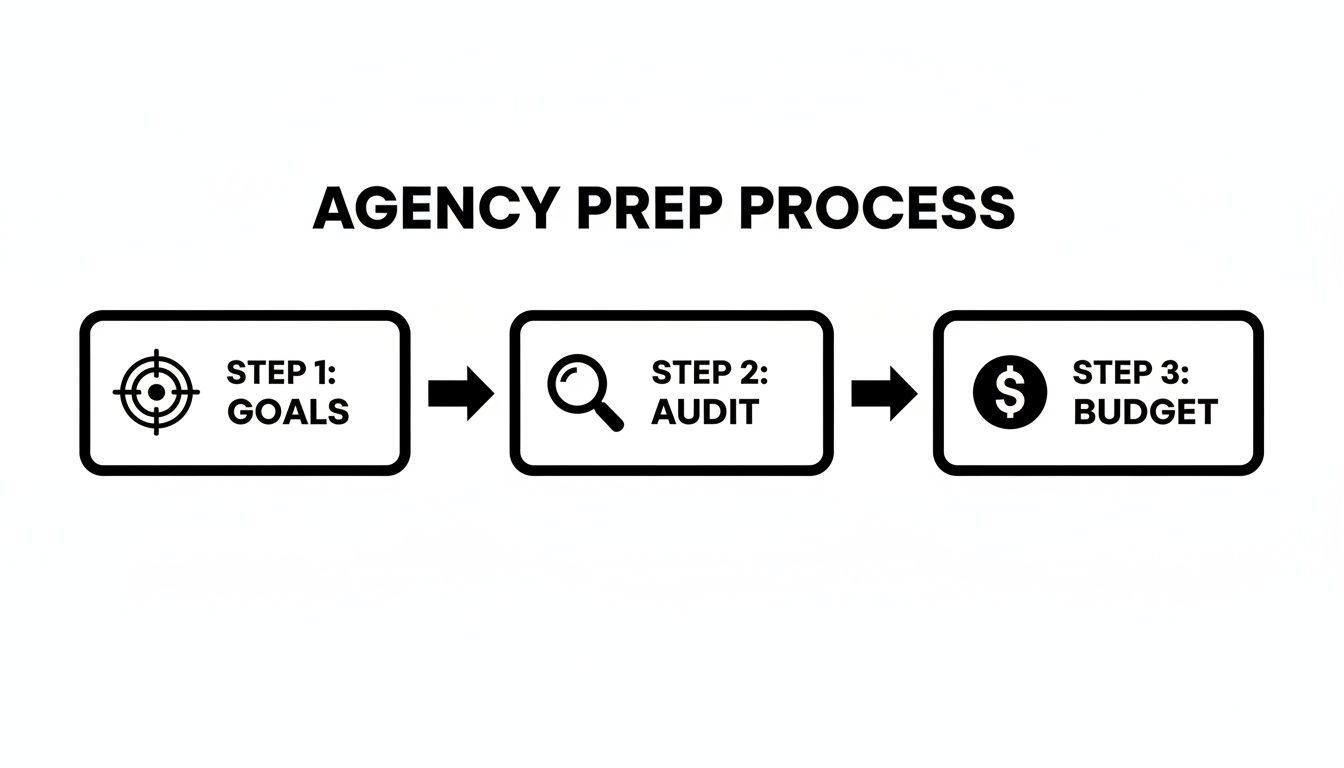
As the flow shows, each step builds on the last, setting you up to walk into agency conversations with total clarity and confidence.
Before you start outreach, a quick self-check can make all the difference. The table below helps you gauge whether you've done the necessary prep work to make your agency search as effective as possible.
Your Agency Readiness Checklist
| Preparation Area | Key Question | Why It Matters |
|---|---|---|
| Goals | Are our business objectives translated into specific, measurable marketing KPIs? | Vague goals lead to vague strategies. Agencies need clear targets to build a plan around and measure success against. |
| Data & Access | Do we have clear performance data (analytics, sales) and can we grant access? | An agency can't fix what it can't see. Providing access to historical data allows for a proper audit and realistic forecasting. |
| Budget | Is our budget defined and tied to our growth expectations? | A clear budget frames the conversation realistically and helps agencies propose strategies that fit your financial reality. |
| Internal Buy-In | Is our leadership team aligned on the need for an agency and the goals we've set? | Without internal alignment, the agency relationship can be derailed by conflicting feedback and shifting priorities. |
| Point of Contact | Who from our team will be the primary contact and decision-maker for the agency? | A designated point person prevents communication bottlenecks and ensures the agency gets timely feedback and approvals. |
Running through this checklist ensures you’re not just ready to hire an agency, but ready to partner with one successfully.
Key Takeaway: Walking into a conversation with a detailed brief—complete with goals, performance data, and a clear budget—instantly elevates the discussion from a generic sales pitch to a focused strategy session.
This internal groundwork is the first, most critical part of the journey. For those ready to dig deeper into what comes next, you can learn more about how to scale an ecommerce business in our detailed guide. Getting this prep work done right ensures every agency you talk to is working from the same playbook, making your final decision that much easier—and smarter.
Pinpointing the Right Agency Capabilities

The term "full-service agency" sounds great on a sales call, but for an ecommerce brand, it can be a serious red flag. A jack-of-all-trades is usually a master of none. Your goal isn't to find an agency that can do everything; it’s to find one that excels at the few things that will actually move the needle for your business.
When you’re vetting agencies, you need to look past the generic service lists and zero in on the high-impact capabilities that drive online sales. These are the skills that separate the generalists from the true growth partners who live and breathe ecommerce.
Core Competencies for Ecommerce Growth
For any modern ecommerce brand, a few key specializations are non-negotiable. These aren’t just buzzwords; they are the fundamental engines of profitable growth. An agency without deep, proven expertise here will struggle to deliver meaningful results.
Your potential partner has to bring serious game in these areas:
- Marketplace SEO: This is a completely different beast from standard Google SEO. A real expert gets the nuances of ranking on Amazon’s A9 algorithm, Walmart, and eBay. They should be talking about optimizing titles, bullet points, and backend keywords for these platforms, not just rambling on about general SEO principles.
- Conversion Rate Optimization (CRO): Getting traffic is only half the job. A top-tier agency needs a proven methodology for turning more of your visitors into buyers. This means A/B testing checkout flows, fine-tuning product pages, and tackling cart abandonment head-on.
- Lifecycle Email & SMS Marketing: The real money is made from repeat customers. A capable agency will build out automated email and SMS flows that nurture customers from their first purchase to their tenth. Think welcome series, post-purchase follow-ups, and re-engagement campaigns designed to maximize customer lifetime value.
Key Insight: Don't get distracted by an agency that lists 20 different services. Find one with a deep, proven track record in the 3-4 services that will have the biggest impact on your revenue.
The Role of AI in Modern Marketing
Artificial intelligence isn't some far-off concept anymore; it's a practical tool that the best agencies are already using to get a leg up on the competition. But you need to cut through the hype. An agency just throwing around "AI" as a buzzword is a warning sign. A true partner will explain exactly how they use it to your advantage.
Look for real-world applications like:
- AI-Driven Ad Optimization: Using machine learning to manage ad spend in real-time, automatically shifting budget to the best-performing audiences and creative on platforms like Google and Meta.
- Predictive Audience Segmentation: Building customer segments based on predicted future behavior, like identifying customers who are most likely to churn or those with the highest potential LTV.
- Dynamic Creative Optimization: Automatically testing thousands of combinations of images, headlines, and calls-to-action to find the perfect ad for each individual user.
The conversation shouldn't be about if they use AI, but about how their specific use of it gives you a competitive edge and a better return on your ad spend.
Aligning Capabilities with Industry Trends
The digital marketing world is always moving. A great partner doesn’t just keep up; they stay a few steps ahead. For example, recent industry data shows a clear shift. Agency adoption of AI-related services is climbing, expected to grow from 10% in 2023 to 17% by 2025.
At the same time, clients are doubling down on paid media and SEO, while owned channels like email and social media have also seen a steady 5-point rise in demand. This tells you that a balanced, modern skillset is crucial.
For brands that rely heavily on visual platforms, digging into the specializations of Instagram advertising agencies can make all the difference. This kind of niche expertise is often what separates a flatlining campaign from explosive growth.
Ultimately, identifying the right capabilities comes down to creating a scorecard of must-have skills. Knowing what to look for helps you cut through the noise and focus on agencies with the specific, modern expertise your brand needs to win. To see how these capabilities fit into a broader plan, check out our guide on the best ecommerce marketing strategies that are working right now.
How to Vet Agencies and See Beyond the Pitch

You’ve got your shortlist of promising agencies. Now for the hard part. A slick sales deck is designed to sell you a dream, but you need to hire for reality. To find a true growth partner, you have to look past the pitch and find real proof they can deliver.
This is where the real work begins—and it’s the most important step in the entire process. It’s about digging into their past work, talking to the people they’ve worked with, and getting a feel for how they actually operate when the sales team isn't around.
Deconstruct Their Case Studies
Every agency is going to show you their greatest hits, complete with those beautiful hockey-stick growth charts. Your job is to poke holes in the story. Don’t get distracted by vanity metrics.
Instead of just nodding along, ask the tough questions to understand the how and why behind their success.
- What was the starting point? A 50% jump in traffic sounds amazing, but it means a lot less if they started from 100 visitors a month.
- What was the client's actual ROI? They’ll flash big revenue numbers, but what was the ad spend? Was the campaign actually profitable after all costs were factored in?
- How long did it take? Get a realistic timeline. Was this a three-month sprint or a two-year grind? This helps set expectations for your own brand.
- What went wrong along the way? Ask them about the challenges they faced. This shows you how they problem-solve when things inevitably don’t go as planned.
A good agency won’t flinch at these questions. They’ll have clear, data-backed answers and be able to connect every action they took to a specific outcome.
Talk to Their Past and Current Clients
References are your single best source of unfiltered truth. Don't just settle for their hand-picked success stories; ask to speak with a current client and, if they're willing, one who no longer works with them. This will give you a much more balanced view.
Once you’re on the phone, skip the generic stuff. You need to understand what it’s really like to work with them day-to-day.
Key Reference Questions to Ask
- Communication: "Describe their communication style for me. How often did you actually hear from your main contact, and were they proactive with updates or did you have to chase them?"
- Problem-Solving: "Tell me about a time a campaign was tanking. How did the agency react? What was their process for turning it around?"
- Reporting: "What did their reports actually look like? Did they explain what the numbers meant for your business, or was it just a data dump you had to figure out on your own?"
- Team Dynamics: "Who did you work with day-to-day? Was it the senior strategist who sold you, or did you get handed off to a junior account manager right away?"
The answers here reveal the operational reality that a sales deck conveniently leaves out. You’re looking for patterns—do they sound transparent, proactive, and strategic?
Pro Tip: Ask references how the agency handled scope creep or an unexpected request. Their answer tells you everything you need to know about their flexibility and whether they see you as a partner or just another contract.
Assess Their Operational DNA
It doesn’t matter how brilliant an agency’s ideas are if they’re a disorganized mess behind the scenes. Poor project management leads to missed deadlines, constant miscommunication, and a whole lot of frustration.
During your calls, get a clear picture of their internal processes.
- Project Management Tools: Do they use a professional system like Asana or Monday.com, or are they running their entire operation from a shared Google Doc? A lack of proper tools is a huge red flag.
- Team Structure: Who is your dedicated point of contact? How is the team around them structured? You need to know you won't get bounced between different people every month.
- Onboarding Process: What do the first 30-60 days look like? A great agency has a structured plan to get up to speed on your brand fast.
Doing this homework is non-negotiable. Vetting is a two-way street, and successfully mastering contracting with suppliers means setting crystal-clear expectations from day one. To see how this fits into a larger framework, check out our guide on building data-driven marketing strategies.
When you see beyond the pitch, you hire a partner based on proof, not just promises.
Asking Smarter Questions to Find the Best Fit
The sales pitch is over. You've reviewed their case studies and even spoken to a few references. Now comes the real test: the agency interview. This is your chance to get past the polished presentation and understand how they actually think. This is where you separate the button-pushers from the true strategic partners.
Generic questions will always get you generic, pre-packaged answers. Asking "What's your process?" is an invitation for them to recite a rehearsed script. Instead, your questions need to be designed to pull back the curtain on their problem-solving skills, communication style, and whether they'll be a good cultural fit for your team.
Probing Their Strategic Mindset
You need a partner who can think on their feet, because in ecommerce, things rarely go exactly to plan. The best way to see how an agency handles pressure is to put them in a hypothetical hot seat.
Give them a real-world scenario to chew on. Try asking questions like these:
- Scenario-Based Problem: "Let's say we're 30 days into working together and our ROAS suddenly tanks by 40%. Walk me through the first three things you'd investigate. What would your communication with us look like during that time?"
- Growth Opportunity: "Based on what you've seen of our brand so far, what's the single biggest untapped opportunity you've spotted? Give me a rough 90-day plan for how you'd go after it."
- Budget Constraint: "Imagine we had to slash our marketing budget by 25% next quarter. How would you reallocate the remaining funds to protect our most important results?"
Their answers here will tell you more than any case study ever could. Do they immediately jump to data-driven diagnostics? Do they bring up proactive communication unprompted? When faced with a budget cut, do they talk about protecting core revenue drivers or just suggest slashing spending everywhere?
Key Takeaway: You're not looking for a magic answer. You're looking for an agency that has a thoughtful, structured, and transparent process for tackling both challenges and opportunities.
Understanding Team Dynamics and Communication
Let's be real: the person who sells you on the agency is rarely the person you'll be working with day-to-day. Getting crystal clear on team structure and communication protocols before you sign is critical to avoiding frustration later on.
It’s time to get specific:
- "How is your client services team structured? Who would be our direct point of contact, and what's their actual, hands-on experience level?"
- "What project management tools do you use? Can we see a sample client dashboard so we know how you track progress and tasks?"
- "What’s the standard meeting and reporting cadence? What do your monthly reports cover, and how do you turn that data into actionable business insights for us?"
A great agency will have confident, straightforward answers and established systems. Vague responses like "we're flexible" can be a major red flag for disorganized operations. For a better sense of what top-tier agencies need to know from you, our SEO discovery questionnaire outlines the foundational questions that set a partnership up for success.
Creating an Objective Scoring Matrix
Going with your "gut feeling" when choosing an agency is a recipe for buyer's remorse. It's too easy for a charismatic salesperson or a flashy presentation to cloud your judgment. A simple scoring matrix brings much-needed objectivity to the decision, forcing you to compare agencies on a level playing field.
This doesn't need to be some complex system. Just open up a spreadsheet and score each agency on a scale of 1-5 across the criteria that matter most to your business. This simple exercise forces you to think critically about each contender's real strengths and weaknesses.
Agency Comparison Scoring Matrix
Below is a sample matrix you can adapt. It helps translate conversations and proposals into cold, hard data.
| Evaluation Criteria | Agency A Score (1-5) | Agency B Score (1-5) | Agency C Score (1-5) |
|---|---|---|---|
| Strategic Insight | 4 | 5 | 3 |
| Team Expertise | 5 | 4 | 4 |
| Communication & Reporting | 3 | 5 | 4 |
| Relevant Case Studies | 5 | 3 | 5 |
| Cultural Fit | 4 | 4 | 5 |
| Pricing & Value | 3 | 4 | 5 |
| Total Score | 24 | 25 | 26 |
This data-driven approach removes emotion from the equation. An agency that wowed you with their creative ideas might fall short when you realize their communication process is a mess. It ensures the partner you choose is the one that scored highest across the board, not just the one you liked the most. This final, methodical check confirms you've found the best possible fit for your brand's future.
Navigating Agency Pricing and Contract Red Flags

Let’s talk money. Understanding an agency’s proposal is about way more than just finding the lowest price. The way an agency structures its fees and contracts says a lot about its confidence, transparency, and overall approach to partnerships.
Confusing models and restrictive terms are often the first sign of a rocky relationship ahead. Before you sign anything, you need to get fluent in the common pricing structures you’ll run into. This knowledge is your best defense against overpaying for underwhelming results.
Decoding Common Pricing Models
Most agencies operate on one of three main models. There isn't a single "best" option—the right one for you depends entirely on your goals, budget, and how much risk you're comfortable with.
- Monthly Retainer: This is the most common setup. You pay a fixed fee each month for a specific scope of work. It’s predictable and great for budgeting, but you need crystal-clear deliverables to know you’re getting consistent value.
- Project-Based Fee: Perfect for one-off jobs like a website redesign or setting up a new email automation sequence. You pay a flat rate for a defined project with a clear start and end date.
- Performance-Based: This model ties the agency’s pay directly to results, like a percentage of ad spend or revenue generated. It sounds ideal, but be careful. These agreements often hide complex terms and can incentivize short-term gains over long-term brand health.
The global digital advertising market was valued at about $667 billion in 2024 and is projected to hit $1.5 trillion by 2030. With that much money in play, agencies are motivated to lock in long-term, high-value contracts. This makes spotting red flags more critical than ever. You can find more digital marketing statistics on rankings.io.
Critical Red Flags to Watch For
A great proposal is clear, specific, and fair. A problematic one often hides behind industry jargon and vague promises. If you see any of the following warning signs, it's time to hit the brakes and ask some very direct questions.
1. Unrealistic Guarantees
Any agency promising a "#1 ranking on Google" or a specific, guaranteed ROAS is either clueless or dishonest. SEO and ad performance are affected by countless factors an agency can't control, from algorithm updates to a competitor’s surprise sale.
2. Vague Deliverables and Scope
Your contract should spell out exactly what you're paying for. Be on high alert for fuzzy language like "ongoing SEO optimization" or "social media management." What does that actually mean?
Pro Tip: A solid contract quantifies the work. It won’t just say "blog posts," it will say "four 1,200-word blog posts per month." It won't say "ad management," it will say "management of up to $10,000 in monthly ad spend." This leaves no room for misunderstanding.
3. Long-Term Contracts with No Escape Clause
Getting locked into a 12-month contract with no performance-based way out is a huge red flag. Confident agencies trust their work. They’ll offer shorter initial terms (like 90 days) or include clear performance benchmarks that let you walk away if they don't deliver.
4. Lack of Transparency on Who Does the Work
You need to know who is actually managing your account day-to-day. Is it the senior expert who pitched you, or will your brand be handed off to a junior employee or an outsourced team? Ask for the names and experience of the people who will be hands-on. If they hesitate to answer, that’s a major warning sign.
Common Questions About Hiring an Agency
Even after all the research, vetting, and interviews, a few last-minute questions almost always pop up. That’s completely normal. Choosing a digital marketing agency is a huge commitment, so it’s smart to get total clarity before you sign on the dotted line.
Getting these final details ironed out helps set clear expectations from day one and makes sure the partnership starts on the right foot.
Here are some of the most common questions we hear from ecommerce brands, along with some straight answers to help guide your decision.
What Is a Typical Contract Length?
Most agencies need a minimum commitment to get their strategies off the ground and show you real, meaningful results. You’ll rarely see a month-to-month contract from the start because it’s just not enough time to make a real impact—especially with something like SEO.
A six-month contract is a pretty common starting point. It gives the agency a reasonable window to get campaigns running, collect data, and start optimizing for performance. After that initial period, many agreements will shift to a rolling monthly or quarterly basis.
Pro Tip: Be wary of any agency that demands a 12-month, iron-clad contract right out of the gate. A confident agency will often suggest a shorter initial term, like 90 days or six months, to prove their value before locking you into a long-term commitment.
How Long Until I See Real Results?
This is the million-dollar question, and the honest-to-goodness answer is: it depends. The timeline for seeing a return on your investment can vary wildly depending on the services you’re using and where your brand is starting from. Any agency worth its salt will be upfront about this.
Here's a realistic breakdown of what to expect:
- Paid Advertising (PPC): You can start seeing initial traffic and data within the first 30 days. But it usually takes 60-90 days to gather enough performance data to really dial in the campaigns for profitability and scale.
- Search Engine Optimization (SEO): SEO is a long game, period. It's rare to see significant movement in organic rankings in less than four to six months. For really competitive keywords, it could take a year or more to claim those top spots.
- Content & Email Marketing: Building an audience and nurturing leads through content takes time. You might see engagement metrics improve pretty quickly, but the real impact on revenue usually becomes clear after three to six months of consistent effort.
Should I Choose a Niche Specialist or a Full-Service Agency?
The "specialist vs. generalist" debate is a big one. A full-service firm offers the convenience of a one-stop-shop, which definitely has its appeal. For an ecommerce brand, though, a niche specialist often delivers a massive advantage.
Think about it: an agency that lives and breathes ecommerce already understands the unique challenges you face. They won't need a crash course on customer lifetime value, cart abandonment, or marketplace algorithms. That expertise is already baked into their DNA.
For example, if your main goal is to crush it on Amazon, an agency specializing in marketplace SEO will run circles around a generalist firm that just dabbles in it. Their deep, focused experience means they can build better strategies and execute them faster.
Before you make that final call, it’s crucial to make sure you and the agency are perfectly aligned on goals and expectations. Using a structured framework, like the one in our web services questionnaire, can help nail down every detail and prevent headaches down the road.
Ultimately, getting clear on these questions helps you move forward with confidence. It ensures you're not just hiring another vendor, but bringing on a true partner who's fully invested in your success from day one.
At Next Point Digital, we build data-driven growth strategies that turn clicks into loyal customers for ecommerce brands. If you're ready for a transparent partnership that delivers measurable results, let's talk. https://npoint.digital